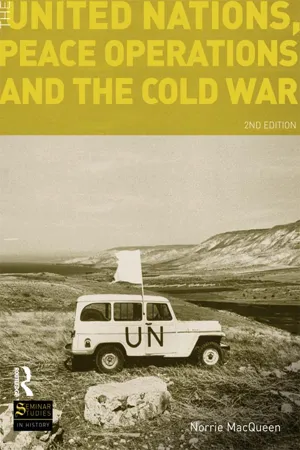
This is the first introduction to the United Nation's activities during the Cold War period. It combines a history of the UN with a broader account of east-west diplomacy during the Cold War and after. Norrie MacQueen begins by looking at the formation, structure and functions of the UN. Then, within a chronological framework, he assesses its contribution to international security from the emergence of the UN's peacekeeping role in 1945-56 right through to UN operations in the 1990s in Angola, Somalia and Bosnia.
- 224 pages
- English
- ePUB (mobile friendly)
- Available on iOS & Android
eBook - ePub
The United Nations, Peace Operations and the Cold War
About this book
Information
Part 1
BACKGROUND
1
The ‘Failure’ of the League of Nations and the Beginnings of the UN
Usually, historical comparisons between the League of Nations and its successor the United Nations emphasise the contrasts between the two organisations rather than their similarities. This tendency is understandable when viewed from the perspective of 1945 when the UN came into existence. The view of the League held almost universally at that time was one of weakness and failure. The League had not performed the function that it had been created for: the prevention of a second world war. Now, in the aftermath of that conflict a new organisation was being forged to succeed where its discredited predecessor had failed. This negative attitude towards the League was natural, but it was also driven by political calculation. In order to sell the idea that the League of Nations should actually have a successor to a sceptical, war-hardened world, the United Nations had to be presented as something new and historically unique. It could not be allowed to carry the taint of failure that too close an association with the League would have placed on it. Yet in reality the League of Nations provided the blueprint for the new institution. The organisation of the United Nations, its broad political structure and of course its fundamental raison d’être within the international system, were all essentially drawn from the template of the League.
League of Nations: Global organisation formed after the First World War which was the precursor to the United Nations; became largely irrelevant in the larger currents of international relations after the mid-1930s and was formally wound up in 1946.
A NEW WORLD ORDER?
The League of Nations, whatever its ultimate fate, had been a profoundly innovative, indeed radical, departure in international relations. This was a reality which only came to be properly acknowledged at the end of the century of the League’s creation; for succeeding decades after its disappearance the League continued to be regarded in the popular memory as a by-word for empty rhetoric and diplomatic hypocrisy. Despite this, it eventually provided the model not just for the United Nations but for almost all of the major inter-governmental organisations whose growth was to be such a prominent feature of twentieth-century international politics. The League’s basic organisation, consisting of an ‘executive’ Council of the big powers and a ‘parliamentary’ Assembly of all its country members, both managed by an international civil service, was in essence a bold transposition of national constitutional arrangements to the international environment. Like many seminal ideas, of course, this approach to the organisation of international institutions has come with familiarity to be seen as something obvious and routine. But in the context of a post-First World War world where there was a natural tendency to look backwards to the pre-catastrophic certainties of the nineteenth century, the League had set out a truly novel manifesto for a new international politics. The fundamental logic of the League’s structure, once the shock of the new had been absorbed, became so deeply embedded in the political consciousness that any successor organisation would naturally tend towards the same basic architecture.
Inter-governmentalism: International organisation based on institutions within which states cooperate without surrendering significant parts of their national sovereignty; the UN is in most respects an inter-governmental organisation but the collective security articles of its Charter do involve some significant qualifications of sovereignty.
The purposes of the League, or at any rate those envisioned by its American planners and their supporters, were also startlingly new. Responsibility for the security and defence of all member countries was, as far as possible, to be removed from those countries themselves. The fears and insecurities which had generated the arms races and aggressive alliances that evidently lay at the root of the catastrophe of 1914–18 would be alleviated by the construction of nothing less than a new world order. National security and therefore international security would now, the visionaries of the League proposed, become the collective responsibility of the world community working through the structures of its new global organisation. Again, this new ‘multilateralism’ was both strikingly bold and somehow obvious, and the basic idea outlived the League itself.
Multilateralism: Commitment to collective, institutional responses to international challenges through the UN or other organisations (rather than unilateral ones by individual states).
MANAGING POST-WAR ADJUSTMENT
During its first decade the League of Nations made a hugely valuable contribution to the management of the post-war international system. Throughout the 1920s it provided mediation in border disputes at various times between such neighbours as Finland and Sweden, Yugoslavia and Albania, and Hungary and Czechoslovakia. It had also initiated what were in effect international peacekeeping operations.
One such force was deployed in the disputed Saar territory between France and Germany. In the aftermath of the war the predominantly German Saar was removed from Berlin’s control and ‘internationalised’ pending a future act of self-determination. This arrangement was itself an achievement for the new international values represented by the League. Initially, France had intended simply to annex the heavily industrialised territory as both punishment and reparation for the damage inflicted on its own industry by Germany’s war of aggression. Instead the French government was prevailed on to accept the economic benefits of the Saar but with the territory placed under a League of Nations administration until 1935. At that date permanent sovereignty over the Saar would be determined by a popular vote of its inhabitants. This was in effect the precursor to the UN’s provision of temporary administrations in such disputed regions as West New Guinea in the 1960s and East Timor and Kosovo at the end of the century. Intriguingly, though, in the case of the Saar the ‘final status’ options included the future government of the territory by the League of Nations itself in perpetuity, a radical choice never offered subsequently by the UN. In the event, the 1935 plebiscite – policed by a peacekeeping force composed of British, Italian, Dutch and Swedish troops – resulted in an overwhelming vote for a return to German sovereignty [Doc. 1, p. 116]. Almost one in ten of those voting, however, would have preferred to remain ‘citizens of the League’.
An international administration and security force also controlled Danzig (the modern-day Polish city of Gdansk) which was removed from German administration and declared a Free City, a status it maintained until it was forcibly reintegrated into Germany by the Nazis in 1939. Elsewhere the League or other multinational agencies supervised and policed with international forces plebiscites designed to settle fraught post-war border issues on the basis of national self-determination (Walters, 1960).
Plebiscite: Popular vote (or referendum) often used to establish the political future of a designated territory (thus embodying the principle of self-determination).
The League also brought a new moral sensibility to the question of colonialism when, instead of the colonies of the defeated powers in 1918 simply being transferred to the victors, they were made the responsibility of the League which ‘mandated’ their administration and responsibility for their eventual self-determination to appropriate member states. This system was not without its difficulties, and in a number of cases led directly or indirectly to United Nations peace operations later in the century. This was the case in South West Africa (Namibia) which was mandated from Germany to South Africa, and in both Rwanda and Burundi which passed from German imperial rule to be mandated to Belgium. Nevertheless, the new system (inherited as ‘Trusteeship’ by the United Nations), marked a clear advance on the post-conflict values of the past.
Mandate system: League of Nations innovation whereby the colonies of the defeated powers in the First World War were ‘mandated’ to the victors not as acquisitions but as responsibilities to be prepared for self-determination; replaced by the UN Trusteeship system.
THE BREAKDOWN OF THE COLLECTIVE IDEA
Despite these bright prospects, a fatal fissure quickly opened at the heart of the new institutionalism. The United States – in the person of President Woodrow Wilson – had driven the planning of the League as part of the Versailles Treaty negotiations. Ultimately, however, the US Congress refused to ratify American membership. As a result, responsibility for the direction of the new organisation passed from those whose vision had guided its construction to the more diplomatically conservative Europeans like Britain and France.
In time it became clear that the nature of international relations in the 1920s would be in sharp contrast with that of the following decade. By the early 1930s the international environment had begun to change. The ‘post-traumatic’ calm of the immediate post-war years now gave way to a new instability. Territorial and ideological revisionism on the part of states which for various reasons rejected the post-Versailles status quo challenged the principles of the League whose origins were inextricably tied to that settlement. It seemed that the ‘successes’ of the League in soothing the international system of the 1920s perhaps had more to do with the character of the system than the actions of the organisation. And, it must be said, the League itself, or at least its leading members, bore some responsibility for the emerging tensions within the system. Not only had the League of Nations been born of the Versailles treaty, which had become an object of hate for some and disappointment for others, but in its first years it had denied membership to a number of key powers, most importantly Germany and the Soviet Union. Their eventual admission could not eradicate their sense of exclusion from the system which the League sought to manage.
In this deteriorating climate the capacity of the League to translate collective security from theory into a practical tool of international relations was now put under severe test. It was a test that the organisation – or more correctly the dominant powers within it – ultimately failed. The League’s collective security plans were outlined in article 10 of its Covenant, its basic constitutional document [Doc. 2, p. 117]. Joint measures were to be taken to preserve the territorial integrity of member states ‘against external aggression’. Tellingly, however, the actual means by which this was to be done were left vague. The League Council had the responsibility to advise on methods to be employed when necessary. The strongest instrument of enforcement which members were supposedly required to apply on the ‘direction’ of the Council was economic sanctions. The Council might ‘recommend’ military action but members were under no obligation to comply, according to article 16 of the Covenant (Archer, 2001). On the rare occasions when economic sanctions were implemented by the League, many members simply declined to participate in them. In this way Italy’s aggression against the African state of Abyssinia (Ethiopia) in 1935 went effectively unpunished. A range of sanctions were agreed belatedly, but they were disregarded by member states which for political or economic reasons did not wish to confront the Fascist regime in Rome (Armstrong, 1982).
Collective security: The multilateral maintenance of international security (based on the United Nations or other international body) rather than by sectional actions on the part of individual states or competing military alliances.
Abyssinia: Older name of present-day Ethiopia; invaded by Italy in 1935.
Earlier, in 1931, the League had been even more passive in the face of Japan’s naked aggression against China in Manchuria. For the big European powers in the League Council this conflict in a remote part of Asia was simply not important enough in the calculation of their own national interests to justify any robust action.
In both these cases the central weakness in the concept of collective security in a world of sovereign states was exposed. However high-minded and idealistic the original conception of the League presented by Woodrow Wilson at Versailles, older and harsher realities governed the behaviour of the states which now dominated the institution (Williams, 2007). States like Britain and France had traditionally conducted their foreign policies on the basis of narrowly defined national interests. The calculation of these interests rarely went beyond considerations of the physical security of the state and its economic well-being (Bennett, 1994). In this sense the international system of the 1930s was, as international relations theorists would put it, highly ‘realist’ and ‘state-centric’. The more generous vision of national interest as best safeguarded by a just and secure global system – the conception at the heart of collective security thinking – simply did not progress during the life of the League.
In the dangerous international conditions of the 1930s the League retreated from the ethical high ground it originally tried to occupy. The terrible fate of China at the hands of Japan featured hardly at all when the powers which made up the League Council made their separate calculations of national interests. Italy, being closer to the centre of a still predominantly European international system, was more problematic – but not much. As a result, in the second half of the 1930s as the world stumbled towards another general war the League became marginalised in global politics. National security remained, as it always had been, the responsibility of the individual state and its alliance partners. Once again a cycle of world conflict would precede a new attempt to reconstruct international security on a multilateral basis. As we have emphasised already, though, the new project did not begin from a tabula rasa. The model and the experience of the League was there to be drawn on, even if those utilising it for the new body were reluctant to acknowledge the fact (Northedge, 1985).
THE WAR-TIME ORIGINS OF THE UN
The concept of the United Nations developed by stages after the United States entered the war following the Japanese attack on Pearl Harbor in December 1941. Already, however, in the previous August, a meeting had taken place between President Franklin Roosevelt and the British prime minister Winston Churchill on board a warship off the Canadian coast. Here the idea of a collective security system for the future post-war world was resurrected. The ‘Atlantic Charter’ which came out of this insisted that ‘all nations of the world, for realistic as well as spiritual reasons must come to the abandonment of the use of force’. To this end it spoke of ‘the establishment of a … permanent system of general security’ [Doc. 3, p. 118]. By the beginning of 1942 the twenty-six anti-Axis powers had committed themselves to this declaration and themselves had begun to describe their military alliance as the ‘United Nations’. During the remaining years of the war, ideas for the new peacetime organisation developed. They did so, of course, under difficult circumstances. The overriding priority for the allied states was the pursuit of victory. This was the obvious prerequisite for the implementation of any post-war blueprint. Too much speculation on the nature of the new international system would have been a misuse of political energies. Additionally, Roosevelt, who like his First World War predecessor Woodrow Wilson a quarter of a century earlier was at the forefront of thinking about the new institution, was anxious to avoid a repeat of the isolationist backlash at home which had kept America out of the League by focusing too much on its proposed successor.
Atlantic Charter: Anglo-American declaration of August 1941 setting out joint aspirations for the post-war international system including the creation of a new collective security system.
Nevertheless, ideas began to emerge. Roosevelt’s initial thoughts centred on the management of security by the big allied powers after the end of the war: the United States, Britain, the Soviet Union and, perhaps, China (Boyd, 1971). This would be made possible by the generalised disarmament of the other states in the international system which would entrust their national security to the collective. Churchill had a more sceptical European perspective on the feasibility of this plan. He was less confident that the necessary cooperation could be achieved and maintained among the big powers. From a more traditionalist perspective he was convinced that states would continue to define their national interests in the same narrow way that had undermined the League’s attempts to implement the earlier plan for collective security. Certainly, the participation of the United States in the new arrangements would be a positive advance, but it would be unlikely to alter the basic approach to national foreign and defence policies ingrained in the attitudes of national leaders across the world. More positively, Churchill was also anxious to avoid the marginalisation of the smaller and middle-sized powers which was implicit in Roosevelt’s proposals. The prime minister’s evolving view was that a strong European dimension should be central to post-war Britain’s external relations. As the two world wars had both begun in the centre of Europe, it was not perhaps blindly Eurocentric to seek global solutions in a new system of relationships there. He therefore favoured a new organisation with a predominantly regional rather than global structure. The new body should, ideally, be one in which loose worldwide arrangements acted as an umbrella for strong local inter-governmental institutions (Luard, 1982).
At the Tehran Conference in November 1943, when the tide of the war was clearly turning in the allies’ favour, the Soviet Union was brought fully into the...
Table of contents
- Cover Page
- Half Title Page
- Title Page
- Copyright Page
- Dedication
- Introduction to the series
- Contents
- Preface to the second edition
- Publisher's acknowledgements
- Chronology
- UN operations established 1948–1995
- Who's who
- Glossary
- Map
- Part One Background
- Part Two Analysis
- Part Three Assessment
- Part 4 Documents
- Further reading
- References
- Index
Trusted by 375,005 students
Access to over 1.5 million titles for a fair monthly price.
Study more efficiently using our study tools.
Frequently asked questions
Yes, you can cancel anytime from the Subscription tab in your account settings on the Perlego website. Your subscription will stay active until the end of your current billing period. Learn how to cancel your subscription
No, books cannot be downloaded as external files, such as PDFs, for use outside of Perlego. However, you can download books within the Perlego app for offline reading on mobile or tablet. Learn how to download books offline
We are an online textbook subscription service, where you can get access to an entire online library for less than the price of a single book per month. With over 1.5 million books across 990+ topics, we’ve got you covered! Learn about our mission
Look out for the read-aloud symbol on your next book to see if you can listen to it. The read-aloud tool reads text aloud for you, highlighting the text as it is being read. You can pause it, speed it up and slow it down. Learn more about Read Aloud
Yes! You can use the Perlego app on both iOS and Android devices to read anytime, anywhere — even offline. Perfect for commutes or when you’re on the go.
Please note we cannot support devices running on iOS 13 and Android 7 or earlier. Learn more about using the app
Please note we cannot support devices running on iOS 13 and Android 7 or earlier. Learn more about using the app
Yes, you can access The United Nations, Peace Operations and the Cold War by Norrie MacQueen,Norrie Macqueen in PDF and/or ePUB format, as well as other popular books in Politics & International Relations & 20th Century History. We have over 1.5 million books available in our catalogue for you to explore.