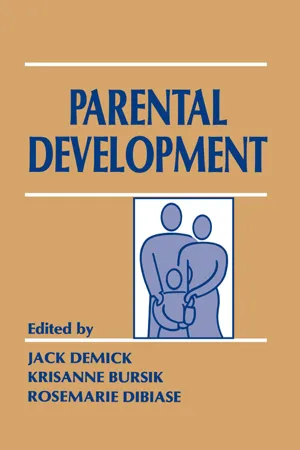
This volume seeks to identify and define the parameters of a relatively new problem area -- parental development. Drawing on the grand developmental theories of Sigmund Freud, Lawrence Kohlberg, Jean Piaget, Lev Vygotsky, Heinz Werner, and their descendants, this book has the potential to generate an area of common concern for those interested in either child/adolescent or adult development through the novel application of developmental principles and considerations to the ecological context of parenting. To that end, this volume brings together theory and research from the subfields of adult and child/adolescent development.
Chapter authors place the problem area of parental development in theoretical context and examine selected psychological part-processes implicated by focusing on cognitive and psychosocial development. The authors then deal with a range of issues that are perhaps less traditional and/or more in line with the complex character of everyday life. That is, they utilize either relatively novel comparison groups or treat parents at later stages of development rather than those in young adulthood as is often the case. Finally, the authors uncover both similarities and differences among their theoretical perspectives with an eye toward delineating some possible future research directions.
- 300 pages
- English
- ePUB (mobile friendly)
- Available on iOS & Android
eBook - ePub
Parental Development
About this book
Information
Publisher
Psychology PressYear
2014Print ISBN
9781138977938
9780805811926
Edition
1eBook ISBN
9781317782056
I

PARENTAL DEVELOPMENT IN CONTEXT: THEORY
1
Parental Development: A Holistic, Developmental Systems-Oriented Perspective
Heinz Werner Institute for Developmental Analysis Frances L. Hiatt School of Psychology, Clark University
There are numerous investigations that examine the impact of parental behavior on child development. Most obvious are investigations that deal with the maltreatment of children (e.g., Azar, 1986; Belsky, 1978; Parke & Collmer, 1975). There is also the well-known work of Baumrind (1967, 1971), which distinguished among the impact of autocratic, authoritative-reciprocal, and permissive childrearing styles on the personality characteristics of children. More recently, there is a powerful literature developing that is related to Vygotsky’s (1978) general theoretical position and, in particular, to his concept of the “zone of proximal development” (divergence between existent level of development of the child and level reached in collaboration with another); this work has had a significant effect in understanding the role of the parent (and more competent peers) in the cognitive and affective development of the child (e.g., Bruner, 1983; Ignjatovic-Savic, Kovac-Cerovic, Plut, & Pesikan, 1988; Rogoff, 1982; Rogoff & Wertsch, 1984; Wertsch, 1984).
These advances in the Vygotsky (1978) position are linked to the so-called co-constructionist approach (e.g., Lightfoot, 1988; Stratton, 1988; Valsiner, 1984, 1987, 1988a, 1988b; Winegar, 1988; Wozniak, 1986), which serves as a bridge to the analysis of parental development insofar as it recognizes the contributions of the individual and the physical/social context to the development of knowledge as well as assumes that understanding is a function of the joint action of interacting individuals. In keeping with this perspective, Holden and Ritchie (1988), for example, have systematically compiled parental characteristics matched with respect to three basic parental roles (child caregiver, manager, nurturer) that are linked to child outcome behaviors and characteristics; however, they assume that these take place, not via a trait or ability of parents, but rather by a dialectic process similar to the model of Riegel (1975, 1976) and others. Holden and Ritchie (1988) assumed that parents must face a rapidly changing organism; be adaptive; balance the child’s needs with their own needs; and handle opposing characteristics, conflicts, and dilemmas in caring for their children. In short, “Parents must alter their behavior in response to changes in the child, themselves, the context or the culture” (p. 46).
Although these and other investigations linked to the approach of Vygotsky (1978) and the co-constructionists touch on the problem of parental development, their main focus has been clearly on child development. Relative to the study of the impact of the parent on child development, a literature search revealed a much smaller number of investigations bearing on the specific aspect of adult development examined in this volume, namely, the nature and course of parental development.
Closest to such an analysis is the work of a number of investigators:
1. those concerned most generally with the transition to parenthood (e.g., Michaels & Goldberg, 1988);
2. those specifically dealing with the regressive impact of first parenthood, such as postpartum depression and psychopathology as well as adaptation of family members (e.g., Fedele, Golding, Grossman, & Pollack, 1988);
3. those treating the impact of the transition to parenthood on the marital relationship and on developmental change in the family system (e.g., Cowan & Cowan, 1988, who provide a structural model of marital adaptation that focuses on the developmentally advanced state of balancing individuality and mutuality);
4. those concerned with personality and attitudinal change during and following the transition to parenthood (e.g., Antonucci & Mikus, 1988, who include literature on personality characteristics of the parental role, factors mediating the impact of parenthood on personality, areas of change in person–such as self-perception, personal efficacy, affective states, personal maturity, values–and the processes underlying them; cf. Buss & Craik, 1983);
5. those directed toward an analysis of the determinants of parenting (e.g., Belsky, 1984, who treats such factors as the personal/psychological well-being of parents, child characteristics, and contextual sources of stress and support);
6. the analysis by Sameroff and associates (1975a, 1975b, 1975c; of parents’ concepts of the child’s development, which are ordered into four levels-symbiotic, categorical, compensating, and perspectivistic–analogous to Piaget’s stages of the intellectual development of the child);
7. those who focus on the timing of parenthood (e.g., Daniels & Weingarten, 1982, who comment “Parenthood is a powerful generator of development. It gives us an opportunity to refine and express who we are, to learn what we can be, to become different” (p. 1; cf. Gutmann, 1975);
8. Galinsky’s (1981) highly informative research that characterizes stages in parent-child development (image making, nurturing, authority, interpretive, interdependent, and departure stages) in terms of tasks to be accomplished by parents at a given stage; and
9. directly addressing parental development, the psychoanalytic literature and its focus on parenthood as a powerful influence in the development of women (cf. Chodorow, 1978; Deutsch, 1973) and of human beings more generally (Anthony & Benedek, 1970).
In line with this last focus, Benedek (1970), for example, believes that the “study of the family as a field of transactional processes … is based on the proposition that the parents’ drive-motivated, emotional investment in the child brings about reciprocal intrapsychic processes in the parents, which normally account for changes in their personalities” (p. 124). She illustrates parental development by attempting to show how successful (unsuccessful) relations with the child makes for advances (regressions) in the superego and self-esteem of the parent. “In terms of dynamic psychology it means that while the parent consciously tries to help the child achieve his developmental goal, he cannot help but deal with his own conflicts unconsciously and by this, normally, achieve a new level of maturation” (p. 131).1
If one takes Kaplan’s (1966, 1983) view that development, as exemplified by the orthogenetic principle–development proceeds from a dedifferentiated to a differentiated and hierarchically integrated organized state (Werner, 1948; Werner & Kaplan, 1956, 1963)–is a norm for interpreting events (rather than a derivation from empirical data), then this principle (where change is described in formal, organizational terms directed toward an ideal endpoint) and the associated holistic, developmental, systems-oriented perspective (Wapner, 1987) can be used to interpret the nature and course of “parental development.”
Accordingly, this chapter describes how the analysis of some aspects of “parental development” might be attacked by the aforementioned perspective (cf. Kaplan, 1966; Wapner, 1987; Wapner & Demick, 1990; Wapner & Werner, 1957; Werner, 1948, 1957; Werner & Kaplan, 1956, 1963). Such an endeavor is possible because the perspective assumes that a developmental analysis that focuses on formal organizational features of experience and action can be applied, not only to ontogenesis, but to any developmentally ordered series (e.g., neuropathogenesis, psychopathogenesis, microgenesis, ethnogenesis, and a number of conditions presumed to be ordered developmentally, such as drugs vs. placebo conditions, fatigue vs. optimal states, etc.). A developmental analysis of people, largely middle-class Americans living the parental role, is addressed more specifically, after briefly characterizing our perspective with respect to assumptions relevant to parental development.
THE HOLISTIC, DEVELOPMENTAL, SYSTEMS-ORIENTED PERSPECTIVE
The general assumptions of the perspective follow.
1. A central notion of the perspective, in keeping with system-oriented approaches, is that the person-in-environment is the unit to be analyzed. Given this unit of analysis, three levels of organization characterize the person, namely, his or her physical/biological aspects (e.g., health, becoming pregnant), psychological aspects (e.g., body and self-evaluation), and sociocultural aspects (e.g., role as a parent). Analogously, three levels of organization characterize the environment, namely, its physical aspects (e.g., physical status of the home setting), interpersonal aspects (e.g., friends, spouse, children), and sociocultural aspects (e.g., abortion legislation, parental role expectations).
2. The transactions of the person with the environment are analyzed structurally (i.e., in terms of part-whole relations) and dynamically (i.e., with respect to means-ends relations). Such transactions include action and experience, where experience is comprised of affective, valuative, and cognitive functions (sensorimotor action, perception, memory, conception, symbolization, language, etc.).
3. The approach is constructivistic insofar as human beings are assumed to structure their environments and to have multiple intentionally, that is, the capacity to focus on different objects of experience such as oneself, the environment (e.g., child), and self-environment relations (e.g., a loving relationship with one’s child). People are assumed to live in different, yet related experiential worlds (Schutz, 1971) or spheres of activity, such as the multiple worlds of family, work, recreation, community, and so forth.
4. Central to the approach is a concern with planning, that is, the plotting of a future course of action, which is viewed as one of a number of means by which the person might move from some initial person-in-environment state to some desired endstate of functioning (Wapner, 1987; Wapner & Cirillo, 1973).
5. The perspective also strongly adheres to a holistic assumption. That is, the person-in-environment system is assumed to operate as a unified whole. This means that a disturbance or perturbation to any part of the person-in-environment system affects the system as a whole at all three levels of organization. Such a systemic impact occurs whether there be a disturbance in any aspect of the person, of the environment, of the relation between person and environment, or in any transaction, in means and in ends, and so forth.
6. Another aspect of the approach is linked to the assumption that transactions include experience as well as action of persons-in-environments. Our approach to understanding the relationship between experience and action consists in seeking to identify: (a) general experiential factors that are preparatory for action, and (b) precipitating events or triggers that operate to initiate action (cf. Agli, 1991; Demick et al., in press; Raeff, 1990; Rioux & Wapner, 1986; Wapner, 1986; Wapner, Demick, Inoue, Ishii, & Yamamoto, 1986).
7. As noted earlier, development is analyzed with respect to an ideal endpoint as characterized by the orthogenetic principle (Werner & Kaplan, 1956), which speaks to a shift from a state of dedifferentiation to differentiation and hierarchic integration. Optimally, ideal development entails a differentiated and hierarchically integrated person-in-environment system with the capacity for flexibility, freedom, self-mastery, self-control, and for shifting from one mode of person-in-environment relationship to another as required by long-term goals, by the demands of the situation or environmental context, and by the instrumentalities available.
The orthogenetic principle has been specified with respect to a number of polarities (see Kaplan, 1966, and Werner, 1948). At one extreme, the polarities represent developmentally less advanced and, at the other extreme, developmentally more advanced functioning:
a. Interfused to subordinated. In the former (interfused), goals and functions are not sharply differentiated; in the latter, goals and functions are differentiated and hierarchized with drive and momentary motives subordinated to long range goals. Example: For the less developmentally advanced parent, always pleasing the child by granting every one of his or her wishes is not differentiated from preparing the child for a realistic future; in contrast, the more developmentally advanced parent is able to differentiate and subordinate the former short-term goal to the latter long-term goal.
b. Syncretic to discrete. The former (syncretic) refers to the merging or fusion of several nondifferentiated mental phenomena, whereas discrete refers to function, mental contents, acts, and meanings that represent things specific and unambiguous. Example: Syncretic thinking is represented by the lack of differentiation between one’s inner and outer experience, that is, the lack of separation of one’s own feelings from that of one’s child out-there; discrete is represented by accurately defining and distinguishing between one’s own feelings and that of one’s child.
c. Diffuse to articulate. Diffuse represents a relatively uniform, homogeneous structure with little differentiation of parts, whereas articulate refers to a structure where differentiation of parts make up the whole. Example: Diffuse is a structure represented by the law of pars pro toto, that is, the part has the quality of the whole, as is the case when a judgment about a child is made on the basis of one brief experience; articulate is represented by an experience where distinguishable events make up the whole impression of one’s child, with each event contributing to and yet being distinguishable from the whole.
d. Rigid to flexible. Rigid refers to behavior that is not readily changeable, whereas flexible refers to behavior that is readily changeable or plastic. Example: Rigid is exemplified by the parent’s perseveration, unchangeability, and routine in handling of his or her child; flexible implies the parent’s capacity to change his or her transactions with the child depending on the context (be it the physical, personal, or sociocultural context) and the particular requirements of a given situa...
Table of contents
- Cover Page
- Half Title Page
- Title Page
- Copyright Page
- Dedication
- Contents
- Preface
- Introduction
- Part I: Parental Development in Context: Theory
- Part II: Cognitive Development in Parenthood
- Part III: Psychosocial Development in Parenthood
- Part IV: Some Variations on Parental Development
- Part V: Directions for Future Research
- Author Index
- Subject Index
Trusted by 375,005 students
Access to over 1.5 million titles for a fair monthly price.
Study more efficiently using our study tools.
Frequently asked questions
Yes, you can cancel anytime from the Subscription tab in your account settings on the Perlego website. Your subscription will stay active until the end of your current billing period. Learn how to cancel your subscription
No, books cannot be downloaded as external files, such as PDFs, for use outside of Perlego. However, you can download books within the Perlego app for offline reading on mobile or tablet. Learn how to download books offline
Perlego offers two plans: Essential and Complete
- Essential is ideal for learners and professionals who enjoy exploring a wide range of subjects. Access the Essential Library with 800,000+ trusted titles and best-sellers across business, personal growth, and the humanities. Includes unlimited reading time and Standard Read Aloud voice.
- Complete: Perfect for advanced learners and researchers needing full, unrestricted access. Unlock 1.5M+ books across hundreds of subjects, including academic and specialized titles. The Complete Plan also includes advanced features like Premium Read Aloud and Research Assistant.
We are an online textbook subscription service, where you can get access to an entire online library for less than the price of a single book per month. With over 1.5 million books across 990+ topics, we’ve got you covered! Learn about our mission
Look out for the read-aloud symbol on your next book to see if you can listen to it. The read-aloud tool reads text aloud for you, highlighting the text as it is being read. You can pause it, speed it up and slow it down. Learn more about Read Aloud
Yes! You can use the Perlego app on both iOS and Android devices to read anytime, anywhere — even offline. Perfect for commutes or when you’re on the go.
Please note we cannot support devices running on iOS 13 and Android 7 or earlier. Learn more about using the app
Please note we cannot support devices running on iOS 13 and Android 7 or earlier. Learn more about using the app
Yes, you can access Parental Development by Jack Demick,Krisanne Bursik,Rosemarie DiBiase in PDF and/or ePUB format, as well as other popular books in Psychology & Developmental Psychology. We have over 1.5 million books available in our catalogue for you to explore.