Offending behaviour is one of the most talked about issues in contemporary society. What can be done to stop people reoffending? What can be done to help people escape their criminal lifestyles? This book aims to review and analyse the different ways in which these questions are addressed in practice, drawing upon the expertise of academics and practitioners.
The book provides a critical reference text for practitioners, students and researchers interested in devising the most effective means of addressing offending behaviour. Its focus is on the actual work undertaken with offenders, and draws upon generic issues of practice applicable across the voluntary, community and statutory sectors.
Addressing Offending Behaviour aims to bridge the gap between practice and research. It explores a wide range of innovative techniques for offender intervention, along with some of the most challenging academic theories. It also considers the wider social, political and legal context in which this work takes place, and explores the values and bias which operate at both individual and institutional levels.
It will be key reading for both students and practitioners involved in the fields of criminology and criminal justice, law, policing, probation, prisons, youth justice and social work.
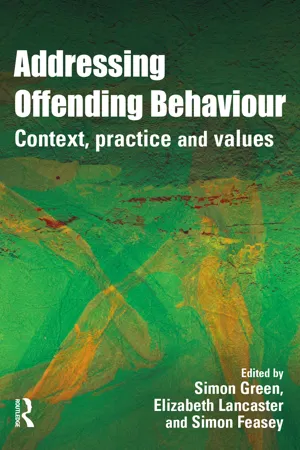
eBook - ePub
Addressing Offending Behaviour
Context, Practice and Value
- 492 pages
- English
- ePUB (mobile friendly)
- Available on iOS & Android
eBook - ePub
Addressing Offending Behaviour
Context, Practice and Value
About this book
Information
Part I
Context
Chapter 1
The legal framework
Martin Wasik
A brief history
The origins of dealing with offenders in the community in an attempt to assist in their rehabilitation goes back to the latter part of the nineteenth century, when voluntary societies appointed police court missionaries to help with the reformation of drunkards and others who appeared before the inner-city courts. The Probation of Offenders Act 1907 put this practice on a statutory footing, and enabled courts to make probation orders in a manner quite similar to that which existed until the end of the twentieth century. Probation was regarded as a form of diversion from the criminal courts. It was imposed ‘instead of sentencing’, and required the offender's consent. The probation order was for many years effectively the only community sentence available to the courts. It gradually became more flexible in content, offering a range of requirements tailored to the needs of the offender which could be written into the order by the court. Local probation services began to offer attendance at ‘day centres’, accommodation at a probation hostel or various activities and programmes which could be described to the court in a social inquiry report and be made part of the order to be served. Treatment for a mental condition could be ordered as part of a ‘psychiatric probation order’. Attendance centres for young offenders were created by statute in 1948, but the community service order was the next major change, introduced as an experiment in 1972 and made generally available in 1975 (Advisory Council on the Penal System 1970).
Community service, another order to which the offender had to consent, involved the performance of between 40 and 240 hours' work (as specified by the court) in the community. The order was overseen and managed by the probation service, but work on site was carried out alongside community volunteers. Community service rapidly gained general acceptance, perhaps because it had elements to appeal to all penal perspectives. It was punitive, requiring the offender to perform physical tasks for the benefit of the community. It was rehabilitative, with the prospect (at least) that the positive values of the volunteers might rub off on the offender. Community service was also the first tangible move in the sentencing system towards reparation, but indirectly through repayment to the community rather than directly to the victim of the offence. A limited mix of probation and community service was also developed, known as a combination order. At this time community-based disposals were usually referred to as ‘intermediate sanctions’ or ‘alternatives to custody’, but it was never clear whether community service was an alternative to custody, an alternative to probation or a little of both. Was it part of, or distinct from, the sentencing tariff occupied by discharges, fines and custody? Should a smaller number of hours of community service be equivalent to other non-custodial penalties and a larger number of hours be seen as alternatives to custody? If so, what was the ‘conversion scale’ between numbers of hours of community service and weeks or months in prison? The development of community service stirred an important debate over the rationale of community sentences generally (Pease 1978; Ashworth 1983: 385–407). The debate was overtaken by wider legislative change.
The Criminal Justice Act 1991
The Criminal Justice Act 1991, based on a 1990 White Paper (Home Office 1990), for the first time set out in statute a general sentencing framework (Wasik and Taylor 1994; Easton and Piper 2005). Central to the Act was the principle of proportionality — that each upward move in the scale of available sentences, from discharge, to fine, through community sentence to custody, had to be justified on the basis of the seriousness of the offence. The Act declared that an offence always had to be ‘serious enough’ to justify a community sentence, or be ‘so serious’ that only custody could be justified. It was based on proportionality (or ‘desert’) principles, but it allowed the courts to incapacitate high-risk violent and sexual offenders by the introduction of ‘longer-than-commensurate’ and ‘extended’ prison sentences. Community sentences were significantly reworked in the Act, with a rejection of the ‘alternatives to custody’ model. They were now, instead, to be regarded as restrictions on liberty, capable of being graded in terms of their relative severity (Wasik and von Hirsch 1988). This change reflected the decline in the rehabilitative model, which had held sway in the middle decades of the twentieth century, and the resurgence of ‘desert’ which had begun in the United States in the 1970s and was becoming influential worldwide (von Hirsch 1976). This did not mean that rehabilitative efforts in community sentences were to be abandoned — it meant that the duration of the order and the requirements it imposed on the offender must be kept in proportion with the seriousness of the crime(s) committed. The rhetoric of desert also chimed well with policy-makers, who wanted to see a fall in the prison population but were faced with resistance from sentencers and the public over community measures which were seen as ‘soft’. It was thought that rebranding these measures as restrictions on liberty might help to convert some of the doubters, but more recent surveys show that the problems endure (Coulsfield 2004; Linklater 2004). After the 1991 Act there was now no question that community service fitted within the sentencing tariff and was to be regarded as a form of punishment. Probation also became, for the first time, a sentence in its own right. The Act also introduced the curfew order, which could be enforced by electronic tagging. The curfew was the first community sentence designed to be punitive and restrictive of liberty, with no rehabilitative pretensions at all.
Some of the intended effects of the 1991 Act were watered down in the Criminal Justice Act 1993, but these reverses did not affect community sentences. A White Paper published in 1995, however, returned to the theme that community penalties were insufficiently tough, the public and sentencers lacked confidence in them and they were not enforced rigorously enough (Home Office 1995). The Crime (Sentences) Act 1997 abolished the requirement that the offender must consent to probation and to community service. As the technology became more reliable there was an exponential growth in the use of electronic tagging to enforce not just curfew orders (Nellis 2004), but to monitor bail conditions and home detention curfew on early release from custody (Dodgeson et al. 2001). Tagging could now be combined with other elements in a community sentence. The drug treatment and testing order (DTTO) was introduced in 1998. This innovative community sentence could be imposed for a period of between six months and three years, with offenders required to undergo treatment for drug dependency and to submit themselves for testing at regular intervals (Turnbull et al. 2000; Hough et al. 2003). The Court of Appeal issued guidance on the proper use of the DTTO in Attorney-General's Reference (No. 64 of 2003) [2004] 2 Cr App R (S) 105. It stated that judges should pass sentences which had a realistic prospect of reducing drug addiction whenever it was possible sensibly to do so, but clear evidence was necessary that the offender was determined to free himself from drugs. A DTTO would be more likely to be imposed in the case of an acquisitive offence carried out to obtain money for drugs and could be appropriate even where the offender had a bad offending record, but a DTTO would rarely be suitable for serious offences involving violence or threats of violence with a weapon. The DTTO had the further element that the sentencer imposing the order could oversee its management, requiring the offender to return monthly to court for progress reviews (McKittrick and Rex 2003; Robinson and Dignan 2004). In 2000 the names of several of the community sentences were changed in a further attempt to make them sound more rigorous. ‘Community service’ became ‘community punishment’ and ‘probation’ became ‘community rehabilitation’, a change criticised as unnecessary and confusing (Faulkner 2001).
From the 1990s onwards sentencing became an ever more volatile and politicised area of public policy (Wasik 2004). ‘Populist punitiveness’ over sentencing was, and still is, fuelled by the media and by politicians (Bottoms 1995), but research demonstrates consistently that when members of the public are properly informed of the facts of a case and educated as to the sentencing alternatives available, they will propose a sentence comparable to, or more lenient than, the sentence which would be selected by a criminal court (see Hough and Roberts 2002; Halliday 2001: App. 5). The traditional discretion of the courts in sentencing matters was coming under pressure from Parliament. The White Paper in 1990 declared that ‘sentencing principles and sentencing practice were matters of legitimate concern to the government’ (Home Office 1990). While it was generally accepted that it was for Parliament to set the agenda in penal policy, but for judges and magistrates to make individual sentencing decisions, there was disagreement over the ‘middle ground’ in sentencing. General principles of sentencing, aggravating and mitigating factors, guidelines and starting points had all been gradually developed over the latter decades of the twentieth century by the Court of Appeal, with little or no intervention from government. That all changed in the 1991 Act with the new legislative framework. There was much opposition to the Act from judges and magistrates, with the Lord Chief Justice of the day describing it as a ‘straitjacket’ on judicial decision-making, and insisting that what was needed instead of legislative restrictions was ‘the widest range of possible measures, and the broadest discretion to deploy them’ (Taylor 1993). Parliament pressed on, however, bolting onto the sentencing framework various special rules such as minimum sentences in the Crime (Sentences) Act 1997 for domestic burglary, drug trafficking and (in the Criminal Justice Act 2003 and the Violent Crime Reduction Act 2006) firearms offences. The Court of Appeal responded by reinstating flexibility wherever it could (see Cunningham (1993) 14 Cr App R (S) 444 on the general provisions of the 1991 Act), and by emphasising judicial discretion to avoid legislative prescription where ‘exceptional circumstances’ existed (see McInerney [2003] 2 Cr App R (S) 240 on the three-strikes rule for domestic burglary and Offen (No. 2) [2001] Cr App R (S) 44 on automatic life sentence provisions, repealed by the 2003 Act).
The Criminal Justice Act 2003
The Criminal Justice Act 2003 (CJA 2003) is now the key statute, certainly as far as offenders aged 18 and over are concerned (Ashworth 2005: ch. 10; Taylor, Wasik and Leng 2004: ch. 12) The Act was, in the main, the product of the Halliday Review (Halliday 2001), as subsequently endorsed by the government (Home Office 2002). The Act recasts community provisions once again. Replacing the earlier range of community sentences, there is now a single community order, within which one or more of 12 possible requirements may be specified by the court. These requirements, with some minor differences, reflect the former community sentences, but the terminology has changed again, so that (for example) ‘community service’, which became ‘community punishment’ in 2000, is now a ‘community order with an unpaid work requirement’. Halliday's criticism of the old community sentences was that they had grown up piecemeal, and should be simplified and made more understandable to the community, sentencers and offenders (Halliday 2001: para. 6.2, though see Rex 2002). The new order is used for offenders aged 18 and over in the Crown Court and in magistrates' courts for offences committed on or after 4 April 2005 (the relevant commencement date). A different community sentencing regime, with a range of different orders, continues for young offenders under 16. A third scheme exists for 16- and 17-year-old offenders, who have not been brought within the 2003 Act provisions and still fall to be dealt with under the old community sentences. Initially this situation was for an interim period only (until April 2007), but it has now been extended by Parliament until April 2009 (SI 2007/391).
The new scheme adopts the 1991 Act criteria in providing that a court must not pass a community order on an offender unless it is of the opinion that the offence (or combination of the offence and one or more offences associated with it) was serious enough to warrant such a sentence (CJA 2003, S.148(1)). This is the ‘community sentence threshold’ of offence seriousness, below which a different option, such as a fine or a conditional discharge, should be used. Just because an offence is ‘serious enough’ to justify a community order does not mean that such a sentence is inevitable. If appropriate, a fine or conditional discharge can still be used instead. The Criminal Justice and Immigration Act 2008 made the community order unavailable for offences which do not carry imprisonment as a penalty, a change designed to restrict the availability of more intensive (and expensive) community measures on serious offences (Home Office 2006b). The phrase ‘associated with’ in S.148(1) means that the court must weigh up any other offences for which the offender is being sentenced at the same time, and any further offences which the offender admits and has asked the cour...
Table of contents
- Cover
- Half Title
- Full Title
- Copyright
- Contents
- Acknowledgements
- Notes on the contributors
- List of abbreviations
- Introduction
- Part 1 Context
- Part 2 Practice: Generic Skills
- Part 3 Practice: Specialist Skills
- Part 4 Values
- Conclusion: a time of fear and excitement
- Appendix: useful websites
- Index
Trusted by 375,005 students
Access to over 1.5 million titles for a fair monthly price.
Study more efficiently using our study tools.
Frequently asked questions
Yes, you can cancel anytime from the Subscription tab in your account settings on the Perlego website. Your subscription will stay active until the end of your current billing period. Learn how to cancel your subscription
No, books cannot be downloaded as external files, such as PDFs, for use outside of Perlego. However, you can download books within the Perlego app for offline reading on mobile or tablet. Learn how to download books offline
Perlego offers two plans: Essential and Complete
- Essential is ideal for learners and professionals who enjoy exploring a wide range of subjects. Access the Essential Library with 800,000+ trusted titles and best-sellers across business, personal growth, and the humanities. Includes unlimited reading time and Standard Read Aloud voice.
- Complete: Perfect for advanced learners and researchers needing full, unrestricted access. Unlock 1.5M+ books across hundreds of subjects, including academic and specialized titles. The Complete Plan also includes advanced features like Premium Read Aloud and Research Assistant.
We are an online textbook subscription service, where you can get access to an entire online library for less than the price of a single book per month. With over 1.5 million books across 990+ topics, we’ve got you covered! Learn about our mission
Look out for the read-aloud symbol on your next book to see if you can listen to it. The read-aloud tool reads text aloud for you, highlighting the text as it is being read. You can pause it, speed it up and slow it down. Learn more about Read Aloud
Yes! You can use the Perlego app on both iOS and Android devices to read anytime, anywhere — even offline. Perfect for commutes or when you’re on the go.
Please note we cannot support devices running on iOS 13 and Android 7 or earlier. Learn more about using the app
Please note we cannot support devices running on iOS 13 and Android 7 or earlier. Learn more about using the app
Yes, you can access Addressing Offending Behaviour by Simon Green, Elizabeth Lancaster, Simon Feasey, Simon Green,Elizabeth Lancaster,Simon Feasey in PDF and/or ePUB format, as well as other popular books in Social Sciences & Criminology. We have over 1.5 million books available in our catalogue for you to explore.