eBook - ePub
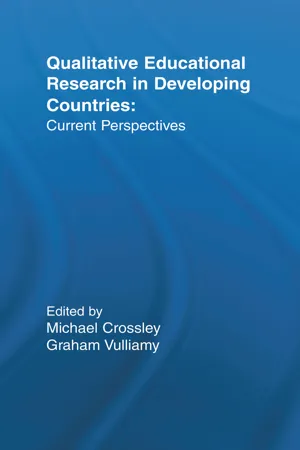
Qualitative Educational Research in Developing Countries
Current Perspectives
- 328 pages
- English
- ePUB (mobile friendly)
- Available on iOS & Android
eBook - ePub
Qualitative Educational Research in Developing Countries
Current Perspectives
About this book
This collection of 11 original in-depth accounts of qualitative research and evaluation in developing countries argues that such innovative methods offer considerable advantages over traditional methods. With examples drawn from Asia, Africa, the South Pacific, Central America and the Caribbean, each chapter focuses upon a specific method-such as qualitative interviews, fieldwork or document analysis-and considers related theoretical and practical issues. Key issues addressed include the identification of appropriate research questions; access; research ethics; practitioner research; case study evaluation; North-South collaboration and the potential of qualitative research for policy-making and theory.
Information
1 | QUALITATIVE RESEARCH IN DEVELOPING COUNTRIES |
| ISSUES AND EXPERIENCE Michael Crossley Graham Vulliamy |
INTRODUCTION
The origins of this book can be traced back to field research conducted by both of the present writers in the early 1980s. The context for this work was the developing country of Papua New Guinea in the South West Pacific. We had both been invited to contribute to the evaluation of a major secondary sector curriculum innovation by the Papua New Guinean Ministry of Education and the Educational Research Unit at the University of Papua New Guinea. Each of us had a separate brief and focus for his own work, though as coordination with local researchers evolved so too did the extent of our own collaboration. The substantive findings of our research into this particular curriculum project are reported extensively elsewhere (see, for example, Crossley, 1981, 1984a, b; Crossley and Vulliamy, 1986; Vulliamy, 1981, 1985a, b). From the methodological perspective, our joint interest in the application of qualitative research and evaluation strategies in developing countries has continued to inform much of our subsequent work.
Since reflexive accounts and biographical histories are themselves characteristic of the qualitative research literature, it is perhaps pertinent to note that our first joint methodological writing explored the potential of school case studies for the field of comparative education, in the light of Stenhouse’s call for detailed field work (1979) and our own Papua New Guinean experience (Crossley and Vulliamy, 1984). Fortuitously, we had both traveled to Papua New Guinea, one directly from the UK and the other via Australia, interested in ways of studying the processes of educational innovation and of documenting the nature and quality of teaching and learning. At that time few substantial qualitative studies of education in developing countries were available in the international literature; but the works of Stake (1967), Stenhouse (1975), Parlett and Hamilton (1977) and other writers then challenging conventional models had already had a broadening influence upon educational research and evaluation strategies in the West. Moreover, the Papua New Guinean authorities were themselves keen to establish a strong and multidisciplinary tradition of educational research (Guthrie and Martin, 1983), and to encourage useful in-depth studies of schools. Our methodological work thus evolved quite naturally to consider the potential and limitations of qualitative research and evaluation for developing countries; and, as we reflected upon our broader field, the importance of related epistemological, theoretical and practical issues for comparative and international studies in education began to emerge increasingly clearly.
In this present volume, published in the Garland Reference Books in International Education series, we aim to build on our previous work, reflect upon relevant methodological developments in the past decade, and draw together useful examples of contemporary qualitative research and evaluation conducted in a selection of developing countries. The book expands on a number of core themes articulated in earlier work (Crossley and Vulliamy, 1984; Vulliamy et al., 1990; Crossley and Broadfoot, 1992), but pursues a wider range of specific methodological issues and debates through the analysis of research experience in a broader sample of developing countries. To enhance the utility of the book most chapters have been carefully planned to focus upon one major research method or issue, in the context of one specific study. Key issues include the importance of fieldwork, document analysis, qualitative interviews, classroom action research, insider fieldwork, ethical problems, case-study evaluation, the planning of qualitative research, dilemmas of teamwork, research capacity building, and north-south collaboration. The studies themselves examine formal and non-formal initiatives, community perceptions, school innovations, teacher training, tertiary education and provision for nomadic communities. Detailed examples of research in practice are drawn from countries in Asia and the Far East, Africa, Central and Latin America, the South Pacific and the Caribbean. Two introductory chapters also deal more broadly with epistemological issues and debates (chapter 2) and the implications and potential of qualitative research and evaluation for educational policy formulation and analysis (chapter 3).
An overview of each chapter is presented below, but here it is appropriate to explain how the structure of the volume is intended to maximize the accessibility of the material for other researchers in a practical but intellectually challenging way. As such we hope the book will be used as both a reference source and methodological text by a wide range of readers interested or involved in research activities relating to education and development. All contributors have been asked to write for an international audience working in both developed and developing countries; and to keep in mind the differing needs, experience and interests of potential readers as diverse as university students, tutors, researchers, policy-makers, educational planners, and specialists with research or evaluation responsibilities in national, international and non-governmental development assistance agencies.
The authors have themselves been chosen carefully to reflect differing intellectual, professional, and cultural backgrounds. All have substantial research experience in developing countries; some are educationalists, but others have different disciplinary expertise; some hold senior administrative positions; some are currently involved in long-term fieldwork; and others are perhaps more accurately described as practitioners. In this way we are, collectively, able to offer a multidisciplinary contribution to the available literature—and one that represents the work of both men and women. Moreover, of particular significance is the fact that a number of our contributors are writing about research carried out within their own home country—so adding important local perspectives to those articulated by foreign researchers. Indeed, collaboration between local and external research personnel is a distinctive characteristic of the present volume and a strategy that, we argue, holds much potential for further research throughout the developing world. The combination of insider and outsider perspectives in qualitative research can, for example, help facilitate studies that are more sensitive to local contextual factors, while retaining systematic rigor and an important degree of detachment from the culture and world view being studied (Crossley, 1992).
At the most fundamental level we hope this book will be of interest and of direct practical help to others planning, or engaged in, educational research of this nature—and that it will contribute in some way to the future quality and relevance of the work conducted, and to the broader process of research capacity building in developing countries.
THE METHODOLOGY AND METHODS OF QUALITATIVE RESEARCH
The first of the key themes we wish to develop from previous work concerns the nature and definition of qualitative research. Discussion of this is in our view frequently bedeviled by a failure to differentiate between a consideration of techniques of data collection, on the one hand, and a consideration of the underlying approach or epistemology guiding the research, on the other. While qualitative researchers tend to use data collection techniques, such as observation and unstructured interviewing, which produce words as data, and quantitative researchers tend to use techniques, such as questionnaire surveys or experiments, which produce numbers as data, such distinctions are not viewed by most qualitative researchers as the crucial differentiating feature. Rather, qualitative researchers usually view themselves as influenced by underlying philosophies and theoretical frameworks that are in conflict with the positivist and postpositivist philosophies which they identify as characterizing much traditional educational research (Guba, 1990b). Such epistemological differences shape a researcher’s overall strategy and approach, irrespective of what data collection techniques are adopted. Thus, qualitative researchers do sometimes use data collection techniques that result in quantification and statistical analysis and positivist researchers sometimes use data collection techniques, such as semi-structured interviewing, which are more usually associated with qualitative researchers. Therefore characterizing research debates in terms of a quantitative/qualitative techniques division—as so often continues to be the case, particularly in developing countries—is unhelpful. As Fetterman points out:
One need only scratch the surface of the qualitative/quantitative debate to understand that the terms “quantitative” and “qualitative” are in themselves misleading. They are commonly accepted handles for both the contrasting paradigms and the methods associated with them. (Fetterman, 1988:5)
While philosophical positions underpinning both positivist and anti-positivist approaches in the social sciences have coexisted since at least the late nineteenth century, it is nevertheless the case that the widespread development over the last twenty five years of qualitative research in education has been a product of epistemological critiques of the positivist tradition that had hitherto dominated educational research in Western countries in the postwar period. Accepting the limitations of any shortened statement on the methodology of positivism (Halfpenny’s 1982 book, for example, delineates twelve different usages of the term), Finch’s definition is nevertheless an adequate guide:
“Positivism” is taken to mean an approach to the creation of knowledge through research which emphasises the model of the natural sciences: the scientist adopts the position of the objective researcher, who collects “facts” about the social world and then builds up an explanation of social life by arranging such facts in a chain of causality, in the hope that this will uncover general laws about how the society works. (1986:7)
By contrast, the critiques of positivism, associated with traditions such as symbolic interactionism (Blumer, 1969), phenomenology (Berger and Luckmann, 1967) and constructivism (Guba, 1990a; Lincoln, 1990) argue that there is a fundamental difference between the study of natural objects and human beings, in that the latter themselves interpret situations and give meaning to them. Schutz (1962) considers the implications of this and argues that any worthwhile sociological explanation must be related to the actual ways in which groups themselves interpret their social situations. This requires a particular standpoint to the research process which Blumer (1971:21) characterizes as taking the role of research subjects and seeing their world from their perspective because “the actor acts towards his world on the basis of how he sees it and not on the basis of how that world appears to the outside observer.” Given this, techniques of data collection are predisposed towards those “such as participant observation, in-depth interviewing, total participation in the activity being investigated, field work etc., which allow the researcher to obtain first-hand knowledge about the empirical social world in question” (Filstead, 1970:6).
We therefore find it helpful to distinguish between research techniques or methods on the one hand and what is variously termed a “paradigm” (derived from Kuhn, 1962), “methodology” or “strategy” (where these refer to the underlying epistemology of a research project) on the other. The relative importance of research methods vis-a-vis research strategies is still a subject of considerable controversy (see, for example, Guba, 1990b and Smith, 1989, together with Hammersley’s 1992a critique of these books). At one extreme, writers such as Guba and Lincoln (1988) argue that the basic assumptions underpinning the conventional positivist and, what is variously called “interpretive,” “naturalistic” or “constructivist” paradigms are totally opposed to each other, and they regard the positivist paradigm as unsuited to the study of human behavior in any context. Consequently, they maintain that while it is possible to mix different research methods within a research project, it is not possible to mix different research strategies. Thus any particular research method means something different, and is used in fundamentally different ways, depending upon whether the research design is a positivist or constructivist one. This distinction between methods and paradigm is made explicit in their attitude to the use of quantitative data where Lincoln reveals that they “have always said that the constructivist ought to be using, where appropriate, quantitative methods,” pointing out that “nonpositivist quantitative methods are quantitative methods that don’t make assumptions about strict linear cause-effect relationships” (quoted in Beld, 1994:108–109). At the other extreme, writers such as Reichardt and Cook (1979) suggest that we should move beyond the paradigm debate and use whatever research techniques suit the research questions in hand, arguing that there are no essential differences between the use of qualitative and quantitative methods. An intermediary position is taken by Patton (1988) who, while accepting the force of Guba and Lincoln’s (1988) analysis at the epistemological level, nevertheless argues for a pragmatic “paradigm of choices” whereby researchers can mix both research methods and research strategies, even within a single project. There are some rare examples of researchers who have shifted their own philosophical positions substantially on these issues; Hammersley’s early work on ethnography in education, for example, leans toward the Guba and Lincoln (1988) end of the above continuum (see, for example, Hammersley, 1979a, b; Hammersley and Atkinson, 1983) while his more recent work leans toward the Reichardt and Cook (1979) end (see, for example, Hammersley, 1992b). However, for most researchers their allegiances to a particular stance on these issues is established early, mainly as a result of their training. Typically, different disciplines or sub-disciplines and different graduate research centers have different emphases. Thus, for example, as a generalization those trained in the psychology of education are more likely to be exposed to a positivist research strategy than an interpretive one, while those trained in the anthropology of education are likely to have the reverse. Sometimes such differences exhibit themselves in markedly varying approaches to different research areas within education. Vulliamy and Webb (1993) argue, for example, that the dominance of psychologists within the special education field has meant that it has been relatively insulated from developments within qualitative research and that this has resulted in a failure to address vital research questions.
The literature on qualitative research methodology suggests that there are several defining features of such research (see, for example, Burgess, 1985:7–10 and Bryman, 1988:61–69). It provides descriptions and accounts of the processes of social interaction in “natural” settings, usually based upon a combination of observation and interviewing of participants in order to understand their perspectives. Culture, meanings and processes are emphasized, rather than variables, outcomes and products. Instead of testing preconceived hypotheses, much qualitative research aims to generate theories and hypothese...
Table of contents
- Cover
- Title page
- Copyright page
- Dedication page
- Contents
- SERIES EDITOR’S FOREWORD
- FOREWORD
- ACKNOWLEDGMENTS
- Chapter 1 QUALITATIVE RESEARCH IN DEVELOPING COUNTRIES: ISSUES AND EXPERIENCE
- Chapter 2 INTEGRATING PARADIGMS IN EDUCATIONAL RESEARCH: ISSUES OF QUANTITY AND QUALITY IN POOR COUNTRIES
- Chapter 3 QUALITATIVE RESEARCH AND EDUCATIONAL POLICY-MAKING: APPROACHING THE REALITY IN DEVELOPING COUNTRIES
- Chapter 4 THE IMPORTANCE OF FIELDWORK: ANTHROPOLOGY AND EDUCATION IN PAPUA NEW GUINEA
- Chapter 5 USING DOCUMENTS FOR QUALITATIVE EDUCATIONAL RESEARCH IN AFRICA
- Chapter 6 INTERVIEWS AND THE STUDY OF SCHOOL MANAGEMENT: AN INTERNATIONAL PERSPECTIVE
- Chapter 7 IMPROVING OUR PRACTICE: COLLABORATIVE CLASSROOM ACTION RESEARCH IN LESOTHO
- Chapter 8 DILEMMAS OF INSIDER RESEARCH IN A SMALL-COUNTRY SETTING: TERTIARY EDUCATION IN ST. LUCIA
- Chapter 9 PLANNING FOR CASE-STUDY EVALUATION IN BELIZE, CENTRAL AMERICA
- Chapter 10 IMPLEMENTING QUALITATIVE RESEARCH IN PAKISTAN: INTERNATIONAL TEAMWORK
- Chapter 11 NORTH-SOUTH COLLABORATION IN EDUCATIONAL RESEARCH: REFLECTIONS ON INDIAN EXPERIENCE
- CONTRIBUTORS
- AUTHOR INDEX
- SUBJECT INDEX
Trusted by 375,005 students
Access to over 1.5 million titles for a fair monthly price.
Study more efficiently using our study tools.
Frequently asked questions
Yes, you can cancel anytime from the Subscription tab in your account settings on the Perlego website. Your subscription will stay active until the end of your current billing period. Learn how to cancel your subscription
No, books cannot be downloaded as external files, such as PDFs, for use outside of Perlego. However, you can download books within the Perlego app for offline reading on mobile or tablet. Learn how to download books offline
Perlego offers two plans: Essential and Complete
- Essential is ideal for learners and professionals who enjoy exploring a wide range of subjects. Access the Essential Library with 800,000+ trusted titles and best-sellers across business, personal growth, and the humanities. Includes unlimited reading time and Standard Read Aloud voice.
- Complete: Perfect for advanced learners and researchers needing full, unrestricted access. Unlock 1.5M+ books across hundreds of subjects, including academic and specialized titles. The Complete Plan also includes advanced features like Premium Read Aloud and Research Assistant.
We are an online textbook subscription service, where you can get access to an entire online library for less than the price of a single book per month. With over 1.5 million books across 990+ topics, we’ve got you covered! Learn about our mission
Look out for the read-aloud symbol on your next book to see if you can listen to it. The read-aloud tool reads text aloud for you, highlighting the text as it is being read. You can pause it, speed it up and slow it down. Learn more about Read Aloud
Yes! You can use the Perlego app on both iOS and Android devices to read anytime, anywhere — even offline. Perfect for commutes or when you’re on the go.
Please note we cannot support devices running on iOS 13 and Android 7 or earlier. Learn more about using the app
Please note we cannot support devices running on iOS 13 and Android 7 or earlier. Learn more about using the app
Yes, you can access Qualitative Educational Research in Developing Countries by Michael Crossley,Graham Vulliamy in PDF and/or ePUB format, as well as other popular books in Education & Education General. We have over 1.5 million books available in our catalogue for you to explore.