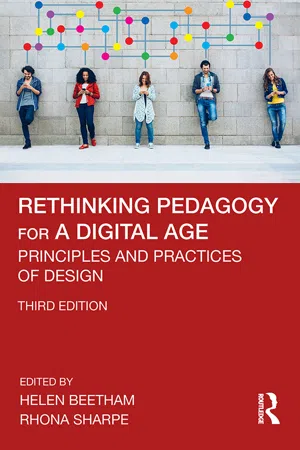
Rethinking Pedagogy for a Digital Age examines contemporary issues in the design and delivery of effective learning through a critical discussion of the theoretical and professional perspectives informing current digital education practice. This third edition has been thoroughly revised to address socio-cultural approaches, learning analytics, curriculum change, and key theoretical developments from education sciences. Illustrated by case studies across disciplines and continents for a diversity of researchers, practitioners, and lecturers, the book is an essential guide to learning technologies that is pedagogically sound, learner-focused, and accessible.
eBook - ePub
Rethinking Pedagogy for a Digital Age
Principles and Practices of Design
- 290 pages
- English
- ePUB (mobile friendly)
- Available on iOS & Android
eBook - ePub
Rethinking Pedagogy for a Digital Age
Principles and Practices of Design
About this book
Part 1
Theories and Principles
Chapter 1
Learning Theory and the New Science of Learning
Editors’ Introduction
Mayes argues that design decisions need to be based on clear theoretical principles, and identifies three broad perspectives on learning from which these principles can be drawn: the associative, cognitive, and situative. In a comprehensive revision of the chapter for this third edition, he summarises new evidence from the fields of artificial or machine learning, neural networks, educational neuroscience, and the study of learning on the participative web. He concludes that new advances do not validate one approach over others, but that the three approaches continue to provide complementary resources for the designer, drawing on different epistemological traditions.
Introduction
The main aim of this chapter is to consider the role of learning theory in the design of pedagogy. Many readers will come to this topic with a sense of being overwhelmed by the complexity of competing theories, and by the debates about their respective importance for pedagogy. Here learning theory is described in a way that is intended to be to directly interpretable by a pedagogic designer. It is presented as a small set of broad perspectives, each of which emphasises a different kind of learning and implies a different kind of pedagogy. Far from competing, the theories together offer a set of complementary ideas which point to broad pedagogical principles.
The chapter starts by revisiting the three traditions described in Mayes and de Freitas (2013). These are the associative, the cognitive, and the situative. These approaches are then considered in the light of what Meltzoff et al. (2009) and Sawyer (2014) have termed the ‘new science of learning’, in which the landscape for theory has been significantly extended – or even radically challenged – by recent research. Cognitive theory is being stretched by research in cognitive development and in neuroscience. Associative models are transformed by work on neural networks, while the situative approach is extended by learning on the participative web. All three are challenged by new research on implicit learning. Finally, the question is put: to what extent do these developments in theory require us to rethink pedagogy?
The Associative Perspective
Through associative learning the contingent relationships in the world – what predicts what – are assumed to be acquired through experience. The relationships can be temporal (what follows what), or structural (what goes with what). Associative theory emphasises the linking of elementary units (these can be external inputs and outputs, or internal representations) and the building of these into more complex patterns through activity and feedback. This simple idea became the dominant approach to learning for the first three quarters of the twentieth century, with behavioural principles uncovered in experiments on both animal and human learning demonstrating how precisely learning can be controlled through structured tasks involving feedback. These principles were then applied with some success in areas such as the workplace and the clinic (see Mace & Critchfield 2010).
Applying the associative approach in education, a method known simply as programmed instruction emphasised the reinforcing of small steps of learning through immediate knowledge of results. The main task for the designer was to organise the subject matter into a sequence that would lead eventually to mastery. After each step a question or test problem required a response which then triggered immediate feedback to the learner. Where errors were made the program could branch into remedial material. Some simple technologies were developed to manage learning using this approach, resulting in the short-lived popularity of what were called teaching machines (see e.g. Benjamin 1988). Despite its rejection in education, most of the principles on which programmed instruction was based – active problem solving with immediate feedback on success, personalisation, and mastery of component steps before the introduction of more complex ones – are not incompatible with much modern pedagogy (Burton, Moore & Magliaro 2003).
This approach was later combined with systems theory and developed into a method called Instructional Systems Design (e.g. Gagné 1985), characterised by the careful specifying of learning objectives based on task analysis, the design of structured tasks aimed at achieving the objectives in a logical sequence, the provision of feedback after each step, and the measurement of learning outcomes. The approach was particularly applicable in skill training where the units could readily be defined in behavioural terms.
The Cognitive Perspective
By the 1960s learning theory had started to focus on understanding in more detail the nature of internal representation. A new emphasis on mental processes was influenced heavily by the development of the computer as a model of the mind. Not only were the simple links of association theory replaced by the idea of propositional networks that carried semantic information, but learning itself became viewed less as the connecting of representations and more as a kind of active problem solving. Successful learning would depend above all on the processing of meaning, which would involve thinking, concept formation, language, attention and, as in a computer, the operation of a set of special purpose devices for the coding, storage and retrieval of information. In more pedagogical terms, the learners’ key challenge now became the building of a framework for understanding – mental structures which interpret the input so that it becomes integrated into existing knowledge. Once a framework is in place then slotting new learning into a pre-existing knowledge structure becomes relatively effortless. Learning becomes a by-product of understanding.
The main pedagogical approach that has emerged from the cognitive perspective is to encourage the active pursuit of understanding. Tasks which are aimed at helping learners achieve this understanding are grouped under the label ‘constructivist’, following Piaget’s (1970) argument that conceptual development depends on active and personal exploration and observation, in contrast to an instructivist approach in which learners absorb ideas through the provision of explanations. There are many different versions of constructivist methodology and a variety of different terms are used to describe the concept (see e.g. Chi 2009). The key aim, however, is to create a situation in which a learner will have to expend effort in reflection and self-explanation. In Chapter 2, Beetham points to learner activity as the ideal focus for learning design. Many early attempts to employ technology in education fell into the trap of trying to enhance learning simply through designing better ways of presenting to-be-learned information. To a constructivist, learning can be enhanced through technology not by somehow amplifying the information but rather by designing tasks and tools for helping learners to think for themselves (Jonassen, Mayes & McAleese 1993).
The Situative Perspective
The situative perspective significantly moves the focus away from the individual learner. The term was introduced through the work of Suchman (1999) whose socio-anthropological approach shifted the unit of analysis to the activity in which learning would take place: a spontaneous interaction between the individual and the situation involving tools, other people, language, and the wider culture. This approach was further developed by Lave and Wenger (1991), whose study of communities of practice in work situations particularly focused on apprenticeship learning. This work inspired a method appropriately called cognitive apprenticeship (Collins & Kapur 2014).
Here, included as ‘situative’ is the extensive research that has examined the simple idea that individual learning is shaped through the influence of other people. As long ago as the 1960s, Bandura (1965) argued that much learning is by proxy – vicariously – through observing the consequences of others’ behaviour. Further work has emphasised the importance of the learning group, where collaboration can produce outcomes that exceed that achieved by individual learners by themselves. Vygotsky’s influence, emphasising learning through interaction with others in the context of the wider culture, has been particularly important in promoting the pedagogic approach known as social constructivism (Palincsar 1998).
Multiple Perspectives
The three orientations depicted above as theoretical ‘perspectives’ or ‘approaches’, or even ‘frameworks’ represent, for the most part, distinct epistemological traditions, with their historically separate literatures. It is also possible to regard them essentially as metaphors, restricting the term ‘theory’ to causative accounts of particular effects that can be tested directly. In the context of discussing high-level metaphors like ‘learning as acquisition’ or ‘learning as participation’, Sfard (1998) has pointed to the danger involved in too great a devotion to one particular way of thinking and rejection of all the others. Each approach will capture something important, but only by holding multiple perspectives simultaneously can we hope to advance our overall understanding. To take one example, in the recent work on conceptual development two different metaphors have been pitted against each other. These are the ‘child-as-data-analyst’ (essentially associative) and the ‘child-as-theorist’ (essentially cognitive) metaphors. The conceptual development literature largely treats these as alternative theories but Waxman and Gelman (2009) have argued convincingly that, as children build a repertoire of concepts and the language to describe them, they call on both their rudimentary theories and the statistics they pick up from their environment. Each metaphor captures a crucial aspect of their learning: an associative account of statistical learning and a cognitive account of theory formation are both necessary. Moreover, a situative perspective on conceptual development is just as crucial for full understanding, as Waxman and Gelman acknowledge. So, in this example, it is the integration of all three perspectives that should guide pedagogy.
Interactions with Context
Sfard (1998) makes another important point: that implications of a metaphor are a result of contextual determinants not less than of the metaphor itself. A large proportion of the literature on the psychology of learning has focused on factors that can be regarded as contextual. The full context for a learning event must include the individual’s past experience, and thus the influence of previous learning, determining both the stage of learning (Fitts & Posner 1967; Anderson et al. 2018) and the extent of transfer (Day & Goldstone 2012). Similarly crucial for learning outcomes will be the current state of various characteristics of an individual learner: aptitude, arousal, emotion, and so on. And above all this is the level of self-regulation – control and commitment – that can be brought to bear on the learning task.
Ideally, at some point there should be an unpacking of this interaction of theory and context into detailed and specific guidance for pedagogy. To offer just one example of a specific effect that demands – for classroom practice – a detailed account, consider the spacing effect (Cepeda et al. 2008). This refers to the superior performance that occurs from repeated learning episodes, focusing specifically on the relationship between the timing of study events and the duration before memory is tested. This phenomenon is still subject to theoretical controversy (e.g. Walsh et al. 2018) though it can be described in a way that is pedagogically robust. Indeed, much of current research on learning that has direct implications for pedagogy will involve testing smaller-scale theory in particular contexts, and then attempting to generalise the results. For example, work on self-regulation (Winne 2018), self-explanation (Bisra et al. 2018), feedback (Nicol 2012) and vicarious learning (Mayes 2015) all involve this mix: theory about a particular effect, testing in context, and generalisation to pedagogical principle.
Neural Network Theory
The view of learning as underpinned by a simple link mechanism took on a new life in the form of neural network theory. This represents a kind of computational version of the associationist approach in the sense that it demonstrates how complex learning can emerge from a network of neurone-like links operating in parallel, producing stimulus-response relationships. The approach has enjoyed a rather strange roller-coaster history beginning with the early work on ...
Table of contents
- Cover
- Half Title
- Title Page
- Copyright Page
- Table of Contents
- List of Illustrations
- Acknowledgements
- Notes on Contributors
- Foreword to the Third Edition
- Foreword to the Second Edition
- Foreword to the First Edition
- An Introduction to Rethinking Pedagogy
- PART 1: Theories and Principles
- PART 2: Practices
- PART 3: Influences and Futures
- PART 4: Resources
- Index
Trusted by 375,005 students
Access to over 1.5 million titles for a fair monthly price.
Study more efficiently using our study tools.
Information
Publisher
RoutledgeEdition
3Year
2019Topic
EducationPrint ISBN
9780815369264
9780815369257
Subtopic
Education GeneraleBook ISBN
9781351252782
Frequently asked questions
Yes, you can cancel anytime from the Subscription tab in your account settings on the Perlego website. Your subscription will stay active until the end of your current billing period. Learn how to cancel your subscription
No, books cannot be downloaded as external files, such as PDFs, for use outside of Perlego. However, you can download books within the Perlego app for offline reading on mobile or tablet. Learn how to download books offline
Perlego offers two plans: Essential and Complete
- Essential is ideal for learners and professionals who enjoy exploring a wide range of subjects. Access the Essential Library with 800,000+ trusted titles and best-sellers across business, personal growth, and the humanities. Includes unlimited reading time and Standard Read Aloud voice.
- Complete: Perfect for advanced learners and researchers needing full, unrestricted access. Unlock 1.5M+ books across hundreds of subjects, including academic and specialized titles. The Complete Plan also includes advanced features like Premium Read Aloud and Research Assistant.
We are an online textbook subscription service, where you can get access to an entire online library for less than the price of a single book per month. With over 1.5 million books across 990+ topics, we’ve got you covered! Learn about our mission
Look out for the read-aloud symbol on your next book to see if you can listen to it. The read-aloud tool reads text aloud for you, highlighting the text as it is being read. You can pause it, speed it up and slow it down. Learn more about Read Aloud
Yes! You can use the Perlego app on both iOS and Android devices to read anytime, anywhere — even offline. Perfect for commutes or when you’re on the go.
Please note we cannot support devices running on iOS 13 and Android 7 or earlier. Learn more about using the app
Please note we cannot support devices running on iOS 13 and Android 7 or earlier. Learn more about using the app
Yes, you can access Rethinking Pedagogy for a Digital Age by Helen Beetham, Rhona Sharpe, Helen Beetham,Rhona Sharpe in PDF and/or ePUB format, as well as other popular books in Education & Education General. We have over 1.5 million books available in our catalogue for you to explore.