eBook - ePub
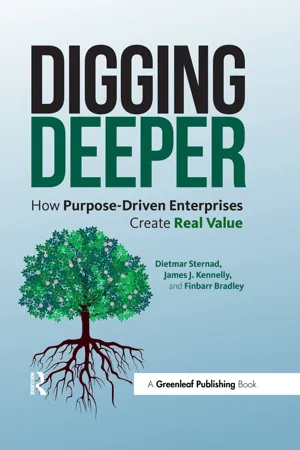
Digging Deeper
How Purpose-Driven Enterprises Create Real Value
- 271 pages
- English
- ePUB (mobile friendly)
- Available on iOS & Android
eBook - ePub
Digging Deeper
How Purpose-Driven Enterprises Create Real Value
About this book
What is the primary purpose of business? The standard answer is 'making profits,' but some visionary entrepreneurs and leaders fundamentally disagree. Instead of just making money, they choose instead to "dig deeper" and make a difference through creating real value – improving the lives of others even as they find deeper meaning in their own. These leaders build enterprises that provide identity and a sense of purpose, create positive relationships and a place to learn and thrive, embed sustainability in all that they do, and strive to improve the quality of life of all of their stakeholders. Although not their primary focus, they also make healthy profits, as their unique approach to value creation provides them with a sustainable competitive edge.Digging Deeper is a book full of inspiring stories that illustrate that there is an alternative to a myopic and narrow capitalism that trades in inequalities, exploitation, collective burnout and negative consequences for our shared natural environment. Remarkable examples from all over the world vividly demonstrate how enterprises can create real value through focusing on what the authors call the 6 Ls: long-term orientation, lasting relationships, local roots, limits recognition, developing a learning community and taking leadership responsibility seriously in its very best sense.Digging Deeper liberates the term "value" from the tight chains in which the global financial community has bound it and demonstrates that businesses can contribute to a better life for all ? if their leaders can go beyond viewing enterprises as single-purpose money-making machines and develop purpose-driven enterprises that create real value for all.
1
In search of real value
What is a cynic?
A man who knows the price of everything,
and the value of nothing.
A man who knows the price of everything,
and the value of nothing.
Oscar Wilde, Lady Windermere’s Fan (1892), Act III
Ask anyone on Wall Street about the value of a particular business. They will likely launch into a lecture on market capitalization, discounted cash flows, capital asset pricing models, mark-to-market accounting or price-to-earnings ratios. But, whatever we call these sophisticated methods, they fundamentally boil down to the proverbial bottom line: how much cash and profit does a company throw off, and what are its stock price and market valuation?
Though the primacy of shareholder value has dominated the mainstream business mindset for decades, and still does even after the latest global financial crisis, it is no longer uncontested. The myopic focus of the business world on maximizing shareholder wealth is now fair game for critics, given its short-termism and lack of sustainability, its neglect of social or environmental impacts, its fostering of economic inequality, and its tendency to incentivize unethical and unprincipled behavior. The call for a broader notion of business and its value-creation imperative is getting louder.
This call is even coming from companies themselves. Take the refreshing example of Apple, where at its 2014 Annual Meeting, the usually calm and collected CEO, Tim Cook, rebuffed a shareholder asking him to commit to only making moves that were profitable for the company. “When we work on making our devices accessible by the blind, I don’t consider the bloody ROI,” Cook told the questioner, a climate change denier complaining about Apple devoting funds to renewable energy and sustainable projects. A clearly incensed Cook added: “If you want me to do things only for ROI reasons, you should get out of this stock” (Business Insider, 2014).
This is a book about businesses that create value. At first blush, this is hardly a novel topic. After all, isn’t value creation the ultimate goal of all businesses? We believe it is. We also believe that profit-making firms are central to the modern economy. But profit-making is not the same as value creation. Clearly, the concept of value means many things to many people. Therefore, before we rush to conclusions too fast, we need to explore a seemingly simple question: What is value? Or, more to the point: What is real value?
Let’s begin this exploration in a metaphorical vein by imagining a garden. A garden is a patch of cultivated earth, tilled and tended by human beings to yield flora of all types – flowers and herbs and vegetables and fruit. Depending on the season, the garden may blaze with bright colors, or scent the air with subtle fragrance, or yield an abundance of fresh produce, or lie dormant and somnolent as it recharges itself. A garden conjures visions of fertility, beauty and utility – co-existing within its ordered confines.
What is the value of a garden? Is it the monetary value of the land on which the garden was cultivated? Or the exchange value of the produce of the garden when it is sold at market? Or are there other, deeper, maybe even hidden sources of value in a garden?
For visitors, a garden might offer a sensory and aesthetic experience, as they admire its order, tranquility, and beauty. Those with a more meditative bent may have a spiritual experience when they contemplate the unique and complex relationship between nature and culture. (It is interesting that the words cultivate and culture both share a similar etymology.) A garden might even offer a healing experience – for the body, with the use of medical herbs that grow in a garden, as well as for the mind, when the outer tranquility releases calmness inside. For those who own a garden, it can represent an artistic creation, a means of self-expression and a level of self-reliance. It can be a work of art because it achieves harmony so that all forms of life are given the opportunity to flourish and reach their potential.
Even for professional gardeners who do not own the garden, the act of cultivation itself can lead to pride in having brought more beauty into our world. They assess a garden’s merit not through growth of its plants but through their beauty and overall harmony. Gardens are also good for the community. They offer a peaceful environment where people can meet, refresh, and relax. They strengthen our relationship with and stewardship of nature. And they can promote physical activities and mental well-being. Last but not least, gardens can have a positive effect on our natural environment, and produce many positive externalities like soaking up carbon dioxide, reducing air pollution and offering a nurturing habitat for insects, birds, and other creatures. In short, gardens are good for us – as individuals and as a community.
The real value of a garden thus goes far beyond its mere monetary value. It lies much deeper, in improving the quality of life of the people who own, cultivate, and visit the garden and of the natural environment that sustains it. Studies have confirmed that gardens have decidedly positive effects on people’s happiness and health (Pretty, 2004; Gardener’s World, 2013; Balch, 2015). And, even if this does not all translate directly into money, the deeper value is there, and it is real.
“Our perception of value is dramatically subjective,” says Dan Ariely, professor of psychology and behavioral economics at Duke University. “It comes from lots of things from the environment,” he explains in the award-winning documentary Real Value. “Neo-classical economics has a very simple answer to it; something’s value is whatever people are willing to pay for it. But the deeper question of what is value is much more complex.”1 Ariely conducted experiments in which people bought coffee. The coffee was surrounded by condiments that were usually never used with coffee. For one sample, these condiments were put into beautiful glass and metal containers, for another sample in non-descript Styrofoam cups. None of these containers had any influence on the taste and use value of the coffee. Yet people were willing to pay a lot more – actually around twice as much – for the coffee that was surrounded by beautiful things. The perceived value of the product dramatically changed with the feelings that the surroundings conveyed.
To explore this more expansive notion of value, let us consider a very special type of garden, one that is mostly used for economic purposes – a vineyard. What is the value of an acre of vineyard? It depends, the connoisseur would say, on many factors – for example, on the terroir, the location of the land and its interaction with the climate, terrain, and soil, on the knowledge and passion of the people who tend the vines, on the tradition and reputation of the wine-growing region and of the estate, and on the age of the vines. It also depends on the “character” of the vines: how have the vines been treated? Have they been exploited for maximum short-term yield, or grown and maintained with care? Has the wine-grower recognized the limits of the plants – for example, regarding their number per acre and the amount of chemical pesticides that they can absorb? Was the focus of the winery itself on the quality or on the mere quantity of the wine? No wine expert would ever assess the value of a vineyard solely on the number of grapes that it yields. Such reductionism, however, is exactly the dominant tendency when we discuss “success” in business. All too often, the value of a business is reduced to one dimension that must be maximized – its financial value.
We think it’s time to liberate the notion of value from the chains with which the financial world has imprisoned it. We believe that real value goes well beyond the more common conception of value bandied about by the general business community. Of course, business value is linked to money and profits: businesses without positive cash flows and profits – at least over time – will simply cease to exist. We are, however, convinced that the real value of a business is far broader than a narrow, financially dominated definition would suggest. As in a garden, the real value of a business lies at least as much in its emotional value and in its contribution to improving the quality of people’s lives as in its financial metrics.
"The world's dumbest idea"
The English word value stems from the Old French valoir, meaning “to be worth.” A quick look into the dictionary tells us that the term value is used for “the material and monetary worth of something.”2 But this definition, in fact, is ranked second in the dictionary to another, more encompassing definition of value: “the regard that something is held to deserve; the importance, worth, or usefulness of something.”3
What is the value – in its wider meaning of the importance, worth, or usefulness – of a business, then? Of course, the answer depends on who is asking. A business owner may answer differently from an employee, a customer, or a neighbor who is affected, for better or worse, by the activities of the enterprise.
It has been decades since R. Edward Freeman’s seminal work in the 1980s first challenged the predominant shareholder value approach with a different, even revolutionary, perspective. His idea was that regardless of their ultimate purpose – which may well remain making money for the owners – businesses needed to pay attention to the effects of their actions on others (Freeman, 1984). Freeman made a case for balancing the interests of all stakeholders, whether employees, suppliers, customers, communities, the environment, or anyone else who could affect or be affected by a business (Freeman et al., 2010). Although stakeholder theory, as it was called, experienced a lot of pushback from both mainstream business gurus who saw it as making unreasonable demands on business and some theorists who asserted that following multiple objectives in the end leaves managers with no objective at all (Jensen, 2001), many businesses have since begun to move toward creating “stake-holder value.” This represented a first, tentative step toward a more comprehensive understanding of value.
Harvard Professor Michael Porter and his colleague Mark Kramer took another step forward in their 2011 Harvard Business Review article “Creating Shared Value” in which they questioned the “out-dated approach to value creation that has emerged over the past few decades” (Porter and Kramer, 2011, p. 64). They complained that companies “continue to view value creation narrowly, optimizing short-term financial performance in a bubble while missing the most important customer needs and ignoring the broader influences that determine their longer-term success” (Porter and Kramer, 2011, p. 64). To their mind, it is time for companies to reorient themselves toward focusing on both creating monetary value for their owners and societal value by addressing the real needs of people and communities. They see an urgent need for capitalism to “reinvent itself” around the concept that they call “shared value,” and are convinced that this new approach of combined monetary and societal value creation will spark a new wave of innovation and prosperity.
Now even Jack Welch, former GE Chief Executive and one of the fathers of the shareholder value movement, has changed his mind. Welch calls the singular goal of maximizing shareholder value the “world’s dumbest idea” (Financial Times, 2009). The apparent limitations of shareholder value thinking are also openly discussed in the business press as well as in leading newspapers such as the New York Times and the Washington Post.4 In the UK, leading economist John Kay, who writes a column for the Financial Times, disagrees that the only purpose of a for-profit business is to make a profit: “we must breathe to live but breathing is not the purpose of life.”5 Commentators argue that nothing in the law compels business to put shareholders ahead of other stakeholders. What the law does require is that directors promote the success of the company, which usually means balancing competing pressures and interests.
The idea of shareholder primacy was strongly promoted by ideologically driven economists like Milton Friedman, who argued that the only goal of the firm was to maximize profits for shareholders (Friedman, 1970).This view has led, as a recent Harvard Business Review article puts it, “to the election of directors who, frankly, don’t know what their legal duties are” (Heracleous and Lan, 2010, p. 24).The article cites a study in which 31 out of 34 directors of Fortune 200 companies said that they would cut down a forest or release unregulated toxic substances to the environment if it had a positive impact on profits (Rose, 2007). They believed that it was their duty to do whatever they could, within the boundaries of the law, to maximize shareholder wealth.
Cornell Law School professor Lynn Stout debunks the idea that shareholders can actually own a public corporation, which she holds is actually an autonomous legal entity; in effect, corporations own themselves (Stout, 2013). What shareholders own, she says, are shares, a contract that gives shareholders limited legal rights. Thus, shareholders need not take precedence over other stakeholders such as bondholders, suppliers, and employees. Contrary to popular belief, says Stout (2013), “the managers of public companies have no enforceable legal duty to maximize shareholder value.” Sure, they can follow a profit maximization principle. But they are also free to choose other objectives: for example, to take care of employees, the local community or society at large. Stout goes even further, arguing that a policy of always putting shareholders first can actually backfire, harming the corporation and even shareholders themselves, particularly when viewed from a long-term value-creation perspective. Stout suggests a better alternative to maximizing shareholder value: “satisficing.” Here, firms try to reach certain threshold levels – or do “well enough” – on several objectives rather than maximizing only one to the detriment of all others. Without doubt, firms cannot survive in the long term without making profits; but by no means does that automatically imply that profit maximization must be the sole and superordinate corporate objective.
Clearly, more companies than ever are questioning the conventional ideology, going beyond the issue of how a business operates to ask why it exists and in what kind of society it is embedded (Markevich, 2009). They ask, do their products or services truly serve deep human needs or is mere consumption the ultimate goal of human existence? Such companies regard profit as important and necessary – but not at the expense of everything else! (Canals, 2010). They realize there is often a mismatch between the two things people genuinely desire: material prosperity and spiritual fulfillment. Progressive companies capitalize on this emerging trend by enabling people, employees, and customers to understand and fulfill their real needs. They know that in the emerging “experience” age, value is increasingly determined by intangible resources such as emotions, meaning, identity, memory, belonging, and community. They clearly understand that the real value of a business reaches far beyond the ubiquitous money-making imperative.
The real meaning of value
Judgments about real value will always be made by human beings – and human beings make judgments with their brains. Neuroscience tells us that human brains make judgments not solely in their prefrontal cortex, the brain region which is associated with rational decision-making, but also in the limbic system. This very old part of the brain (in an evolutionary sense) is also called the “emotional brain.” All stimuli that our senses send to our brain pass through the limbic system, where they are checked for their emotional value, arousing either positive or negative emotions. Human judgment and human decision-making are thus inextricably tied to our emotional lives. In our brains, rationality depends critically on sophisticated emotionality, and both must work well together to create intelligent behavior. But as psychology professor Jonathan Haidt points out in his book The Happiness Hypothesis (2006...
Table of contents
- Cover
- Half Title
- Title
- Copyright
- Contents
- Figures
- Foreword
- Preface
- 1. In search of real value
- 2. Long-term orientation: creating value for generations
- 3. Lasting relationships: cooperation instead of competition
- 4. Local roots: the place-based enterprise
- 5. Limits recognition: self-restraint works wonders
- 6. Learning community: rooting innovation in meaning
- 7. Leadership responsibility: individuals who make a difference
- 8. Conclusion: business for a better life
- Endnotes
- References
- About the authors
Trusted by 375,005 students
Access to over 1.5 million titles for a fair monthly price.
Study more efficiently using our study tools.
Frequently asked questions
Yes, you can cancel anytime from the Subscription tab in your account settings on the Perlego website. Your subscription will stay active until the end of your current billing period. Learn how to cancel your subscription
No, books cannot be downloaded as external files, such as PDFs, for use outside of Perlego. However, you can download books within the Perlego app for offline reading on mobile or tablet. Learn how to download books offline
Perlego offers two plans: Essential and Complete
- Essential is ideal for learners and professionals who enjoy exploring a wide range of subjects. Access the Essential Library with 800,000+ trusted titles and best-sellers across business, personal growth, and the humanities. Includes unlimited reading time and Standard Read Aloud voice.
- Complete: Perfect for advanced learners and researchers needing full, unrestricted access. Unlock 1.5M+ books across hundreds of subjects, including academic and specialized titles. The Complete Plan also includes advanced features like Premium Read Aloud and Research Assistant.
We are an online textbook subscription service, where you can get access to an entire online library for less than the price of a single book per month. With over 1.5 million books across 990+ topics, we’ve got you covered! Learn about our mission
Look out for the read-aloud symbol on your next book to see if you can listen to it. The read-aloud tool reads text aloud for you, highlighting the text as it is being read. You can pause it, speed it up and slow it down. Learn more about Read Aloud
Yes! You can use the Perlego app on both iOS and Android devices to read anytime, anywhere — even offline. Perfect for commutes or when you’re on the go.
Please note we cannot support devices running on iOS 13 and Android 7 or earlier. Learn more about using the app
Please note we cannot support devices running on iOS 13 and Android 7 or earlier. Learn more about using the app
Yes, you can access Digging Deeper by Dietmar Sternad,James J. Kennelly,Finbarr Bradley in PDF and/or ePUB format, as well as other popular books in Business & Business General. We have over 1.5 million books available in our catalogue for you to explore.