![]()
Chapter 1
The Most Spiritual Use of Plants
Incense is not for humans; it is food for the gods.
Mohan Rai, Kirati shaman and shamanism mediator
from Müller-Ebeling et al., 2000
With the morning star guiding their way, the caravan plodded along, cutting a winding trail into the blank canvas of sand. Tassels shook and hooves knocked in the otherwise silent desert. The heat of the day was just hours away, and with it came the danger of transporting the valuable cargo along the trade routes. Battles were fought and people died for this most ancient of plant products—incense.
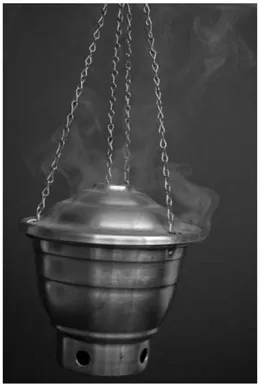
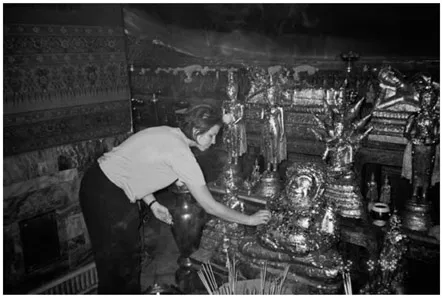
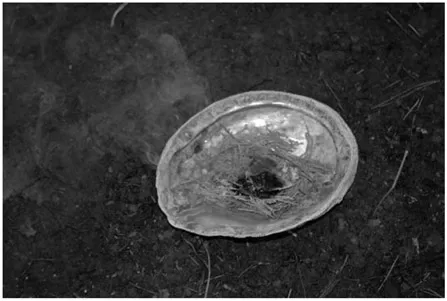
How is it that something with such a long and rich history, that is present in almost every major religion, can go almost completely unnoticed and undiscussed? Explore the far corners of the world, and incense use is sure to be there. From the Catholic priest swinging incense-filled censers down the aisles of a church in Rome, to the billows of incense smoke that cloud and curl around the Buddha icons in a Buddhist temple in Thailand, to cedar and sweetgrass smoke that fills a Native American sweat lodge in South Dakota—we have been using incense to connect to divinity in almost every culture and class of society for as long as we can look back in time (see Photos 1.1, 1.2, and 1.3).
A Worldwide Ritual
I believe that incense may be the most spiritual way we use plants across cultures. Almost every major world religion and many smaller, tribal spiritualities light plant parts in worship to seek greater connection
PHOTO 1.1. A censer, also called a thurible, with frankincense and myrrh resin incense smoldering, as used in a Catholic church.
PHOTO 1.2. Author Kerry Hughes at a Buddhist temple in Thailand with incense offering.
PHOTO 1.3. Flat cedar and sage in an abalone shell.
to the divine. Even outside of “religious” use, many people light incense sticks in the home just for the sweet smell and the ability it has to transform space. We may not remember why we started doing it, but unconsciously we know the strength of this ritual.
This book will take you on a tour of the many aspects of incense use, and hope to answer questions about why we do it, where we do it, what greater meanings it assumes, and how can you best use it at home. Incense use is a very broad subject due to its pervasiveness in many cultures, and for this reason this book is not intended to be a comprehensive analysis or account of its use—it is merely multiple dips in the pond.
I expect this book will also run into trouble and question in many of your minds, as spirituality is a deeply personal and controversial topic. This book favors no religion or spiritual practice over another, and the examples that are given are simply those that I have been fortunate enough to find material on, observe, or learn something about. I am no master in this realm, and it is only my deep love for plants and my personal connection with nature and divinity that has driven me to write on these subjects. As an ethnobotanist, I have been fortunate to have had experiences traveling to many areas of the world to learn the ways different cultures and people interact with plants. Although I had never studied incense use formally before writing this book, I always used incense at home and I always collected incenses for my own personal curiosity and use when visiting plant markets in various corners of the globe. I have found these collected incenses to be the greatest reminders of the beautiful lands far away and cultures I have encountered.
I have also felt that incense use is one of the most beautiful and spiritual uses of plants throughout history and still today. Having my deep love of plants, I have often mused how there really couldn’t be a more symbolic way to honor the divine as to offer fragrant plants. I have also wondered how others view incense, and have included interviews with various spiritual leaders in this book. Though the reasons for using incense vary considerably throughout different religions and areas of the world, I have found many repeating themes and will discuss them in this book. For me, it seems to be a good way for people to develop a greater connection and respect for nature as they honor divinity through incense, and gain a greater appreciation for what nature has given us.
Honoring the Divinity in Nature
With the emerging trends of the lifestyles of health and sustainability, of which 30 percent of the population is said to follow, it seems apparent that many people are walking around this life looking for “connection.” They may not be able to articulate what it is they seek, and often this desire is misplaced in overindulgence in materialism, food, alcohol, smoking, or drugs, among other things. As our lives become faster and more surrounded by the urban landscape, it is becoming harder for people to take the time to find out what that desire for connection is all about. Our connection with divinity and nature is not a luxury, and not something that should take a lot of money to cultivate. Our desire for connection is a natural part of who we are as humans, and without it we become unhealthy, diseased, and even perverted. Heng Sure, PhD a Buddhist monk from Berkeley, California, explains that the Buddha’s description of the world is related to his experience in meditation, “It [meditation] survived because when other people meditated the way he did, they experienced the same thing—and that is that it [the world] is really ALIVE!” (Sure, personal communication, December 2, 2003).
Our connection with nature is health, and nature supplies us with the vital energy that we need to remain healthy. We all know this innately, and it is very obvious to all of us once we spend a little time in nature. Nature calms and reassures us, and fills us with the vitality of all the life around us. But how can you gain a connection with nature when you live in the city? You don’t need to give up your modern luxuries and move out to the country—or even become a hippie! People feel this connection in many ways—from spending time in nature, or through religion and spirituality, to spending time with family or children. These types of activities are part of human nature. This book is not a guide on how to cultivate this connection, but I would like to highlight incense as just one of the aids people use to feel this connection.
The nature of incense—its qualities of being somewhat ethereal, of this world but yet not of this world, here and yet gone, tangible and yet intangible—represents the great mystery of life that we all seek in spirituality. It is a way of gaining an understanding about this mystery and also paying reverence to it. As people burn incense they use their senses and they often ponder the great mysteries of life. Incense is also a way we can invite the divinity that is in all of life and nature into our daily spiritual practice. Even if we live in the city, we can light incense and try to cultivate that connection. The Native American Sioux (hereafter referred to as Lakota)—even those who live in the cities—use incense (called “medicines” or smudges) in their ceremonies, and when they do this they say we are mitakuye oyasin—we are all related (see Photo G.1 in the color photo gallery).
This is perhaps the most important understanding for gaining that feeling of connection: to understand that we are all related. Not just the many races of humans on the planet, but also the members of nature—the animals, the plants, the insects—are all here to live life with us, and we are all connected to the divine.
As Heng Sure explains,
Most of the time (and cognitive science proves this) we have to limit the amount of data that we can process with our six senses. For instance, [if we didn’t] how could we drive a car? When we meditate we are tuned in to the senses more. And this makes us aware of how we are in a fabric of existence. So being awake the way that Buddha was awake is a process of not struggling amidst this process, but at the same time not dominating, not having to have it “my way.” The Buddha’s prime thing that he awakened to is that the self is just a construct. The “me” in the middle—separate and broken—is just a way of seeing it, and you can practice not seeing it. So when you meditate you awaken to your true self. And this true self is your Buddha-nature. Other religions have other words for this, but it is the concept that you are connected. (Sure, personal communication, December 2, 2003)
If you seek that connection and you aren’t sure where to start, perhaps lighting a good quality stick of incense and then sitting down to enjoy it and ponder it is a good start (see Photo G.2 in the color photo gallery). Think about what the plant that it comes from must have looked like, then close your eyes and think about how the scent makes you feel. Think about what paradise means to you and what would it look like. Is it filled with fragrant plants? Then clear your mind and try not to think at all. Do any messages pop into your mind? Imagine you are connected with all of the green trees and beautiful parts of nature you have seen before. Try to feel the love you hold for all of this beauty, and take it with you throughout your day.
Unification of Mind, Body, and Spirit
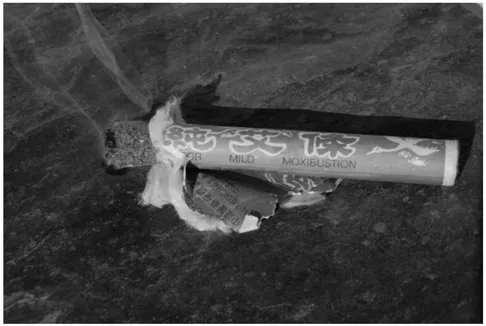
Beyond our sense of connection that we need to be healthy, incense can also help us to garner awareness and align ourselves in mind, body, and spirit. As incense signifies elements of the spirit realm, it is often used as a medicine and for healing in traditional healing systems throughout the world. If you have ever been to an acupuncturist that has used moxa on you, then you have experienced the use of incense in medicine (see Photo 1.4). As the mind is inseparable and a very useful part of healing the body, so is spirit considered to have an inseparable role in the healing of our physical and mental illnesses in many cultures.
Many people who live the busy Western lifestyle are unaware of this connection, and go about their lives feeling as if they are a “head” with a body that is attached but separated from the daily functions of the mind. With yoga’s emergence as a popular new “workout trend” in the United States, many people are discovering for the first time that their minds and bodies are connected. The thoughts and emotions that run around in our heads daily affect our health and the way we feel. By gaining awareness first, and then access to this connection, we may improve our overall health and help prevent several of the typical Western diseases, such as high blood pressure. Many people use meditation or yoga to cultivate the connection between mind and body, but incense can play a role in this as well.
PHOTO 1.4. A moxa stick as used for moxibustion within traditional Chinese medicine.
Just as the mind-body connection is important to health, so is our connection with spirit, according to many traditional healing systems. Many more primitive and ancient healing systems throughout the world have a type of doctor that is a doctor-priest. They may be called witch doctors, shaman, or curanderas, but in any case they are healers that appeal to the spirit dimension in the healing of disease. To such individuals, illness is believed to have a spiritual component, and taking medicine alone is usually not the only prescribed course of treatment. In the various rituals and methods that these healer-priests use, incense is an important medicine. It often is used for chasing away bad energies or spirits, attracting good ones, and protecting the patient and healer in the course of healing. The use of incense in healing is a deep topic, but it is a key topic to mention when understanding the importance of incense to the many aspects of our selves.
What is Incense?
We have all seen incense sticks, and many of us have ideas of what incense use is or isn’t depending on our exposure to its popular use or various spiritual rituals. Many people who have been to a Roman Catholic church may have witnessed the swinging of censers down the aisle, filling the church with sweet-smelling resins. Others in the Western world may have a stigma connecting incense sticks and illegal drug use. This may be because “head shops” carry synthetically fragranced incense sticks that marijuana smokers and psychedelic aficionados like to use to cover up the smell of pot. Still others may have tried the incense sticks in the home for scenting the air, and found them to be too smoky, irritating to the eyes and nose, and nothing like the fragrant descriptions on the package, and thus decided never to light one again. However, incense sticks are not the same as pure, clean, raw incense. Raw incense is just that—raw plant parts that are usually dried and ready for use for burning to release fragrant smoke. In addition, although good quality natural incense is available in stick or cone form, most of the incense we buy on the shelf is of very poor quality and made with synthetic fragrances. Vast differences exist between incense sticks that are made from natural oils and resins and ones that are made from synthetic oils and mixtures, as the vast majority are these days.
Incense is defined as a material that is burned to produce an odor, usually fragrant, and is also referred to as the perfume or fumigation itself that is produced from the burning of p...