No two writing situations are exactly the same and skilled writers, like skilled painters, must develop the know-how to represent the objects of their writing as part of a flexible art. This special art of writing lies hidden between grammar--the well-formedness of sentences--and genre--the capacity of texts to perform culturally holistic communicative functions (e.g., the memo, the strategic report, the letter to the editor). Concealed between grammar and genre, this less visible art of writing is what Kaufer and Butler call "representational composition." Texts within this hidden art are best viewed not primarily as grammatical units or as genre functions, but as bearers of design elements stimulating imagistic, narrative, and information-rich worlds, and as an invitation to readers to explore and interact with them.
This volume presents a systematic study of the principles that underlie writing as representational composition. Drawing from student models derived from a studio method, the authors use each chapter to present a different aspect of what unfolds--across the course of the book--into a cumulative, interactive, and unified body of representational principles underlying the design of texts. They reveal what makes the textual representations achieved by expert writers worthwhile, and, at the same time, difficult for novice writers to reproduce. Extending the framework of their 1996 volume, Rhetoric and the Arts of Design, into a realm of textual design, this volume will interest students and instructors of writing, rhetoric, and information design.
eBook - ePub
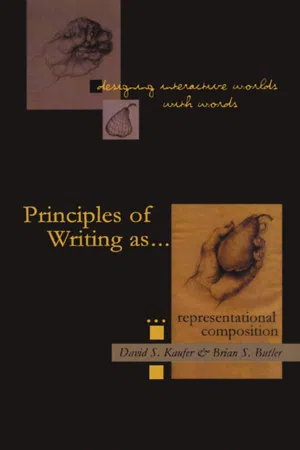
Designing Interactive Worlds With Words
Principles of Writing As Representational Composition
- 312 pages
- English
- ePUB (mobile friendly)
- Available on iOS & Android
eBook - ePub
Designing Interactive Worlds With Words
Principles of Writing As Representational Composition
About this book
Information
III. Invitations for Interaction
5
Invitations to Learn
Readers are an important consideration to the writer designing an interactive world. Writers must cue readers about their role within the reading experience. Just as a painting must define perspective to give viewers an orientation to look, texts must give readers a perspective from which to read.
In the previous chapters, the textual elements defining the reader perspective have been understated, even muted. The previous chapters have focused on building worlds for an off-scene reader. The reader is an invisible element in the world of the text, part of the offstage background with no addressed role to play.
The forthcoming chapters move to information writing. From the offstage background, the reader, as role identity, enters the visible representation of the world of the text. The reader becomes increasingly the customer of the writing rather than a patron of literary art. The textual elements defining the reader role and the writer-reader relationship are now more dominant in the overall composition. The world of the information text becomes not only a world of experience, a world asking the reader to sense and notice, but also a world of explicitly cued writer-reader transactions, asking the reader to learn, generalize and act on what is sensed and noticed.
Experiential worlds of portraits and landscapes continue to matter to information writing. Yet they matter less as an end than as a means to serve the reader’s interest in generalization and action. The reader is explicitly cued to take from a textual world a durable commodity— information—meant to remain with the reader intact after she finishes reading.
The secret behind the reader’s capacity to flip the switch from taking in “experience” to taking in “information” is to perceive the elements defining the world of writer-reader interaction as dominating the elements that contribute to the inner world of the text. Similarly, to move writers from designers of experience to designers of information is to mentor them in the techniques that allow the world of interaction to stand ahead and apart from the inner world of the text.
Information writing requires that these techniques be used visibly. However, our studio writers begin work on these techniques long before they come to full visibility in the information writing assignment. Each successive writing assignment asks writers gradually to strengthen the world of interaction against the world of inner representation. This gradual strengthening happens as a result of our asking students, in successive assignments, to achieve increasingly greater distance from the inner world of the writing.
In self-portraiture, all cues of this distance are suppressed. The writer and the world of the text are centrally aligned in thought, time, and space. In observer portraiture and scenic writing, the writer occupies the physical space depicted in the writing, but nonetheless stands, as an observer, outside the dominant focus of that space. In narrative history, the writer distanced herself from the temporal as well as the spatial anchor points of the world written about.
The transition from experiential to information writing marks a watershed where the inner world of the writing becomes not only a distal point for the writer, but also subordinate to the writer-reader relationship. The world of the writing now exists for the sake of the reader’s interactive learning.
Elements of the text are now perceived as elements crafted to bring about reader outcomes. In experiential writing, the writer was not obliged to pin down exacting outcomes for the reader. To be sure, readers take generalizations away from written portraiture and landscapes. Still, the generalizations they take from an experiential text are too amorphously shaped for a reader to regard as stand-alone products. The writer of information, by way of contrast, contracts with the reader about reading outcomes. The information text subordinates the writer and reader’s placement in time and space to less time- and space-bound generalizations. The text itself takes on commodity status, a product more than an experience. The world of the well-functioning information text serves whatever external purposes that readers bring to it.
Targeted reader outcomes are now dominant experiences to embed in the information text. Consequently, designing texts with the elements to support these outcomes takes on increased importance. The reader’s journey through the text must be closely guided. Close guidance is achieved through hierarchical organization, where the reader can visit tiered categories of information on a tour the writer has plotted out in advance. Writers visualize the reader’s tour through the convention of the outline. They signal points prominent in the information hierarchy with textual cues (e.g., topic sentences, sentence endings, or main clauses) that are designed to call attention to new information (i.e., information unfamiliar to the reader). They cue less prominent points through textual clues (e.g., non-topic sentences, sentence beginnings, or subordinate and relative clauses) that are designed to highlight familiar or more established information.
Writers who know how to provide these signals do so knowing that learners learn best when they are able to link the unfamiliar to the familiar. Readers who understand what writers are doing know to follow these signals in order to assume their role as learner.
While these observations record some of the shifts between experiential and information writing, they do not yet specify the representational challenges of information writing in terms of independent elements to coordinate. To appreciate these challenges and their contrast with challenges previously surveyed, it is useful briefly to review the earlier challenges. In every type of writing we have thus far surveyed, we have documented significant representational challenges facing the writer, each requiring the skillful alignment of independent representational elements. We saw that the writer of portraiture must skillfully align independent elements—disclosure and enactment in the case of self-portraiture; spatial, biographical, and quoted language in the case of observer portraiture. We saw that the writer of landscapes must also create a skillful combination of independent elements— immediacy and displacement—that do double duty both as default assumptions of communication and as representational elements. The scenic writer, seeking to use immediacy for representational purposes, foregrounds a heightened sense of immediacy against a muted sense of communicative displacement. Narrative history requires elevating displacement to representational prominence while keeping immediacy prominent as well. This causes the reader to experience a past that feels distant from the present, while at the same time capturing this feeling with the vividness of the present.
Informational writing brings new challenges of representational design. The writer must not only develop the world of the text in the writing but also develop as a dominant element the interactive ties of the reader to that world. The design of the text must encode what the reader is supposed to learn, do, or decide as a result of the reading experience. The text must specify and anticipate the cognitive actions and outcomes (e.g., generalization learning, experiential learning, the learning of guided action) on the reader’s side as a way of directing the reader’s learning.
The representational challenge of the information writer is to monitor the reader’s side every step of the way. In informational writing, the content must be selected and elaborated in terms of the reader’s ability to acquire it. The writer makes such selections and elaborations by aligning elements that include what the reader already knows with elements that the reader is targeted to learn.
The effective alignment of reader-familiar and reader-unfamiliar elements is fundamental to skilled information writing. The elements of the familiar and unfamiliar resemble the elements of similarity and difference that combine to make self-portraiture. However, in an information context, the elements of the similar and different no longer relate or differentiate human beings, but rather relate and differentiate groups of human beings according to their familiarity or unfamiliarity with externally referenced subject matters.
As one might guess, there are problems with placing students in the role of information writer that precede even the representational challenges. For information writing presupposes that the writer is in possession of exclusive knowledge the reader wants. The information writer must thus enter the writing transaction with some acknowledged expertise.
Student writers are often unsure of their expertise over subjects. They are accustomed to providing information as test takers but not as authors or authorities possessing exclusive knowledge. Challenged to provide information at the boundary of reader familiarity and unfamiliarity, they are often driven to soul-search about their authority over readers. They ask, “What do I know that others do not know and want to know?”
In our studio experience, we ask student writers to conduct personal inventories and external research to locate their expertise if they do not bring it to the writing assignment. We also rely on student peers, role modelling the average lay reader, to help their fellow students define the knowledge that can set them apart. Some of our studio writers are already deeply immersed in subject matters. They have taken on specialized jobs, experienced specialized training, acquired specialized lexicons, and entered specialized subcultures that set them apart. These writers tend to feel more immediately comfortable in the role of expert. They tend to worry little about where to find their subject matter authority.
Whether students’ lack of knowledge per se is a problem for information writing, the problem is one of knowledge rather than representationproper. Beyond the knowledge hurdle, there are two additional representational hurdles to clear, both confronting the writer with expert knowledge to impart. The first hurdle is what we call the discrimination hurdle. The second hurdle is what we call the alignment hurdle. Clearing the discrimination hurdle requires the writer to step outside expert knowledge long enough to take a perspective on the target reader’s horizon of the familiar and unfamiliar. Clearing the alignment hurdle requires the writer to position unfamiliar elements at the end of familiar elements so that the reader can learn new generalizations from familiar points of entry.
Without clearing all three hurdles, the writer cannot pull the sleight of hand that characterizes the world’s best information writing— leading the reader through a subject matter by following her native curiosity for it. When this representational effect is achieved, the reader experiences reading as self-learning, experiences the text as the one the reader herself would have written had (contrary to fact) the reader known in advance exactly what she needed and wanted to learn. To move in the direction of this compelling illusion, the reader must be given prominence as an addressed and interactive presence whose interests and investments are directing the text.
It may seem odd to use the term interactive with reference to a static text. Interactivity calls to mind the newer, dynamic technologies such as the Internet, computer games, and virtual worlds. In these contexts, interactivity means that a medium can change in response to the user’s choices and actions. The medium receives input from the user and the medium changes in response. The flow between the person and the medium thus moves both ways.
The word user in the digital age refers to persons who interact with media that permit two-way interaction. Increasingly, readers in the digital age are becoming users as well. They are able to read a text on a website and then point and click to move to another text. Reading has becoming increasingly hyper-textual in the age of the Internet. Yet, within the confines of a single linear text, our culture still differentiates readers from users on the assumption that reading remains a one-way process. Why do we make this assumption? The reason seems to have little to do with digitalization for even when digitized, linear texts are seen as a static medium. The reason seems more to do with our underlying assumptions about linear texts. We assume that texts cannot support true (two-way) interactivity, because, being fixed within and across lines, texts are not themselves changed, do not act dynamically, when readers interact with them.
These assumptions are unobjectionable as they go. What they leave out, however, is that through representational design, skilled writers have always had the ability to simulate two-way interactivity. Through anticipation of a reader’s responses, a writer can design a text to simulate a text’s responding, and so changing itself in mid-course, to a reader’s anticipated interaction. The reader, at a certain passage, thinks to herself “Well, okay, but what about this or what about that?” The writer anticipates this reader response at composing time and inserts it into the linear flow. This is text design with two-way interactivity in mind, with the writer anticipating the responses of an interactive partner in absentia.
Learning to discriminate and align the reader’s horizon of the familiar and unfamiliar is the pathway for simulating this two-way interactivity. With each new clause and sentence produced, the writer must appeal to her mental image of the reader to continue to ascertain: “What questions does the reader likely bring at this moment of interaction?” and “Given these questions, what is an effective way for the text to continue to remain timely and responsive?” The design of the text is driven forward by the writer’s internal responses to these questions. The interactivity of the text, by design, adapts to the reader’s learning purpose, allows the reader to see her internal questions externally addressed in the linear flow.
To give writers in our studio immersed practice in information writing, we rely on not one but two prototypes: exposition and popular explanation. Two prototypes are required because information writing can take place under two diametrically opposed contextual assumptions and we need a special prototype for each assumption.
Exposition has writers develop unfamiliar information in anticipation of a reader’s wanting to acquire new generalizations in the context of the familiar. Exposition supports generalization learning. Popular explanation has writers develop familiar information in anticipation of a reader’s wanting to acquire familiar experience in the context of a subject matter considered impenetrable. Popular explanation supports experiential learning.
To further illustrate the difference between exposition and popular exposition, let us map them as opposite poles. On one pole, the reader has been anticipated to find 100% of the information in a text familiar and 0% unfamiliar. This predicts a text that is so familiar that it will be perceived not worth reading. At the other extreme, the anticipated reader will find 100% of the information unfamiliar and 0% familiar. This predicts a text that will seem too inaccessible to read.
Skilled writers contextually activate exposition when they anticipate a reader closer to the familiarity pole. An information hierarchy giving prominence to elements of the unfamiliar is crucial in this context. Information that is new and unfamiliar is the target and focus and so positioned prominently in the information hierarchy. The new information is featured in titles, headings, and topic sentences in order to ease the reader’s search for it. Information that is familiar and needed as background context for the new information is positioned less prominently in the hierarchy. Exposition lets the reader learn by imparting through the clarity of the hierarchy the unfamiliar generalizations that are the targets of the reader’s learning.
Skilled writers contextually activate popular explanation when they anticipate a reader closer to the unfamiliarity pole. The writer is challenged to furnish a text that is, contrary to the reader’s worst expectation, accessible. Unlike exposition, featuring the unfamiliar is neither the problem nor the point in popular explanation. The reader, after all, is already anticipated to feel overwhelmed by unfamiliarity. The writer must feature familiarity as a dominant element, must come across as a humane and patient guide encouraging the reader through. Popular explanation makes use of familiarizing elements in the service of giving the reader the experience of the subject matter without the technical generalizations that literally define it. These familiarizing elements are crafted through literary devices such as resemblance, analogy, metaphors, visual imagery, narrative, thought experiments and, in general, any renderings of experience that are close to the reader’s access. The unfamiliar technical matter is stripped of its technical context and swaddled in the elements of the familiar. Popular explanations impart to readers the motivation to learn without trying to impart, or expecting the reader to achieve, technical mastery.
Exposition and popular explanation are not mutually exclusive genres. They are rather different prototypes from which to navigate a reader through an information space. They live in harmony within many natural genres of information. Whenever a writer informs a reader, both prototypes are serviceable for developing the text. One or both prototypes may remain in control for short or long stretches of the composing action. Control can shift, moreover, with variations in the subject and reader represented. When writers engage in information writing, therefore, they often blend expositional and popular explanation without knowing in advance how the blends will work. Our own studio practice is to ask students to “teach” a reader and let the writer’s own path establish where on the dimensions of exposition and popular explanation it falls.
Although exposition and popular explanation are tightly linked prototypes in the practice of information writing, they are still analytically distinct. We have fou...
Table of contents
- Cover Page
- Title Page
- Copyright Page
- Foreword
- Preface
- Acknowledgements
- Introduction: Writing and Representational Composition
- I. Portraiture
- II. Landscapes
- III. Invitations for Interaction
- Epilogue: The Promise of Representational Theory in Writing Education
- References
Trusted by 375,005 students
Access to over 1.5 million titles for a fair monthly price.
Study more efficiently using our study tools.
Frequently asked questions
Yes, you can cancel anytime from the Subscription tab in your account settings on the Perlego website. Your subscription will stay active until the end of your current billing period. Learn how to cancel your subscription
No, books cannot be downloaded as external files, such as PDFs, for use outside of Perlego. However, you can download books within the Perlego app for offline reading on mobile or tablet. Learn how to download books offline
Perlego offers two plans: Essential and Complete
- Essential is ideal for learners and professionals who enjoy exploring a wide range of subjects. Access the Essential Library with 800,000+ trusted titles and best-sellers across business, personal growth, and the humanities. Includes unlimited reading time and Standard Read Aloud voice.
- Complete: Perfect for advanced learners and researchers needing full, unrestricted access. Unlock 1.5M+ books across hundreds of subjects, including academic and specialized titles. The Complete Plan also includes advanced features like Premium Read Aloud and Research Assistant.
We are an online textbook subscription service, where you can get access to an entire online library for less than the price of a single book per month. With over 1.5 million books across 990+ topics, we’ve got you covered! Learn about our mission
Look out for the read-aloud symbol on your next book to see if you can listen to it. The read-aloud tool reads text aloud for you, highlighting the text as it is being read. You can pause it, speed it up and slow it down. Learn more about Read Aloud
Yes! You can use the Perlego app on both iOS and Android devices to read anytime, anywhere — even offline. Perfect for commutes or when you’re on the go.
Please note we cannot support devices running on iOS 13 and Android 7 or earlier. Learn more about using the app
Please note we cannot support devices running on iOS 13 and Android 7 or earlier. Learn more about using the app
Yes, you can access Designing Interactive Worlds With Words by David S. Kaufer,Brian S. Butler in PDF and/or ePUB format, as well as other popular books in Social Sciences & Communication Studies. We have over 1.5 million books available in our catalogue for you to explore.