eBook - ePub
Nonverbal Behavior and Communication
- 640 pages
- English
- ePUB (mobile friendly)
- Available on iOS & Android
eBook - ePub
Nonverbal Behavior and Communication
About this book
First published in 1987. An attractive feature of nonverbal communication as a research area is that it has captured the interest of scholars of different disciplinary backgrounds psychologists, linguists, anthropologists, psychiatrists, and sociologists with each discipline bringing to the area its peculiar theoretical and methodological perspectives and biases. Each of these disciplines also tend to have a favorite topic or problem area within the general domain of nonverbal communication. Along with the varying yet overlapping topical concerns that the different disciplines bring to the area of nonverbal communication are major differences in methodology. The sections into which the book is divided roughly organize the chapters in terms of their concerns with the bodily structures and zones that are involved in nonverbal behavior.
Information
Publisher
Psychology PressYear
2014Print ISBN
9780805800180
9781138436565
Edition
2eBook ISBN
9781317760481
IA NEUROPSYCHOLOGICAL PERSPECTIVE
1 Parliamentary Procedure and the Brain
Jaffe Joseph
College of Physicians and Surgeons of Columbia University and
New York State Psychiatric Institute
Parliamentary procedure, codified in Robert’s Rules of Order, assures the efficient and equitable conduct of business by an assembly. It requires that only one person hold the floor at a time. Yet people who have something to tell one another could conceivably do so simultaneously. The fact that they don’t suggested the following experiment.
While listening to a news broadcast on the radio, I began to tell an interesting story aloud. This “split attention” task yielded an eerie experience. When I tried to speak fluently, the broadcast was reduced to gibberish, like the babble of peripheral conversation at a large cocktail party. It was unquestionably speech but was as meaningless as a poorly understood foreign language. Conversely, if I made a concerted effort to follow the gist of the newscast, my own speech became halting and repetitious and I lost the thread of my story. Performance on this task did not improve with practice. Apparently, a listener cannot simultaneously be a speaker and vice versa; the brain cannot generate and decipher novel sentences concurrently.
“Novel” is a key word here, for there was indeed one way out of the bind. The newscast remained comprehensible provided my own speech was highly automatic and overlearned. Examples of such speech are simple counting and familiar nursery rhymes, both of which can be produced at a low level of attention. Receptive capacity is not “jammed” by these automatic sequences.
Another apparent counterexample to speaking-listening incompatability is the phenomenon of simultaneous translation, in which the two activities indeed appear to proceed concurrently. Yet even this unusual skill is partly illusory. Henri Barik (1970) showed that the simultaneous translator attempts to make good use of the speaker’s pause to deliver his own version, so as to have more time to listen without having to speak concurrently. These findings were similar for all translators studied regardless of their proficiency level or of our nature of the translation task. Such contrived experiments illuminate one of our most commonplace experiences; speaking-listening incompatibility is the biological foundation of politeness, which apportions the speaking time in conversations.
Two people in informal conversation share the available speaking time; when one takes a turn as the speaker the other synchronously becomes the listener. The sending and receiving roles remain neatly reciprocal, as if an invisible parliamentarian were presiding over the interchange, signalling switches of “possession of the floor.” This interaction pattern is established early in childhood and is maintained by a complex and as yet poorly understood set of coupling rules. Like most dependable prescriptions for human conduct, they are noticed more in the breach than in the observance. The participants in verbal exchange dovetail their sending-receiving states so automatically that the switching mechanism is largely unconscious until the rules are inadvertently or experimentally violated.
One breach of the reciprocity rule occurs when both partners listen simultaneously, each waiting for the other to speak. If the ensuing silence is not broken within a reasonable length of time, the verbal conversation dies. Another breach occurs when both partners speak simultaneously. If the resultant interruption was inadvertent, one of the concurrent speakers falls silent within about .5 sec, leaving the other in possession of the floor. On the other hand, a purposeful interruption by an erstwhile listener may lead to a prolonged contest for the floor with a determined speaker. These common sense illustrations suggest the following principle. There are four possible configurations of a linguistic system composed of two persons (A and B): B listens while A speaks; A listens while B speaks; both listen; both speak. Only the first two of these configurations are compatible with stable verbal conversation.
The case of mutual listening is trivial, but why is joint speaking so intolerable? The simplest explanation of the speaking-listening incompatibility is that a common neural substrate is employed for both the production and comprehension of speech. Linguistic machinery functions as a unit. It can be biased toward speaking or listening, but it can’t do both at once.
I became intrigued by the force of conversational expectancies 30 years ago, as a young psychitarist trying his wings in Freudian psychoanalysis (Fig. 1). The technique of this therapy required the patient to recline on a couch and to verbalize, continuously and without censorship, all thoughts “that came to mind.” To facilitate this state of “free association” the doctor sat behind the patient and adopted an attitude of passive listening, that is, refraining from all vocal response for periods of up to 50 minutes. The violation of social expectancies in the name of this technique included (1) the requirement for continuous monologue by the patient who was unable to see the doctor’s facial expression or gestures and (2) an enforced inhibition of the doctor’s customary verbal responsiveness. Thus, awkward silences in the patient’s monologue were allowed to continue to the point of discomfort and questions were not answered. One purpose of these arbitrary maneuvers was to discourage conventional social discourse. This abrogation of the ordinary rules of conversational interchange made me poignantly aware of the precise social expectancies that were being frustrated. For example, the participants are not face-to-face, a situation we accept in telephone conversations but rarely in the physical presence of the other person. Another violation occurs when the patient demands a response, for example, by asking a question. While waiting for the answer, which may not be forthcoming, a mutual listening state may persist for many minutes before the patient’s monologue resumes or the doctor encouragingly asks what thoughts “come to mind.” Perhaps of greatest present interest is the speaker’s depriviation of “listener feedback,” both gestural and vocal.
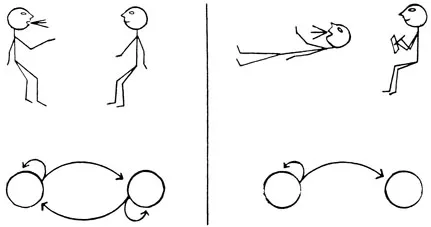
FIG. 1. On the left, a social conversation (above) and a flow diagram (below) showing the source and destination of overt vocal and gestural messages. Each participant can monitor himself and can send and receive messages. The system is “closed loop” in both senses. On the right, a psychoanalytic “conversation” (above) and its flow diagram (below). The patient can send and monitor himself but cannot receive; the doctor can receive but not send. The system is “open loop” (Jaffe, 1958).
Gestural feedback must be seen and includes all the body language now treated by the discipline known as kinesis. Such visual signals are highly redundant, as attested to by ordinary telephone communication and by the conversations of blind persons. In both, the information burden of the visual channel is completely assumed by the acoustic channel. Yet though redundant, some type of feedback is necessary. Purposeful omission of all vocal interjections by the listener in a telephone call is profoundly upsetting to the speaker, as anyone can verify in a few minutes.
The gestural and vocal components of interjections are synchronized. For example, when the speaker pauses at the end of a phrase, the listener may nod and say, “I see.” Vocal feedback includes all the snorts, chuckles, grunts, murmurs, and brief remarks that let us know that somebody exists at the other end of a telephone call while we are speaking. These interjections account for about one-third of the speaker switches in informal social conversation (Fig. 2).
Monosyllabic interjections by the listener are variously transcribed as “Hmmm.,” “Hmmm!,” “Hmmm?,” “Yes.,” “Yes!,” “Yes?” and so forth. They possess a melodic, emotional quality, an average duration longer than that of syllables in polysyllabic speech and a time course matching the nonverbal gestures such as head nods with which they are synchronized. It is not generally realized that monosyllabic utterances are always stressed and that stressed syllables are always longer than unstressed syllables, even in polysyllabic speech (for example, MAry HAD a LITtle LAMB). Even when interjections take the form of stereotyped, polysyllabic, semisentences such as “I see,” “Go on,” “Too bad,” “Indeed,” “Really,” “How’s ABOUT that?” and so forth, the melodic contour alone virtually conveys the complete message in the absence of the articulated words (Fig. 3). Such mavericks of spoken messages, midway between speech and music, are generally banished by linguists to a wastebasket named paralanguage, that is, nonlinguistic noises made with the vocal tract, which occur in a code situation between speaker and listener. Research on paralanguage, as on kinesics, is in a rudimentary stage. Most attention to date has been directed to the utterances of the speaker rather than of the listener, for example, to the intonation contours of whole sentences, rendered orthographically as comma, period, and question mark at phrase endings. These features modify, quantify, or qualify the meaning of the sentence and partake more of the steady-state, melodic quality of vowels than of the transient, articulated quality of consonants. We now examine the nature of the information conveyed by this qualitative dichotomy between “language” and “paralanguage.”
For many years, degradation of speech signals by means of bandpass filtering has been a standard research technique. The effective range of the speech signal from about 30 to 12,000 Hz has been electronically dissected. When the low frequency range of the voice spectrum is rejected, intelligibility of speech is preserved, but biological parameters such as the sex, age, and emotional state of the speaker are indeterminate. On hearing such filtered speech one is struck by the preservation of the crisp, high-frequency consonant information and the relative loss of low frequency vowel information. The impression gained is that of a sort of acoustic speedwriting, as would be produced if one could pronounce a text from which all vowel sounds were deleted. In contrast, when the signal is filtered to reject the higher frequency range of the voice spectrum, speech becomes unintelligible. Yet the emotional state of the speaker and the distinction of male from female and child from adult speakers is retained. Now the effect is that of hearing a murmured conversation, as through a thick door, perhaps the way a text from which all consonants had been deleted might sound if read aloud. Thus the latter technique of low bandpass filtering has become an established method for studying the biological parameters of speakers such as maturity, sex, mood, state of alertness, and so forth, irrespective of what is being said but preserving information as to who is speaking and how they feel. Recalling our previous characterization of paralanguage in general, and listener’s interactions in particular, as biased toward a vowel-like, steady-state, musical, emotional quality, one can characterize the results of these filtering experiments as a rough separation between the linguistic and paralinguistic aspects of spoken messages. The plight of a speaker who cannot see or hear his listener now becomes clearer. He is deprived of both paralinguistic and gestural feedback regarding the impact of his message. Is the listener drowsy, excited, bored, delighted, angry, confused, incredulous, depressed? Feedback of such information from receiver to sender “closes the loop” and permits ongoing modification of transmitted messages. Deprived of all feedback, a speaker is in an “open-loop” situation and can only guess at the quality of the human relationship in which he is engaged.
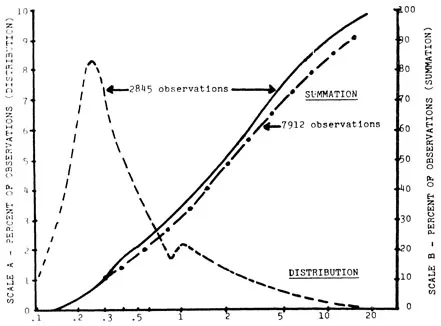
FIG. 2. Frequency distribution of the length of time between speaker switches (dashed line) and its summation (solid line). Redrawn from a pioneering study conducted almost 40 years ago at the Bell Telephone Laboratories by Norwine and Murphy (1938), who tabulated the durations of holding the floor. They defined the event as “speech by one party, including his pauses, which is preceded and followed, with or without intervening pauses, by speech from the other party.” On the basis of 2845 such events they concluded, “Since most telephonic speech syllables are shorter than 0.3 second the modal value of .25-sec makes it clear that monosyllabic replies are by far the most numerous.” It may be seen that these, in conjunction with terse replies or questions under one second duration, constitute about one-third of the events. More extensive data from our own laboratory on face-to-face conversations confirm this (7912 observations, shown as summation only, in a dot-dash line). The telephonic data from Bell Labs suggest that speakers who can’t see their listeners should expect to hear a brief vocal interjection every 14 seconds on the average. In the face-to-face situation in our laboratory the rate drops to one every 18 sec since silent gestures probably substitute for some of the vocal ones. (Adapted with permission from The Bell System Technical Journal. Copyright 1938, The American Telephone and Telegraph Company.)
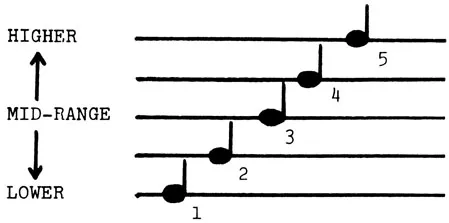
FIG. 3. These are significant noises, occurring independently of language, that differ from one another only by the parameter of tone. In relative musical notation, they are labeled by numbers 1–5 as shown. Level 3 is variously written as ah, er, uh, hm, and is called a “hesitation vowel,” signalling Wait, I’m not finished if produced by the speaker, or Go on! if interjected by the listener. A 3–4 sequence indicates assent and contrasts with a 3–5 sequence (I thought so! I told you so.). The 3–2 pattern signifies negation and contrasts with the 3–5 pattern Too bad! Sorry you hurt yourself). Adapted from an original analysis of the interjections called “vocal segregates” (Austin, 1972).
The placement of vocal interjections is never random. A fluent speaker has the option to pause briefly at phrase endings without sounding hesitant. Such “juncture pauses” mark syntactic boundaries in the speech stream and aid the listener in the decoding task. Investigators agree that listeners’ interjections occur preferentially during such permissible pauses, hence the literal meaning of “interject” or the paralinguist’s term “vocal segregate.” Several years ago, Louis Gerstman, Stanley Feldstein, and I showed that a syntactic boundary with its characteristic intonation, especially in conjunction with a ...
Table of contents
- Cover Page
- Half Title page
- Title Page
- Copyright Page
- Contents
- List of Contributors
- Introduction
- I A Neuropsychological Perspective
- II Body Movement
- III Facial and Visual Behavior
- IV Vocal Behavior
- V Functional Perspectives
- Author Index
- Subject Index
Trusted by 375,005 students
Access to over 1.5 million titles for a fair monthly price.
Study more efficiently using our study tools.
Frequently asked questions
Yes, you can cancel anytime from the Subscription tab in your account settings on the Perlego website. Your subscription will stay active until the end of your current billing period. Learn how to cancel your subscription
No, books cannot be downloaded as external files, such as PDFs, for use outside of Perlego. However, you can download books within the Perlego app for offline reading on mobile or tablet. Learn how to download books offline
Perlego offers two plans: Essential and Complete
- Essential is ideal for learners and professionals who enjoy exploring a wide range of subjects. Access the Essential Library with 800,000+ trusted titles and best-sellers across business, personal growth, and the humanities. Includes unlimited reading time and Standard Read Aloud voice.
- Complete: Perfect for advanced learners and researchers needing full, unrestricted access. Unlock 1.5M+ books across hundreds of subjects, including academic and specialized titles. The Complete Plan also includes advanced features like Premium Read Aloud and Research Assistant.
We are an online textbook subscription service, where you can get access to an entire online library for less than the price of a single book per month. With over 1.5 million books across 990+ topics, we’ve got you covered! Learn about our mission
Look out for the read-aloud symbol on your next book to see if you can listen to it. The read-aloud tool reads text aloud for you, highlighting the text as it is being read. You can pause it, speed it up and slow it down. Learn more about Read Aloud
Yes! You can use the Perlego app on both iOS and Android devices to read anytime, anywhere — even offline. Perfect for commutes or when you’re on the go.
Please note we cannot support devices running on iOS 13 and Android 7 or earlier. Learn more about using the app
Please note we cannot support devices running on iOS 13 and Android 7 or earlier. Learn more about using the app
Yes, you can access Nonverbal Behavior and Communication by Aaron W. Siegman, Stanley Feldstein, Aaron W. Siegman,Stanley Feldstein in PDF and/or ePUB format, as well as other popular books in Psychology & History & Theory in Psychology. We have over 1.5 million books available in our catalogue for you to explore.