This second edition presents the core fundamentals of the subject in 11 manageable chapters while maintaining the book's scientific integrity. The research methods students need to understand, interpret, and analyze social psychological research are emphasized throughout. The streamlined approach provides an economical textbook for students and a flexible format that allows instructors to cover the entire book in a single semester. A book specific Web site contains a free online study guide and a variety of teaching tools. An Instructor's Manual/Test Bank and a Computerized Test Bank are also available.

- 528 pages
- English
- ePUB (mobile friendly)
- Available on iOS & Android
eBook - ePub
Social Psychology
About this book
Information
Publisher
Psychology PressYear
2013Print ISBN
9780805835205
9781138136991
Edition
2eBook ISBN
9781135660390
Chapter 1
Understanding Social Behavior
The scene inside Columbine High in Littleton, Colorado, must have been something right out of Dante’s Inferno. Two students dressed in long black trench coats swept through the halls of Columbine High like avenging angels from hell. Eric Harris and Dylan Klebold carried with them a small arsenal, including several pipe bombs. After shooting several students outside the school, the pair entered the cafeteria and began throwing pipe bombs around the room. While their fellow students dove for cover wherever they could, Harris and Klebold left the cafeteria and headed for the library on the second floor.
On their way, they encountered a teacher, William “Dave” Sanders, outside the cafeteria, trying to get a group of students to the second floor to safety. On the second floor, Harris and Klebold opened fire, wounding Sanders twice in the back. Despite his wounds and the continuing danger, he got his students to a room on the second floor. There his students tried desperately to keep Sanders alive until help arrived. They were successful for about 2 hours. However, help did not come in time, and Sanders died from his wounds. His greatest concern was not for himself but for the safety and lives of his students.
Once in the library, according to surviving witnesses, Harris and Klebold began singling out students to be killed. First, they wanted all the “jocks” to stand up. Those who did were killed, including Isaiah Shoels, who was black. Although the killing rampage was not motivated by racism, Harris and Klebold made several racist statements before they shot Shoels in the head. Another student was singled out because she believed in God. Others were seemingly chosen at random.
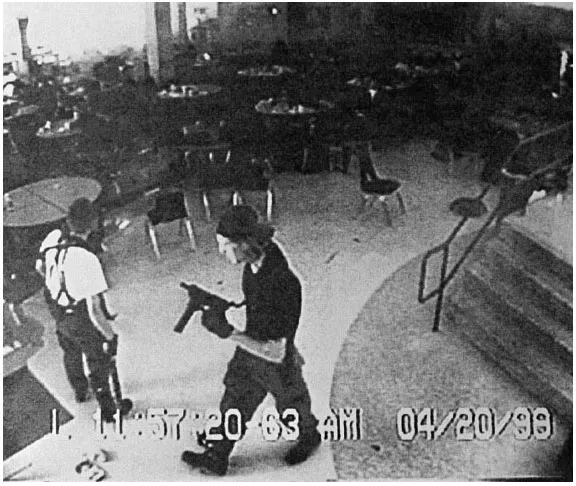
As police arrived, it became apparent to Harris and Klebold that they were not going to be able to escape, so in the library, among their victims, Harris and Klebold took their own lives. They left behind the largest death toll of any such crime in the United States. They also left behind 30 pipe bombs and a large propane bomb in the school’s kitchen. It was apparently their plan to destroy the entire school.
In the aftermath of the killings, several things came to light about Harris and Klebold. They were affiliated with a group of apparent outcasts, known as the Trench Coat Mafia, who other students considered weird and perhaps dangerous. Apparently, Harris and Klebold had been taunted by some “mainstream” students and, searching for a sense of belonging, had turned to this group of outcasts and misfits. Harris and Klebold were fascinated by movies glorifying killing, such as Oliver Stone’s Natural Born Killers. They also played violent, bloody video games obsessively, and Harris had a Web site devoted to violence and hatred. They became enamored of Nazi culture and staged their murders on Adolph Hitler’s birthday.
When we read or hear about incidents such as the one at Columbine High, many questions come to mind. We wonder, for example, how the dissatisfaction of two apparently normal students could explode into such levels of violence. Would the outcome of this confrontation have been different had the police responded more quickly, as some have speculated? We wonder about the teacher who sacrificed his life to save the lives of his students. What forces operated to cause this ultimate display of altruism? And what of Harris and Klebold themselves? Were they “bad” people, or were they caught up in a culture that glorifies violence and allows ready access to guns? What role did affiliation with a group of other disenchanted students play? How did the ready access to guns and information about bomb making on the Internet relate to the crime? Is there something about the high school social environment that pushes some students to, and sometimes, over the edge? These are some of the questions addressed in this chapter.
Key Questions
AS YOU READ THIS CHAPTER, FIND THE ANSWERS TO THE FOLLOWING QUESTIONS:
- What is social psychology?
- How do social psychologists explain social behavior?
- How does social psychology relate to other disciplines that study social behavior?
- How do social psychologists approach the problem of explaining social behavior?
- What is experimental research, and how is it used?
- What is correlational research?
- What is the correlation coefficient, and what does it tell you?
- Where is social psychological research conducted?
- What is the role of theory in social psychology?
- What can we learn from social psychological research?
- What ethical standards must social psychologists follow when conducting research?
Social Psychology and the Understanding of Social Behavior
The events that occurred at Columbine High School and the questions concerning why they happened all can be better understood and answered through a knowledge of social psychology. Social psychology is the scientific study of how individuals think and feel about, interact with, and influence one another, individually and in groups. It is the branch of psychology that studies social behavior—the thinking and behavior of individuals as they relate to other human beings.

social psychology
The scientific study of how individuals think about, interact with, and influence each other.
Social psychology provides tools for understanding the events that occur around you every day. In your personal life, it can help you make sense of your day-to-day interactions—your friendships, love relationships, interactions at work, and performance at school. It can give you insight, for example, into why your most recent romantic relationship did not succeed, and why you find yourself attracted to one person in your afternoon math class but not to another. It can also help you understand why you may behave aggressively when someone cuts ahead of you in a cafeteria line, or why you get annoyed when someone sits right next to you in a theater when there are plenty of other empty seats. Social psychology can also help you understand why other people act the way the do. For example, social psychology can help us understand the forces that led to the massacre at Columbine High.
Your life also is touched by events beyond your immediate, day-to-day affairs—events that occur in the community and the nation. Although these events are more distant, you may still feel strongly about them and find a link between them and your personal life. If your friend’s father were very sick, for example, you might want to share with him knowledge about a man whose determination kept him alive for 6 years. Perhaps the story would encourage him to keep on with his life. If something like the Columbine High incident happened in your city or town, you would experience directly the impact of disenfranchised teenagers exploding in anger. You probably would hear many people decrying the violence and talking about ways to deal with violent television and movies and the ready access of guns.
In one form or another, all the events at Columbine High represent recurring themes in human history. No, people haven’t always been exposed to violent movies or had such easy access to guns. But humans have always been both aggressive and altruistic toward one another. Human beings have always had to find ways to live with each other. We have always functioned together in groups; had love relationships; tried to persuade others of our point of view; followed or rebelled against authority; and sought ways to resolve conflicts, whether through negotiation or through coercion. We help each other, and we hurt each other. We display prejudice and discrimination; we even have tried to kill entire populations. History is a tapestry of the best and the worst that human beings can do. Social psychology can help us understand these human social events in their infinite variety.
It’s important to note, however, that social psychologists do not simply wonder and speculate about social behavior. Instead, they use scientific methods involving carefully designed and executed research studies to help explain complex, uncertain social issues. Social psychology is first and foremost a science. Through theory, research, and thoughtful application of concepts and principles to real-life situations, social psychologists provide insights into everyday events, both past and present, as well as those monumental events that are the stuff of history.
More than any other branch of psychology, social psychology offers a broad perspective on human behavior. Rather than focusing on the personal histories of individuals, or on how individuals respond to their environment, it looks at how people interact with and relate to each other in social contexts. As we have seen, a wide range of behavior and events falls within its domain.
A Model for Understanding Social Behavior
Social psychologists are interested in the forces that operate on individuals and cause them to engage in specific examples of social behavior. But social behavior is typically complex and has many contributing causes. Consequently, explaining social behavior is a difficult task. To simplify this task, we can assign the multiple causes of social behavior to one of two broad categories: the situation and the individual. According to a formula first proposed by Kurt Lewin (1936), one of the important early figures in social psychology, social behavior is a function of the interaction of the situation and the individual’s characteristics, or

Lewin’s model of social behavior was inspired by his observation that the individual’s perception of a situation is influenced by the tasks he or she has to accomplish. Lewin was a soldier in the German Army during World War I. He noticed that as he came nearer the battlefield, his view of the world changed. Where he once might have seen beautiful flowers and beckoning forests, he now saw boulders to hide behind and gullies from which he could ambush the enemy. Lewin came to believe that a person’s perception of the world is influenced by what he or she has to do in that situation. He termed the combination of individual needs and situational factors the psychological field in which the individual lives (Pratkanis & Aronson, 1992).
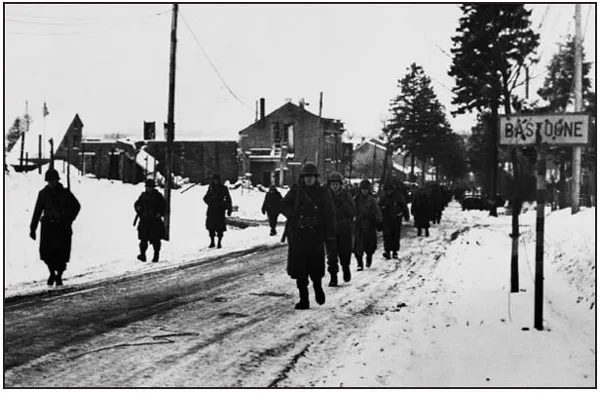
As noted by Lewin, as soldiers march toward battle their perceptions of their environment change. Where they may have been aware of the birds and clouds far from the battleground, as they approach they become more aware of things that can help them survive in combat.
According to this view, individuals with different needs and tasks would come to see the same event in dissimilar ways (Pratkanis & Aronson, 1992). Although Lewin looked at the individual’s needs and tasks, he emphasized the importance of social context in producing the forces that control the individual’s actions. Lewin was aware that we often fail to take situational factors into account when we try to explain why people behave as they do (Ross & Nisbett, 1991). For example, there were undoubtedly other students at Columbine High who were taunted by other students. However, their differing needs and interpretations of the social situation did not manifest itself in an overt act of mass killing.
Thus far we have seen that the situation and individual characteristics are central to the understanding of social behavior. How do social psychologists define situation and individual characteristics? Let’s take a closer look.
THE SOCIAL SITUATION The social situation comprises all influences on behavior that are external to the individual. A situational factor might be any aspect of the physical and/or social environment (the presence of other people, real or imagined) that influences behavior. Different individuals will react differently to the social situation.
Sometimes the situation works on us in more subtle ways. We may modify our behavior even if there is no pressure on us to do so. We may imagine or believe that we are expected to act a certain way in a certain situati...
Table of contents
- Cover
- Half Title
- Title Page
- Copyright page
- Table of Contents
- Preface
- Chapter 1. Understanding Social Behavior
- Chapter 2. The Social Self
- Chapter 3. Social Perception: Understanding Other People
- Chapter 4. Prejudice and Discrimination
- Chapter 5. Attitudes
- Chapter 6. Persuasion and Attitude Change
- Chapter 7. Conformity, Compliance, and Obedience
- Chapter 8. Group Processes
- Chapter 9. Close Relationships
- Chapter 10. Interpersonal Aggression
- Chapter 11. Altruism
- Glossary
- References
- Name Index
- Subject Index
- Photo Credits
Trusted by 375,005 students
Access to over 1.5 million titles for a fair monthly price.
Study more efficiently using our study tools.
Frequently asked questions
Yes, you can cancel anytime from the Subscription tab in your account settings on the Perlego website. Your subscription will stay active until the end of your current billing period. Learn how to cancel your subscription
No, books cannot be downloaded as external files, such as PDFs, for use outside of Perlego. However, you can download books within the Perlego app for offline reading on mobile or tablet. Learn how to download books offline
Perlego offers two plans: Essential and Complete
- Essential is ideal for learners and professionals who enjoy exploring a wide range of subjects. Access the Essential Library with 800,000+ trusted titles and best-sellers across business, personal growth, and the humanities. Includes unlimited reading time and Standard Read Aloud voice.
- Complete: Perfect for advanced learners and researchers needing full, unrestricted access. Unlock 1.5M+ books across hundreds of subjects, including academic and specialized titles. The Complete Plan also includes advanced features like Premium Read Aloud and Research Assistant.
We are an online textbook subscription service, where you can get access to an entire online library for less than the price of a single book per month. With over 1.5 million books across 990+ topics, we’ve got you covered! Learn about our mission
Look out for the read-aloud symbol on your next book to see if you can listen to it. The read-aloud tool reads text aloud for you, highlighting the text as it is being read. You can pause it, speed it up and slow it down. Learn more about Read Aloud
Yes! You can use the Perlego app on both iOS and Android devices to read anytime, anywhere — even offline. Perfect for commutes or when you’re on the go.
Please note we cannot support devices running on iOS 13 and Android 7 or earlier. Learn more about using the app
Please note we cannot support devices running on iOS 13 and Android 7 or earlier. Learn more about using the app
Yes, you can access Social Psychology by Kenneth S. Bordens,Irwin A. Horowitz in PDF and/or ePUB format, as well as other popular books in Psychology & History & Theory in Psychology. We have over 1.5 million books available in our catalogue for you to explore.