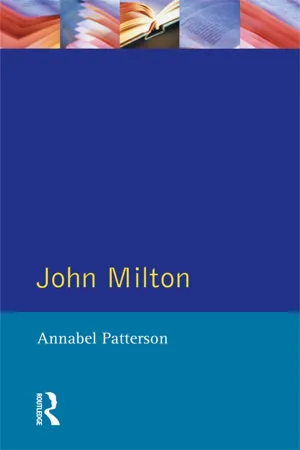
This collection of selected writings represents the best of recent critical work on Milton. The essays cover all stages of his career, from the early poems through to the later poems of the Restoration period, especially Paradise Lost. Professor Patterson includes British and American critics such as Michael Wilding, Victoria Kahn, James Grantham Turner and Mary Ann Radzinowicz and guides the reader through the varied ways Milton's achievement has been explored and debated by modern criticism.
- 248 pages
- English
- ePUB (mobile friendly)
- Available on iOS & Android
eBook - ePub
John Milton
About this book
Information
1 Introduction
Caught in the cross-fire between the market appeal of a ‘great’ author and the strictures of postmodernism against a ‘humanist’ or author-centred literary theory, Catherine Belsey asks the question, ‘Why Milton?’1 and, in answering, understandably attempts to have it both ways by claiming that significance lies not in the man but in the era. Milton’s canonical poems chart, she claims:
some of the struggles and transformations which brought into being the world we now inhabit. They also constitute an intervention in those struggles and transformations. They record and participate in the historical turning-point which marks the installation of the modern epoch.
(p. 8)
In introducing the essays in this volume, I naturally also assert Milton’s significance as an object of advanced and intensive study, even and especially at the end of the twentieth century. The claim on our attention of an English writer of three centuries ago may seen tenuous compared with the demands by or on behalf of those who represent the enormously expanded and conflicted world we now inhabit. Yet the fact is that Milton’s writings, though comparatively without influence on his immediate contemporaries, have been either a touchstone for ideas or a battleground of beliefs ever since his death in 1674, and he has been a symbolic figure in the evolution of at least three different disciplines. Readily constructed as a hero of the Whigs, not least by the eighteenth-century biography of John Toland, on the grounds of the political pamphlets written from 1649 to 1660 in defence of the English republic and the execution of Charles I, Milton has had a place comparable to that of John Harrington or John Locke in the history of political thought, particularly in the arenas of constitutional theory and individual liberties. In a looser sense he became a name in the canon of liberalism or libertarianism by way of his attack, in Areopagitica, on the Long Parliament’s return to censorship.
For the same reasons (Milton’s authorship of polemical tracts that in their own way chart the history of England from 1640 to 1660), supplemented by the fact that he held an official position in Oliver Cromwell’s civil service, as Latin Secretary responsible for much international correspondence, Milton has always been a figure of some interest to historians. Towards the end of the twentieth century, this interest has intensified as a result of internecine struggles among British historians over the events of 1640–60, as to whether those events did indeed constitute a sociopolitical revolution with profound and definable causes and principles (including religion) or whether what happened was merely a civil war that occurred more or less by accident, through bad management on the side of both King Charles and his parliamentary critics, most of whom had never intended to bring about major structural changes in the government. In that debate Milton has acquired a new prominence, specifically in the work of Christopher Hill, the great Marxist historian of seventeenth-century nonconformity and sectarianism, to whose biography of Milton we shall return.
Most of the readers of this volume will, of course, be literary critics, who will approach Milton primarily as a poet and as the author of Paradise Lost. Nevertheless, much of this introduction will be dedicated to showing that it is impossible (though it has been tried) to separate the author of Paradise Lost from the Milton of seventeenth-century politics and history. Indeed, the shape of Milton’s career has itself determined to some extent the trajectory both of earlier literary criticism and of the contemporary literary theory to which this series is dedicated. Whereas contemporary approaches to George Eliot, to cite the inaugural volume in this series, fall into the broad categories of debates on representation, language theory and deconstruction; politics and ideology; feminism; and psychoanalysis, in that order of importance, recent approaches to Milton have been dominated by two of these categories – the national politics that shaped both his career and his reception as a poet, and the sexual politics that unites Paradise Lost with his own pamphlets on divorce and that, ever since Sandra Gilbert defined him as an egregious representative of patriarchalism, has made him one of the monuments of feminist criticism.2 By comparison, deconstruction has hitherto affected Milton criticism primarily, as we shall see, by way of his theology. Although a case could very well be made that Adam’s conversations with Raphael in Paradise Lost are themselves debates about representation and problems of signification, most of the followers of Jacques Derrida have had difficulty in demonstrating the presence of metaphysical or epistemological aporias in a writer so confident that Truth, though fumbled together on earth, has divine guarantees elsewhere. Thus R. A. Shoaf, in a study of Milton’s philosphical assumptions that consistently uses the language of deconstruction, concluded that ‘to deconstruct his text would necessarily be to transgress his intention’, a caveat which, while some deconstructionists would find it laughable, nevertheless goes to the heart of a procedural dilemma.3
As for psychoanalytic criticism, its systematic application is almost solely represented by William Kerrigan’s The Sacred Complex, which reads the Miltonic career, and especially the epic with its emphasis on the Father/Son relationship, as an Oedipal drama. But here too, interestingly, Milton’s theology dominates the interpretation and gives it a very different twist to that normally expected from Freudian or Lacanian influences. ‘I would like,’ Kerrigan wrote in his introduction, ‘to recover something of the original urgency of the encounter between religion and psychoanalysis. If psychoanalysis would guard us against the primitive illusions of religion, perhaps religious affirmations of the superego would guard us gainst the civilized illusions of a self-authenticating ego.’4 The central insight here – that Milton was obsessed with a superego derived from his own relation to his father, and that he transferred his Oedipal feelings to his religious mythology – seems, now that Kerrigan has brought it to our attention, inarguable. But there are other aspects of the Miltonic psyche – as, for example, his obsessive attitude to work – that have not yet received sustained psychoanalytic attention.5
Fortunately, some of the best practitioners of the new critical theories cannot simply be constrained by the categories just outlined, but are skilled eclecticists and syncretists. In this volume I have tried to represent equitably the major models or brands of contemporary criticism and literary theory by using examples that are easily intelligible yet which avoid simple ‘applications’ of a single method. Few of the essays included are ‘pure’ instances of any one contemporary approach or theory, and several, especially the concluding piece by John Guillory, are masterly syntheses of approaches – in this case psychoanalysis and socioeconomic theory – normally thought of as incompatible. And the careful reader will discover many unforeseen connections and conversations between these essays, which suggests that the new ‘theories’ are not ranged so sharply against each other as some have supposed.
The beginnings of critical theory
In the case of Milton, the emergence of ‘new’ theoretical approaches cannot be fully understood and was to some extent determined by his earlier history of reception. While Milton scholarship has proceeded throughout this century more or less unmoved by critical fashion (I refer to the Columbia edition of the Works, 6 which began to appear in the 1930s, the Yale edition of the Prose Works, a project begun in the 1950s, 7 the founding of Milton Studies in 1968 and of the Milton Variorum under the editorship of Merritt Hughes in 19708), the theoretical narrative begins with the moment – unusual in literary history – of Milton’s removal from the literary canon. This was by authority of T.S. Eliot and F.R. Leavis, who together provoked a controversy among British intelligentsia that spanned two decades. In 1936 Eliot published an essay that began, provocatively: ‘While it must be admitted that Milton is a very great poet indeed, it is something of a puzzle to decide in what his greatness consists.’ Milton was subjected to the ‘serious charge’ of being a bad influence on poets; of indulging in ‘rhetoric’, as opposed to the conversational style which was carried forward by Dryden, to the extent of creating a barrier of style between his meaning and his reader. ‘So far as I perceive anything,’ Eliot continued, ‘it is a glimpse of a theology that I find in large part repellent, expressed through a mythology which would have been better left in the Book of Genesis, upon which Milton has not improved.’9 In 1947, however, Eliot delivered another statement on Milton, supposedly to correct the misjudgements of his previous one. Milton was, after all, a great poet whose influence might be less noxious than he had supposed, the ‘remoteness of his language from ordinary speech’ now appearing ‘one of the marks of his greatness’.10 Understandably, modern poets like himself, who had been carrying out ‘another revolution in idiom’, had been biased. Their bias depreciated Milton while contributing to the ‘taste’ for Donne; but a decade later, Eliot felt, ‘we cannot, in literature, any more than in the rest of life, live in a perpetual state of revolution’ (p. 148). This political language, as we shall see, was scarcely coincidental. But what Eliot gave back with one hand he took away with the other. Milton’s language is now seen as ‘a perpetual sequence of original acts of lawlessness’ (p. 141) (another not-so-dead political metaphor); and Milton is praised for ‘his inerrancy, conscious or unconscious, in writing so as to make the best display of his talents, and the best concealment of his weakness’ (p. 142).
The significance of this episode resides in its paradigmatic relation to the history of modern literary criticism, including the ideological implications of an exclusive focus on style, language, or the ‘text itself’. As the founding fathers of the movement that, when it spread to the United States, came to be called New Criticism, Eliot and Leavis were, indeed, rebuked by some of their sons for their attitude to Milton. New Critics like Cleanth Brooks, as much as traditional Milton scholars like Douglas Bush, set about demonstrating how extremely readable Milton’s poetry was. And it seemed that, if Milton was to be unequivocally restored to canonical status, it would have to be in the same terms that had been used to unseat him. In the early 1960s this feat was accomplished by two critics, J.B. Broadbent11 and Christopher Ricks,12 whose views on Milton were as closely related as those of Eliot and Leavis, which they symmetrically reversed. Ricks, in particular, restored the idea of the ‘Grand Style’ as an honorific, rather than a stigma; but he did so by exploiting every nuance in Milton’s language, especially his latinisms, and by privileging that most New Critical of values, ambiguity. It was only in his very last pages that Ricks wondered whether there was not ‘something dangerously exclusive in concentrating on Milton’s style alone’, and raised the question of content; and then he significantly failed to answer it. Instead, he closed his case with the extraordinary statement that ‘Milton writes at his very best only when something prevents him from writing with total directness.’ Milton’s ‘greatest effects are produced when he is compelled to be oblique as well as direct’ (pp. 147–8). What such an inhibition might be, precisely, New Critical methods were unable to suggest.
In fact, Eliot himself was more revelatory, at least in 1947, about the issues so obscured, even though part of his candor was unintentional, the product of an attempt to establish his own scientific perspective in contrast to Dr Johnson’s more primitive cognitive tools.
There is one prejudice against Milton, apparent on almost every page of Johnson’s Life of Milton, which I imagine is still general: we, however, with a longer historical perspective, are in a better position than was Johnson to recognize it and to make allowance for it. This is a prejudice which I share myself: an antipathy towards Milton the man…. But this prejudice is often involved with another, more obscure: and I do not think that Johnson had disengaged the two in his own mind. The fact is simply that the Civil War of the seventeenth century, in which Milton is a symbolic figure, has never been concluded. The Civil War is not ended: I question whether any serious civil war ever does end…. Reading Johnson’s essay one is always aware that Johnson was obstinately and passionately of another party. No other English poet, not Wordsworth, or Shelley, lived through or took sides in such momentous events as did Milton; of no other poet is it so difficult to consider the poetry as poetry, without our theological and political dispositions, conscious and unconscious, inherited or acquired, making an unlawful entry.
(p. 134).
Given that Eliot wrote this statement two years after the British Labour Party took over the government of his adopted country, and proceeded to construct a social revolution, and knowing what we know from other sources of Eliot’s ‘theological and political dispositions’, we may guess that, like Johnson, Eliot confused his ‘antipathy towards Milton the man’ with his antipathy towards Milton the hero of the Whigs.
The emergence of ‘reading’ as a theoretical enterprise
In Milton studies the moment of transition from New Criticism to something still newer was, perhaps, 1971, when there appeared a book which was simultaneously a consummate display of New Critical procedures and a defiance of Eliot’s influential verdict that Milton’s theology was ‘repellent’. Stanley Fish’s Surprised by Sin: The Reader in Paradise Lost13 showed that New Critical methods could be deployed in the service of Miltonic content, and that they could assist in the task usually assumed by traditional Milton scholars – of deciding what, precisely, Milton intended his readers to learn about free will and obedience. Yet these issues inevitably brought back with them the author-centred, historically situated criticism that New Criticism, as ...
Table of contents
- Cover
- Half Title
- Title Page
- Copyright Page
- Table of Contents
- General Editors’ Preface
- Acknowledgements
- 1 Introduction
- 2 JONATHAN GOLDBERG Dating Milton
- 3 STANLEY FISH What It’s Like to Read L’Allegro and Il Penseroso
- 4 MICHAEL WILDING Milton’s Early Radicalism
- 5 DAVID NORBROOK The Politics of Milton’s Early Poetry
- 6 FRANCIS BARKER Areopagitica: Subjectivity and the Moment of Censorship
- 7 JAMES GRANTHAM TURNER The Intelligible Flame
- 8 ANNABEL PATTERSON NO Meer Amatorious Novel?
- 9 WILLIAM MYERS The Spirit of Différance
- 10 MARY ANN RADZINOWICZ The Politics of Paradise Lost
- 11 CHRISTINE FROULA When Eve Reads Milton: Undoing the Canonical Economy
- 12 MARY NYQUIST Fallen Differences, Phallogocentric Discourses: Losing Paradise Lost to History
- 13 VICTORIA KAHN Allegory and the Sublime in Paradise Lost
- 14 JOHN GUILLORY The Father’s House: Samson Agonistes in its Historical Moment
- Notes on Authors
- Further Reading
- Index
Trusted by 375,005 students
Access to over 1.5 million titles for a fair monthly price.
Study more efficiently using our study tools.
Frequently asked questions
Yes, you can cancel anytime from the Subscription tab in your account settings on the Perlego website. Your subscription will stay active until the end of your current billing period. Learn how to cancel your subscription
No, books cannot be downloaded as external files, such as PDFs, for use outside of Perlego. However, you can download books within the Perlego app for offline reading on mobile or tablet. Learn how to download books offline
Perlego offers two plans: Essential and Complete
- Essential is ideal for learners and professionals who enjoy exploring a wide range of subjects. Access the Essential Library with 800,000+ trusted titles and best-sellers across business, personal growth, and the humanities. Includes unlimited reading time and Standard Read Aloud voice.
- Complete: Perfect for advanced learners and researchers needing full, unrestricted access. Unlock 1.5M+ books across hundreds of subjects, including academic and specialized titles. The Complete Plan also includes advanced features like Premium Read Aloud and Research Assistant.
We are an online textbook subscription service, where you can get access to an entire online library for less than the price of a single book per month. With over 1.5 million books across 990+ topics, we’ve got you covered! Learn about our mission
Look out for the read-aloud symbol on your next book to see if you can listen to it. The read-aloud tool reads text aloud for you, highlighting the text as it is being read. You can pause it, speed it up and slow it down. Learn more about Read Aloud
Yes! You can use the Perlego app on both iOS and Android devices to read anytime, anywhere — even offline. Perfect for commutes or when you’re on the go.
Please note we cannot support devices running on iOS 13 and Android 7 or earlier. Learn more about using the app
Please note we cannot support devices running on iOS 13 and Android 7 or earlier. Learn more about using the app
Yes, you can access John Milton by Annabel M. Patterson in PDF and/or ePUB format, as well as other popular books in Literature & Literary Criticism. We have over 1.5 million books available in our catalogue for you to explore.