Introducing Psychology for Nurses and Healthcare Professionals
eBook - ePub

Introducing Psychology for Nurses and Healthcare Professionals

  1. 424 pages
  2. English
  3. ePUB (mobile friendly)
  4. Available on iOS & Android
eBook - ePub

Introducing Psychology for Nurses and Healthcare Professionals

About this book

What makes someone feel healthy? Why do some people respond differently under stress to others? Why dont people always follow nursing advice?

This second edition of Introducing Psychology for Nurses and Healthcare Professionals provides an accessible but thorough introduction to the key psychological theories and concepts which underpin nursing and healthcare, and clearly demonstrates how they can be applied in clinical practice. Using a research-led approach, each chapter guides you through important theories and topics in health psychology, such as lifespan and development, communication, and social processes, and helps you use your understanding to deliver better patient care.

Frequently asked questions

Yes, you can cancel anytime from the Subscription tab in your account settings on the Perlego website. Your subscription will stay active until the end of your current billing period. Learn how to cancel your subscription.
No, books cannot be downloaded as external files, such as PDFs, for use outside of Perlego. However, you can download books within the Perlego app for offline reading on mobile or tablet. Learn more here.
Perlego offers two plans: Essential and Complete
  • Essential is ideal for learners and professionals who enjoy exploring a wide range of subjects. Access the Essential Library with 800,000+ trusted titles and best-sellers across business, personal growth, and the humanities. Includes unlimited reading time and Standard Read Aloud voice.
  • Complete: Perfect for advanced learners and researchers needing full, unrestricted access. Unlock 1.4M+ books across hundreds of subjects, including academic and specialized titles. The Complete Plan also includes advanced features like Premium Read Aloud and Research Assistant.
Both plans are available with monthly, semester, or annual billing cycles.
We are an online textbook subscription service, where you can get access to an entire online library for less than the price of a single book per month. With over 1 million books across 1000+ topics, we’ve got you covered! Learn more here.
Look out for the read-aloud symbol on your next book to see if you can listen to it. The read-aloud tool reads text aloud for you, highlighting the text as it is being read. You can pause it, speed it up and slow it down. Learn more here.
Yes! You can use the Perlego app on both iOS or Android devices to read anytime, anywhere — even offline. Perfect for commutes or when you’re on the go.
Please note we cannot support devices running on iOS 13 and Android 7 or earlier. Learn more about using the app.
Yes, you can access Introducing Psychology for Nurses and Healthcare Professionals by Dominic Upton in PDF and/or ePUB format, as well as other popular books in Medicina & Enfermería. We have over one million books available in our catalogue for you to explore.

Information

Publisher
Routledge
Year
2013
eBook ISBN
9781317902478
Edition
2
Subtopic
Enfermería
Chapter 1
Introduction: psychology in nursing care
Learning Outcomes
At the end of this chapter you will be able to:
Understand the development of psychology as a science
Appreciate some of the schools of thought in psychology
Appreciate the research methods in psychology
Understand the social context for health and health psychology
Understand the role of psychology in many aspects of life
Appreciate the role of psychology in all aspects of health and illness from the cradle to the grave.
Your starting point
Answer the following questions to assess your knowledge and understanding of the relationship between psychology and nursing and the key terms and principles underlying psychology.
1.
By the 1920s a new definition of psychology had gained favour. Psychology was said to be the science of:
(a)
mind
(b)
consciousness
(c)
computers
(d)
behaviour
(e)
philosophy?
2.
What is the independent variable, in experimental research:
(a)
a variable which nobody controls or changes
(b)
the variable which is manipulated in an experiment
(c)
the variable which is measured, to see results of an experiment
(d)
a variable which describes some durable characteristic of the subject
(e)
a variable which is held steady?
3.
Cartesian dualism specifies that:
(a)
The body can interact with the mind via the pineal gland.
(b)
The mind can interact with the body via the pineal gland.
(c)
The mind and the body do not interact at all.
(d)
Both (a) and (b).
(e)
Neither (a) nor (b).
4.
According to many, who was the founder of modern day psychology and first ‘psychologist’:
(a)
Wundt
(b)
Fechner
(c)
Weber
(d)
Helmholtz
(e)
none of the above?
5.
Which of the following schools of thought would be most likely to reject the method of introspection to study human experience:
(a)
behaviourism
(b)
psychoanalysis
(c)
structuralism
(d)
functionalism
(e)
none of the above?
1.1 Introduction
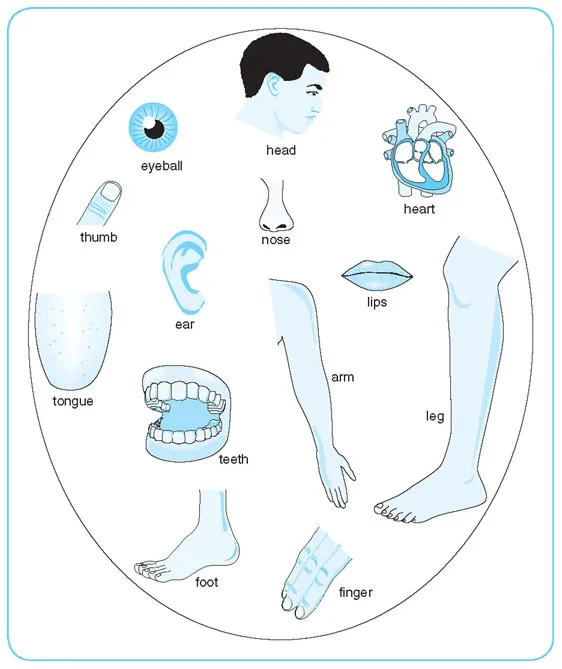
Being a nurse is all about medicine and nursing practice, isn’t it? It is all about biochemistry, physiology and anatomy? As a nurse you need to understand the patient’s medical and nursing history, you need to understand their diagnosis and their treatment, you need to understand what is going on, inside the brain, the liver, the kidneys, the heart and so on. However, a human being is more than the sum of bodily parts (see Figure 1.1) and this has an important consequence for your nursing practice and the importance of psychology in healthcare.
Figure 1.1 The human being is more than a sum of its parts
It could be argued, of course, that your individual patient is not that concerned about their body parts – what they want is to get better in the shortest and most painless manner. They want to be treated with respect and dignity, they want to be involved in their care and they want the nurse to act in a thoroughly professional manner. All of these have a psychological element.
Key message
Humans are more than a collection of organs.
The patient also wants to know what caused their illness – is there something that can be done about it, and if so, what? How can they prevent it from occurring again and how can they be included in their care? Again, all of these have a psychological element.
Key message
Psychology is the most important subject you will study.
We must also appreciate t...

Table of contents

  1. Cover
  2. Half Title
  3. Title Page
  4. Copyright Page
  5. Table of Contents
  6. Preface
  7. Acknowledgements
  8. Chapter 1. Introduction: psychology in nursing care
  9. Chapter 2. Psychological approaches to understanding people
  10. Chapter 3. Psychology across the lifespan
  11. Chapter 4. Social processes
  12. Chapter 5. Perception, memory and providing information
  13. Chapter 6. Stress and stress management
  14. Chapter 7. The psychology of pain
  15. Chapter 8. Psychology of mental health
  16. Chapter 9. Developmental disorders: learning disability
  17. Glossary
  18. References
  19. Index