- 456 pages
- English
- ePUB (mobile friendly)
- Available on iOS & Android
eBook - ePub
About this book
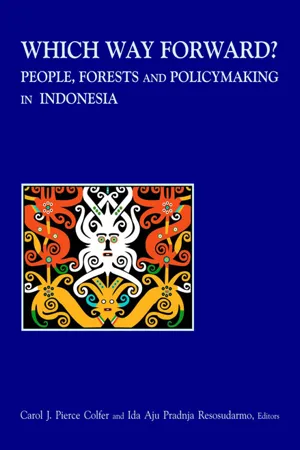
Indonesia contains some of Asia's most biodiverse and threatened forests. The challenges result from both long-term management problems and the political, social, and economic turmoil of the past few years. The contributors to Which Way Forward? explore recent events in Indonesia, while focusing on what can be done differently to counter the destruction of forests due to asset-stripping, corruption, and the absence of government authority. Contributors to the book include anthropologists, economists, foresters, geographers, human ecologists, and policy analysts. Their concerns include the effects of government policies on people living in forests, the impact of the economic crisis on small farmers, links between corporate debt and the forest sector, and the fires of the late 1990s. By analyzing the nation's dramatic circumstances, they hope to demonstrate how Indonesia as well as other developing countries might handle their challenges to protect biodiversity and other resources, meet human needs, and deal with political change. The book includes an afterword by Emil Salim, former Indonesian Minister of State for Population and the Environment and former president of the Governing Council of the United Nations Environment Programme. A copublication of Resources for the Future and the Center for International Forestry Research (CIFOR) and the Institute for Southeast Asian Studies (ISEAS).
Information
CHAPTER ONE
Changing Policy
Discourses and
Traditional Communities,
1960–1999
Rachel Wrangham
Indonesia's forests are among the most diverse and spectacular in the world. Yet with an annual deforestation rate as high as 1.5 million ha, the state of the remaining forest is a matter of concern for the entire international community (see Chapter 5). So far Indonesia's record of managing its resources and responsibilities has been mixed. Before the Asian economic crisis, the country was lauded as a capitalist success story, with rising standards of living and rapid industrialization. Yet even before that bubble burst, Indonesia had a second face—the exploitation of not only resources but also people (specifically expropriation and corruption, the repression of indigenous peoples, and the unsustainable extraction of the country's natural wealth). In October 1999, Indonesia seemed to teeter between an extractive and centralist past and an uncertain future. This chapter provides a historical context in which to understand this ongoing transition.1
In this chapter, I consider the ways in which power over land and forest resources has been concentrated in the hands of the state, and I outline the discourses that I consider to have been associated with this process. The first of these is a discourse that identifies forest-dwelling communities as destroyers of national forest resources, outside modernity and the nation. The second is the discourse of national unity, modernity, national development, and nationhood that underlay the whole New Order system.2 I also look at a third countervailing discourse that privileges the local and indigenous, considering that community management of forests is both the fairest and the most sustainable form of management (compare the discussion of policy narratives in the conclusion to this book). To situate this discussion and to indicate how the balance of influence has shifted between these discourses, I take a broadly chronological approach, looking at laws and policies to elucidate the ways in which these discourses have developed and changed.
This chapter is based largely on library research, interviews with individuals and organizations in Jakarta, and six months of fieldwork in the Tanimbar Islands, Southeast Maluku, in 1998. As a result of this research, my discussion focuses on the letter of the law and the ways laws have been used and interpreted by different groups during different periods.
Land Tenure: The Legislative Framework
Understanding the laws and decrees governing forest ownership, use, and conservation is extremely complicated. The confusion is worsened because these sometimes contradictory laws issue from several different ministries, which themselves have changed in composition over time.3 In this section I give a brief and necessarily selective account of the changes in Indonesian law and policy on land tenure and how these changes have led to multiple layers of contested and often contradictory rights to land, to the use of land, or to its natural resources.
Land tenure law as developed by the Dutch can be seen as an early attempt to find a compromise between the recognition of preexisting rights systems and the desire of the colonial state to exploit and benefit from natural resources. At Independence, three systems of land law were recognized: (a) unwritten adat (traditional or customary) law, which varied from place to place and included both communal and individual rights; (b) land registered according to the Indonesian Civil Code; and (c) state land, which according to the agrarian law of 1870 included all land that could not be proved to be otherwise owned and could be leased for plantations. Conflicts over whether such lands were in fact unoccupied could and did arise, but in theory preexisting customary rights were recognized4 (Thiesenhusen et al. 1997).
The Indonesian constitution of 1945 did nothing to clarify the situation. Article 18 specifically continued to recognize historical rights (hak asal-usul), while Article 33 (another frequently quoted passage) declared the right and responsibility of the state to control (menguasai) natural resources for the general good of the Indonesian people. Article 33 has been used to justify most New Order forest management practices and to explain why many of the fundamental reforms now being demanded are constitutionally impossible.
It was not until 1960 that the problem of these multiple systems of land tenure was addressed. The Basic Agrarian Law (Undang-Undang [UU] 5/1960) intended to end the confusion and create a uniform system. It allowed the registration of four different rights over land: (a) the right to own (hak milik); (b) the right to cultivate state land (hak guna usaha), which may be granted for up to 35 years and extended for an additional 35 years; (c) the right to build and own buildings on land owned by another (hak guna bangunan); and (d) the right to use or collect products from state or private land for a certain period (hak pakai). It also recognized but denied the registration of various other rights, including rights to clear land, gather forest products, use water, and raise and catch fish. Other forms of customary law were also recognized, so long as they did not interfere with state or national interests and were not superseded by rights granted under the Basic Agrarian Law. This law was very much a first step: its scope was extremely general, and so far it has required more than 3,000 implementing regulations (Thiesenhusen et al. 1997).
The next addition to the legislation governing land tenure, this time specifically relating to forests, came in 1967. This marked the end of the more socialist concerns of the Soekarno era and the beginning of the New Order's emphasis on economic development. The Basic Forestry Law ([BFL] UU 5/1967) gave the state legal authority to plan and regulate all forest tenure and to use arrangements in its jurisdiction. It stated that forests must be protected and used for the welfare of the Indonesian people. The government was left to determine the balance between these and a range of other objectives, including prevention of flooding, harvesting of forest products for national development, protection of the earnings of those in and around the forest, conservation, migration, agriculture, and plantations. The law centered authority on the minister, who was given the power to designate land as forest, determine the purpose and use of all forests, regulate forest management, stipulate and regulate judicial relations between citizens or corporations and forests, and regulate juridical deeds about forests. It granted minimal recognition to customary rights, although Article 17 stated that customary communities may have rights to obtain benefits from the forest, so long as these rights do not disturb the objectives of the BFL, as interpreted by the minister (Thiesenhusen et al. 1997).
At about the same time as the BFL, three other important laws were promulgated: the Basic Law on Mining (UU 11/1967), the Law on Foreign Investment (UU 1/1967), and the Law on Domestic Investment (UU 6/1968). In 1970 two government regulations were issued—Peraturan Pemerintah ([PP] government regulation) 21/1970 Forest Exploitation Rights and Forest Product Harvesting Rights and PP 33/1970 on Forest Planning. Together these laws and regulations created the framework for the systematic economic exploitation of Indonesia's natural resources by large companies. In the forestry sector this exploitation was made possible by a process of classifying and demarcating forestland and then prohibiting local access or resource use. This process started with the BFL in 1967 and has been governed by the Consensus Land Use Planning Decree from the Ministry of the Interior (Surat Keputusan [SK] or ministerial decree 26/1982) and the Spatial Planning Law (UU 24/1992). The text of these two laws was neither as anticommunity nor as nonparticipatory as their implementation has been, in a world dominated by forest concessions, ideas of forest exploitation (pengusahaan) rather than management (pengelolaan), and mistrust of communities. The result of these laws and the climate in which they have been implemented has been the gradual though incomplete extension of state control, via central and provincial forest departments, over about 70% of Indonesia's land.
My suggestion, which I explore in the remainder of this chapter, is that this climate displays a clash between the two contradictory sets of discourses that I sketched at the outset: on the one hand a modernist, centralist discourse of state-led management, backed by a justificatory discourse of local destruction, and on the other a rights-based discourse of indigenous forest use. Policies were developed and laws formulated and implemented in conversation between these discourses. Changes in the policy climate reflect the changing balance of power between the proponents of these discourses. In the next three sections I examine these discourses in more detail.
Who Controls, Who Destroys?
The majority of forest-related laws during the 1970s and 1980s were detrimental to the rights and livelihoods of traditional communities, based on customary law (or masyarakat hukum adat), as commercial timber extraction was privileged over local forest use.5 For example PP 21/1970 (on Forest Exploitation Rights and Forest Product Harvesting Rights), PP 18/1975 (its revision), and PP 7/1990 (on Industrial Timber Plantations) did not give equal rights to traditional communities compared with private or nationalized companies. PP 28/1985 (on Forest Protection) minimized the role of traditional communities by centralizing forest protection functions, which reduced the scope for local involvement or responsibility. The Law on Forest Planning (PP 33/1970) did not allow for a participatory process of boundary setting, nor did it guarantee compensation for lost land. The conclusions drawn by Suharjito and his associates (1999, 62–63), on whose work the above analysis is based, is that the laws mentioned were not conducive to the development and growth of community-managed forestry. They also commented that the result of all sorts of policies that merely spoke of “community” was that the recognition of the traditional management of customary forests became hazy, and the character and existence of customary forests was sidelined.
Leaving aside the rights and wrongs of this situation, these policies and laws were based on an image of forest dwellers and local forest users as destroyers of the national forest resource and trespassers on state or concession land. The discourse of destruction had several roots and was extremely important in justifying state forest policy. Zerner (1992, 14) commented that the Indonesian government's assessment of shifting cultivation “continues to follow the trajectory of negative colonial assessments of these practices: that swidden and its practitioners are environmentally unsustainable, destructive and wasteful.” Furthermore the government assumed that forest-dwelling communities traditionally lived in isolated integrity, their practices governed by unchanging customary laws. As this was self-evidently no longer the case, the argument then was that such communities were no longer traditional and were unfit to manage natural resources. The result was that for much of the New Order, the ministry's position on community involvement in any kind of forest management was negative; despite a limited rhetoric of participation, the different departments tended to regard forest communities as a threat, rather than as partners.6 This discourse underlay approaches to forest management into the 1990s. For example SK 251/1993 identifies forest communities as a potential threat to timber companies; meanwhile it aims to protect their rights to nontimber forest products (NTFPs) and timber for consumptive use. In another instance the 1993 Joint Decree from the Ministries of Agriculture, Home Affairs, and Transmigration and Forest Dwellers 480/Kpts-II/1993 describes forest dwellers who practice shifting cultivation as destroyers of the forest resource.
The discourse of destruction is powerful and by no means confined to Indonesia. It tells a clear story about what has gone wrong, and it has equally clear recommendations of advisable improvements and changes. As Scott (1998) suggested, the management practices that follow from it can be seen as part of a broader attempt by the modern state to make the people, practices, and landscape under its aegis more legible in a bid to increase control. Yet it has remained a discourse, a story of how things ought to be, rather than an account of what has actually happened. It has proven impossible to bring the vast area of Indonesia's forest under state control. In some cases, branches of government have resorted to violence in their attempt to remove local people from state land, but in other cases traditional communities have stayed, generally with the connivance or cooperation of local government (Sirait et al. 1999). Thus while any community living on state land is in a vulnerable position, the legal tangle coupled with de facto decentralization of authority (despite ostensible centralization and uniformity—see the next section) means that policy implementation has depended to a great degree on personalities and place. The lack of certainty in the law, combined with the lack of a legal structure clearly linking the forest resource to its users, has created a free-for-all in which forest management has become the responsibility of no one (Seve 1999). The result is that the Ministry of Forestry (MoF)7 has not succeeded in managing the forest, even according to its own limited definitions. It has been unable to regulate just access to land, nor does it have the enforcement capacity for sustainable forestry management.
The Centralizing State
A second discourse underlies much official policy toward Indonesia's forests: that of the unified and centralized state. Again this is not unique to Indonesia, but in Indonesia it reached an unusual level of elaboration and complication, and it was fundamental to the identity of the nation—hence the national motto, “Unity in Diversity.”
In the field of forestry legislation, this concept was worked out in three ways. First, laws were drafted for the whole of Indonesia, taking no account of the diversity of the Indonesian environment. Laws and regulations were drafted in Jakarta, usually after negligible local consultation. Implementing regulations were also composed in Jakarta and tended to deal solely with the outputs, never the outcomes of laws. This meant that decisions were taken and actions were monitored far from the forest itself. Second, government bureaucratic systems were extended right down to the local level. As a result of two laws on local government (UU 5/1974 and UU 5/1979), village government and administration were drawn into the central and uniform bureaucratic net. These laws extended government control into villages and undermined adat leadership systems right at their roots. Villages were redefined to destabilize these traditional systems, and an Indonesia-wide pattern for village administration replaced the older arrangements. Third, there was almost complete government domination of the policy arena within a closed yet strikingly disunified bureaucratic system. The result was that policies tended to serve the interests of particular sections of government.
In the same way the discourse of destruction has been challenged, so has the trajectory of decentralization. The result has been that the government's domination of village-level government and the policy arena has not in fact been total. It is my suggestion that some of the contradictory rights-based discourse described next was in fact created by the very nature of the Indonesian state.
The Indonesian state, for all its centralization, can be pictured as being centered on a vacuum. By this I mean that there has been no legislative center at the heart of the governmental process. At the heart of Indonesia's pyramidal and centralized state has lain a range of executive agencies and ministries and the military rather than legislative bodies. This situation came about because of Soeharto's desire for a strong government; he believed that only this could guarantee economic development and political stability. It involved the concentration of power in the hands of the president and his ministers at the expense of the legislature and judiciary, and therefore most law and government policy has taken the form of ministerial decrees, rather than laws approved by parliament. Once again, Indonesia is not unique in privileging the executive, but the situation is more accentuated than in many other countries.
My suggestion is that one of the unintended consequences of concentrating power in the hands of competing ministries is that there has been a bit more space for alternative discourses to develop and for ministries to develop rather different policies.8 The lack of policy harmony—for example, the contradictions between the BFL (1967) and the Basic Agrarian Law (1960)—has led to an ad hoc system of government with different laws being implemented in different places. Authority and the granting of exceptions have become highly personalized, so that demands and requests have been channeled through patron–client linkages rather than through representative institutions (Lindaya...
Table of contents
- Front Cover
- Title Page
- Copyright
- About Resources for the Future and RFF Press
- Resources for the Future
- Contents
- Contributors
- Acknowledgments
- Halftitle
- FOREWORD
- INTRODUCTION
- CHAPTER ONE Changing Policy Discourses and Traditional Communities, 1960–1999
- CHAPTER TWO Ideas and Institutions in Social Forestry Policy
- CHAPTER THREE Responsibility, Accountability, and National Unity in Village Governance
- CHAPTER FOUR Devolution and Indonesia’s New Forestry Law
- CHAPTER FIVE Differing Perspectives on Community Forestry in Indonesia
- CHAPTER SIX Reforming the Reformists in Post-Soeharto Indonesia
- CHAPTER SEVEN Structural Problems in Implementing New Forestry Policies
- CHAPTER EIGHT Timber Management and Related Policies
- CHAPTER NINE Timber Concession Reform
- CHAPTER TEN The Political Economy of Indonesia’s Oil Palm Subsector
- CHAPTER ELEVEN Effects of Crisis and Political Change, 1997–1999
- CHAPTER TWELVE Corporate Debt and the Indonesian Forestry Sector
- CHAPTER THIRTEEN Forest Fires in Indonesia
- CHAPTER FOURTEEN Ten Propositions to Explain Kalimantan’s Fires
- CHAPTER FIFTEEN Forests and Regional Autonomy
- CHAPTER SIXTEEN Dynamics of Illegal Logging in Indonesia
- CONCLUSION
- AFTERWORD
- APPENDIX
- Abbreviations and Acronyms
- Glossary
- Index
Trusted by 375,005 students
Access to over 1.5 million titles for a fair monthly price.
Study more efficiently using our study tools.
Frequently asked questions
Yes, you can cancel anytime from the Subscription tab in your account settings on the Perlego website. Your subscription will stay active until the end of your current billing period. Learn how to cancel your subscription
No, books cannot be downloaded as external files, such as PDFs, for use outside of Perlego. However, you can download books within the Perlego app for offline reading on mobile or tablet. Learn how to download books offline
Perlego offers two plans: Essential and Complete
- Essential is ideal for learners and professionals who enjoy exploring a wide range of subjects. Access the Essential Library with 800,000+ trusted titles and best-sellers across business, personal growth, and the humanities. Includes unlimited reading time and Standard Read Aloud voice.
- Complete: Perfect for advanced learners and researchers needing full, unrestricted access. Unlock 1.5M+ books across hundreds of subjects, including academic and specialized titles. The Complete Plan also includes advanced features like Premium Read Aloud and Research Assistant.
We are an online textbook subscription service, where you can get access to an entire online library for less than the price of a single book per month. With over 1.5 million books across 990+ topics, we’ve got you covered! Learn about our mission
Look out for the read-aloud symbol on your next book to see if you can listen to it. The read-aloud tool reads text aloud for you, highlighting the text as it is being read. You can pause it, speed it up and slow it down. Learn more about Read Aloud
Yes! You can use the Perlego app on both iOS and Android devices to read anytime, anywhere — even offline. Perfect for commutes or when you’re on the go.
Please note we cannot support devices running on iOS 13 and Android 7 or earlier. Learn more about using the app
Please note we cannot support devices running on iOS 13 and Android 7 or earlier. Learn more about using the app
Yes, you can access Which Way Forward by Carol J. Pierce Colfer in PDF and/or ePUB format, as well as other popular books in Politics & International Relations & Development Economics. We have over 1.5 million books available in our catalogue for you to explore.