- 152 pages
- English
- ePUB (mobile friendly)
- Available on iOS & Android
eBook - ePub
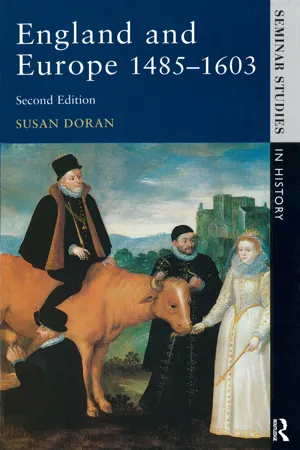
England and Europe 1485-1603
About this book
This Seminar Study introduces students to England's foreign policy during the reigns of the Tudor monarchs. In this succinct introduction the author addresses the key questions facing students - for example, to what extent did monarch or minister make policy. Each reign is analysed in turn providing a narrative and explanation of the major events and policy decisions throughout the Tudor period.
1 International Context
For most of the Tudor period Spain and France dominated the European arena, and the rivalry between them was a central feature of international politics. Both states by the 1490s had emerged as strong and powerful after a long period of internal disunity, weak government and partial occupation by foreign powers. In 1479 the Crowns of Aragon and Castile were united in the persons of Ferdinand and Isabella. They reconquered Granada in the south from the Moors in 1492, the same year that Columbus, under their patronage, began the voyage which was to bring Spain an overseas empire. The Spanish monarchs strengthened their position vis-à-vis the Spanish nobles, the church and the towns, while creating a centralized authority in their kingdoms, especially Castile. In France a succession of able rulers from Charles VII onwards reasserted royal power and regained lands once conquered or alienated from the Crown. All the territories held by England, save Calais, had been restored to Charles VII by 1453. Picardy, the Somme towns and the ancestral duchy of Burgundy were returned to Louis XI after a series of clashes with his arch-enemy Charles, Duke of Burgundy. The duchy of Brittany was annexed by Charles VIII in 1492. The French kings eroded the privileges of nobles, pays and parlement, while gaining the effective right of taxing at will.
The focal point of rivalry between these two powers from 1494 to 1559 was Italy. The conflict had small beginnings: the rival dynastic claims of Anjou (Charles VIII) and Aragon to the insignificant and impoverished kingdom of Naples. There were also minor disputes over Cerdagne, Roussillon, Perpignan and Navarre on the Franco-Spanish border. French ambitions in Italy were extended to Milan in 1499 after the accession of Louis XII who had a personal claim to that duchy. The ensuing Italian Wars (1494–1515) ended with the Spanish conquest of Naples and the French capture and then loss of Milan.
A new dimension to Franco-Spanish rivalry arose around the person of Charles V. As duke of Burgundy (1506), king of Spain (1516), ruler of Austrian Habsburg lands (1516) and Holy Roman Emperor (1519), he impinged on the interests and security of France. First, he ruled over lands which were nominally French fiefs (Artois and Flanders) and which had been coveted by the French kings since the reign of Louis XI. Then, he inherited the disputes over Naples and the territories along the Pyrenees. Furthermore, Milan was an Imperial fief* and more importantly the vital bridge from Charles’s territories in the Netherlands, Germany and Franche-Comté to Naples. Finally, France was virtually encircled by Habsburg lands; her borders were vulnerable to Spanish troops (Artois and Flanders were but 290 kilometres from Paris) while any move to expand eastwards would be blocked by a strong hostile power. Dynastic and strategic considerations thus combined to create an intense Habsburg-Valois rivalry to be fought out in a series of wars from 1515 to 1559.
Exhaustion of resources, not the cessation of differences, brought about the end of the wars in the 1559 Treaty of Câteau-Cambrésis. Consequently, Franco-Spanish hostility continued, but as a latent feature of the second half of the sixteenth century. It was latent, not open, because of the French civil wars (1562–98). The collapse of the French monarchy’s power in the face of doctrinal strife and aristocratic rebellion prevented France from renewing the wars or even from exploiting effectively Spain’s own weaknesses; for Spain too had major problems. The Netherlands were in rebellion in 1566 and again from 1572. At times, the French tried to aid the rebels for their own ends – Coligny in 1571 and Alençon from 1576 till his death in 1584 – but their help was mainly ineffectual. It was Philip II of Spain who broke the uneasy peace when he ordered Parma, commander of the Flanders army, to invade France in 1590 to prevent the Huguenot,* Henry of Navarre, from becoming king. Fear of further and greater French aid to the Dutch rebels, as well as religious considerations, prompted his actions. The war which followed marked the recovery of France, as hatred of Spain overrode domestic doctrinal differences. The Treaty of Vervins (1598) ended the war but again this was only temporary. Franco-Spanish rivalry was to dominate the seventeenth century as it had the sixteenth.
This was the context within which English foreign policy had to operate. Franco-Spanish hostility brought some security to England, as did the internal problems of the two states after 1560. As the earl of Sussex expressed it in 1577: ‘the troubles of both places when they have been carried jointly have certainly bred our quiet, and so would continue it if they jointly are continued’ [158 p. 346]. Yet English governments, without the benefit of hindsight, did not know when a peace might be made permanently or internal problems be settled. French support for a pretender, French intrigues in Scotland, French ambitions in Flanders and a Catholic crusade initiated by either France or Spain were spectres to haunt English governments during the Tudor period. Franco-Spanish rivalry also provided some opportunities for England. If she chose to embark on campaigns to win back her French territories, she could be assured of a powerful ally.
2 Overseas Trade
In the first half of the sixteenth century, the primary export of England was undyed woollen cloth. Most of it was destined for Antwerp where it was exchanged for a variety of foreign goods, including wines, alum, hemp and iron. The Antwerp money market with its banking, credit and insurance facilities was also widely used by Englishmen, and came to be the main source of government loans from 1544 to 1574. The English economy was so dependent on Antwerp that a foreign observer could cynically remark: ‘If Englishmen’s fathers were hanged in Antwerp’s gate, their children would creep betwixt their legs to come into the said town’ [83 p. 9].
This fundamental economic fact had repercussions on English foreign policy. First, the governments of both England and the Netherlands recognized the importance of the London-Antwerp trade axis and were consequently anxious to keep on good terms with each other. Second, both were prepared to use the trade as a political bargaining counter. Third, as the market became less stable, English governments began to make diplomatic overtures towards other towns and states, and to back traders, explorers, even privateers seeking new markets.
Economic considerations combined with political interests in encouraging English rulers to maintain friendly relations with the rulers of the Netherlands during the first three-quarters of the Tudor period. Yet whenever serious political differences arose between the two governments, each would sacrifice, or rather use as a weapon, economic interests to obtain political advantages. Henry VII diverted English cloth exports from the Netherlands on two occasions as retaliation for Burgundian protection of his Yorkist enemies; the first in September 1493 and the second in 1505. In 1527 Henry VIII and Wolsey tried to employ similar tactics against Charles V but by then the policy was no longer practicable; not only did customs revenues fall dramatically but unemployment in the cloth industry posed a serious threat to public order. As a result the king was forced to climb down and conclude a truce. During Elizabeth’s reign it was the Netherlands’ government that initiated economic sanctions. In November 1563 the duchess of Parma (governor of the Netherlands) took advantage of an outbreak of plague in England to place a ban on English imports. She was irritated by English support for heretics in her territories, and indignant at the new export duties which had been introduced in the 1558 Book of Rates. The stoppage, she believed, would force Elizabeth to make concessions. On this occasion, however, the embargo affected Antwerp at least as adversely as it did England, and consequently both governments agreed to resume trade on 1 January 1565. But in December 1568 trade was again suspended, this time for four years, as retaliation against Elizabeth’s seizure of Spanish treasure ships [82; 148].
These kinds of political dislocations revealed England’s vulnerability in being so heavily reliant on the Antwerp market [Doc. 1]. The economic slump of 1551–2 equally demonstrated the dangers of England’s dependence on one outlet for its goods. In the second half of the century, therefore, the Merchant Adventurers* were forced to invest in voyagers seeking new markets and trade routes. Moreover, when the political conditions seemed right, they were able to attract government patronage.
Even before this development, Henry VII had attempted to encourage commercial expansion and diversity. Not only did he work to strengthen England’s trading position in the Netherlands by negotiating the Intercursus Magnus (1496) and Intercursus Malus (1506); at the same time he used diplomacy to diversify into other markets and his patronage to encourage the discovery of new trade routes. In 1489 and 1490 he negotiated an agreement with Denmark aimed at extending English trade in the Baltic. The 1378 commercial treaty with Portugal was renewed in 1489; a new Anglo-French commercial treaty was signed in 1497. There were also a treaty with Florence (1490), commercial clauses in treaties with Spain (1489 and 1499) and an abortive treaty with Riga (1499). Henry became patron of first, John Cabot and then his son, Sebastian, in their search for new lands to the west, although admittedly he was not as generous to them as has sometimes been assumed [19; 55]. In effect, Henry’s efforts paid low dividends; comparatively few English traders were prepared to forsake the security of the Antwerp market for more risky ventures elsewhere and the royal initiative was not continued under his son.
Only after the 1551 collapse of the Antwerp cloth market did attitudes change. The duke of Northumberland listened to projects of oceanic exploration, and acted as the patron of the French pilot Jean Ribault, Sebastian Cabot and John Dee. With the duke’s active support, a joint stock company was established which raised money to finance Sir Hugh Willoughby’s and Richard Chancellor’s expedition in search of the North-East passage to China and the Indies. The Edwardian Privy Council also promoted attempts to open trade with Morocco and Guinea. Not all of these commercial activities, however, continued to receive royal support under Mary, because the queen’s husband, Philip of Spain, wanted to prevent any intrusion by English seamen and traders into the Iberian empires. Consequently, he not only prohibited direct English contacts with Spanish America but also tried to stop the development of trade with Portuguese West Africa. In 1553, in response to Portuguese complaints about the English breaking into their monopoly in Guinea, Philip ordered the Spanish ambassador in England to stop a proposed English voyage to the West African coast [Doc. 2a]. Towards the end of 1555, Philip again protested about English encroachments into the Portuguese Empire, and Mary officially halted the Guinea trade [20]. On the other hand, trade with Russia raised no such divided loyalties from Philip. As a result, Mary’s government was free to build upon Chancellor’s unexpected success in opening up a trade link with Moscow, by assisting in the formation of the Muscovy Company in 1555 and penning a letter to Tsar Ivan IV which elicited a favourable response in the form of a charter of privileges [103]. Philip also invited the explorer, Stephen Borough (who had unsuccessfully made an attempt to find the North-East passage), to visit Seville and allowed him to consult the charts, notebooks and treatises deposited there [55].
A more decisive impulse was provided for commercial expansion and diversification during Elizabeth’s reign. After 1564, both political disturbances in the Netherlands and temporary governmental embargoes disrupted the Antwerp market and necessitated the finding of alternative outlets in north-west Europe. Briefly during the 1564 crisis, Emden in East Friesland, which was just outside Spanish jurisdiction, was used as a cloth staple.* Then in 1567, nervous about the civil unrest which had rocked the Netherlands the previous year, the Merchant Adventurers backed by the Crown made an agreement with Hamburg which allowed the city to serve as an English cloth staple for ten years. The Adventurers, however, saw this commercial treaty primarily as an insurance measure in the event of further political unrest, and most of the company intended to continue their normal trade with Antwerp. With the more serious Anglo-Netherlands trade rupture of 1569, however, the London merchants, encouraged by the Privy Council, flocked to the German Lutheran city. Even after the lifting of the embargo in 1573 and signing of the Anglo-Spanish Treaty of Bristol in August 1574, English merchants continued to use Hamburg as their chief continental market, since Calvinist privateers* and rebels operating from their base at Flushing were attacking all shipping which sailed down the River Scheldt towards Antwerp. In the uncertain political and military climate, there was little incentive for the Adventurers to return to their traditional staple. Even before the sack of Antwerp by mutinying Spanish troops in 1576, probably fewer than a score of them were active within the city; thereafter, trade declined still further, ‘waxing daily less and less’, until English merchants finally departed from the city in 1582 [82 p. 189]. Eventually the merchants settled at Emden again (1578–87), Stade (1587–98 and 1601–11) and Middleburg (1587–1621) The government consulted with the merchants in the choice of these towns and gave the trade its support whenever it could [58; 82; 148; 149].
The disruptions caused by the Netherlands Revolt also stimulated commercial ventures by English merchants in the Mediterranean and Baltic [119; 120; 149]. During the 1570s when Philip II employed economic warfare against the Dutch, English merchants filled the commercial void and took over the lucrative carrying trade between Northern Europe and the Iberian Peninsula. At the same time merchants started to trade directly with more distant markets where they might not only sell cloth but also purchase luxury items in demand at home. Elizabeth’s government gave diplomatic support to many of these activities. The queen repeatedly sent special envoys to Ivan IV to protect and extend the privileges of the Muscovy Company; she also supported the initiative of English merchants, seeking to open up trade with Turkey, by incorporating the Turkey Company in 1581 (the precursor of the Levant Company formed in 1592) [19]. Still more adventurous traders tried to break through the Iberian monopolies in Africa and the Americas. Here Elizabeth was more circumspect in her patronage. She usually left the financial initiative to others and always treated this kind of trade as secondary to European power politics, but for the most part she defended her ‘sea-dogs’ Hawkins, Drake, Gilbert, Frobisher and Raleigh, when their voyages provoked howls of protest from the Spaniards and Portuguese [19; 102].
By the end of the Tudor period the pattern of overseas trade had changed. ‘New markets had been found, new companies incorporated to exploit them, new varieties of cloth produced to sell in them’ [83 p. 82]. Although Tudor monarchs consistently subordinated economic considerations to political ones of dynasty or defence, nevertheless Henry VII and Elizabeth did much to encourage this extension and diversification of English trade. Their encouragement of foreign trade was designed to consolidate and extend royal power. Both monarchs realized that a flourishing overseas trade meant a high income from the customs and an increase in private shipbuilding which would in turn improve England’s naval power. They recognized too the importance of retaining the fav...
Table of contents
- Cover Page
- Title Page
- Copyright Page
- Contents
- Editorial Foreword
- Preface to the First Edition
- Note on Referencing System
- List of maps
- Acknowledgements
- Part One: The Background
- Part Two: Analysis
- Part Three Part Three: Assessment
- Part Four Documents
- Maps
- Chronology
- Glossary
- Bibliography
- Index
- Related Titles
Trusted by 375,005 students
Access to over 1.5 million titles for a fair monthly price.
Study more efficiently using our study tools.
Frequently asked questions
Yes, you can cancel anytime from the Subscription tab in your account settings on the Perlego website. Your subscription will stay active until the end of your current billing period. Learn how to cancel your subscription
No, books cannot be downloaded as external files, such as PDFs, for use outside of Perlego. However, you can download books within the Perlego app for offline reading on mobile or tablet. Learn how to download books offline
Perlego offers two plans: Essential and Complete
- Essential is ideal for learners and professionals who enjoy exploring a wide range of subjects. Access the Essential Library with 800,000+ trusted titles and best-sellers across business, personal growth, and the humanities. Includes unlimited reading time and Standard Read Aloud voice.
- Complete: Perfect for advanced learners and researchers needing full, unrestricted access. Unlock 1.5M+ books across hundreds of subjects, including academic and specialized titles. The Complete Plan also includes advanced features like Premium Read Aloud and Research Assistant.
We are an online textbook subscription service, where you can get access to an entire online library for less than the price of a single book per month. With over 1.5 million books across 990+ topics, we’ve got you covered! Learn about our mission
Look out for the read-aloud symbol on your next book to see if you can listen to it. The read-aloud tool reads text aloud for you, highlighting the text as it is being read. You can pause it, speed it up and slow it down. Learn more about Read Aloud
Yes! You can use the Perlego app on both iOS and Android devices to read anytime, anywhere — even offline. Perfect for commutes or when you’re on the go.
Please note we cannot support devices running on iOS 13 and Android 7 or earlier. Learn more about using the app
Please note we cannot support devices running on iOS 13 and Android 7 or earlier. Learn more about using the app
Yes, you can access England and Europe 1485-1603 by Susan Doran in PDF and/or ePUB format, as well as other popular books in History & British History. We have over 1.5 million books available in our catalogue for you to explore.