Linguistics and Aphasia is a major study of recent developments in applying psycholinguistics and pragmatics to the study of acquired language disorders (aphasia) and their remediation.
Psycholinguistic analyses of aphasia interpret disorders in terms of damaged modules and processes within what was once a normal language system. These analyses have progressed to the point that they now routinely provide a model-based rationalefor planning patient therapy. Through a series of case studies, the authors show how the psycholinguistic analysis of aphasia can be assessed for its effectiveness in clinical practice.
Pragmatic approaches to the study of aphasia are of more recent origin. Ruth Lesser and Lesley Milroy evaluate their considerable significance to the study of aphasia and their relevance to practical issues of diagnosis and treatment. Controversial analysis, in particular, offers a fruitful and productive framework within which to assess the functional adequacy of the language used by aphasic speakers in everyday contexts.
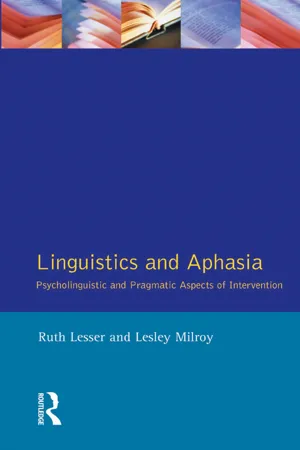
eBook - ePub
Linguistics and Aphasia
Psycholinguistic and Pragmatic Aspects of Intervention
- 400 pages
- English
- ePUB (mobile friendly)
- Available on iOS & Android
eBook - ePub
Linguistics and Aphasia
Psycholinguistic and Pragmatic Aspects of Intervention
About this book
Information
PART I:
THE BACKGROUND
THE BACKGROUND
_____
ONE
_____
Introduction
Aphasia, the language impairment in adults which can follow various kinds of brain injuries such as strokes, is a topic which has been explored by researchers from the different perspectives of medical, cognitive and linguistic sciences. Much of this work is of interest both to the speech-language therapists whose task it is to treat aphasic patients and to relatives and friends who wish to understand more about the impairment and learn to cope with its consequences on their lives. Aphasia is also an intrinsically interesting topic, holding a fascination for many people from the wide range of theoretical and applied disciplines concerned with language and communication. We are aware of this widespread interest on the part of both specialists and non-specialists, and have therefore written this book with a rather heterogeneous range of readers in mind.
Our focus is, however, rather narrower than these opening comments imply. Much recent research in aphasiology, in relation both to the management of the aphasic patient and to the modelling and explanation of patterns of language deficit, has followed advances in two rather divergent sub-disciplines of linguistics — psycholinguistics and pragmatics. Both of these sub-disciplines are also interdisciplinary, being centrally connected to linguistics but facing away from it in quite different directions. Psycholinguistics interfaces with various branches of psychology and the neurological and cognitive sciences, pragmatics chiefly with philosophy, anthropology and sociology and to a lesser extent psychology. The main purpose of this book is to examine the impact of recent developments in psycholinguistics and pragmatics on aphasia research and on the practical management of aphasia.
Although this book is intended to be accessible to non-specialists, we have particularly tried to write it in a way which is helpful and informative to aphasia therapists. However, we have also kept in mind cognate professionals such as educationists, psychologists and those from a range of medical (including psychiatric) specialisms who want to understand more about the character of acquired language disorders and of disordered discourse. For this reason, the second introductory chapter of this book provides a brief survey of some clinical aspects of aphasia for non-specialists. In the main part of the book, we have tried to provide an informative evaluation and synthesis of some recent developments which have influenced aphasia studies. A more important goal perhaps is the provision of a basis for evaluating current research and for planning research projects, both major and minor. Most important of all, we hope to offer here an illuminating perspective on the routine management of aphasia.
The level of knowledge which can be assumed by the authors of an interdisciplinary book with an interdisciplinary readership is rather problematic, and we shall try to outline our policy here. Our decision to ‘anchor’ the work by directing it primarily towards aphasia therapists, rather than, for example linguists, means that for the main part of the book we assume not only a certain level, but a certain kind of knowledge. For example, both education in speech-language pathology-therapy and the general aphasiological literature often make quite detailed reference to certain syntactic theories and syntactic descriptive techniques. On the other hand, pragmatic theory and techniques for describing conversation are much less well integrated into either educational syllabuses or the research literature. We therefore deal relatively rapidly with quite difficult syntactic material, limiting our comments to points of contact with psycholinguistic theory. Basic references are provided to fill gaps for interested readers, while Crystal (1991) offers an up-to-date glossary of linguistic terminology. However, we treat even those pragmatic concepts which linguists might find relatively straightforward in some detail. This is because the application of pragmatic concepts in aphasia is particularly difficult and contentious. This problem is not unique to aphasia studies, but pertains generally to attempts to apply pragmatic concepts, and is particularly apparent in other clinical linguistic areas such as the study of schizophrenia and dementia. Similarly, the application of psycholinguistic theory to aphasia is only just becoming an essential component of education in speech-language pathology-therapy, though it has perhaps advanced more rapidly in Britain than in many other English-speaking countries, since the new discipline of cognitive neuropsychology which incorporates this application was initiated there. In psycholinguistics, too, we have been selective, and described only those developments which seem to us to have direct applications in the analysis of aphasia and in planning remediation.
Although this strategy of selectivity may entail the provision of too much information for some readers and too little for others at various points in the book, we have attempted to compensate for unevenness of coverage by supplying a summary of key topics at the end of each chapter, in order to allow readers to omit that chapter if they wish. In short, we have tried to judge the amount, type and level of information necessary for current purposes, as defined by the goals set out in this introduction.
CHAPTER SUMMARIES
After this introductory Part I, the book is divided into two further parts. Part II deals with the models and methods which are used in the two sub-disciplines of linguistics we have selected. Part III discusses the implications of the issues raised for planning intervention in aphasia, and discusses some ways in which these have actually been applied.
Chapter 3, the first in Part II, provides a context by outlining the different kinds of contribution to aphasiological study offered by linguistics. In doing so, it provides an anchor for later chapters by locating, in particular, the field of pragmatics in relation to the discipline of linguistics as a whole. A somewhat more selective review is offered of a number of issues in linguistic theory of psycholinguistic relevance which are taken up later in Chapters 4 and 5. The question of how far linguistic theories can be viewed as ‘psychologically real’ is discussed, as this is particularly pertinent to the design and interpretation of psycholinguistic investigations which make extensive reference to ‘mentalist’ theories of the type pioneered by Chomsky (1965).
Chapters 4 and 5 describe some of the psycholinguistic models which have been applied in the interpretation of the disorders of aphasic individuals. These have been most fully developed (although still underspecified) in respect of the mental processing of single lexical items, and this forms the theme of Chapter 4. Less well elaborated and experimentally tested through aphasia is the model of sentence processing which is described in Chapter 5. Nevertheless discussion of these models is necessary as they have already begun to be directly applied in aphasia therapy.
Chapters 6 to 9 deal particularly with pragmatics in relation to aphasia therapy. It is important to remember that pragmatics, like psycholinguistics, is a very active research area, but is plagued with contentious issues, ill-defined concepts and partly developed methods. The purpose of these chapters is to select, describe and evaluate topics and approaches which seem to be particularly pertinent to the management of aphasia, rather than to duplicate existing texts. Chapters 6 and 7 on the one hand and 8 and 9 on the other are organized as complementary. Chapters 6 and 7 concentrate initially on the principles underlying discourse and conversational structure, rather than presenting a template for analysing bodies of data. Chapters 8 and 9 present an account of the mechanisms of negotiating a conversation and suggest procedures for approaching real and consequently intractable data. This division corresponds roughly to two major approaches to conversation, the linguistic/philosophy-of-language approach and the ethnomethodology/conversational analysis approach, respectively referred to by Owen (1989) as ‘top-down’ and ‘bottom-up’ modes of analysis.
While Chapters 8 and 9 offer a relatively straightforward exposition of a conversation analysis approach to both normal and aphasic conversation, we need to comment briefly on the content and organization of Chapters 6 and 7. As with the chapters on psycholinguistics, the principle underlying the selection of topics for detailed discussion is their particular relevance to aphasia. For example it has often been reported that aphasic people have difficulties with articles, pronouns and verb tenses, although discussion of these difficulties is less often placed within a coherent conceptual framework. All three categories can illuminatingly be considered under the overlapping headings of deixis and definiteness, and we have discussed such central topics as straightforwardly as possible in relation to aphasia, referring frequently to examples.
We have also considered critically, with attention to potential applications, the underlying assumptions of the theories of Searle and Grice which have wide currency in the applied literature but have been subject to some criticism within pragmatics. The overall goal of these chapters is to examine the various strands of the complex of models and approaches which comprise a sociolinguistically orientated pragmatics. We shall argue that this orientation is potentially best able to provide a more principled basis for therapeutic intervention and for evaluation of existing assessment instruments. These are discussed in Chapter 11.
Part III of the book deals with the implications for therapy of the observations made in Part II. We have not attempted a synthesis of the psycholinguistic and pragmatic approaches, but have devoted separate chapters to each (Chapters 10 and 11 respectively). This is because at present the underlying philosophies of each are quite different. The psycholinguistic orientation to aphasia therapy is essentially that of experimental psychology, and is based on the testing of model-motivated hypotheses. The intervention which derives from this is often direct didactic work on language (although it may also incorporate the teaching of substitutory language strategies — as discussed in Chapter 8). In contrast, the pragmatic approach is observational and eclectic, without exclusive commitment to a particular theory or model. The intervention which derives from the pragmatic approach is generally concerned with the development of compensatory strategies to achieve functional communication, and with management of the patient's communicatory environment. It is primarily facilitative rather than didactic — though again there are exceptions, as is shown in Chapter 11. Therefore, rather than attempting to construct a combined psycholinguistic/pragmatic model, we look in the concluding chapter at the areas in which these two approaches overlap, both from a theoretical and a clinical perspective.
_____
TWO
_____
Aphasia: the clinical background
This chapter gives a brief account of the nature and aetiologies of aphasia, and its prognosis for recovery, as a preliminary to the later chapters in this book which concern intervention aimed at promoting or accelerating that recovery. The chapter is intended to be primarily of interest to non-specialists in aphasia, and readers who are aphasia therapists may wish to move straight to Chapter 3.
THE CAUSES AND NATURE OF APHASIA
Aphasia can take many forms. Indeed some would argue that there are as many forms of aphasia as there are individuals who suffer from it. But patterns emerge which show commonalities in sub-components of the disorder, even though each individual's combinations of particular dysfunctioning sub-components may differ, as well as response and adjustment to the condition. All aphasic people have in common (by definition) that they have suffered some form of brain damage (from stroke, head-injury, tumour, metabolic disorder, toxicity or other aetiology), which has destroyed neuronal cells in parts of the brain on which language seems to be critically dependent. In most individuals this will be in a central zone of the left cerebral hemisphere, and will involve destruction of parts of the cerebral cortex and connecting fibres, although sub-cortical damage can also interfere with language. Typically the damage which causes aphasia is unilateral; it affects only, or predominantly, one of the cerebral hemispheres, in contrast to other neurological conditions which lead to articulatory or intellectual disorders in which the damage more typically affects both sides of the brain.
Right cerebral damage can also have consequences for language, even in people whose left hemispheres are dominant for language, but the changes which occur after unilateral right hemisphere damage are generally more subtle (affecting prosody, semantic discrimination and affective uses of language, for example) and are not usually given the label of aphasic.
We give below some samples of aphasic speech from patients who have suffered left cerebral damage. The first is a conversation between two elderly members of a Speech after Stroke Club, discussing their school days. Both have a longstanding aphasia.
(1) (Fleming, 1989)
1. M (2) erm (.) d you (1.0) d you er what school wan you?
2. (points to B)
3. B (1.0) buts
4. M (1.0) buts?
5. B yes
6. M (1.0) buts
7. B yes
8. M yes
9. B er (.) d vou oh dear (2) erm (4) erm (2) sums // sums
10. M oh yes yes
11. M...
Table of contents
- Cover Page
- Half Title page
- Series Page
- Title Page
- Copyright Page
- Dedication
- Contents
- General Editor's Preface
- Acknowledgements
- Transcription conventions
- Part I The Background
- Part II Models and Methods
- Part III Implications and Applications
- References
- Author Index
- Subject Index
Trusted by 375,005 students
Access to over 1.5 million titles for a fair monthly price.
Study more efficiently using our study tools.
Frequently asked questions
Yes, you can cancel anytime from the Subscription tab in your account settings on the Perlego website. Your subscription will stay active until the end of your current billing period. Learn how to cancel your subscription
No, books cannot be downloaded as external files, such as PDFs, for use outside of Perlego. However, you can download books within the Perlego app for offline reading on mobile or tablet. Learn how to download books offline
Perlego offers two plans: Essential and Complete
- Essential is ideal for learners and professionals who enjoy exploring a wide range of subjects. Access the Essential Library with 800,000+ trusted titles and best-sellers across business, personal growth, and the humanities. Includes unlimited reading time and Standard Read Aloud voice.
- Complete: Perfect for advanced learners and researchers needing full, unrestricted access. Unlock 1.5M+ books across hundreds of subjects, including academic and specialized titles. The Complete Plan also includes advanced features like Premium Read Aloud and Research Assistant.
We are an online textbook subscription service, where you can get access to an entire online library for less than the price of a single book per month. With over 1.5 million books across 990+ topics, we’ve got you covered! Learn about our mission
Look out for the read-aloud symbol on your next book to see if you can listen to it. The read-aloud tool reads text aloud for you, highlighting the text as it is being read. You can pause it, speed it up and slow it down. Learn more about Read Aloud
Yes! You can use the Perlego app on both iOS and Android devices to read anytime, anywhere — even offline. Perfect for commutes or when you’re on the go.
Please note we cannot support devices running on iOS 13 and Android 7 or earlier. Learn more about using the app
Please note we cannot support devices running on iOS 13 and Android 7 or earlier. Learn more about using the app
Yes, you can access Linguistics and Aphasia by Ruth Lesser,Lesley Milroy in PDF and/or ePUB format, as well as other popular books in Medicine & Linguistics. We have over 1.5 million books available in our catalogue for you to explore.