A Practical Guide to Career Learning and Development
eBook - ePub

A Practical Guide to Career Learning and Development

Innovation in careers education 11-19

  1. 128 pages
  2. English
  3. ePUB (mobile friendly)
  4. Available on iOS & Android
eBook - ePub

A Practical Guide to Career Learning and Development

Innovation in careers education 11-19

About this book

A Practical Guide to Career Learning and Development is an essential guide for all those involved in careers education, either with sole responsibility or as part of a team. With a focus on career happiness, resilience and growth, this exciting book offers effective pedagogical strategies, techniques and activities to make career learning and development accessible and enjoyable, contributing to positive outcomes for all young people in the 11-19 phase of their education.

With a wealth of support material such as teaching ideas, lesson plans, case studies and an illustrative student commentary, key topics covered include:

  • Career Learning and Development needs of young people
  • Career Learning and Development in the curriculum
  • Practical activities for 11-14, 14-16 and 16-19 year olds
  • Creating a positive environment for learning
  • Teaching approaches
  • Leadership and management
  • Facilitating professional learning.

A Practical Guide to Career Learning and Development is an invaluable resource for careers advisers and staff in schools with responsibility for leading and providing careers education as well as work-related learning, PSHE, citizenship, and pastoral programmes. It enables and supports all practitioners as they develop careers provision that better prepares young people for their future well-being and an ever-changing and unpredictable world of work.

Frequently asked questions

Yes, you can cancel anytime from the Subscription tab in your account settings on the Perlego website. Your subscription will stay active until the end of your current billing period. Learn how to cancel your subscription.
No, books cannot be downloaded as external files, such as PDFs, for use outside of Perlego. However, you can download books within the Perlego app for offline reading on mobile or tablet. Learn more here.
Perlego offers two plans: Essential and Complete
  • Essential is ideal for learners and professionals who enjoy exploring a wide range of subjects. Access the Essential Library with 800,000+ trusted titles and best-sellers across business, personal growth, and the humanities. Includes unlimited reading time and Standard Read Aloud voice.
  • Complete: Perfect for advanced learners and researchers needing full, unrestricted access. Unlock 1.4M+ books across hundreds of subjects, including academic and specialized titles. The Complete Plan also includes advanced features like Premium Read Aloud and Research Assistant.
Both plans are available with monthly, semester, or annual billing cycles.
We are an online textbook subscription service, where you can get access to an entire online library for less than the price of a single book per month. With over 1 million books across 1000+ topics, we’ve got you covered! Learn more here.
Look out for the read-aloud symbol on your next book to see if you can listen to it. The read-aloud tool reads text aloud for you, highlighting the text as it is being read. You can pause it, speed it up and slow it down. Learn more here.
Yes! You can use the Perlego app on both iOS or Android devices to read anytime, anywhere — even offline. Perfect for commutes or when you’re on the go.
Please note we cannot support devices running on iOS 13 and Android 7 or earlier. Learn more about using the app.
Yes, you can access A Practical Guide to Career Learning and Development by Barbara Bassot,Anthony Barnes,Anne Chant in PDF and/or ePUB format, as well as other popular books in Education & Education General. We have over one million books available in our catalogue for you to explore.

Information

Publisher
Routledge
Year
2013
eBook ISBN
9781317914143
Edition
1
Part I
Preparing to teach Career Learning and Development (CLD)

Chapter 1
What is CLD?

Introduction

All young people need to be prepared for the world of work in the 21st century. In the past, it was sufficient to help them think about what they were going to do when they left school and to enable them to make an informed and realistic decision and to cope well with the transition from school to work. In today’s changing and turbulent labour market, subject to the vagaries of the worldwide economy, this is no longer enough. Any decision regarding their future that young people make is likely to be the first of many such decisions that they will make during their adult life. For many people, the certainties of having a job in the long term and the feelings of security that this brings can no longer be taken for granted. Instead, we can expect to have to take control of our learning and development and manage our own careers.

The changing concept of career

The case study of ‘Ruth’ shows the experiences of an adult over the first few years of her working life. It illustrates something of what the future could hold for many young people.
Ruth
From an early age, Ruth enjoyed all kinds of artistic activities. Ruth was happy when she was painting and drawing at home or at school, making things or reading about how things were made. She decided to take art and design as one of her General Certificate of Secondary Education (GCSE) options, and when she chose her A levels, the only problem was which other subjects she would take with art as the rest came very much second choice. Ruth’s A level in art helped her to develop her interests further, and she then went on to art college to do a foundation course. During her year at college, her interest in textiles emerged, and she applied to university to study for a degree in textiles for interiors.
As part of her degree course, Ruth spent three months in industry undertaking two unpaid placements, one working for a magazine and the other working in the textile design department of a well-known retailer. Here her love for all aspects of textile design was fostered. Ruth graduated with an upper-second-class honours degree and began to look for work.
Finding work in textile design for interiors proved extremely difficult. Ruth soon realised that there were many more jobs in fashion design (which do we buy more often, new clothes or new furniture and curtains?), and she knew she had to be more flexible in her outlook. She began to apply for a wide range of jobs in fashion and, after some searching, gained a job as a designer’s assistant, working for a company making women’s wear. The job was poorly paid, but fortunately, it was near to home. Ruth was frustrated as she was not involved in any aspect of the design process but learned an enormous amount about the production process. In her spare time, she undertook a little freelance work, and through this she continued to update her portfolio. Business was bad generally, and after just under a year, Ruth was made redundant.
After a short period of unemployment, Ruth’s next job was again on the production side and again in fashion. Once more, she was frustrated with her lack of involvement in design but got to know some of the junior designers well. She realised by this time that she lacked some of the skills needed, particularly in computer-aided design (CAD), and was grateful when one of the designers offered to help her develop in this area in their spare time. She learned a lot from him and added the work she was doing to her portfolio. Ruth stayed with the company for a year, but times were still hard in the textiles sector, and she was made redundant again.
Ruth’s next job, almost three years after graduating, was as a junior designer for a company that makes socks. She had never designed socks before, but she quickly progressed; she is now a designer, managing contracts for most of the stores in the United Kingdom where large numbers of people go to buy their socks. All of her sock designs are done on computer, but she always draws them by hand first, something that her clients particularly like as the end product is easier to visualise. She travels regularly to China and Turkey to visit the factories where her socks are made and then sees them in local stores at home.
You could argue that Ruth is now a long way away from her aspirations as a designer of textiles for interiors. However, her story shows that her journey was unpredictable, demanding a high level of resilience. She has become a designer, which contributes to her happiness, well-being and job satisfaction. This is something that many of her fellow students on her degree course failed to achieve, and she has needed to continue to develop her skills and talents in order to make herself marketable to employers and clients. Now in her early thirties, it is clear that she will need to continue to do this to progress, and even survive, in the highly competitive fashion industry.
Today’s labour market makes many demands on young people. These include the following:
  • Having a wide range of skills that can be transferred from one work situation to another as the need arises.
  • Being flexible, adaptable and confident.
  • Being well motivated and willing to continue to learn and develop the knowledge and skills required for the changing labour market.
  • Being prepared to gain experience without necessarily being paid well (or even at all), especially in the early years of working life – good qualifications alone are no longer enough.
  • Being prepared to continue to study whilst working, even if this means paying for it yourself and doing it on your own time.
  • Being able to sell yourself to an employer.
  • Having the determination to continue in the light of disappointment and rejection.
Young people at school are in the early days of their career development, and it would be wrong to expect them to be able deal with all of these demands effectively whilst still there. However, school can, and should, provide them with a safe and secure environment where they can practise their skills and build their knowledge in relation to career.

What is CLD?

In the past, most careers work was done by applying the matching model (‘round peg in a round hole’). In our first book, An Introduction to Career Learning and Development 11–19, CLD was described as offering a different model with a distinctly alternative theoretical orientation. The metaphor of the CLD Bridge was used by Bassot (2009) and is built on the principles of social constructivism. For further information about the application of social constructivism to career guidance, see Bassot (2006). This approach argues that knowledge about career is not simply acquired by some kind of osmosis; people are not ‘empty vessels’ that can be ‘filled up’ with careers information, on the assumption that they can be advised or guided into making good decisions. By contrast, CLD asserts that knowledge about career is constructed through participation in activity and in interactions with a variety of people (including career professionals, employers, teachers, parents, peers and so on). Individuals (like Ruth) need ongoing experiences and opportunities for discussion in order to construct this knowledge within their changing social and cultural context. CLD happens not only when people are at school, but throughout their lives, as they continue to develop their knowledge and skills and adapt to the changing labour market.
CLD is important on three levels:
Individual – if people are happy and fulfilled at work they are more likely to achieve physical, emotional and mental well-being. Paid work is important in a basic financial sense, but it also gives people structure to their lives, provides a range of social relationships and forms part of a person’s identity. Changing circumstances mean that people need to regularly revisit what is important to them and review the decisions they have made, and indeed need to continue to make throughout their lives.
Community – in our highly individualised society, work can be one of the few places where we feel that we belong to a community. We spend more time with the people we work with than most of the other people we know – even family and friends. In addition, CLD practitioners need to work with people within their own communities (e.g. employers, colleges, training providers and universities) in order to be able to offer a range of useful learning experiences to their students.
Social – work plays a vital role in maintaining social cohesion fostering well-being and promoting equality. High levels of unemployment can lead to high levels of dissatisfaction and isolation, low feelings of purposefulness and fulfilment and, for some, depression. CLD has a role to play in equipping people to deal with life’s challenges and to challenge inequalities in society.

The CLD Bridge model revisited

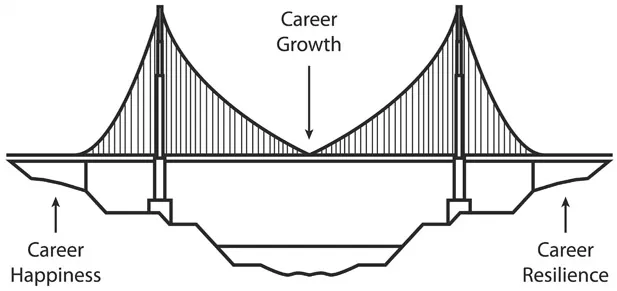
In Chapter 11 of our first book, An Introduction to Career Learning and Development 11–19, we introduced the metaphor of the CLD suspension bridge as a way of describing how careers work needs to move forward in the future. Figure 1.1 shows the various aspects of the CLD Bridge; the bridge functions because of the tensions on opposing sides that keep it in balance.
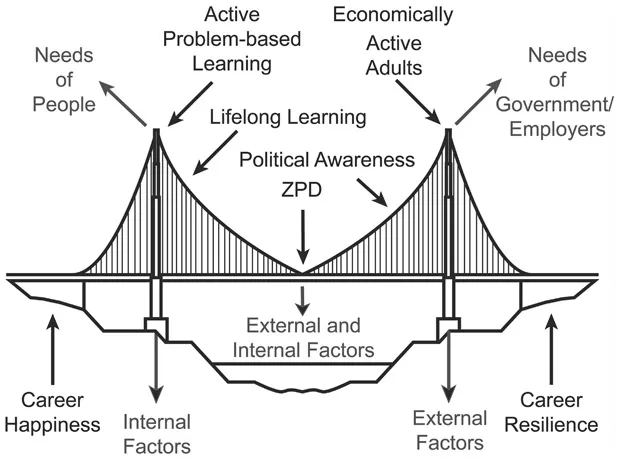
The focus of this practical guide is to help you to understand how young people can learn to balance the pressures that they will experience as they construct their career. The left-hand side of the CLD Bridge focuses on the individual, and the right-hand side on society, often shown by the needs of employers and other stakeholders, and of governments who want to achieve their political goals. The elements of the bridge that we focus on in this book are shown in Figure 1.2.
They are as follows:
  • Career resilience
  • Career happiness
  • Career growth.
Figure 1.1 The CLD Bridge
The issue of balance is of primary importance when considering the model of the CLD Bridge. The road (career growth) is supported by the anchorage blocks of career happiness on the left and career resilience on the right. If there is a lack of balance (e.g. all happiness and no resilience or vice versa), then the road collapses and there is no career growth. Programmes of CLD need to enable students to develop happiness and resilience and to consider how they can keep these in balance so that career growth can happen. Each of the three elements is discussed in some detail in this chapter. At this point, it is worth spending a little time explaining two other key elements as shown in Figure 1.1.
Figure 1.2 Three key elements of the CLD Bridge
  • Active problem-based learning – in order to learn about career, young people need the opportunity to gain a range of experiences and to discuss them with others (teachers, tutors and peers). There is no substitute for experience, and all the activities in this guide are based on this premise. The notion of career is extremely abstract, and a lot needs to be done to help young people to learn in a more concrete way, particularly in the early...

Table of contents

  1. Cover
  2. Title
  3. Copyright
  4. Dedication
  5. Contents
  6. List of figures and tables
  7. Acknowledgements
  8. List of abbreviations
  9. Introduction
  10. PART I Preparing to teach Career Learning and Development (CLD)
  11. PART II Facilitating CLD
  12. PART III Developing your expertise in CLD
  13. References
  14. Index