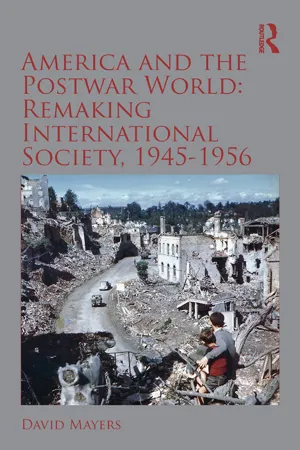
Half of the children are totally blind. Others have lost one or more limbs. Several of them have terribly lacerated faces. Most of the injuries were sustained from land mines. The children have not yet accustomed themselves to their handicaps. The little blind tots groped around until they found someone to cling to, and then they held my hand in a puzzled, frightened way.1
Herbert Lehman, July 1945 visit to children
sheltered in Rome’s Quirinal Palace
* * *
The urgent problem posed by the cessation of Allied–Axis hostilities centered on destruction. It encompassed psychic no less than physical dimension, a result of that hallucinogenic fury rained—in engineering-mathematical deliberation—upon Europe and Asia. None of the devastation suggested prompt recovery. The totality of violence, folly, and cruelty surpassed calculation, reconfirming humanity’s moral shortcomings, cumulatively a condition to manage but not a puzzle to resolve.
Precise casualty figures do not exist. Estimates of the war dead hover around sixty million, the majority (two-thirds) civilian.2 Many more people were left maimed, others depleted by grief. By the end of 1945, refugees, deportees, POWs, slave laborers, and internally displaced or otherwise uprooted people in Asia and Europe numbered in the tens of millions.3 Homelessness, diseases, and hunger gripped regions from the Netherlands to Ukraine to Bengal to China and beyond. Marauding armies, air forces, and blockading navies had inflicted damage to cities, industrial sites, transportation infrastructure, and agricultural production that dwarfed previous experience. This destruction, combined with great sums spent by the belligerent nations, left economies throughout the war zones in shambles. Whether in rural districts or urban centers—London, Rotterdam, Hamburg, Dresden, Warsaw, Leningrad, Stalingrad, Belgrade, Nanjing, Tokyo, Yokohama, Hiroshima, Nagasaki, Manila—desolation had swept victors and vanquished, righteous and guilty alike.
Only in time to come will Europeans discover, despite their material recovery, whether they can revive the spiritual dynamism and cultural genius that slipped in 1914, then was expunged, seemingly irrevocably, twenty-five years on. Eva Fahidi, a Jewish Hungarian memoirist and survivor of Nazi concentration camps, explained in 2015: “Time does not help. It only deepens the feeling that something is missing.”4 Neither music nor literature nor philosophy consoled her.
The Polish poet Czeslaw Milosz expressed comparable disconsolateness in his 1985 meditation on the difficulty of writing an analytically scrupulous history of the twentieth century:
I still think too much about the mothers
And ask what is man born of woman.
He curls himself up and protects his head
While he is kicked by heavy boots; on fire and running,
He burns with bright flame; a bulldozer sweeps him into a clay pit.
Her child. Embracing a teddy bear. Conceived in ecstasy.
I haven’t learned yet to speak as I should, calmly.5
Before members were arrested, the Munich-based White Rose student circle (1942–1943) protested the Third Reich’s murder of European Jewry and delivered this alarm on behalf of Germans of conscience:
Who among us has any conception of the dimensions of shame that will befall us and our children when one day the veil has fallen from our eyes and the most horrible of crimes—crimes that infinitely outdistance every human measure—reach the light of day?6
The burden of shame, alas, has lain heavy upon Germans born since 1945 or others equally innocent of Third Reich atrocities. To Sabina de Werth Neu (b. 1941 in Berlin), survivor of Anglo-U.S. bombings and rape by Red Army soldiers, the most enduring dilemma was rooted in national identity. Like many of her generation, she felt herself “a reluctant German.” If not directly, she allowed in 2011, “we were the children of monsters” by association.7
Brutality in Asia, from 1937 Nanjing to 1945 Nagasaki, also encased perpetrators and blameless in time outside of normal time. Compliance with humanitarian tenets plunged, in the maltreatment of Allied prisoners by their Japanese captors, the massacring of Chinese civilians, and the ravishing of tens of thousands of “comfort women.”
Formerly a student at a Christian-sponsored school for girls, Hata Tomoko of Hiroshima discerned “an instance of the utmost human insolence” in the atomic killing of non-combatants on 6 August 1945. Of the purported justification, reliant upon utilitarian arithmetic, that countless Japanese and Allied lives were thereby saved, she protested: “Nobody except God is allowed to do such a thing, using an uncertain calculation about the future as a basis for committing an irreparable crime in the present.”8
That the suffering of innocents transcended geography and rival blocs also struck onetime Auschwitz inmate Primo Levi, when in 1978 he ruminated upon Anne Frank, who died at Bergen–Belsen, and an unknown Japanese girl: they belonged to the same sorrowful sorority. Before them, and the other untold dead, the Cold War wielders of modern weapons might pause.
Nothing is left of …
The Dutch girl imprisoned by four walls
Who wrote of her youth without tomorrows.
Her silent ash was scattered by the wind,
Her brief life shut into a crumpled notebook.
Nothing remains of the Hiroshima schoolgirl,
A shadow printed on a wall by the light of a thousand suns,
Victim sacrificed on the altar of fear.
Powerful of the earth, masters of new poisons,
Sad secret guardians of final thunder,
The torments heaven sends us are enough.
Before your finger presses down, stop and consider.9
Despite the annihilations or the threat of resumption, restoration was launched in 1944–1946 in several former war zones. To this cause, the United Nations Relief and Rehabilitation Administration (UNRRA) made early contribution. Under UNRRA’s first director general, Herbert Lehman, aid reached millions of Asians and Europeans. Simultaneous with this attempt to repair damages, an effort was made to prevent future cataclysm of potentially larger scale, conveyed in the Acheson–Lilienthal idea of placing atomic science and technology under United Nations aegis. Both UNRRA and the proposed internationalization of atomic science supposed that a disordered world might yet be righted and cross over to safety.
UNRRA
Achievements
Varied initiatives were taken during World War II to ease the plight of peoples touched by violence. Hundreds of faith-based and secular groups were financed and staffed in Allied countries, prominently in Great Britain, Canada, and the United States. Unitarians, Quakers, Jews, Catholics, and mainline Protestants, sometimes joined to ethnic fraternal organizations, numbered in the rescue formations. These and other nongovernmental philanthropies struggled to supply sufferers with food, clothing, medicines, and other balm.10 This last included, as provided by the New York-based Emergency Rescue Committee, safe haven for intellectuals and artists hunted by Nazi pursuers.
The U.S. government, at the behest of Treasury secretary Henry Morgenthau, established the War Refugee Board (WRB) in January 1944. Albeit little and late compared to the need, the WRB did manage to save 200,000 imperiled Jews and an additional 20,000 persons. The State Department had earlier created the Office of Foreign Relief and Rehabilitation Operations (OFRRO). The commissioning of this agency in November 1942 particularly gratified former president Herbert Hoover. He had lobbied since the outset of European hostilities for a program, modeled on his World War I relief work conducted in Belgium behind German lines, to succor trapped civilians, irrespective of where they resided or under which regime they lived.11 As actually mandated, OFRRO, in coordination with other Allied agencies, was to deliver necessities of life to victims of Axis power provided that they dwelt in territories liberated from Third Reich conquest.12 This proviso, contra Hoover, stemmed from the British government’s concern—voiced in August 1940 by Prime Minister Churchill —that assistance intended for people in Axis-subjugated countries would inevitably land in enemy hands, thus inadvertently supplementing German strength.13
A modest undertaking, crewed by only 150 staffers, OFRRO provided help to refugees (Poles, Greeks, Yugoslavs, Jews) and others in need in French North Africa, Egypt, Palestine, Spain, and Kenya. Picked by FDR to head OFRRO, Lehman later recalled its doings with pride; he regarded his ten-month-long tenure, punctuated by bruising moments in Washington’s interagency warfare, as useful rehearsal for his subsequent UNRRA career.14
Headquartered in Washington, UNRRA constituted a unique multinational aid effort, underwritten by forty-four Allied countries. Through combined action and pooling of resources, these “United Nations” (a moniker coined by FDR to designate the anti-Axis coalition) meant to enlarge upon OFRRO while also enlisting many of its top administrators. As originally devised in January–June 1943 by Dean Acheson, then assistant secretary of state for economic affairs, and resident Washington ambassadors—Lord Halifax (UK), Maxim Litvinov (USSR), Wei Taoming (China)—UNRRA proposed to help people whose countries had been overrun by Axis armies and could not yet procure adequate amounts of foodstuffs, medicines, or other essentials on the world market.15 (As later amended, Axis lands were designated eligible for UNRRA aid, albeit restricted to supporting refugees and displaced people and providing nourishment to children and mothers.16) Upon signing of the UNRRA protocols in a White House ceremony on 9 November 1943, President Roosevelt delivered this mission statement:
The sufferings of the little men and women who have been ground under the Axis heel can be relieved only if we utilize the production of ALL the world to balance the want of ALL the world. In UNRRA we have devised a mechanism, based on the processes of true democracy, which can go far toward accomplishment of such an objective in the days and months of desperate emergency which will follow the overthrow of the Axis.17
As stipulated by Acheson and company, UNRRA operations would be maintained by member states that had been spared Axis invasion, each doing so to the value of 1 percent of its annual national income.18 This formula in actual practice was not realized, however; the theoretically eligible nations did not contribute at the designated levels. Nor was the burden of supporting UNRRA budgets evenly shouldered, their final total amounting ...