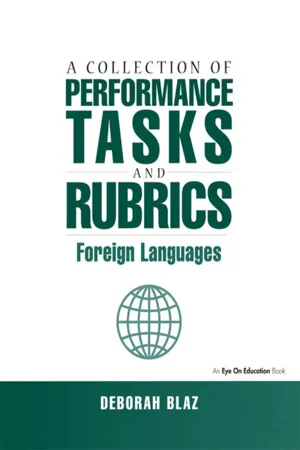
This book features 68 performance tasks and rubrics, all designed to motivate and engage your students. Also included are samples of student work to help you apply the rubrics and develop your grading and scoring skills. The performance assessments in this book were contributed by teachers like you from all over the country and they include:
- open-ended and extended response exercises
- projects and portfolios
- behavioral assessments (skits, debates, discussions, etc.)
- authentic assessments
- and student self-assessments, in addition to those administered by teachers.
- 160 pages
- English
- ePUB (mobile friendly)
- Available on iOS & Android
eBook - ePub
About this book
Information
1

WHY USE PERFORMANCE ASSESSMENTS?
Clearly, assessment is a popular topic encountered in publications, workshops and inservices, college training courses, and discussions in the teacher’s lunchroom. Why is there a sudden interest in assessment strategies? The interest in multiple intelligences, new research and discoveries on how the brain learns a language, and new technologies (such as the Internet) now available in many classrooms, have forced us to reevaluate and often to modify our teaching methods. Especially influential is the emphasis on relevance, which acknowledges the effect context has on performance, and which leads us to want assessment strategies that reflect this new emphasis.
The word “assess” comes from the Latin, meaning “to sit beside.” Tutors sat beside their students, correcting, praising, or admonishing them, and guiding them toward a better performance. Modern teaching practices, supported by research on learning, are now trying to return to this concept of the teacher as a “guide by the side,” and assessment must adapt to reflect this change as well.
The American Council on the Teaching of Foreign Languages and the National Standards in Foreign Education Project have, at long last, released the Standards for Foreign Language Learning. The many different language organizations, such as the American Association of Teachers of French (AATF), American Association of Teachers of Spanish and Portuguese (AATSP), and others are in the process of adapting those standards more specifically for the strengths and particular requirements of each language. However, teachers are still dependent on the textbook publishers or their own ingenuity when it comes to assessing the degree of knowledge and proficiency of their students. It is this need that this book addresses, first by discussing in Chapter 1 the need for variety in assessment, in Chapter 2 by exploring how to choose an evaluation based on curriculum and how to create a rubric for that assessment tool, and, finally, in the following chapters, by discussing methods of evaluation based on a student’s performance in the four main areas of foreign languages: speaking, writing, reading, and listening.
This is not an “ivory tower” treatise on assessments. Each section includes actual “tried-and-true” assessments contributed by foreign language teachers from all over the United States as well as examples of student work and explanations of scoring of that work. It is hoped that each can be used or adapted immediately for your classroom, as well as serving as models for creation of additional tasks of your own.
WHAT IS AN ASSESSMENT?
Assessment may be defined as “any method used to better understand the current knowledge that a student possesses.” This means that an assessment can be almost anything, from a teacher’s subjective judgment based on a single observation of student performance to a five-hour standardized test. Assessment may affect decisions about placement in a certain level, grades, advancement to the next level of a language, instructional needs, and changes in teaching strategies or curriculum.
In many classrooms, the primary purpose of assessment is to determine a student’s grade. Teachers tend to think of “assessment” as being synonymous and interchangeable with “testing,” “grading” and “evaluation,” and the main form of assessment used is a pencil-and-paper test. This is not to say that these tests are not appropriate, but just that, alone, they are not enough. The national commission, whose findings are published in Breaking Ranks: Changing an American Institution (NASSP, 1996), says that teachers should “assess the academic progress of students in a variety of ways so that a clear and valid picture emerges of what they know and are able to do” (p. 54).
What teachers, students, and parents need, therefore, are multiple and varied forms of assessments: performance assessments such as portfolios and journals, evaluations of student products, and traditional paper-and-pencil assessments. This rich mixture should do several things:
♦ It should tell what the student knows and how it relates to the curriculum.
♦ It should provide an opportunity for the student to demonstrate what they can do with what they have learned.
♦ It should provide a method for assessing the student’s achievement as compared with that of other students.
♦ It should be rigorous, yet fair enough so that students know what is expected of them, and have confidence in their ability to accomplish the task.
♦ It should provide a rich supply of information that reflects student progress.
Mastering the basic principles of assessment is not easy. First, we need to know and carefully consider the following five standards of assessment (Stiggins, 1996):
♦ Standard 1: Quality assessment arises from and accurately reflects clearly specified and appropriate achievement expectations for students.
What is our target for this assessment? What skills must a student have mastered? We cannot select ...
Table of contents
- Cover
- Title Page
- Copyright Page
- Table of Contents
- ABOUT THE AUTHOR
- ACKNOWLEDGMENTS
- 1 WHY USE PERFORMANCE ASSESSMENTS?
- 2 CHOOSING AND WRITING A PERFORMANCE ASSESSMENT AND ITS RUBRIC
- 3 FROM THEORY TO PRACTICE: ORAL ASSESSMENTS
- 4 FROM THEORY TO PRACTICE: WRITTEN ASSIGNMENTS
- 5 FROM THEORY TO PRACTICE: READING ASSESSMENTS
- 6 FROM THEORY TO PRACTICE: ASSESSMENTS OF LISTENING PROFICIENCY
- 7 STRATEGIES FOR KEEPING ASSESSMENTS MANAGEABLE
- 8 ALTERNATIVE FORMS OF ASSESSMENT
- BIBLIOGRAPHY
Trusted by 375,005 students
Access to over 1.5 million titles for a fair monthly price.
Study more efficiently using our study tools.
Frequently asked questions
Yes, you can cancel anytime from the Subscription tab in your account settings on the Perlego website. Your subscription will stay active until the end of your current billing period. Learn how to cancel your subscription
No, books cannot be downloaded as external files, such as PDFs, for use outside of Perlego. However, you can download books within the Perlego app for offline reading on mobile or tablet. Learn how to download books offline
Perlego offers two plans: Essential and Complete
- Essential is ideal for learners and professionals who enjoy exploring a wide range of subjects. Access the Essential Library with 800,000+ trusted titles and best-sellers across business, personal growth, and the humanities. Includes unlimited reading time and Standard Read Aloud voice.
- Complete: Perfect for advanced learners and researchers needing full, unrestricted access. Unlock 1.5M+ books across hundreds of subjects, including academic and specialized titles. The Complete Plan also includes advanced features like Premium Read Aloud and Research Assistant.
We are an online textbook subscription service, where you can get access to an entire online library for less than the price of a single book per month. With over 1.5 million books across 990+ topics, we’ve got you covered! Learn about our mission
Look out for the read-aloud symbol on your next book to see if you can listen to it. The read-aloud tool reads text aloud for you, highlighting the text as it is being read. You can pause it, speed it up and slow it down. Learn more about Read Aloud
Yes! You can use the Perlego app on both iOS and Android devices to read anytime, anywhere — even offline. Perfect for commutes or when you’re on the go.
Please note we cannot support devices running on iOS 13 and Android 7 or earlier. Learn more about using the app
Please note we cannot support devices running on iOS 13 and Android 7 or earlier. Learn more about using the app
Yes, you can access Collections of Performance Tasks & Rubrics by Deborah Blaz in PDF and/or ePUB format, as well as other popular books in Education & Education General. We have over 1.5 million books available in our catalogue for you to explore.