- 188 pages
- English
- ePUB (mobile friendly)
- Available on iOS & Android
eBook - ePub
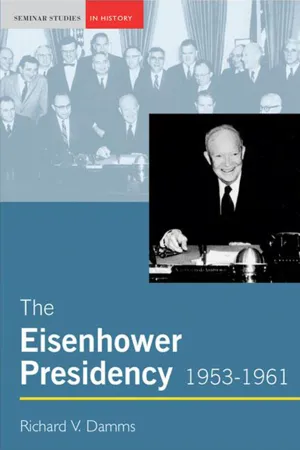
The Eisenhower Presidency, 1953-1961
About this book
This seminar study examines the Eisenhower presidency. The author argues that the presidency marked an important stage in the evolution of modern America, but left a decidedly mixed legacy for future presidents. Domestically Eisenhower pursued a 'middle way'. Imbued with a profound district of politics and politicians, Eisenhower sought as much as possible to concentrate public policy making in the hands of an enlightened elite of public and private experts. Internationally, Eisenhower's policies exacerbated the nuclear arms race, institutionalised the Cold War, and extended the East-West struggles to new arenas in the Third World. This new account offers an up-to-date synthesis of this newly emerging literature, and reviews Eisenhower's record - from the mishandling of the Civil Rights movement to the escalation of the arms race and the intensification of the Cold War.
Information
CHAPTER ONE
INTRODUCTION
No American president has undergone such a thoroughgoing re-examination by historians in the last generation, nor experienced such an improvement in reputation, as Dwight David Eisenhower. Shortly after the thirty-fourth president left office, the conventional wisdom held that Eisenhower was a personable, decent, honest man who nevertheless had led the nation unimaginatively throughout the decade of the 1950s and had failed to capitalize on his unquestioned personal popularity to rally the American people behind any noble cause. Worse, he had delegated primary responsibility for his administration’s major domestic and foreign policies to outspoken, influential aides, such as the unpopular White House Chief of Staff, Sherman Adams, and the inveterately anti-communist Secretary of State, John Foster Dulles. Political observers in the late 1950s and early 1960s generally lamented the ‘great postponement’ under Eisenhower, a period when nothing had been done to address such pressing social problems as poverty and racism (Shannon, 1958). A 1962 poll of American historians seemed to confirm such judgements, ranking Eisenhower a lowly twenty-second among all American presidents, only one place higher than Andrew Johnson, at that time the only president to have been impeached (Schlesinger, 1962; DeSantis, 1976; Burk, 1988; Broadwater, 1991).
The 1962 historians’ poll marked the nadir of Eisenhower’s reputation among intellectuals. As Eisenhower’s successors grappled unsuccessfully with an unpopular war in Vietnam, urban uprisings, social protest movements, budget deficits, spiralling inflation and economic stagnation, Americans began to look back upon the relative calm and prosperity of the Eisenhower years with a sense of nostalgia. As early as 1967, journalist Murray Kempton suggested that contemporaries had grossly underestimated Eisenhower’s achievements. Compared with the flawed activism of John F. Kennedy and Lyndon B. Johnson, Eisenhower’s deliberately restrained leadership had carefully avoided partisan rancour, kept the nation on a sound economic footing, initiated work on the modern interstate highway system, built the St Lawrence Seaway, and, most importantly, kept the peace (Kempton, 1967). Garry Wills went even further, characterizing Eisenhower as a ‘political genius’ whose awkward public statements and apparent delegation of responsibility were a shrewd act to disguise his true involvement in his administration’s policies, convey the impression of a national leader above party, and generate public confidence (Wills, 1969).
The journalistic reassessments of Eisenhower in the late 1960s and early 1970s represented the first ripples of a tide of Eisenhower revisionism that would engulf the historical profession over the next decade. Not only did Eisenhower’s reputation benefit from an increasingly favourable comparison with his successors, but also the gradual opening of the holdings of the Dwight D. Eisenhower Presidential Library after Eisenhower’s death in 1969 enabled scholars to document the president’s central role in meetings with the National Security Council, the Cabinet, personal aides and congressional leaders. The Eisenhower diaries, in particular, provided remarkable insight into Eisenhower’s thinking on contemporary issues. The newly-available archival evidence effectively laid to rest the notion that Eisenhower was diffident, uninformed and not thoroughly involved in directing his administration’s major policies. By the mid-1970s, detailed works by Herbert Parmet, Peter Lyon and Charles C. Alexander began to present a more favourable portrait of the thirty-fourth president. Parmet argued that Eisenhower’s restrained, middle-of-the-road presidency was exactly what most Americans wanted in the affluent, comfortable 1950s (Parmet, 1972). Lyon criticized Eisenhower’s bellicose anti-communist foreign policy, particularly his interventionism in the Third World, but conceded that his calm leadership managed to keep the peace in the face of numerous crises (Lyon, 1974). Similarly, while unsympathetic to Eisenhower’s conservative views, Alexander recognized that the president had nonetheless succeeded in ‘holding the line’ against any further expansion of the welfare state, demands for more vigorous prosecution of the Cold War and pressure to expand the military (Alexander, 1975).
The high tide of Eisenhower revisionism arrived in the early 1980s, with important studies by political scientist Fred I. Greenstein and historians Robert Divine and Stephen Ambrose. Greenstein built on Wills’s earlier observations to identify a carefully-crafted ‘hidden-hand’ leadership style. Eisenhower, he argued, skilfully worked behind the scenes to promote his policies while delegating responsibility for articulating them to subordinates who would then have to bear the brunt of public scrutiny and criticism. Contrary to earlier critics who condemned Eisenhower for refusing to stand up to Senator Joseph McCarthy’s anti-communist witch-hunting, Greenstein suggested that it was actually Eisenhower who quietly masterminded the downfall of the junior senator from Wisconsin (Greenstein, 1982). Divine’s generally sympathetic overview of Eisenhower’s major foreign policies praised the president for steering the nation through several difficult crises and avoiding war. While unable to achieve his larger goals of reducing Cold War tensions and halting the nuclear arms race, Eisenhower nevertheless provided a ‘model of presidential restraint’ that his successors would have been well-advised to emulate (Divine, 1981: 155). Finally, in a richly-detailed biographical study, Ambrose painted a picture of a president very much in control of the policy-making process. Although Eisenhower failed to end the Cold War and seize the moral high ground in the case of African-American civil rights, he ‘almost single-handedly’ held down defence spending, supported economic policies that produced a decade of prosperity, and excelled at crisis management. In sum, it was a ‘magnificent performance’ (Ambrose, 1984: 626). A new poll of presidential historians in the early 1980s reflected the influence of these more positive appraisals. Eisenhower now ranked ninth, achieving the status of a ‘nearly great’ president.
In the course of the last decade, the ending of the Cold War, the disintegration of the Soviet Union, the opening of additional archival holdings in the United States and Europe, and the increasing availability of carefully-researched, archival-based monographs providing in-depth analyses of various aspects of the Eisenhower years have made possible a more balanced and sophisticated understanding of the Eisenhower presidency. Most scholars now largely accept the basic tenets of Eisenhower revisionism, most notably that Eisenhower was an informed, thoughtful, hands-on policy-maker, but recent analyses place more emphasis on the substance and efficacy of his policies. The purpose of this study is to provide a general introduction and critical overview of the Eisenhower presidency and synthesize much of the current scholarship. As will become readily apparent, this introduction to the Eisenhower era relies heavily on the monographic literature that preceded it. The basic thesis here is that the Eisenhower administration was neither as reactionary as the early critics claimed nor as unerringly successful as the later revisionists suggested.
Eisenhower’s storybook rise from humble origins as the third son of a mid-western family of modest means to Supreme Commander of the Allied Expeditionary Forces in Europe during World War II and mastermind of the successful D-Day invasion of France made him an ideal presidential candidate in the eyes of many. As a professional military man, Eisenhower frequently expressed disdain for politics and politicians and believed that soldiers should confine themselves to purely military matters, but as early as 1943 journalists suggested that his leadership qualities well-suited him for the nation’s highest office. By that time, under the guidance of his mentor, Army Chief of Staff George C. Marshall, Eisenhower had risen from being a relatively obscure lieutenant colonel in the Third Army to commander of the successful Anglo-American invasions of North Africa in 1942 and Sicily and Italy in 1943. Preoccupied with winning the war and maintaining Allied unity, Eisenhower had little patience for speculation about a political candidacy. Nevertheless, throughout his military career, he repeatedly demonstrated remarkable political and diplomatic skills. He rose through the ranks of the interwar army, an intensely political organization in its own right, survived a stint as mercurial General Douglas MacArthur’s aide in the 1930s, and exhibited the tact and shrewdness to forge a working wartime coalition among such inflated egos as British Prime Minister Winston Churchill, Field Marshal Bernard Law Montgomery, General George S. Patton and Free French leader Charles de Gaulle. Following his acceptance of the German defeat in the west and promotion to five-star general, many Americans viewed Eisenhower as the nation’s greatest military hero. Thus, despite repeated protestations that he harboured no political ambitions, both Democratic and Republican leaders continued to bandy the name of Eisenhower as a potential presidential candidate with mass appeal. During the July 1945 Potsdam Conference, even President Harry S. Truman offered to assist Eisenhower in securing the Democratic nomination for president in the 1948 election, which the general politely declined.
Eisenhower’s political education continued in the postwar years. He inherited Marshall’s position as Army Chief of Staff in 1945, presided over Columbia University from 1948 to 1950, and eventually became the first Supreme Commander for the newly-created North Atlantic Treaty Organization (NATO) in 1951. In each of these positions, Eisenhower remained intimately involved in the discussion and implementation of national security policy, but he grew increasingly uneasy with the direction in which the nation was heading. As Army Chief of Staff, Eisenhower supervised the rapid demobilization demanded by the American public, but he quickly became frustrated with the intensely political atmosphere in Washington. More ominously, as relations between the West and the Soviet Union deteriorated into a state of Cold War, he worried about the lack of a coherent strategy for maximizing the nation’s limited resources to contain the communist threat. In the name of efficiency, he supported a system of universal military training and greater unification of the armed forces. Congress never approved the former, but Eisenhower helped to shape the controversial 1947 National Security Act that subordinated the individual services to a National Military Establishment, later called the Department of Defense. He supported President Truman’s request for aid to Greece and Turkey and generally endorsed the policy of containment, but worried about the administration’s piecemeal approach to defence strategy and his fellow officers’ failure to appreciate that true national security required a sound economy and spiritual strength in addition to military might. Without a clear strategic concept and recognition of the need to balance means and ends, Eisenhower feared that the nation courted disaster. Such concerns became even more urgent when the Cold War took a dramatic turn for the worse. The explosion of a Soviet nuclear device in 1949 and the outbreak of the Korean War the following year persuaded Eisenhower to accept Truman’s request to return to active duty as NATO Supreme Commander. As expected, Eisenhower’s appointment bolstered European confidence in the twelve-nation collective security system and helped to sell the idea of a long-term American military commitment to Western European defence to the American public. The bloody stalemate in Korea and the Truman administration’s adoption of the alarmist National Security Council Paper 68, which forecast impending war with the communist world and advocated a massive, permanent military build-up, however, were important factors in Eisenhower’s decision to accept his friends’ entreaties and run for the presidency in 1952 as a Republican.
A second set of factors in Eisenhower’s decision to seek the presidency were his concerns for the future of the Republican Party and the nation’s apparent drift towards socialism under Democratic presidents Franklin D. Roosevelt and Truman. At Columbia University, Eisenhower cultivated friendships and associations with some of the nation’s wealthiest business leaders, most of whom were moderate, internationalist Republicans. He found that he shared their anti-statist views, particularly the notion that high taxes, rising government expenditures and an expanding federal bureaucracy would ultimately undermine the nation’s economic health and erode individual freedoms. Having failed to win the presidency since the Great Depression, Republicans desperately sought a candidate with broad popular appeal who could wrest back control of the federal government before it was too late. In 1948, Eisenhower expected that his friend, New York Governor Thomas E. Dewey, would be that candidate and so turned aside both Republican and Democratic efforts to recruit him. When Dewey unexpectedly lost to Truman, however, Eisenhower began a quiet campaign to position himself to accept a ‘draft’ in 1952 should no suitable alternative Republican be available. The emergence of Senate Minority Leader Robert A. Taft of Ohio as the frontrunner among Republican candidates added urgency to the covert manoeuvres by Eisenhower’s internationalist friends. Taft had opposed NATO and the Marshall Plan, preferred an Asia-first foreign policy, and had little knowledge of foreign affairs generally. Taft’s candidacy convinced Eisenhower to enter the race for the Republican presidential nomination, both to safeguard the collective security system that he deemed vital to winning the Cold War and to prevent yet another Republican defeat in the general election. The unpopular Truman’s decision not to seek re-election made Eisenhower’s entry into the presidential race somewhat easier as he would not now have to run against his commander-in-chief. After resigning his NATO post, Eisenhower returned to the United States in mid-1952 and, at a bitterly-contested Republican convention in Chicago, won the nomination on the first ballot (Pickett, 2000).
During the 1952 general election, Eisenhower performed a delicate balancing act. As the candidate of the minority party, he had to secure not only the traditional base of Republican voters but also a substantial number of independents and disaffected Democrats. Eisenhower and his campaign manager and friend, Senator Henry Cabot Lodge of Massachusetts, shrewdly papered over significant differences between Republican internationalists and isolationists, Atlanticists and Asia-firsters, by downplaying his role in NATO and emphasizing Truman’s loss of China to the Communists. They also delegated the drafting of the party’s foreign policy platform to Republican stalwart John Foster Dulles. Capitalizing on his image as a war hero and statesman who would remain above politics, Eisenhower turned to surrogates to deliver the more shrill partisan attacks on the Democrats and their record. His young running-mate, Senator Richard M. Nixon of California, and Wisconsin Senator Joseph R. McCarthy hammered home the campaign themes of ‘Korea, communism and corruption’ with alacrity. Eisenhower remained largely above the fray and never referred to his opponent, Illinois Governor Adlai Stevenson, by name. On the most pressing issue of the day, the ongoing war in Korea, Eisenhower made no specific policy proposals. Instead, he simply stated: ‘I shall go to Korea.’ It was enough. On election day, Eisenhower comprehensively defeated Stevenson by more than six million popular votes and carried all but nine states. He was the first Republican in a generation to capture the traditionally Democratic southern states of Tennessee, Texas, Florida and Virginia. His personal popularity enabled the Republicans to win both houses of Congress by a narrow majority: 221 to 214 in the House of Representatives, and 49 to 47 in the Senate. Faced with such little margin for error and significant divisions among fellow Republicans, however, Eisenhower recognized that he would need to steer a moderate, bipartisan course in order to govern effectively.
CHAPTER TWO
THE MIDDLE WAY
Dwight D. Eisenhower entitled the first volume of his presidential memoirs ‘mandate for change’, but the narrow margin of the Republican victory belied such a claim. While certainly underscoring Eisenhower’s tremendous personal popularity, the election results also seemed to confirm the American public’s preference for a government that would cater to what one scholar has termed ‘the vital centre’. Indeed, even had Eisenhower not been dependent on a degree of Democratic support to govern, he was philosophically sympathetic to the notion of a middle-of-the-road administration that would seek bipartisan consensus. In domestic affairs, Eisenhower’s priority was to lay the foundation for a healthy economy by bringing the budget into balance, lifting wartime economic controls and taxes, and arresting the trend towards statism. Some of Eisenhower’s fellow Republicans, particularly the so-called Old Guard, wanted to go much further, however, and envisioned sweeping tax cuts and a roll back of the New Deal and Fair Deal welfare state programmes of the 1930s and 1940s. Eisenhower worked to moderate their views, but with mixed success. In fact, some of Eisenhower’s most troublesome political problems during his first administration would come from within the Republican Party.
EISENHOWER’S POLITICAL PHILOSOPHY
Dwight D. Eisenhower came to the presidency with a set of deeply-held convictions about the proper role of the federal government in the modern age and the ideal society. As a professional military man, he had developed a yen for efficient organization, a strong dislike for politics and politicians, a suspicion of popular democracy and a deep commitment to duty and disinterested public service. His philosophy has been described by one historian as the ‘corporate commonwealth’. He sought to resolve the contradictions of modern capitalism by fostering a harmonious society free of class conflict, selfish acquisitiveness and divisive party politics. Like the social thought of the last Republican president, Herbert Hoover, Eisenhower stressed the mutual interdependence of classes and economic interests. He once wrote to a friend ‘that agriculture, labor, management and capital frequently speak of themselves as if each were a separate and self-sufficient enterprise or community. Yet the simple fact is that each is helpless without the others; only as an effective member of an integrated team can any one of them prosper’ (Griffith, 1984: 91). Like Hoover, Eisenhower envisioned a mutually cooperative society where interest groups would voluntarily work together for the common good to achieve order, stability and progress.
The key to achieving this corporate commonwealth, Eisenhower believed, was to seek balance, a ‘middle way’ in his words, between labour and capital, liberalism and conservatism, and the federal government and the private sector [Doc. 1]. Like many of the Old Guard conservative members of his Republican Party, Eisenhower wanted to check what he viewed as the dangerous New Deal/Fair Deal drift towards statism. Unlike them, however, he envisioned a positive, if limited, role for the state in the nation’s political economy. He recognized that it would be politically impossible to dismantle popular New Deal programmes, such as Social Security, that now had built-in constituencies. In some areas, moreover, he believed that the state had a responsibility to ‘prevent or correct abuses springing from the unregulated practice of a private economy’ (Griffith, 1984: 92). The government could also function to bring competing interests and groups together to foster social harmony and blend the individual and the public good. On several occasions, Eisenhower repeated the dictum attributed to Abraham Lincoln: ‘The legitimate object of government is to do for a community of people whatever they need to have done but cannot do at all or cannot do so well. In all that the people can individually do … for themselves Government ought not to interfere’ (PPP, 1953: 395).
Eisenhower frequently expressed his distaste for politics, by which he meant the narrowly selfish actions of particular interest groups and classes. He believed that his Democratic predecessor had pandered to uneducated public opinion for political gain at the expense of the common good. Eisenhower instead resolved to govern in the national interest, and sought like-minded public-spirited leaders from the private sector who could exercise disinterested judgement on the pressing issues of the day. Harkening back to a theme of turn-of-the-century progressivism, Eisenhower exhibited great faith in elite leadership by enlightened expert administrators who could stand above narrow self-interest and partisan politics.
Eisenhower’s vision of a corporate commonwealth was shared by many progressive-minded business leaders. During the 1930s, so-called corporate liberals in the business community had endorsed certain New Deal reforms aimed at promoting economic stability, but had remained wary of any move towards state socialism. During World War II, thousands of corporate managers had participated in a highly productive and mutually beneficial business-government partnership to mobilize the nation’s resources for war. The war had also witnessed the emergence of new, progressive business groups, such as the Council for Economic Development (CED) and the Advertising Council. These organizations promoted continued cooperation between business and government in order to moderate economic conflict, regulate markets, promote international trade, and foster economic growth. At the same time, they also urged on the federal government responsible fiscal and monetary policies conducive to private enterprise. In Eisenhower, these corporate liberals saw a means of wresting political power back from the New Dealers and securing the kind of positive, but limited, state intervention in the economy that they favoured. Indeed, business leaders such as Paul G. Hoffman of the Studebaker Corporation, Thomas J. Watson of International Business Machines, Philip D. Reid of General Electric, financiers Clifford Roberts and John Hay Whitney, and publishers Helen Rogers Reid and Henry Luce were crucial to Eisenhower’s election. They reinforced his own conviction that it was his duty to run, backed him financially and editorially, and bolstered his views on political economy. Not surprisingly, as president, Eisenhower turned to some of these same corporate leaders to provide the expert leadership he preferred.
ECONOMIC POLICY
Eisenhower’s ‘middle w...
Table of contents
- Cover
- Half Title
- Title Page
- Copyright Page
- Table of Contents
- Introduction to the Series
- Preface
- Acknowledgments
- Chronology
- Maps
- 1 Introduction
- 2 The Middle Way
- 3 Waging Peace
- 4 Holding the Line
- 5 Expanding the Cold War
- 6 Assessment
- Documents
- Glossary
- Who’s Who
- Guide to Further Reading
- References
- Index
Trusted by 375,005 students
Access to over 1.5 million titles for a fair monthly price.
Study more efficiently using our study tools.
Frequently asked questions
Yes, you can cancel anytime from the Subscription tab in your account settings on the Perlego website. Your subscription will stay active until the end of your current billing period. Learn how to cancel your subscription
No, books cannot be downloaded as external files, such as PDFs, for use outside of Perlego. However, you can download books within the Perlego app for offline reading on mobile or tablet. Learn how to download books offline
Perlego offers two plans: Essential and Complete
- Essential is ideal for learners and professionals who enjoy exploring a wide range of subjects. Access the Essential Library with 800,000+ trusted titles and best-sellers across business, personal growth, and the humanities. Includes unlimited reading time and Standard Read Aloud voice.
- Complete: Perfect for advanced learners and researchers needing full, unrestricted access. Unlock 1.5M+ books across hundreds of subjects, including academic and specialized titles. The Complete Plan also includes advanced features like Premium Read Aloud and Research Assistant.
We are an online textbook subscription service, where you can get access to an entire online library for less than the price of a single book per month. With over 1.5 million books across 990+ topics, we’ve got you covered! Learn about our mission
Look out for the read-aloud symbol on your next book to see if you can listen to it. The read-aloud tool reads text aloud for you, highlighting the text as it is being read. You can pause it, speed it up and slow it down. Learn more about Read Aloud
Yes! You can use the Perlego app on both iOS and Android devices to read anytime, anywhere — even offline. Perfect for commutes or when you’re on the go.
Please note we cannot support devices running on iOS 13 and Android 7 or earlier. Learn more about using the app
Please note we cannot support devices running on iOS 13 and Android 7 or earlier. Learn more about using the app
Yes, you can access The Eisenhower Presidency, 1953-1961 by Richard Damms in PDF and/or ePUB format, as well as other popular books in Politics & International Relations & North American History. We have over 1.5 million books available in our catalogue for you to explore.