- 408 pages
- English
- ePUB (mobile friendly)
- Available on iOS & Android
eBook - ePub
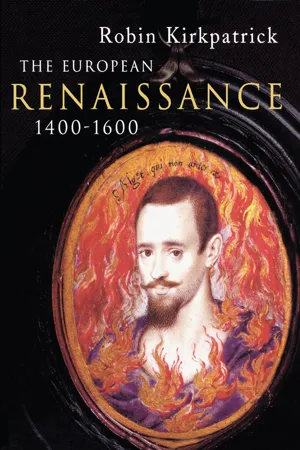
The European Renaissance 1400-1600
About this book
With Italy at its centre, but encompassing the whole of Renaissance Europe, this evocative history challenges some of the popularly-held views on the Renaissance period. In particular, whilst always acknowledging the brilliance and exhuberance of Renaissance culture, Robin Kirkpatrick draws equal attention to the strangeness and often unresolved tensions that lay beneath the surface of that culture.Insisting on a European rather than purely Italian viewpoint, he embraces Renaissance thinking and culture in all its diversity: from Northern thinkers such as Cusanus, Luther and Calvin, to the painting of Van der Weyden and El Greco, and the music of the Flemish musicians, Josquin des Prez and Orlando Lassus. Special attention is also paid to the unique contribution made by Margueritte of Navarre to the development of humanist culture. The book concludes with a study of Shakespeare in which his plays are viewed as a searching critique of some of the main principles of Renaissance culture.
part one

THOUGHT AND CONTEXT
part one
THOUGHT AND CONTEXT
chapter one
CITIES, SPACES AND INSTITUTIONS
THE PIAZZA AND POLITICAL IMAGINING
In the 1450s, Leon Battista Alberti – architect, social theorist and the author of treatises on both painting and sculpture – devised a plan for a terrace of city houses that might, in a perfect city, have surrounded the piazza of a marketplace (Fig. 7). In this design, Alberti identifies a number of the aesthetic principles that had already begun to display themselves in the construction of both civic and private buildings in Florence and that subsequently would be fundamental to the formation of Renaissance taste. In Alberti’s eyes, the function of architecture is ‘to prescribe an appropriate place, exact numbers, a proper scale and a graceful order for whole buildings and for each of their constituent parts’ so that in its siting, lineaments and angles the edifice should immediately communicate an effect of proportion (Re Aed., I, i, p. 7). Similarly, the city at large should exhibit an orchestrated relationship between buildings which, while continuing to respond to the demands of ‘convenience dignity and beauty’, also encourages the many different activities at play in the social nexus. Squares, for instance, will be designed ‘for the exposing of merchandise in times of peace but also for the exercises proper to youth and equally for the laying-up of supplies in war-time’ (ibid. IV, viii). In order to achieve such a harmony, the ambitions of citizens will of course have to be governed by a measured understanding of the whole. Such restraint, however, will not preclude an interest in ornamentation and stylish display. Columns are an especially important feature, allowing the architect to demonstrate an understanding of both mathematical proportion and classical forms of embellishment.

Figure 7 Leonbattista Alberti, Terrace to surround a Market place, from De Re Aedificatoria. VIII c.1450 (illustrated from Italian translation, C. Bartoli, 1550). This figure is reproduced by kind permission of the Syndics of the Cambridge University Library.
In architecture such as this, no less than in Ariosto’s Orlando Furioso, order and variety, display and discretion appear as prevailing characteristics of the Renaissance mentality; indeed in Alberti’s marketplace, mathematical expertise and classical erudition would have been present to the eyes of his fellow citizens, even while they were shopping. This particular marketplace was never built. But Alberti was responsible for public works in Mantua, Rimini and Rome as well Florence (Fig. 13); and his influence – combining with a renewed interest in the writings of the Roman architect, Vitruvius – spread progressively throughout Europe at large. Variations on Alberti’s Florentine formula were subsequently performed by Bramante (in the rebuilding of Papal Rome), by the Bolognese architect Sebastian Serlio (who carried Renaissance motifs to France, England and Poland), and above all by Andrea Palladio whose influence was to extend as far as eighteenth-century America.
The significance of these developments cannot be limited to the area of architectural taste. For, properly understood, the Renaissance concern with the delineation and decoration of urban space is the visible expression of an ethical and eventually political concern that animates all aspects of life, whether intellectual or social, in this period. To be human in the Renaissance is essentially to participate in the public life of the piazza. Indeed, for Alberti (drawing upon notions he discovered in Cicero) the proportions of a city should themselves reflect and magnify the proportions of the human body. Correspondingly, it is through its performance on the public stage that, as a social self, the individual discovers its true destiny. ‘Glory’, as Alberti declares, ‘is to be sought not in the realm of private leisure but in the public spaces of a city.’ The meaning of glory differs from culture to culture, sometimes being sought in monastic contemplation of divine creation, sometimes in the salon, or science laboratory. For Alberti, glory means unambiguously the excellence that human beings may cultivate in their secular existences. For him the public spaces of the city – echoing with the achievements of heroes past and present, of orators, warriors, merchants and gymnasts – is the stage on which the whole gamut of human activities are nurtured, pursued and applauded.
The City, then, is the point of intersection between theory and practice, word and deed, mind and marble and mortar. To say this is in part to emphasize that the growth of cities throughout Europe was initially fuelled by vigorous economic advances. Nor was Alberti – the builder of marketplaces – unmindful of this. On the contrary, he speaks of money itself without the least embarrassment. Money is for him a ‘bait’ but also a ‘source of nourishment’; so far from being the root of all evil, money is the lifeblood of everything that matters: ‘whoever lacks money lacks almost everything’. Money is necessary for everything. It would nonetheless be simplistic to suppose that conspicuous consumption were the catch-all explanation of Renaissance culture. Better say that there occurred in this period a unique (if highly unstable) alchemy of money and intellect. Ideas themselves will here prove saleable; but money is often no more than a catalyst, facilitating but not entering into a chain reaction of artistic and intellectual excitements.
The potentialities of Alberti’s thinking are realized as much in the imagination as in the pocket. Henceforth, visual artists were able to produce plans for ideal cities conceived with mathematical rigour on classical principles (Fig. 8); and painters such as Botticelli, Mantegna or Perugino (Fig. 9) were quick to include exuberant and sometimes fantastic representations of architecture in their paintings. Likewise, the period is rich in conceptions of Utopia or of Golden Worlds – often with reference to Plato’s Republic or to the classical pastoral; and if Shakespeare’s theatre is called the Globe, then this is because it seeks to assemble an audience in microcosm and recreate in fictional space its own understanding of the actual world. As William H. Sherman has written, there are ‘striking parallels between the “wooden O” of the Renaissance theatre and the “wooden world” of the Renaissance ship’; and exploration, trade and travel in this period would demand, alongside artistic imaginings, very considerable advances in cartography and navigational aids to encompass newly discovered territories.

Figure 8 Luciano Laurana (designer; probably painted by Piero della Francesca), View of an Ideal City, late 15th century, Panel, 60.5 × 200.5 cm. Galleria Nazionale delle Marche, Palazzo Ducale, Urbino. With permission from Scala.

Figure 9 Perugino, Christ giving the Keys to St Peter. Fresco Sistine Chapel, Rome. With permission from Scala.
In conjunction with these imaginative and scientific configurations, the Renaissance witnesses a whole series of experiments in the formation of ethical, political and religious space. Rome is reconstructed on decidedly theatrical principles; Calvin conjures up a severe Utopia on the shores of Lake Geneva; and as geographical (and ultimately astronomical) space expands under the impulse of economic and dynastic or national ambition, so political theory also develops in response to the many pressures and possibilities that were revealed in this expansion.
Around 1500, the Florentine Guicciardini declared, in a mood of panic and alienation, that there was too much space in the world; and well he might, for the spaces beyond Florence were shortly to be filled with vertiginous displays of hungry dynasticism. Conversely, at the end of the period, the political prisoner Tommaso Campanella (1568–1639) – the author of the Utopic City of the Sun, who in his own time was also described as the new Machiavelli – is happy to justify a use of all the devices of modern warfare in Imperial adventures to ensure the diffusion of knowledge and science, arguing the fundamental human right is the right to know. Since then, the Western mind has been characterized by a desire to encompass all conceivable space and fill it with the evidence of its own supposedly civilized achievement. The contradictions in this ambition are evident, as William Blake was to recognize when he raises his voice against the clangour of ‘mind-forged manacles’ that resonate in London on the banks of the ‘charted’ Thames. This was eighteenth-century London. Yet in retrospect it is by no means impossible to discern in Alberti’s Florentine commitment to mathematics and money remote anticipations of these sounds. And certainly the sounds will grow louder as one travels (in sections three, four and five of this chapter) from a court such as Urbino, to the palace of Francis I at Fontainebleau and on to the consistories and chancelleries of Geneva and Rome, observing in each place how the patterns of institutional control were intimately linked with the architectural designation of space. Alberti himself would not, however, have wished to hear this, even though his own Medici patrons were in this regard as in many others precursors of a larger European development. Alberti, throughout the early part of his life, had been an exile. He understood at first hand how hard it is for a human life to flourish in isolation from the universe of civic activities. To him, Florence was still in some measure a sacred place, where the Florentine tribe could cultivate the forms of thought and art that other generations would turn to other uses.

Figure 10 Medieval Towers of San Gimigniano, Tuscany. With permission from Scala.
THE FLORENTINE FORMULA
The Florence to which the exiled Alberti returned was changing rapidly. Its medieval cityscape – like those of most Italian cities, including Rome – had been dominated by a stark forest of towers, such as are now seen at San Gimigniano (Fig. 10). These towers were once the clan houses or strongholds of feudal families, and stood as the expression of mutual suspicion as well as of a desire to outbuild the neighbours. But insofar as the feudal nobility had begun to move into the city at all – attracted by the possibilities of merchant adventure – they also represent the beginnings of a new order.
To Dante, this moment was the cataclysmic origin of a decadent age where avarice, envy and pride would defile the sacred territory of the city, unleashing the forces that led to his exile. But the exiled Alberti a hundred years later saw things differently. From as early as the thirteenth century, Italian intellectuals – in particular Florentines such as Dante himself – had shown a profound interest in the revival of interest in Roman Law, and Ciceronian rhetoric was simultaneously a focus of intellectual attention. By the end of the fourteenth century, the city had developed a jubilant conception of its new-found possibilities. Leonardi Bruni (1370–1444), for instance – an Aretine by birth who had been drawn to Florence and eventually served as its Chancellor – writes his Laudatio Florentinae urbis of 1401 in praise of the Florentine constitution, its government and even its bureaucracy. Orsanmichele had been transformed from a commercial warehouse into a church. Masaccio and Donatello (see Figs 3 and 44–48) were now energetically at work. And most important, from Alberti’s point of view, architects were now beginning to open up and ornament the spaces of the city in a highly distinctive style.

Figure 11 Filippo Brunelleschi, Ospedale degli Innocent, begun 1419 and completed mid-15th century. Piazza della SS. Annunziata, Florence. With permission from Scala.
In particular, Filippo Brunelleschi (1377–1446) had shown a capacity to build in a manner that responded to classical models while subtly adapting these models to the interests and ambitions of contemporary Florence. In Santo Spirito he designed a Church with many of the qualities of a Roman basilica. In the Pazzi Chapel he delicately adapted Roman domestic architecture to a space that fitted the Gothic precincts of the great Franciscan Church of Santa Croce. Among the most graceful of Brunelleschi’s creations is the Foundlings Hospital with its portico of Corinthian columns (Fig. 11).
The most significant of Brunelleschi’s works, however, to speak politically as well as architecturally, is the high, red dome of the Duomo (Fig. 12). This was the largest dome to be erected since the Pantheon in Rome; and classical aspirations speak clearly in its lines. Yet its somewhat ovoid shape, along with a Gothic tension in its ascent, was also to insert itself into the vernacular memory as an inspiration to Michelangelo when he came to build the dome of St Peter’s. To Alberti, the Florentine dome was a structure ‘rising sheer above the skies, yet ample enough to cover with its shadow the people of all Tuscany, built without aid of cross beams … an artifice to surpass modern or even perhaps ancient times’. Structure and engineering skill are here accorded due appreciation. So, too, are politics and ethics: the dome encompasses the whole region of Tuscany in its protective embrace; and – as a symbol of ascendancy – even rises above the Heavens. Unlike a Gothic tower, diminishing towards the sky, this edifice articulates space, both vertical and lateral, as though the horizontal space were its own political possession.

Figure 12 Filippo Brunelleshi, The Dome at the Cathedral at Florence, 1420–1436. With permission from Scala.
Whenever Alberti speaks of churches, the term he invariably employs is the Latin – therefore profane – term ‘temple’. He also expresses a fervent desire that any modern temple should be illuminated not by ‘the feeble and guttering light of tapers’ but rather by fenestrations that could orchestrate ‘majestically’ the natural light of the sun. Yet the secularism implied in this view should not lead one to ignore a darker and more troubled obverse to Alberti’s enthusiasms. This is evident whenever he speaks – as in his satire Theogenius – ‘of how the ether is besieged by an unbelievable clamour of holy vows: Apollo’s path is encumbered, Juno’s court wholly covered by them’. Here, it seems, human stupidity defiles the purity of the pagan skies with its superstitious chantings and prayers. The suggestion must be that, secretly, Alberti entertained a desire to preserve the clarity of geometric construction from the untidy contamination of human folly.
This surreptitiously dictatorial tendency is confirmed when Alberti sets himself in Della Famiglia to celebrate the family principles that sustained the great Alberti clan in their mercantile endeavours – he himself being an illegitimate offspring. Despite a skilful employment of dialogue-form, which allows him to explore many different facets of the family ethos, Alberti speaks with unfailing admiration of the autocratic discipline exercised by the Alberti patriarchs. This is particularly evident in his discussion of the women of the family. Wives will be chosen for their virtue and for the honour they bring. They will be instructed in the secrets of the household, with the aim of enabling them, in their turn, to exert a rigorous supervision of the activities performed by lesser members of the ...
Table of contents
- Cover Page
- Half Title Page
- Front Matter
- Title Page
- Copyright Page
- Dedication
- Contents
- General Introduction
- Preface
- List of Illustrations
- Notes on the Cover
- INTRODUCTION: RENAISSANCE QUESTIONS
- Part One THOUGHT AND CONTEXT
- 1 CITIES, SPACES AND INSTITUTIONS
- 2 EDUCATION, IMITATION AND CREATION
- 3 REFORMATION AND THE RENAISSANCE INDIVIDUAL
- 4 SCIENCE, ART AND LANGUAGE: A CONCLUSION TO PART ONE
- Part Two THE ARTS
- 5 THE FIGURATIVE ARTS
- 6 LYRIC, EPIC AND PASTORAL
- 7 MUSIC
- 8 PROSE FICTION AND THEATRE
- Reference
- Index
- Back Matter
Trusted by 375,005 students
Access to over 1.5 million titles for a fair monthly price.
Study more efficiently using our study tools.
Frequently asked questions
Yes, you can cancel anytime from the Subscription tab in your account settings on the Perlego website. Your subscription will stay active until the end of your current billing period. Learn how to cancel your subscription
No, books cannot be downloaded as external files, such as PDFs, for use outside of Perlego. However, you can download books within the Perlego app for offline reading on mobile or tablet. Learn how to download books offline
Perlego offers two plans: Essential and Complete
- Essential is ideal for learners and professionals who enjoy exploring a wide range of subjects. Access the Essential Library with 800,000+ trusted titles and best-sellers across business, personal growth, and the humanities. Includes unlimited reading time and Standard Read Aloud voice.
- Complete: Perfect for advanced learners and researchers needing full, unrestricted access. Unlock 1.5M+ books across hundreds of subjects, including academic and specialized titles. The Complete Plan also includes advanced features like Premium Read Aloud and Research Assistant.
We are an online textbook subscription service, where you can get access to an entire online library for less than the price of a single book per month. With over 1.5 million books across 990+ topics, we’ve got you covered! Learn about our mission
Look out for the read-aloud symbol on your next book to see if you can listen to it. The read-aloud tool reads text aloud for you, highlighting the text as it is being read. You can pause it, speed it up and slow it down. Learn more about Read Aloud
Yes! You can use the Perlego app on both iOS and Android devices to read anytime, anywhere — even offline. Perfect for commutes or when you’re on the go.
Please note we cannot support devices running on iOS 13 and Android 7 or earlier. Learn more about using the app
Please note we cannot support devices running on iOS 13 and Android 7 or earlier. Learn more about using the app
Yes, you can access The European Renaissance 1400-1600 by Robin Kirkpatrick in PDF and/or ePUB format, as well as other popular books in History & History of Renaissance Art. We have over 1.5 million books available in our catalogue for you to explore.