It is often argued that the unification of Germany in 1871 was the inevitable result of the convergence of Prussian power and German nationalism. John Breuilly here shows that the true story was much more complex. For most of the nineteenth century Austria was the dominant power in the region. Prussian-led unification was highly unlikely up until the 1860s and even then was only possible because of the many other changes happening in Germany, Europe and the wider world.
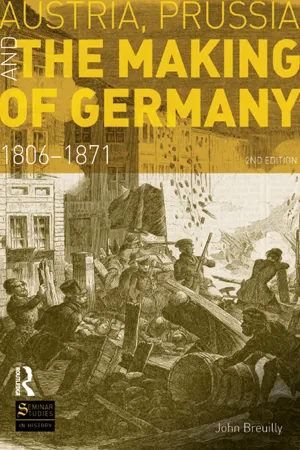
- 240 pages
- English
- ePUB (mobile friendly)
- Available on iOS & Android
eBook - ePub
Part One
ANALYSIS
1
Introduction
THE SETTING
Between 1805 and 1807 Austria and then Prussia suffered defeat in war with France. Prussia was reduced to a rump state east of the Elbe. Austria was reduced to her core territories in south-east Europe, and lost more territory with yet another defeat in 1809. Much of the remainder of the German lands was organised into the Confederation of the Rhine (henceforth Rheinbund) under the protection of Napoleon. (See Chronology; Docs 1, 2, 4, pp. 116, 117, 120; and compare Maps 1 and 2.) The struggle for supremacy in Germany had apparently been settled and the winner was – France!
This book considers how Austria and Prussia by 1815 had recovered great power status, wrestling supremacy in Germany away from France and reorganising the German lands. Thereafter the focus is upon how cooperative domination of Germany by Austria and Prussia alternated with phases of competition or loss of control and ended with a war between them for supremacy. In this introduction I sketch the pre-1806 relationships between Austria, Prussia and Germany, outline various approaches towards the subject and explain how the book is arranged.
THE BACKGROUND
For the period from Napoleon until the Austro-Prussian war of 1866, Austria and Prussia were allied German powers and France their principal enemy. This was not the case earlier. Between 1740 and 1792 Prussia and Austria were opponents, fighting two wars (1740–48, 1756–63). In the first war Prussia allied with France and Austria with Britain; in the second war the alliances switched with Britain backing Prussia and France supporting Austria. Austria and Prussia were the two leading members of the Holy Roman Empire of the German Nation but this ‘Germany’ was just one part of Europe in which they fought for power, albeit often by manipulating imperial institutions rather than through alliances and war (Schroeder 1994, chap. 1).
Austria and Prussia were briefly allies in 1792 against revolutionary France. Prussia effectively left that war in 1794, making a separate peace with France in 1795 which lasted until 1806. While Austria fought further wars against France until 1809, Prussia enjoyed peace and territorial expansion until her catastrophic defeat in 1806–7. Both states exploited the dismembering of the Empire between 1797 and 1803. These two states were not natural allies in defence of either Germany or their own interests against France (Simms 1998, chaps 2 and 3). Rather they were dynasties with interests in power and prestige both within and beyond the German lands. Austria is well known for being multi-national but Prussia also had a significant minority of non-German speaking subjects, especially Poles.
In the later eighteenth century the combined impact of Polish partition and French revolution weakened France and strengthened Russia, which expanded into central Europe and came to share extensive frontiers with Austria and Prussia. They had to worry as much, if not more, about their Russian neighbour as about France or each other. Britain was the fifth, more distant, power, with German interests through the Hannoverian connection and concerns about Baltic trade but, more importantly, concerned to prevent any one power challenging its overseas interests or dominating Europe. This meant an anti-French orientation until well beyond 1815 as well as a growing concern about Russia. (See Schroeder 1994 for international relations to 1848.)
The German lands apart from Austria and Prussia, organised in the Holy Roman Empire, constituted an ‘intermediate zone’, that is a region which separated major powers from one another. The reduction of such zones to the direct control of one power could be destabilising because it brought major powers directly up against one another, as the Polish partitions had done with Austria, Prussia and Russia. Sometimes, in order to avoid such direct contact, a major power might prefer to exercise indirect influence rather than take over territory. Sometimes an intermediate zone was preserved as an area of neutrality or contest between two or more major powers. Switzerland is a good example. Sometimes such a zone was created as a neutral area, arguably the case with the Netherlands after 1815 and then Belgium when it was recognised following an uprising against Dutch rule in 1830.
Clearly, the Holy Roman Empire, divided into hundreds of political units, was not a state. It did have provisions for making diplomacy and war but these were of minor importance. More importantly, it was what has been described as a legal or peace order, providing institutions for handling disputes between its members and between rulers and subjects. At elite level it was associated with a certain kind of German ‘patriotism’ which Austria and Prussia sometimes claimed to represent when in conflict with one another and seeking support from within the Empire (Gagliardo 1980; Wilson 1999 and 2004).
The formal destruction of the Holy Roman Empire in 1806 had several consequences. First, a number of medium-sized states were created which pursued more ambitious policies than their smaller and more numerous predecessors. Of these the most important which survived into the post-1815 period were the newly created kingdoms of Bavaria and Württemberg as well as the established kingdom of Saxony, the Grand Duchy of Baden and the Landgravate of Hesse-Darmstadt, as well as the restored state of Hannover. Second, the Rheinbund, which replaced the Empire, was a Napoleonic creation designed for the extraction of money and soldiers.
Admirers of what had been achieved have emphasised the first of these consequences, seeing in these medium states the basis for a modern and progressive Germany preferable to Prussian, Austrian or foreign domination. They point to the many reforms these states introduced during the Napoleonic period and how constitutional advance and liberal movements developed most strongly in these parts of Germany after 1815. By contrast, critics stress the second consequence, contending that the new states were Napoleonic lackeys and that their preservation after 1815 allowed the selfish ‘particularism’ of this ‘third Germany’ to work as an obstacle to greater national unity and independence. (No one before 1815 and few for some time after 1815 seriously contemplated a single state but there were many calls for greater coordination by a federal authority in military, tariff and foreign policy spheres.) (On the Napoleonic impact on a European scale, see Broers 1996; Ellis 1996; Woolf 1991. Specifically for Germany, see Nipperdey 1996, chap. 1; Sheehan 1989: 253–74. The negative view was strongly argued by the ‘Prussian school’ of historians from the later nineteenth century: see Berger 1997 and Iggers 1969.)
Whatever view one takes, it is difficult to deny that initially the Rheinbund was the brutal creation of power imposed from above, made with little reference to dynastic, ethnic or confessional traditions. The new states remained subject to arbitrary will, embodied in the restless, amoral and ruthless figure of Napoleon (Dwyer and Forrest 2007). However, what was at stake was not simply who held power, but also the principles on which states should be organised and relate to one another. There always was a ‘German’ political system, from empire to Rheinbund to Deutsche Bund, not just a collection of states.
The terms ‘Austria’, ‘Prussia’ and especially ‘Germany’ are elusive. They refer to political entities which underwent constant territorial and institutional change and shifts in relationships both amongst themselves and with the rest of Europe. To make matters more complicated the terms also refer to ideas which people held about them and what it meant to be a German, Austrian or Prussian. In order to understand how ‘Austria’ and ‘Prussia’ regained great power status and how this in turn could lead to a struggle between them for supremacy in ‘Germany’, we need to clarify some of these terms and consider different approaches taken by historians.
HISTORIOGRAPHY
In 1866 Austria and Prussia fought a war for supremacy in Germany which Prussia won decisively. Prussian triumph over France in 1870–71, in alliance with the other German states except Austria, led to the formation of the German Second Empire, in many ways the basis of present-day Germany. In 1871 the Habsburg government accepted the impossibility of reversing the outcome of 1866. Knowledge of Prussian success conditions the way historians look at previous chapters of the story. There is the danger of reading the ending back into those earlier stages. Indeed, the use of such words as ‘chapters’ or ‘stages’ implies as much. Already by the 1850s and with increased influence after 1871, the ‘Prussian school of history’ presented Prussia as destined to play the role of maker of the German nation-state (Berger 1997; Iggers 1969; Breuilly and Speirs 2005).
Yet to an observer in 1807 such an outcome would have appeared incredible, not only because France was so dominant but also because Prussia was in an even more desperate state than Austria. If ever there was an improbable story-line, it is of the transformation of Prussia literally within one lifetime from a defeated, truncated bankrupt to the triumphant creator of modern Germany. Prince William was ten years old when the Peace of Tilsit was signed; in 1871 he had seventeen years still to reign as King of Prussia and German Emperor. (On Prussian history see Clark 2006.)
Yet it would equally be a mistake to see the story as a series of accidents, a race in which the best or luckiest driver stays on the track while others, perhaps with better cars, crash, spin off, run out of fuel or break down. For some historians the conflict between Prussia and Austria remained open to different outcomes right up to the ‘accident’ of 1866. For other historians this unfortunate accident in some sense derailed the ideal or expected course of events by subordinating the German nation to the power of the Prussian state. Prussia needed luck and good drivers but we must also consider the nature of the struggles and the strengths and weaknesses of the various competitors if we are to make intelligent evaluations of these different views. In order to do this we have to identify the nature of the competition.
In focusing on the relationship between the two major German powers, broadly there are three levels at which analysis can be pitched: Europe, Germany, the two states of Austria and Prussia. That analysis needs to take into account military, diplomatic, political, economic, cultural, intellectual and social history.
For a long time the emphasis in historical writing was on diplomacy and war, partly because these were strong interests amongst late nineteenth- and early twentieth-century historians but also these were obviously crucial ingredients in the unification of Germany. From 1806 to 1815 the main concern was with war, the turning-point coming with Napoleon’s invasion of Russia in 1812, the construction of a grand alliance against France in 1813 and the capacity of Austria and Prussia to put large and effective armies into the war effort, so ensuring a prominent place for themselves at the peace settlement. There was no war between European powers between 1815 and 1854, so attention shifted to diplomacy. Following the Crimean War in 1854, there was war in 1859 between France (allied with Piedmont) and Austria and then the three wars known retrospectively as the wars of German unification. At its ‘purest’ this focus on war and diplomacy considers Austria and Prussia as states seeking to maintain or increase their power against one another, and Germany as a specific zone within which they competed. The approach can take on a personal form, stressing the superiority of Bismarck over his diplomatic counterparts in Vienna, Paris and elsewhere, or of Moltke over those in command of Austrian and French armies. (The classic study which coined the term ‘struggle for supremacy’ is Friedjung 1966.)
Historians of political ideas and culture object that this is too narrow a view. States are not mechanical objects which seek ‘power’ by whatever method seems appropriate. Individuals, no matter how great, have to achieve key positions and control the right resources to succeed. These individuals and the states within which they operate need to be understood as arising out of conflicts between groups of people who have assumptions and passions about what they want to achieve. In particular we must examine such assumptions and passions in relation to German nationalism.
Napoleonic domination evoked nationalist resistance. From 1815 onwards nationalist sentiment influenced, or even directly shaped, policy-making. By 1860 nationalism in Germany and elsewhere was sufficiently strong to make the pursuit of any overtly anti-national policy difficult, if not impossible. Prussia was better placed than Austria to hitch itself to the national wagon because it had much less in the way of non-German territories or interests. However, this same nationalism turned Prussian success from territorial aggrandisement of the kind pursued by Frederick the Great into national unification, providing the popular legitimacy that German princes had lacked. Bismarck may have thought he was manipulating nationalism but without it, at the very least, his achievement cannot be understood. (For general studies of German nationalism, see Breuilly 1992, 1996; Hughes 1988; Schulze 1991.)
But why did nationalism develop? Why was Prussia able to forge links with nationalism and to organise its diplomacy and war-making so as to effect national unification rather than Prussian expansion? How far could the ‘third Germany’ influence events, in alliance with nationalism? ‘Nationalism’ is as problematic a driving force behind German unification as ‘Prussia’ or ‘Bismarck’. (For general debates, see Özkirimli 2010; Smith 1998.)
Some historians have explained unification in terms of economic and social changes. The trend towards an urban and industrial society with increased social and geographical mobility provided the basis for the growth of national consciousness and made political fragmentation appear obsolete (Gellner 2006). Prussia’s leading role in such modernisation arguably provided it with both the inclination and capacity to lead the way to national unification. For others, such a view echoes the Prussian-centred approach with its air of inevitability, only now based on social and economic rather than diplomatic and military history, a view captured in the comment by John Maynard Keynes that Germany was unified not by ‘blood and iron’ but by ‘coal and iron’. (See Böhme 1974 as an example of this approach. Some of the extracts, e.g. Document 45, are taken from translations of a document selection made by Böhme with a similar approach in mind.) Within this socio-economic framework, other historians have argued for other possibilities of forging closer links between German states, whether through Austria or the medium-sized states or the emergence of a powerful national movement led by modernising middle-class elites. (For revisionist views of Austrian economic history, see Huertas 1977 and Komlos 1983.) One could argue that such links did not have to take the form of a single state under the domination of Prussia or Austria but could have been within a federalist framework (as in Sw...
Table of contents
- Cover Page
- Half Title page
- Title Page
- Copyright Page
- Introduction to the series
- Contents
- Publisher's acknowledgements
- Author's acknowledgements
- Chronology
- Who's who
- Glossary
- Map
- Part One Analysis
- Part Two Documents
- Guide to Further Reading
- Bibliography
- Index
Trusted by 375,005 students
Access to over 1.5 million titles for a fair monthly price.
Study more efficiently using our study tools.
Frequently asked questions
Yes, you can cancel anytime from the Subscription tab in your account settings on the Perlego website. Your subscription will stay active until the end of your current billing period. Learn how to cancel your subscription
No, books cannot be downloaded as external files, such as PDFs, for use outside of Perlego. However, you can download books within the Perlego app for offline reading on mobile or tablet. Learn how to download books offline
Perlego offers two plans: Essential and Complete
- Essential is ideal for learners and professionals who enjoy exploring a wide range of subjects. Access the Essential Library with 800,000+ trusted titles and best-sellers across business, personal growth, and the humanities. Includes unlimited reading time and Standard Read Aloud voice.
- Complete: Perfect for advanced learners and researchers needing full, unrestricted access. Unlock 1.5M+ books across hundreds of subjects, including academic and specialized titles. The Complete Plan also includes advanced features like Premium Read Aloud and Research Assistant.
We are an online textbook subscription service, where you can get access to an entire online library for less than the price of a single book per month. With over 1.5 million books across 990+ topics, we’ve got you covered! Learn about our mission
Look out for the read-aloud symbol on your next book to see if you can listen to it. The read-aloud tool reads text aloud for you, highlighting the text as it is being read. You can pause it, speed it up and slow it down. Learn more about Read Aloud
Yes! You can use the Perlego app on both iOS and Android devices to read anytime, anywhere — even offline. Perfect for commutes or when you’re on the go.
Please note we cannot support devices running on iOS 13 and Android 7 or earlier. Learn more about using the app
Please note we cannot support devices running on iOS 13 and Android 7 or earlier. Learn more about using the app
Yes, you can access Austria, Prussia and The Making of Germany by John Breuilly in PDF and/or ePUB format, as well as other popular books in History & 19th Century History. We have over 1.5 million books available in our catalogue for you to explore.