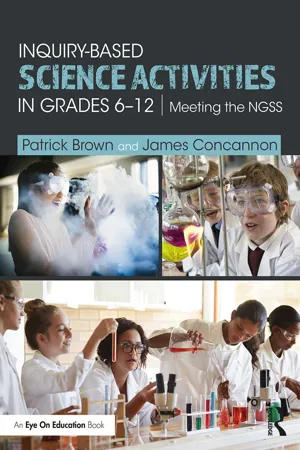
This new book shows middle and high school science teachers how to use evidence-based inquiry to help students achieve deeper conceptual understanding. Drawing on a wealth of research, authors Pat Brown and Jim Concannon demonstrate how direct, hands-on experience in the science classroom can enable your students to become more self-reliant learners. They also provide a plethora of model lessons aligned with the Next Generation Science Standards (NGSS) and offer advice on how to create your own lesson plans and activities to satisfy the demands of your curriculum. With the resources in this book, you and your students will be able to ditch the textbook and embark upon an exciting and rewarding journey to scientific discovery.
eBook - ePub
Inquiry-Based Science Activities in Grades 6-12
Meeting the NGSS
- 124 pages
- English
- ePUB (mobile friendly)
- Available on iOS & Android
eBook - ePub
About this book
Information
1
What Are the Features of Evidence-Driven Inquiry?
Kids love to explore the world and explain how nature works. They form ideas about the causes for the changing of the seasons, create theories about the phases of the moon, and try to describe why they have some physical characteristics like their parents. These are just a few of the many science areas that students have ideas about based on their experiences. Students at a very early age think logically about their environment and look for patterns and relationships to form explanations for science. Regardless of the accuracy of their ideas, students’ immediate experiences are the basis for how they know and understand the world they live in.
While students’ scientific understandings can be a great starting point for instruction, they can also act as barrier for gaining knowledge. Research in the cognitive sciences and science education demonstrate the implications of students’ prior knowledge, and particularly their misconceptions, on learning (Bransford, Brown, and Cocking 2000; Donovan and Bransford, 2005). Prior knowledge is an important consideration in teaching, and students’ incoming ideas, including misconceptions, must be addressed in order for them to gain more accurate and complete science understanding. In fact, many resources are dedicated to identifying typical misconceptions in many different science disciplines (see Driver, Squires, and Wood-Robinson 1994) and several books offer engaging ways to elicit students’ science views (see Keeley and Tugel 2009; Keeley, Eberle, and Dorsey 2008; Keeley, Eberle, and Farrin 2005; Keeley, Eberle, and Tugel 2007). The reason why prior knowledge is so important in teaching relates back to the early 1980s and conceptual change research. This continued line of research clearly shows that the most powerful and influential instructional sequences require a purposeful interaction between students’ incorrect or partially incomplete ideas and direct experiences to develop more plausible, intelligible, and fruitful explanations (Posner et al. 1982). For students to accommodate new information, they must first become dissatisfied with their current conceptions, and this is achieved by teachers providing opportunities for students to collect data and scientific evidence that cannot be explained when students rely upon their incomplete understandings. Learning facts is not enough to improve students’ understanding of science. To understand science, students need opportunities to view new ideas in broader contexts of meaning.
From a conceptual change perspective, instruction should start with assessing students’ incoming ideas. If a teacher’s entry point into a lesson does not begin with students’ prior knowledge, conceptual misunderstandings may arise whereby students simply assimilate new information into their existing inaccurate foundation of knowledge (National Research Council 1997; Posner et al. 1982). By knowing students’ prior knowledge and experiences, teachers can choose the best types of experience to create dissatisfaction for incorrect ideas so that students can begin to construct conceptions that are more accurate. The best experiences are ones whereby students are provided with evidence-based experiences. Because students have great capacity to reason at very sophisticated levels from teaching approaches that productively scaffold their developing content knowledge and science reasoning skills, how teachers provide “hands-on” science for students requires deeper exploration.
Evidence-Driven Inquiry
If the ultimate goal is for students to derive understanding from experiences, then we must carefully consider our professional practices. While hands-on learning can naturally be engaging for students, the experiences must be carefully weaved into the flow of instruction to produce the desired outcomes. What are the desired incomes? An important finding from America’s Lab report is that many students view science as a “false dichotomy,” meaning that students think that the hands-on, “doing” part of science is separate from content (Singer, Hilton, and Schweingruber 2006). As a result, the desired outcomes are for students to discard incorrect ideas, accept the most accurate scientific explanations, and for students to learn the nature by which these science explanations are generated. Evidence-driven inquiry allows teachers to meet these goals by first providing students with immediate experiences to form accurate understandings; and second, by connecting student’s claims to scientifically accepted explanations. Connections are established when teachers purposefully link evidence from explorations to evidence-based explanations. Explanations can be further supported by lecture, readings, and discussions. In sum, evidence-driven inquiry requires a special combination of students’ evidence-based experiences, students’ scientific claims, and the teacher connecting students’ claims to our current understandings of science phenomena. Three interrelated educational ideas, referred to here as “path-ways,” are catalysts for promoting evidence-driven inquiry.
Pathway 1: Sequencing Science Instruction
Science instruction should be sequenced where students explore prior to teachers introducing science terminology, ideas, or concepts. The learning cycle is an approach where students explore prior to any introduction of science terminology or formal explanation. The learning cycle includes three sequential phases (1) exploration, (2) invention (term introduction), (3) discovery (concept application) (Karplus and Their 1967). The learning cycle was initially created to align to Piagetian stages of assimilation, disequilibrium, and accommodation (Treagust and Tsui 2014). When employing the learning cycle, students have experiences with data (exploration) that is then used by them to construct accurate evidence-based claims (student portion of invention phase). Students’ evidence-based claims are the foundation for their understanding and used to introduce key science terms, concepts, and supporting ideas (teacher portion of invention phase). Once students have constructed knowledge and have authoritative explanations (e.g., teacher lectures, textbook readings, discussions, etc. that occur during the teacher portion of the invention phase), they are given the opportunity to practice and test out new knowledge in new and different situations (discovery phase). Thus, the learning cycle places primacy on students’ exploratory experiences from which they construct some aspect of science knowledge at a conceptual level. Student-constructed knowledge is used as an “anchor” for learning related topics. Studies have compared the learning cycle to variations that sequence the teachers’ explanation and the beginning of instruction and use investigations to verify provided ideas. As result of a learning cycle process, students use science vocabulary accurately and can explain valid and reliable ways to generate ideas about their everyday world. This line of scholarship shows the learning cycle sequence to be more effective at promoting science achievement, motivation, and encouraging scientific reasoning than any other variation (Abraham 1992; Abraham and Renner 1986; Gerber, Cavollo, and Marek 2001; Purser and Renner 1983; Renner, Abraham, and Birnie 1988). Since the initial invention of the learning cycle, other models have been created that retain the exploration before explanation sequence such as the POE (Predict, Observe, and Explain) and the 5Es (Engagement, Exploration, Explanation, Elaboration, and Evaluation) (Bybee 1997). By sequencing lessons using an Explore before Explain instruction sequence, teachers can create a student-centered learning environment where students ask questions, plan and conduct investigations, gather data, and make evidence-based explanations.
Pathway 2: Wedding Science Content with Practices
Evidence-based inquiry is an approach where students seamlessly learn science content and the nature by which scientific knowledge is produced in valid and reliable ways. The nature by which scientific knowledge is produced has long been an important learning standard. The practices of how science knowledge is developed has been termed “inquiry” and is described by the National Research Council (NRC 2000) as consisting of five essential features:
- The learner engages in scientifically oriented questions.
- The learner gives priority to evidence.
- The learner formulates explanations based on evidence.
- The learner connects explanations to scientific knowledge.
- The learner communicates and justifies explanations.
The five essential features of inquiry describe the interconnected processes that scientists use to describe the natural world. In teaching, inquiry is a multifaceted activity that requires students to use critical thinking skills and make connections between evidence and scientific knowledge.
Three perspectives of inquiry include science teachers’ implementation of essential features of inquiry into instruction, students learning science in an inquiry-based classroom, and students learning about scientific inquiry (Lederman and Niess 2000). Students are motivated in an inquiry classroom because they perceive instruction as relevant, transferable, and useful in future problem-solving situations (Anderson 1997). Though inquiry is much more complex than hands-on science activities (Crawford 2000), studies have found that hands-on is a critical component and improves students’ attitudes and student achievement (Freedman 1997). Studies also show that inquiry-based instruction helps close the gender, ethnic, and socioeconomic status gap with respect to science achievement (Von Secker and Lissitz 1999).
Arguably, one can perceive that scientific inquiry is at the core of science literacy (Songer, Lee, and McDonald 2003) whereby students are engaged in scientifically oriented questions, explore ideas, develop procedures, and make evidence-based decisions in relation to current scientific theory (Newman et al. 2004). Crawford (2000) explains that significant components of an effective inquiry-based classrooms are: “instruction situated in authentic problems; (teachers and students) focus on grappling with data, collaboration of students and teacher, connections with society, teacher modeling behaviors of scientists, and development of student ownership” (p. 933). Teachers have to take on multiple roles to achieve this, a few being a motivator, guide, modeler, learner, and collaborator (Crawford 2000).
Inquiry in the classroom spans a continuum ranging from structured to guided, and from guided to open/independent (Windschitl 2003). A structured approach would be more appropriate for incorporating inquiry with a classroom of younger or inexperienced learners. Structured inquiry requires more facilitation and guidance from the teacher whereby the problem, methods of investigation, and the answers are provided by the teacher (Schwab 1962; Herron 1971). Though structured inquiry requires much more teacher facilitation, the role of the teacher is not to provide a verification-type experience. Verification occurs when science teachers explain the expectations of an activity or a laboratory. The sure-sign of verification is when a science teacher says, “This is what you should expect if you do the lab right.”
At the other end of the spectrum, open inquiry requires less direction from the teacher and more decisions to be made by students. In open inquiry, students are more responsible for developing and carrying out their own independent scientific investigations in a process that is much more intellectually challenging for learners (Windschitl 2003). Walking into a classroom where learners are engaged in open inquiry, one would see multiple elements of authentic scientific research in the classroom. From students developing research questions, creating procedures and models, collecting data, using data as evidence for assertions, evaluating the reliability and validity of the data collection process, to considering various aspects of error and ways to limit error in the procedure are just a few possible accounts of how students would be engaged in undertaking science.
Pathway 3: Using Science Phenomena as the Foundation for Learning
A third component in promoting evidence-driven inquiry is honing in on the phenomena that students explore. The idea behind phenomena-based teaching is to focus students’ experiential learning on science experiences that lead to wonderment about the natural world. Beneficial explorations invoke curiosity and promote investigations that produce empirical data or qualitative observation and accurate evidence-based claims. In addition, meaningful science phenomena are complex ent...
Table of contents
- Cover
- Title
- Copyright
- Dedication
- Contents
- List of Figures
- List of Tables
- Meet the Authors
- Acknowledgements
- Introduction
- 1. What Are the Features of Evidence-Driven Inquiry?
- 2. Next Generation Science Standards (NGSS)
- 3. Model Lesson 1: How Thin Is Foil? Applying Density to Find the Thickness of Aluminum Foil
- 4. Model Lesson 2: An Interdisciplinary Theme: Topographic Maps and Plate Tectonics
- 5. Model Lesson 3: Students' Use of the PSOE Model to Understand Weather and Climate
- 6. Model Lesson 4: Teaching Bernoulli's Principle through Demos
- 7. Model Lesson 5: Gravity Is Easy to Understand, Right? The Difference between Calculating and Comprehending
- 8. Model Lesson 6: Students' Investigations in Temperature and Pressure
- 9. Model Lesson 7: 2-Liter Bottles and Botanical Gardens: Using Inquiry to Learn Ecology
- 10. Model Lesson 8: Students Conceptualizing Transcription and Translation from a Cellular Perspective
- 11. Model Lesson 9: Are You Teaching Your Students about Stem Cells?
- 12. Model Lesson 10: Transforming Osmosis: Labs to Address Standards for Inquiry
- 13. Lessons Learned
Trusted by 375,005 students
Access to over 1.5 million titles for a fair monthly price.
Study more efficiently using our study tools.
Frequently asked questions
Yes, you can cancel anytime from the Subscription tab in your account settings on the Perlego website. Your subscription will stay active until the end of your current billing period. Learn how to cancel your subscription
No, books cannot be downloaded as external files, such as PDFs, for use outside of Perlego. However, you can download books within the Perlego app for offline reading on mobile or tablet. Learn how to download books offline
Perlego offers two plans: Essential and Complete
- Essential is ideal for learners and professionals who enjoy exploring a wide range of subjects. Access the Essential Library with 800,000+ trusted titles and best-sellers across business, personal growth, and the humanities. Includes unlimited reading time and Standard Read Aloud voice.
- Complete: Perfect for advanced learners and researchers needing full, unrestricted access. Unlock 1.5M+ books across hundreds of subjects, including academic and specialized titles. The Complete Plan also includes advanced features like Premium Read Aloud and Research Assistant.
We are an online textbook subscription service, where you can get access to an entire online library for less than the price of a single book per month. With over 1.5 million books across 990+ topics, we’ve got you covered! Learn about our mission
Look out for the read-aloud symbol on your next book to see if you can listen to it. The read-aloud tool reads text aloud for you, highlighting the text as it is being read. You can pause it, speed it up and slow it down. Learn more about Read Aloud
Yes! You can use the Perlego app on both iOS and Android devices to read anytime, anywhere — even offline. Perfect for commutes or when you’re on the go.
Please note we cannot support devices running on iOS 13 and Android 7 or earlier. Learn more about using the app
Please note we cannot support devices running on iOS 13 and Android 7 or earlier. Learn more about using the app
Yes, you can access Inquiry-Based Science Activities in Grades 6-12 by Patrick Brown,James Concannon in PDF and/or ePUB format, as well as other popular books in Education & Education General. We have over 1.5 million books available in our catalogue for you to explore.