Nursing & Health Survival Guide: Palliative Care
eBook - ePub

Nursing & Health Survival Guide: Palliative Care

  1. 80 pages
  2. English
  3. ePUB (mobile friendly)
  4. Available on iOS & Android
eBook - ePub

Nursing & Health Survival Guide: Palliative Care

About this book

This easy-to-use guide provides a quick reference to the principles of palliative and end-of-life care for adults, to help you enable your patients to not only die peacefully but also live until they die.

The Nursing & Health Survival Guides have evolved - take a look at our our app for iPhone and iPad.
Frequently asked questions

Yes, you can cancel anytime from the Subscription tab in your account settings on the Perlego website. Your subscription will stay active until the end of your current billing period. Learn how to cancel your subscription.
No, books cannot be downloaded as external files, such as PDFs, for use outside of Perlego. However, you can download books within the Perlego app for offline reading on mobile or tablet. Learn more here.
Perlego offers two plans: Essential and Complete
  • Essential is ideal for learners and professionals who enjoy exploring a wide range of subjects. Access the Essential Library with 800,000+ trusted titles and best-sellers across business, personal growth, and the humanities. Includes unlimited reading time and Standard Read Aloud voice.
  • Complete: Perfect for advanced learners and researchers needing full, unrestricted access. Unlock 1.4M+ books across hundreds of subjects, including academic and specialized titles. The Complete Plan also includes advanced features like Premium Read Aloud and Research Assistant.
Both plans are available with monthly, semester, or annual billing cycles.
We are an online textbook subscription service, where you can get access to an entire online library for less than the price of a single book per month. With over 1 million books across 1000+ topics, we’ve got you covered! Learn more here.
Look out for the read-aloud symbol on your next book to see if you can listen to it. The read-aloud tool reads text aloud for you, highlighting the text as it is being read. You can pause it, speed it up and slow it down. Learn more here.
Yes! You can use the Perlego app on both iOS or Android devices to read anytime, anywhere — even offline. Perfect for commutes or when you’re on the go.
Please note we cannot support devices running on iOS 13 and Android 7 or earlier. Learn more about using the app.
Yes, you can access Nursing & Health Survival Guide: Palliative Care by Heather Campbell in PDF and/or ePUB format, as well as other popular books in Medicine & Nursing. We have over one million books available in our catalogue for you to explore.

Information

Publisher
Routledge
Year
2014
eBook ISBN
9781317905837
Edition
1
Subtopic
Nursing

What is palliative care?

The term palliative is derived from the Latin verb palliare which means ‘to cloak’.
Reference / Regnard, C.F.B. and Kindlen, M. (2002) Supportive and Palliative Care in Cancer. Abingdon: Radcliffe Medical Press.
The most widely recognised definition is that of the World Health Organization (WHO 2002) and examines the needs of the adult patient:
Palliative care is an approach that improves the quality of life of patients and their families facing the problems associated with life-threatening illness, through the prevention and relief of suffering by means of early identification and impeccable assessment and treatment of pain and other problems, physical, psychosocial and spiritual.
Palliative care:
  • Provides relief from pain and other distressing symptoms
  • Affirms life and regards dying as a normal process
  • Intends neither to hasten nor postpone death
  • Integrates the psychological and spiritual aspects of patient care
  • Offers a support system to help patients live as actively as possible until death
  • Offers a support system to help the family cope during the patient’s illness and in their own bereavement
  • Uses a team approach to address the needs of patients and their families, including bereavement counselling, if indicated
  • Will enhance quality of life, and may also positively influence the course of illness
  • Is applicable early in the course of illness, in conjunction with other therapies that are intended to prolong life, such as chemotherapy or radiation therapy, and includes those investigations needed to better understand and manage distressing clinical complications
Reference / http://www.who.int/cancer/palliative/definition/en/

■ When does Palliative Care Begin?

Reflection
Consider a situation where palliative care may be used for a patient who may not have a diagnosis of a life-limiting illness.
Support from the palliative care team may sometimes be needed for pain management postoperatively or to provide psychological support for patient and family in the event of a sudden unexpected death.
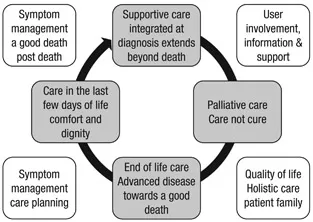
However, palliative care is part of the longer term support that should be offered to patients and families with life-limiting illness when care rather than cure is the emphasis:
  • Supportive care
  • End of life care
  • Care in the last few days of life
They contribute to providing a seamless pathway and share the following characteristics:
  • Enhancing quality of life
  • Enabling autonomy and control in decisions
  • Ensuring holistic care and symptom management
fig0001
  • Encouraging a multidisciplinary approach
  • Extending to include family care
Summary
  • Palliative care aims to improve quality of life when cure for a life-limiting condition is generally no longer an option
  • It is part of a broader approach to care to support patient and family on their illness journey
  • It includes care at the end of life and after death
‘Palliative care is about putting life into a patient’s days not days into their lives.’
Nairobi Hospice

■ National Policy

fig0002
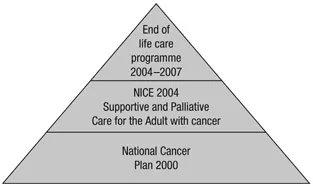
Key points
  • Policy that has influenced palliative care initially started with cancer
  • Policy identified the importance of patient choice
  • Policy recommended the importance of integrated health and social care
  • Policy recommended the use of systems and processes to optimise care

End of Life Care Strategy

The End of Life Care Strategy (Department of Health 2008) evolved from the End of Life Care programme. In summary it:
  • Emphasised the importance of patient choice particularly around place of care at end of life
  • Promoted the increased use of end of life care tools
  • Recognised the need for all those with life-limiting illness to receive appropriate support and care
  • Recognised the need to work towards enabling a good death
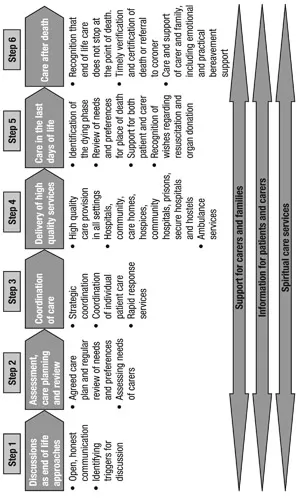
It anticipated that this could be achieved by developing an end of life care pathway with six key steps (see p. 6).
Reference / Department of Health (2008) End of Life Care Strategy – Promoting high quality care for all adults at the end of life. London: DH Publications.
Reflection
What do you notice about the steps of the pathway?
You may have noticed a number of things but the start of the pathway rests with having conversations about the future and the timing of these.

End of Life Care Strategy, DH 2008, with six key steps

fig0003
Determining end of life may not always be straightforward because each life-limiting condition has its own disease trajectory. A disease trajectory is a recognised general pattern of how certain life-limiting conditions progress over time. Some chronic conditions like end-stage heart failure and respiratory disease have acute episodes which are often interspersed with long periods of stability which mean that estimating when patients are at end of life may be more difficult.
The cancer trajectory, however, has been described as a steady progression but then a steep decline which usually ends in death and a point where end of life may be estimated.
Action
Read more about disease trajectories and prognostic indicators at www.goldstandardsframework.org.uk
...

Table of contents

  1. Cover
  2. Title
  3. Copyright
  4. contents
  5. INTRODUCTION
  6. WHAT IS PALLIATIVE CARE?
  7. THE PATIENT JOURNEY
  8. ROLE OF THE NURSE
  9. COMMUNICATION IN PALLIATIVE CARE
  10. HOLISTIC ASSESSMENT
  11. SYMPTOM MANAGEMENT
  12. PAIN MANAGEMENT
  13. NAUSEA AND VOMITING
  14. BREATHLESSNESS
  15. CONSTIPATION
  16. FATIGUE
  17. CARE AT END OF LIFE
  18. SYMPTOMS AT END OF LIFE
  19. A GOOD DEATH
  20. CARE IN THE LAST FEW WEEKS, DAYS, HOURS
  21. SUPPORTING FAMILY AND CARERS
  22. LOOKING AFTER SELF
  23. USEFUL WEBSITES