eBook - ePub
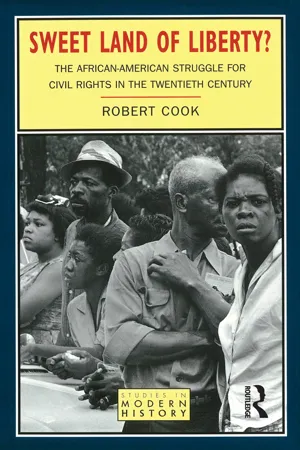
Sweet Land of Liberty?
The African-American Struggle for Civil Rights in the Twentieth Century
- 336 pages
- English
- ePUB (mobile friendly)
- Available on iOS & Android
eBook - ePub
Sweet Land of Liberty?
The African-American Struggle for Civil Rights in the Twentieth Century
About this book
A powerful and moving account of the campaign for civil rights in modern America. Robert Cook is concerned less with charismatic leaders like Martin Luther King, and more with the ordinary men and women who were mobilised by the grass-roots activities of civil-rights workers and community leaders. He begins with the development of segregation in the late nineteenth century, but his main focus is on the continuing struggle this century. It is a dramatic story of many achievements - even if in many respects it is also a record of unfinished business.
Chapter 1

Change and Continuity in the Jim Crow South
The main target of the civil rights movement between 1955 and 1965 was the system of de jure segregation which underpinned the second-class citizenship of African Americans in the southern states. No understanding of the black freedom struggle is possible without an awareness of how the southern caste system developed over time and a recognition that the system was neither monolithic nor entirely immutable.
Reconstruction and the post-Civil War South
The crushing military defeat of the Confederacy in the spring of 1865 settled two outstanding questions. Firstly, it preserved the American Union, President Abraham Lincoln’s ‘last, best hope of earth’ for which so many northern volunteers had fought and died.1. Although southern whites would continue to regard themselves in a somewhat different light from other Americans, they would never again be in a position to launch a serious bid for nationhood. Secondly, while the war was fought to save the Union and not to free the slaves, it did result in the liberation of four million black bondsmen and women who had provided the bulk of the labour force in the antebellum South’s vibrant cotton economy.
What the Civil War failed to do was provide equal citizenship for the so-called freedmen. True, Republican-dominated Congresses took steps in this direction by passing the Fourteenth and Fifteenth Amendments to the Constitution. Supported by moderate and Radical members of the Republican Party and ratified in 1868 and 1870 respectively, these amendments aimed to give full citizenship rights to African Americans. Such rights included the ‘equal protection’ of the laws under the federal Constitution and, remarkably in the context of the time, manhood suffrage. Attempts to secure these rights in practice for southern blacks, however, foundered on pervasive interracial factionalism within the southern state Republican organisations, the tenacious resistance of local whites, the salience of new issues, the persistence of systemic racism throughout the nation, the reluctance of moderate Republican leaders to countenance a permanent increase in the powers of the central state, and a growing desire for sectional reconciliation on the part of northern whites. As a consequence, while Reconstruction did advance black rights, many of the resulting gains were quickly eroded after 1877 when the federal government finally abandoned the freedmen to their fate.
For all its failings, Reconstruction anticipated some of the actions necessary to reform the South’s repressive caste system in the twentieth century. Particularly significant was the positive role taken, at least initially, by the federal government. Washington not only set up the Freedmen’s Bureau in 1865 to oversee the transition from slavery to freedom, but also evinced a readiness to exert military power over southern whites when the latter proved reluctant to accept the consequences of their wartime defeat. In 1867 Congress responded to the South’s rejection of the Fourteenth Amendment by dividing the rebel states into five military districts under the command of Union generals. This action demolished the conservative, white-dominated regimes fostered by the excessively lenient Reconstruction policy of President Andrew Johnson, a conservative Tennessee Unionist who had served as Lincoln’s vice-president in the final stages of the Civil War, and provided for black participation in southern politics. In states containing large black populations such as South Carolina, Mississippi and Louisiana, the extension of the electoral franchise to blacks combined with the consciousness-raising efforts of black Union Leagues to overturn the existing political order. Scores of African Americans were elected to local and state office as Republicans during the late 1860s and early 1870s and a handful, including US Senator Hiram Revels of Mississippi, were sent to Congress.2. Without federal intervention southern blacks, outgunned and outnumbered by their former masters, would never have experienced the heady years of political activism in the 1870s. It was a lesson that did not go unheeded by civil rights campaigners in the twentieth century.
Reconstruction left many legacies for the future. One of them was the bitterness felt by most southern whites at their sufferings during the period of alleged misrule by the three leading elements in the southern Republican coalition: ‘carpetbag’ adventurers from the North; opportunistic southern white race-traitors whom they dubbed ‘scalawags’; and supposedly ignorant blacks perceived as dupes of their white Republican allies. Such sufferings were more imagined than real. There was corruption aplenty in the post-war South, not least in Radical-controlled states like South Carolina and Louisiana.3. Some former Confederates, moreover, were disfranchised by congressional legislation, civil liberties were adversely affected by military rule, and the tax burden on ordinary southerners, hard hit by the economic consequences of war and defeat, did increase after 1867. Corruption, however, transcended race, party and region in Gilded Age America and was certainly not confined to the carpetbag governments of the 1870s. Leading Confederates quickly regained their political rights; withdrawal of habeas corpus was an infrequent occurrence; and southern tax rates were not especially high relative to other regions of the country. What southern whites really resented about Reconstruction was the fact that they had been forced to surrender power to their northern conquerors and former slaves. In spite of the fact that they had regained political control in all the ex-Confederate states by 1877, southern whites remembered the humiliating years of ‘subjugation’ long after the last federal troops had been withdrawn to barracks. Reconstruction was seared into the public memory of the white South by historians and movie-makers alike, with predictably damaging results for the cause of social progress below the Mason-Dixon Line.
There were, however, more positive legacies of Reconstruction. Congressional policies enabled African Americans to seize a much greater measure of control over their own lives. Although blacks were far from passive victims of white domination under slavery, efforts to forge a genuinely autonomous culture were inevitably constrained by the dictates of their confinement. During Reconstruction the obstacles to independent activity were reduced, enabling black men and women to test the limits of their newly won freedom. As well as allowing the liberated slaves to engage in political activities, Reconstruction gave the freedmen the space and tools necessary to build more of their own durable institutions. Churches, schools, small urban businesses, and a plethora of self-help organisations mushroomed after Appomattox, contributing to black self-confidence and the social diversity of the black community.4. Some of the institutions founded during the Reconstruction era, including colleges of higher education like Howard and Fisk, would provide the kind of race leaders necessary to carry the struggle for civil rights into the next century. Reconstruction may have been less a part of black folk memory than that of the white variant, but as a time of unprecedented social and political opportunity for blacks it had no parallel in African-American history.
One of the principal reasons why southern blacks were unable to thwart the conservative counter-revolution (‘Redemption’) which occurred in the 1870s was their lack of economic power. Great swathes of the southern states were devastated by the war and cultivation of the South’s chief export staple, cotton, had been severely disrupted. Most congressional Republicans believed that a swift return to plantation agriculture offered the best chance of restoring prosperity and order to the late rebel states. In their view, the emancipated slaves (ill-equipped for freedom as most of them were held to be) could be best provided for as wage labourers on southern plantations. Rejecting Radical calls for the destruction of the plantocracy’s economic power base and the granting of material aid (encapsulated in the slogan ‘forty acres and a mule’) to southern blacks, moderates and conservatives hoped that temporary institutions like the Freedmen’s Bureau would help to inculcate planters and freedmen alike with the values of ‘free-labour’ democracy. Bureau officers had orders to enforce binding contracts, and to use their extensive authority to preserve a precarious balance between employers and employees.5.
Black aspirations were dashed not only by the demise of Reconstruction (including the termination of the Freedmen’s Bureau), but also by a multiplicity of economic problems which consistently hindered the South’s post-war recovery.6. The most serious of these was the region’s continuing dependence on cotton well into the twentieth century. Prior to 1861 high world demand for southern cotton had helped to augment the fortunes of the region’s dominant planter class, thereby swelling sectional confidence in the face of the perceived threat from the antislavery Republican Party. A number of respected southern commentators had warned that the South’s over-reliance on monoculture was unhealthy but even defeat in the Civil War failed to stem the general enthusiasm for cotton, particularly in the immediate postbellum years when the staple continued to fetch attractive prices on the international market. ‘New South’ proponents of economic diversification were forced to confront the reality that cotton continued to be far more profitable per acre than any other southern crop. As a consequence thousands of indebted whites who had previously played a marginal role in the region’s economy were drawn into the cotton nexus during the late nineteenth century. Their initial intention was to become thriving commercial farmers like their peers in the Midwest. However, when the surge in world demand for American cotton began to slow in the 1870s, many yeoman farmers found themselves mired in the same vicious cycle of debt and poverty which quickly trapped the freed-men on the plantations. Visions of wealth and independence proved to be as great a mirage for most southern whites as did liberty and justice for African Americans.
Southern blacks were unable to escape from the grip of King Cotton for two reasons: they lacked land and credit. The failure of the Republicans to carry out a systematic programme of land reform in the South after the Confederate surrender at Appomattox has long been seen as a fundamental precondition for the rise of Jim Crow. Deprived of the means of achieving economic independence by northern politicians intellectually and politically indisposed to compensate blacks for their years of captivity, African Americans were inevitably handicapped in their search for equal rights in a capitalist republic where landownership had always been viewed as an integral component of citizenship. Equally damaging to black aspirations was the paucity of available credit which the freed-men needed to engage successfully in commercial farming. They lacked access to wealth for obvious reasons: few blacks had received wages under slavery and the federal government showed even less inclination to provide them with hard cash than it did to give them forty acres and a mule. It was not just blacks, however, who were deprived of the means to take full control over their own lives. The entire South was starved of capital, not only because of the war, but also because the nation’s economic power lay in the industrialising Northeast. Like their midwestern counterparts, with whom they had much in common, southerners lacked economic muscle in the shape of essential credit institutions and an elastic circulating medium. This had always been the case, even during the antebellum years when regional self-confidence had reached its apogee, but after the war the rapid pace of northern industrialisation combined with the predominance of cotton culture to maintain the South’s position as an economic colony within the Union.
These material deficiencies meant the halting growth of a fullblown wage labour economy in the southern states. For all their attachment to the meritocratic values of commercial capitalism, the victorious Republicans made little attempt, beyond setting up the Freedmen’s Bureau and pouring substantial amounts of taxpayers’ money into shaky railroad schemes, to develop a modern capitalist economy in the South. Strapped of credit and hard currency, southern planters found it difficult to comply with the dictates of a wage economy. The result was the rapid emergence throughout the Deep South of the sharecropping system by which planters furnished their credit-starved tenants with tools, animals and fertilisers in return for a share of the cotton crop at the end of the year.
Although Marxist scholars tend to view sharecropping as a coercive labour system imposed on the freedmen by a reactionary planter class, most historians view the rise of sharecropping as a compromise between planters and their workforce.7. Planters often lacked the ability to pay regular wages, but needed labourers to cultivate the cotton crop on a year-round basis. While the freed slaves could no longer be forced to work from sun-up to sun-down for virtually nothing beyond their keep, their desire for a greater measure of independence was usually thwarted by their poverty. In this sense both groups gained something from sharecropping: planters secured a cheap and relatively reliable labour force to which they could devolve some of the risks inherent in commercial farming; blacks no longer had to labour under constant supervision and won a degree of material security in an era of unsettling change.
While devotees of classical economics have sought to argue that a relatively free labour market developed in the post-war South, it would be wrong to discount the Marxist interpretation entirely.8. The relationship between planters and labourers was not an equal one as was clearly demonstrated by the former’s legal right to a first lien on the crop and the latter’s inability to break out of the cycle of debt inflicted on them by the furnishing system. Rural croppers and tenants not only rented the means to farm from their employers but also purchased basic foodstuffs and luxuries from the plantation store, owned either by the planter himself or a local merchant with whom the former was often allied. Normally such goods were supplied on credit. As a result, because the yield from the cotton crop was invariably deemed insufficient to pay off their cumulative debt, farm workers found themselves plantation-bound for yet another year. Southern labour mobility did increase after 1865 as the regional economy began to expand and the existence of a farm-ladder of sorts did allow space for some labourers to achieve a measure of economic independence. In general, however, the advent of sharecropping restored a significant degree of coercion to the lives of the former slaves – one that was increased by the growth of a formal caste system at the turn of the century.9.
The chief beneficiaries of the South’s predominantly agricultural, labour-intensive economy were the planters and merchants who possessed the necessary links to outside capital. By no means all of them had been in power before the war, but the survivors of the old slave-holding class quickly combined with arrivistes to form a dominant elite in the post-war South. Centred in the cotton regions of the Deep South (the so-called Black Belt) as well as other outposts of plantation agriculture like Virginia’s tobacco-growing Southside, this privileged group of largely white males proceeded to impose their political will on society in most of the former Confederate states. They were allowed to do so for a variety of reasons, not least of which was the retention of a decentralised system of government in the United States after the Civil War. A pervasive laisser-faire ideolo...
Table of contents
- Cover
- Half Title
- Title Page
- Copyright Page
- Dedication
- Table of Contents
- Note on Terminology
- Acknowledgements
- List of Abbreviations
- Introduction
- 1. Change and Continuity in the Jim Crow South
- 2. A Pre-history of the Civil Rights Movement
- 3. A Movement Stirs 1940–60
- 4. The Destruction of Jim Crow 1960–65
- 5. Grass-roots Organising and the Mississippi Freedom Summer
- 6. The Movement in Decline 1965–68
- 7. The Roots of Success
- 8. The Struggle Continues
- Select Bibliography
- Maps
- Index
Trusted by 375,005 students
Access to over 1.5 million titles for a fair monthly price.
Study more efficiently using our study tools.
Frequently asked questions
Yes, you can cancel anytime from the Subscription tab in your account settings on the Perlego website. Your subscription will stay active until the end of your current billing period. Learn how to cancel your subscription
No, books cannot be downloaded as external files, such as PDFs, for use outside of Perlego. However, you can download books within the Perlego app for offline reading on mobile or tablet. Learn how to download books offline
Perlego offers two plans: Essential and Complete
- Essential is ideal for learners and professionals who enjoy exploring a wide range of subjects. Access the Essential Library with 800,000+ trusted titles and best-sellers across business, personal growth, and the humanities. Includes unlimited reading time and Standard Read Aloud voice.
- Complete: Perfect for advanced learners and researchers needing full, unrestricted access. Unlock 1.5M+ books across hundreds of subjects, including academic and specialized titles. The Complete Plan also includes advanced features like Premium Read Aloud and Research Assistant.
We are an online textbook subscription service, where you can get access to an entire online library for less than the price of a single book per month. With over 1.5 million books across 990+ topics, we’ve got you covered! Learn about our mission
Look out for the read-aloud symbol on your next book to see if you can listen to it. The read-aloud tool reads text aloud for you, highlighting the text as it is being read. You can pause it, speed it up and slow it down. Learn more about Read Aloud
Yes! You can use the Perlego app on both iOS and Android devices to read anytime, anywhere — even offline. Perfect for commutes or when you’re on the go.
Please note we cannot support devices running on iOS 13 and Android 7 or earlier. Learn more about using the app
Please note we cannot support devices running on iOS 13 and Android 7 or earlier. Learn more about using the app
Yes, you can access Sweet Land of Liberty? by Robert Cook in PDF and/or ePUB format, as well as other popular books in History & African American History. We have over 1.5 million books available in our catalogue for you to explore.