eBook - ePub
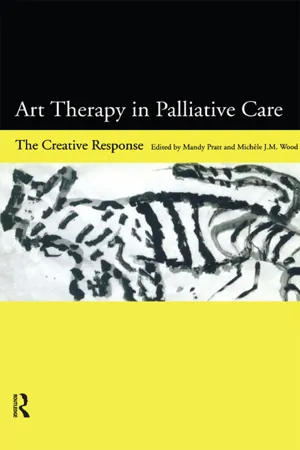
Art Therapy in Palliative Care
The Creative Response
- 224 pages
- English
- ePUB (mobile friendly)
- Available on iOS & Android
eBook - ePub
Art Therapy in Palliative Care
The Creative Response
About this book
This book provides a comprehensive and accessible introduction to the practice and results of art therapy in palliative care. It includes first-hand accounts from both therapists and clients in a variety of palliative care settings including:-
* hospices and hospitals
* patients own homes
* prisons (AIDS patients)
* adolescent griefwork groups
These case studies include examples of client art work and illustrate clearly how art therapy can allow patients to regain feelings of control over their lives.
Information
Chapter 1
What is art therapy?
INTRODUCTION
The combination of the words ‘art’ and ‘therapy’ are frequently greeted with incomprehension by people encountering art therapy for the first time. They often have an intuitive sense that art activity can be ‘therapeutic’ in some way, but are not sure how this extends beyond relaxation and recreation. In this chapter I would like to describe what art therapy is, and indicate the ways in which it works. (A more detailed description of the use of art therapy in palliative care will be given in Chapter 3.)
Put simply, art therapy is the use of art materials for self-expression and reflection in the presence of a trained art therapist. The creation of an image or artefact provides the client and therapist with a concrete form depicting something of the client’s experiences, with which both client and therapist can engage.
The art-making activity is facilitated by the art therapist in a number of ways according to the needs of the client, the setting in which they are meeting and the therapist’s style. The art therapist uses his or her understanding of the client’s interactions with their artwork and with the therapist to bring about a greater self-awareness within the client. This involves noting the client’s responses to the art materials available, the client’s choice of media and the manner in which the artwork is executed. The thoughts and feelings evoked in the therapist by the client’s artwork and those observed in and reported by the client all comprise the substance of the therapeutic encounter. If the art therapy is taking place within a group context then the effects of the relationships with other group members and their artwork are also considered by the art therapist. In other words art therapy involves not only the artwork produced but also the process by which it is made.
The overall aim of art therapy is to enable the client to change and grow on a personal level. Art therapy is often wrongly assumed to be a form of distraction or diversion from personal difficulties. This is not the case. In fact the opportunity for expression and communication without recourse to words can enable a person to see more clearly the nature and extent of the problems with which they struggle. Thus art therapy provides an alternative to spoken language as a means of representation and communication. In the making of a picture or artwork previously unacknowledged feelings can be given form which may lead to these feelings being reflected upon and then spoken about with the art therapist. The client’s artwork is a container for a rich breadth of issues, which may be contradictory, contentious or even bizarre and which may be difficult for them to articulate in any other way. The possibility of depicting something personal which can be changed and developed in a series of images is a very useful part of the therapeutic process, as is the permanence of the artwork, for it allows a continued exploration, reflection and comparison over a number of sessions whereas words can be more easily forgotten or denied. The fact that the client can represent themselves in their own terms through their artwork can strengthen and validate their sense of identity.
The use of verbal and non-verbal processes in art therapy and the concrete nature of art making means that art therapists are able to work with a diversity of clients. Adults with a range of mental health problems have benefited from art therapy. For example, Dalley, Rifkind and Terry (1993) provide an account of the process of art therapy with a man suffering depression. Murphy (1984), Luzzatto (1994), Mahony and Waller (1992), Rust (1994), Levens (1995) and Schaverien (1995) document their work with people who have addictive and self-destructive behaviours. Art therapy has been used with people who have learning difficulties (Stott and Males 1984; Strand 1990; Tipple 1994; Stack 1996), and many art therapists have written about their work with people with psychotic illnesses (for example Charlton 1984; Killick 1991; Killick and Greenwood 1995; Crane 1996). Art therapy is also used with children who may have educational, behavioural or emotional difficulties or may have suffered traumatic experiences (Wood 1984; Case and Dalley 1990; Arguile 1992). Art therapy has been undertaken with people who are elderly (Miller 1984; Byers 1995), and with those who are chronically or terminally ill (Szepanski 1988; Malitskie 1988; Wood 1990; Connell 1992; Thomas 1995).
Art therapists, therefore, can be found working in many different settings, from community-based facilities such as schools, child guidance centres and day centres to residential establishments such as hospitals and prisons. Obviously the methods used by art therapists vary according to the particular needs of their clients and the context of their work. We can, however, identify the features which are distinctive to art therapy practice thus (based on Waller 1991):
• Art therapy is a means of representing inner feelings.
• Art therapy involves three parties: a therapist, a client (or clients if in a group) and artwork.
• In art therapy the client should have easy access to a variety of mark-making and plastic media.
• Art therapy should take place in an environment designated for that purpose.
• Art therapy is distinct from art education since the art therapist offers no technical assistance or advice beyond what may aid the client in achieving an intended communication.
THE LOCATION
The location in which art therapy occurs has a considerable influence upon the therapy. It provides a tangible expression of the boundaries of the therapeutic relationship. The choice of furniture and its position in the room convey to the client what is to be expected from the therapist and how they are to behave. Clients need to feel that the space for art therapy sessions will allow what is made and discussed to remain confidential to the therapist, or other members if in a group. Consequently, soundproofing and storage of artwork are factors to be considered. All art therapy rooms need a sink, for without access to water paints and clay cannot be used, and the client will be severely restricted in their ability to make a ‘mess’.
Art therapy rooms which are set up as art studios and in which the client may position themselves at a distance from the art therapist will have a different effect from rooms in which therapist and client are seated close together and where the therapist has a clear view of the client’s work as it is being made. Many art therapists working in large hospitals built in the last century have had the advantage of generously proportioned rooms which they have filled with patients’ artworks and plants to provide a creative and stimulating atmosphere. Such rooms have also benefited from having large windows which provide ample sunlight and good views. In this way art therapy has provided an environment which counters the sterile institutional atmosphere that is often found elsewhere in these enormous hospitals.
With the current relocation of services into the community, art therapists have found themselves sharing rooms with other professionals, often in cramped conditions not conducive to art activity. The issue of where art therapy can take place is described in the chapters in Part II. Whatever the practical constraints surrounding the location of art therapy sessions, the art therapist’s task is to ensure that the surroundings allow enough privacy for a client to get on with their work (see Case and Dalley 1992 for a fuller discussion).
THE ART MATERIALS
There must be a large enough range of art materials from which the client can choose, as each medium lends itself to certain kinds of emotional communications. Several writers have argued that the perceived world of sensations and objects (animate and inanimate) are imbued by humans with expressive qualities (Arnheim 1954 and Rycroft 1985). For example, the marks made by a ‘screeching’ pencil will convey a different emotional quality to thick paint that is stroked onto the paper with care. Objects from the client’s own environment may be brought to art therapy and incorporated into mixed media pieces, to convey perhaps some intimate symbolic meaning. The therapist must ensure that the client can explore the materials provided and use them without unnecessary obstacles. For clients with a physical disability this may require ingenious support on the part of the therapist.
THE AIMS OF ART THERAPY
As we have seen, art therapy is a flexible tool and as such has extensive aims. These can be summarised as Creativity, Control, Communication, Catharsis and Change (based on Luzzatto and Gabriel 1998, p. 750).
Creativity
The challenge of a blank sheet of paper and a variety of art media can stimulate the creative forces within individuals who come for art therapy. Creativity is an aspect of experience which transcends notions of ‘art’ or ‘science’ and which can be seen in the lives of individuals, groups and cultures. Definitions of creativity are many, but in relation to art therapy we would suggest that the enjoyment of the individual’s own creative thinking and experience, through the art materials, provides a means of movement on a psychological level. In this way creativity enables the person to make connections with the material and social worlds in which they exist. Implicit in the definition of creativity is the notion of change; a creative act always brings into existence something new.
Although creativity is assumed to be implicit in art making, this is not always the case. Mann (1990) has argued that art activity, rather than being an expression of creativity, can in fact be a means of defending the individual from a truly creative experience. He defines creativity as the capacity to experience change and suggests that this involves an individual in moving from something ‘known’ towards something that is as yet ‘unknown’. This transition from known to unknown brings with it some anxiety. According to Mann an individual’s ability to persevere in the face of such feelings is an essential part of creativity. Considered in this way creativity is understandably no easy matter and so the emotional support of the art therapist is vital for clients who, for a variety of reasons, may find creativity a difficult venture. In this respect the art therapist’s focus on the value of the art-making process as well as the eventual product is crucial to facilitating an authentic creative experience in the client.
Art and craft activities with clients are provided by professionals who are not art therapists and these are without doubt of great value in contributing to the aesthetic experiences of the client and enhancing many positive feelings. Two organisations which promote the use of arts in healthcare in the UK are Hospital Arts and Hospice Arts. Artists, sculptors, writers, poets and musicians are variously employed as artists-in-residence, or as project workers providing workshops to encourage patient participation (Frampton 1986). The creative activities promoted by such arts agencies are aimed at improving the milieu and enhancing patients’ quality of life. For Hospital Arts, healthcare settings also provide opportunities for the work of artists to reach wider audiences (Kaye and Blee 1997). Arts activities and art therapy have a common goal in the encouragement of patients’ creativity, and a shared outcome in the increased value placed upon creativity by other members of the staff team and patients’ families. However, the two approaches are different, with art therapists able to work with the barriers to creativity and able to provide support on emotional and psychological levels.
Control
The freedom to use art materials in art therapy provides the client with a tangible way to develop control of and to enjoy some mastery over the media. By splashing, pounding, tearing, sticking, scratching or smoothing the materials the client is able to order and symbolically represent their experiences. The opportunity of using the art materials to exercise and experience personal choices and control in a symbolic way can be enormously valuable for people with difficulties in this aspect of their lives.
Communication
Through the process of using the art materials and through the resulting imagery or marks the client can find a means of communication. The use of shapes, colours or symbols can provide expression for previously ill-understood issues or feelings. Contrary opinions, thoughts or desires can be communicated both to the client and to the art therapist. The result is that the client can gain a greater understanding of themselves. Many clients who benefit from art therapy have physical, psychological or emotional difficulties which make verbal communication problematic. Some people may be highly articulate and yet unable to communicate on an emotional level. For them, the non-verbal processes of art therapy can provide a non-threatening means of communication. At the other extreme are those who do not have the capacity to use speech (for example, those with aphasia or with severe learning difficulties), but who can use art materials for communication. The receptive presence of the art therapist is a crucial part of the communication.
Catharsis
Sometimes the use of materials can bring with it an expression of strong feelings so that the experience becomes a cathartic one. Powerful feelings are thereby accessed and discharged through the art materials. In this way the client can find a way of releasing ‘dangerous’ feelings. The use of striking colours, and substances like paint and clay which are strongly associated with the body and its fluids, can be used to convey feelings in a more socially acceptable way. The recognition of this element of art therapy raises anxieties amongst some healthcare professionals who fear that art therapy will uncover a torrent of frightening feelings which will overwhelm the client and those around them. In fact the client’s manipulation of the materials during the art making requires him or her to maintain a level of control which mitigates the feeling of being ‘out-of-control’. The therapist’s skill in keeping the boundaries of the therapy ensures that these feelings are contained and the client (and therapist) are kept safe.
Change
As described earlier, art therapy provides a client with the opportunity to experience and make changes that will have a beneficial effect on all aspects of their life. The strengthening and integration of the client’...
Table of contents
- Cover Page
- Half Title page
- Title Page
- Copyright Page
- Contents
- Foreword
- Preface
- Introduction
- Acknowledgements
- Part I
- Part II
- Appendix I Complications to grieving
- Appendix II Psychological defences and the mourning process
- Appendix III Childhood bereavement
- Appendix IV The Barcelona Declaration on Palliative Care
- Glossary of terms
- Useful addresses
- Index
Trusted by 375,005 students
Access to over 1.5 million titles for a fair monthly price.
Study more efficiently using our study tools.
Frequently asked questions
Yes, you can cancel anytime from the Subscription tab in your account settings on the Perlego website. Your subscription will stay active until the end of your current billing period. Learn how to cancel your subscription
No, books cannot be downloaded as external files, such as PDFs, for use outside of Perlego. However, you can download books within the Perlego app for offline reading on mobile or tablet. Learn how to download books offline
We are an online textbook subscription service, where you can get access to an entire online library for less than the price of a single book per month. With over 1.5 million books across 990+ topics, we’ve got you covered! Learn about our mission
Look out for the read-aloud symbol on your next book to see if you can listen to it. The read-aloud tool reads text aloud for you, highlighting the text as it is being read. You can pause it, speed it up and slow it down. Learn more about Read Aloud
Yes! You can use the Perlego app on both iOS and Android devices to read anytime, anywhere — even offline. Perfect for commutes or when you’re on the go.
Please note we cannot support devices running on iOS 13 and Android 7 or earlier. Learn more about using the app
Please note we cannot support devices running on iOS 13 and Android 7 or earlier. Learn more about using the app
Yes, you can access Art Therapy in Palliative Care by Mandy Pratt, Michele Wood, Mandy Pratt,Michele Wood in PDF and/or ePUB format, as well as other popular books in Medicine & Public Health, Administration & Care. We have over 1.5 million books available in our catalogue for you to explore.