eBook - ePub
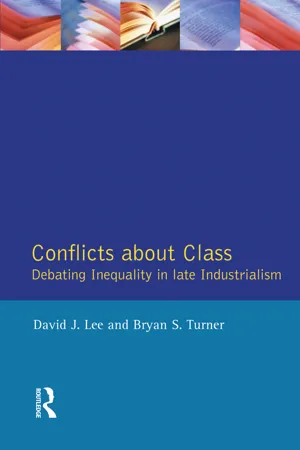
Conflicts About Class
Debating Inequality in Late Industrialism
- 316 pages
- English
- ePUB (mobile friendly)
- Available on iOS & Android
eBook - ePub
About this book
In recent years there has been growing debate among sociologists about the concept of class and its relevance to the highly industrialised world of the late twentieth century. This book makes available in a single volume all of the key contributions to this debate and takes it a step further with a number of specially commissioned pieces. An editorial introduction which sets the main arguments in context, additional commentary and two alternative conclusions help to make this a unique text for a subject that remains crucial yet highly contentious.
Information
Part One
Class in a Post-Communist World
Editorial Overview to Part One
Class metaphors and triumphant individualism
Over this opening selection of papers looms the theme of the triumph of individualism in late twentieth-century society and its implications for the analytical viability of the sociology of class. All of the authors were either born in or work in non-European societies, specifically the USA or Australia, where class traditions are, at best, weak and where the market economy and individualistic values (the ‘American Dream’, the ‘Lucky Country’) are deeply entrenched in the political and social culture. From this vantage it has been perhaps easier than in Europe to claim that the type of society which Toennies called Gesellschaft, based on the predominance of impersonal, heterogenous and largely contractual relationships between autonomous and legally ‘free’ individuals, provides the general paradigm for what is now virtually a world social order. Moreover, for political liberals in both the New and the Old world, Gesellschaft is the model of order which people in uncoerced situations will ‘naturally choose’.
On the other hand, as Holton argues in his highly influential paper, the ‘idiom’ of class in European social theory emerged out of nineteenth-century pessimism about the stability and desirability of Gesellschaft. It and the socialist political rhetoric with which it was associated embodied a nostalgia for Gemeinschaft (community), and for traditional forms which the individualistic order had destroyed. In its specific form of communism (not, admittedly, to be confused with Marxism as a whole) political class struggle became an attempt to redirect history and define circumstances in which community may again triumph over atomism. Has the recent collapse of that experiment provided final vindication of both liberal political theory and of individualistic theories of Gesellschaft in sociology?
The core of Holton’s case is what he calls the difficulty of distinguishing between the value concerns underlying class theory and the efforts of sociological class analysis to develop scientific procedures for measuring and analysing class. He accepts, however, that it will not be possible to drop class analysis altogether because economic inequality will continue to be part of the distribution of power in late twentieth-century Gesellschaft. But the conceptualisation of class itself will become progressively ‘weaker’ in the sense used in the Introduction.
The difficulty of making any clear separation between the representation of the actual nature of contemporary social conditions and the choice of a conceptual and evaluative framework within which to do so is well illustrated in the critique of class analysis by Clark and Lipset on one hand and the response to them by Hout, Brooks and Manza, on the other. Careful scrutiny of these chapters will show that the formal definition of class by both sets of authors is remarkably close. Both are prepared to see it in very broad terms as structured inequality between individuals arising out of ownership of property or out of market advantage. Their usage is very different, however. Clark and Lipset introduce a separate notion of ‘hierarchy’ and are clearly concerned with how far perceptions of class and hierarchy influence behaviour in what they call ‘situses’ (or institutional segments) of society, in particular work, politics and the family. They make, in fact, an astonishing range of substantive claims some of which are addressed by the chapters in Part Three (see e.g. Goldthorpe on politics) but the major theme to emerge is the fragmentation of stratification taking place within each of these situses as a result of the advance of individualistic values and the death of the old solidarities which fostered class identity and struggle.
Hout and his colleagues are on the other hand keen to direct our attention back to the central issue, the empirical persistence of class as a major organising principle of economic inequality in contemporary US and other highly industrialised societies. Their paper not only provides a useful overview of some of the principal studies and sources on this topic of the last few years but also cites fresh findings of their own.
The last two chapters in Part One are both by authors from the University of Tasmania who have already written about the post-modernisation of society (Crook et al. 1992) and whose papers were printed in International Sociology in the wake of the Clark/Hout exchange. The first author, Pakulski, accuses the disputants of talking past each other. Clark and Lipset are talking about the fragmentation of stratification, whereas Hout and his colleagues are talking about the persistence of economic inequality which, Pakulski thinks, is not at issue. Conceptually too Hout et al. retain some elements of a Marxist theory of class as objective material interest which Pakulski sees as unsustainable in the wake of the individualising changes which have occurred. In the interest of clarification he proposes a useful fourfold typology of class conceptions which would distinguish descriptive from explanatory usages and the objective aspect of class from the subjective. Water’s starting point is also the link between the conceptualisation of class and the issue of whether or not class exists. His is an ambitious attempt to demonstrate not just the fragmentation of stratification but the succession of different systems of stratification over time. He argues that this makes it possible to not only to retain the Marxist concept of class (as a description of a now superceded set of conditions) but also to comprehend Marxist society itself as a superceded order of stratification. The work of both of these authors usefully contains overviews of the substantive changes which they and others believe characterise post-modernity and which might be regarded as the ultimate point which individualisation and Gesellschaft can reach. The celebration of this state of affairs might in turn be regarded as the late twentieth-century form taken by political liberalism.
CHAPTER 1
Has class analysis a future? Max Weber and the challenge of liberalism to Gemeinschaftlich accounts of class1
Class has often been presumed dead (Nisbet 1959), or less and less able ‘to do useful work for sociology’ (Pahl below, p. 113). Many of the bolder propositions of class theory have proved false or inadequate, not least Marx and Engels’s celebrated expectation of proletarian revolution in the advanced capitalist world. Meanwhile the idea of a unitary general theory of inequality linked to class has given way to an increasing emphasis on the multiple intersections between class, gender, race and ethnicity. Yet for all this the language of class continues to be widely used in popular culture and political debate (see, for example, Crompton 1993:9). The discourses of class also continue to haunt social theory and social research.
The meaning of class terminology appears to vary considerably between the domain of popular culture (where it is often synonymous with status), and that of social theory (where it is usually treated as a sui generis component of social inequality linked to the structure of economic power). But there is little unanimity of definition or conceptualisation in intellectual circles either. Meanwhile, political actors invoke class as a means of dramatising their claims to be organic leaders of mass opinion. In this situation the persistence of the language of class may simply signify intellectual confusion, and the conflation of analysis with rhetoric, or perhaps conceptual piety to an enduring piece of intellectual artifice.
A more likely interpretation of the persistence of class, however, is its powerful and multi-dimensional metaphoricality. Metaphors are figures of speech ‘in which a name or descriptive term is transferred to some object to which it is not properly applicable’ (Oxford English Dictionary). For Ossowski (1963) metaphors function to combine intuitive understanding with routine application in a way that evades comprehensive and systematic definition. Class, he argued, is one such metaphor, able to draw on a wide range of possible meanings or allusions. These include the methodological practice of categorising, the labelling of cohesive social groups possessing a quality distinct from other social groups, and the use of spatial allusions to suggest distance between social groupings, as well as more rhetorical political allusions to the existence of organic agents of conflict and social change in society and world history. Class is simultaneously an objective feature of the world – ‘something which in fact happens’ (Thompson 1968:i) – and a subjective idea. Its metaphorical flexibility is also reflected in the proliferation of dichotomic, gradational and functional class schema.
There are a number of further ways in which we can unravel the metaphoricality of class. One of these involves the serviceability of class concepts in both Gemeinschaft-based and Gesellschaft-based accounts of society. In other words, class is equally used to discuss community formation, as it is to refer to the distribution of individuals within roles available within structures of economic production and exchange. Developing this point it is possible to identify three typical idioms of class analysis on the Gemeinschaft-Gesellschaft spectrum. Speaking metaphorically, it is possible to specify a strong class idiom at the Gemeinschaft end of the spectrum, a weak class idiom at the Gesellschaft end, and certain intermediate positions.
The strong class idiom operates both as a structural account of relationships of power, inequality and exploitation, and simultaneously an account of consciousness, group formation, and social movements as emancipatory social change. As in most conventional accounts of class, these relations derive in a fundamental sense from economic relations of production and exchange instituted in property rights. However, in the strong class idiom these relations are not only contained within the economy, but suffuse politics, culture, and so on. The strong class idiom presents a unitary account of society, whereby the theory of class is coterminous with the theory of society. Its most influential formulation is to be found in Marx’s and Engels’s emphasis on class as the motive force of history.
To describe the strong class idiom in terms of Gemeinschaft relations is more a metaphorical than a literal procedure. This is because the literal sociological usage of Gemeinschaft is generally related to pre-modern particularistic accounts of community tied together by blood, kinship, and locality; whereas the classic Marxist account of class under capitalism takes as its starting point the cash nexus of the Gesellschaft, or society of ‘free’ individuals. Yet the strong class idiom is precisely an attempt to define the circumstances under which community may again triumph over individual atomisation. In this sense, it is legitimate to describe the strong class idiom, metaphorically, as a Gemeinschaftlich view of class.
The ‘weak’ class idiom, by contrast, treats class as one of several patterns of power and inequality, which may exist in any given society. This idiom not only rejects a unitary account of class in society, but also argues against any necessary connection between class positions and the development of group formation, class communities, social change, and the course of world history. A typical formulation of this approach is to be found in Weber’s tripartite account of the distribution of power in terms of class, status, and party. Here, class is again derived from economic relations, but the centre point of the approach concerns the character of class positions occupied by individuals. Social class formation is a contingent possibility, but there is room here for some sense of exploitation.
Weber’s approach is typical of what might be called the radical liberal perspective on class. This accepts the Gesellschaftlich account of modern society as a given and seeks out dimensions of marketplace exchange where power inequalities affect the life chances of individuals. There is an underlying commitment here to Gesellschaft relations as the foundation for equality of opportunity, but also space for justifications of class inequalities of condition, especially where these result from differences in marketable skill and human capital endowment. The metaphorical flexibility of class permits its continued usage in this very different context, though its provenance is restricted to the analysis of economic inequality and its contingent social consequences.
Between the strong and weak class idioms there has grown up a range of intermediate positions. These have generally arisen as a result of perceived weaknesses in the strong class idiom as originally formulated in the nineteenth century. Class continues to be seen as a major dimension to social inequality, and as having a connection with group formation, conflict, exploitation, and change. On the other hand, the strong claim for class as a unitary account of inequality, and as the motive force for history, is no longer advanced with confidence. Far more typically, class is projected as a manifestation of economic conflict within the work-place, which generally fails to achieve radical political expression. This goes further than the weak idiom in its continuing emphasis on conflict and collectivist organisation, as well as in the elusive search for a more robust understanding of class politics. This search has, however, led some to abandon key elements of the older Gemeinschaftlich position, such as the labour theory of value, while still maintaining a critique of capitalism and liberalism as inegalitarian and exploitative.
The main aim of this chapter is to evaluate this relationship between Gemeinschaft and Gesellschaft elements in class theory in the light of Weber’s earlier statement of the ‘weak’ Gesellschaft idiom. Although there are relatively few enthusiasts any longer for the strong class idiom, it remains clear that there has been some regrouping around a ‘transitional’ position on the Gerneinschaft–Gesellschaft spectrum. The argument of this chapter is, first, that the case for any kind of Gemeinschaft component of class theory is getting progressively weaker. Much of the debate between neo-Marxists and radical liberals is now taking place on the terrain of the Gesellschaft idiom. This is particularly evident in the deployment of rational choice and game theory assumptions within Marxist and radical discourse. A further feature of my argument is that Gesellschaft theories of class offer limited but significant justifications for retaining class analysis. The analysis of contemporary social structures, and relations between markets, households, organised interests, and the state, cannot dispense with class analysis altogether. Weber’s radical liberal legacy has been of some use in encouraging social theorists in this direction, although Weber himself failed to follow through a thoroughgoing radical liberal account of market relations, linking production and distribution to consumption.
Class and the problem of Gemeinschaft in Western social thought
It is important to re-emphasise that class has always been far more than a sociological concept debated among intellectuals. The language of class, and the social movements activated in the name of class, were a fundamental emergent feature of European capitalist industrialisation (Briggs 1976, Williams 1976). In the process, the linguistic meaning of ‘class’ was massively extended and transformed. What began as a generic classificatory device became both a political and industrial rallying cry and a major discourse within social analysis. In both cases, issues of inequality and exploitation were linked with social conflict and the problem of how to overcome emergent social cleavages.
Until then, inequalities between social groups had generally been understood in terms of a complex status hierarchy of ranks, orders, and degrees. The new terminology of class now shifted attention to the ‘economic’ basis of social divisions and conflicts, and their expression in political action and cultural identity. This shift still left room for disagreement over precise specification of the nature of the economic processes involved. Of particular interest is the debate over the relative importance of inequalities of exchange relations in the distribution of income (as in Ricardianism), compared with the Marxist emphasis on inequalities in the social relations of production. None the less, the fundamental formal principle at stake in class theory was, and continues to be, the...
Table of contents
- Cover Page
- Title Page
- Copyright Page
- Dedication
- Contents
- Preface
- Acknowledgements
- Editorial Introduction: Myths of classlessness and the ‘death' of class analysis
- Part One Class in a Post-Communist World
- Part Two British Sociology and Class Analysis
- Part Three Researching Class
- Editorial Conclusions
- Weak class theories or strong sociology?
- Capitalism, classes and citizenship
- References
- The Editors
- Notes on contributors
- Index of principal topics
- Index of authors
Trusted by 375,005 students
Access to over 1.5 million titles for a fair monthly price.
Study more efficiently using our study tools.
Frequently asked questions
Yes, you can cancel anytime from the Subscription tab in your account settings on the Perlego website. Your subscription will stay active until the end of your current billing period. Learn how to cancel your subscription
No, books cannot be downloaded as external files, such as PDFs, for use outside of Perlego. However, you can download books within the Perlego app for offline reading on mobile or tablet. Learn how to download books offline
Perlego offers two plans: Essential and Complete
- Essential is ideal for learners and professionals who enjoy exploring a wide range of subjects. Access the Essential Library with 800,000+ trusted titles and best-sellers across business, personal growth, and the humanities. Includes unlimited reading time and Standard Read Aloud voice.
- Complete: Perfect for advanced learners and researchers needing full, unrestricted access. Unlock 1.5M+ books across hundreds of subjects, including academic and specialized titles. The Complete Plan also includes advanced features like Premium Read Aloud and Research Assistant.
We are an online textbook subscription service, where you can get access to an entire online library for less than the price of a single book per month. With over 1.5 million books across 990+ topics, we’ve got you covered! Learn about our mission
Look out for the read-aloud symbol on your next book to see if you can listen to it. The read-aloud tool reads text aloud for you, highlighting the text as it is being read. You can pause it, speed it up and slow it down. Learn more about Read Aloud
Yes! You can use the Perlego app on both iOS and Android devices to read anytime, anywhere — even offline. Perfect for commutes or when you’re on the go.
Please note we cannot support devices running on iOS 13 and Android 7 or earlier. Learn more about using the app
Please note we cannot support devices running on iOS 13 and Android 7 or earlier. Learn more about using the app
Yes, you can access Conflicts About Class by David J. Lee,Bryan S. Turner in PDF and/or ePUB format, as well as other popular books in Social Sciences & Political Economy. We have over 1.5 million books available in our catalogue for you to explore.