The isolation and structural characterization of substances present at very low concentrations, as is necessary to satisfy regulatory requirements for pharmaceutical drug degradants and impurities, can present scientific challenges. The coupling of HPLC with NMR spectroscopy has been at the forefront of cutting-edge technologies to address these issues. LC-NMR: Expanding the Limits of Structure Elucidation presents a comprehensive overview of key concepts in HPLC and NMR that are required to achieve definitive structure elucidation with very low levels of analytes. Because skill sets from both of these highly established disciplines are involved in LC-NMR, the author provides introductory background to facilitate readers' proficiency in both areas, including an entire chapter on NMR theory.
The much-anticipated second edition provides guidance in setting up LC-NMR systems, discussion of LC methods that are compatible with NMR, and an update on recent hardware and software advances for system performance, such as improvements in magnet design, probe technology, and solvent suppression techniques that enable unprecedented mass sensitivity in NMR. This edition features methods to quantify concentration and assess purity of isolated metabolites on the micro scale and incorporates computational approaches to accelerate the structure elucidation process. The author also includes implementation and application of qNMR and automated and practical use of computational chemistry combined with QM and DFT to predict highly accurate NMR chemical shifts. The text focuses on current developments in chromatographic-NMR integration, with particular emphasis on utility in the pharmaceutical industry. Applications include trace analysis, analysis of mixtures, and structural characterization of degradation products, impurities, metabolites, peptides, and more. The text discusses novel uses and emerging technologies that challenge detection limits as well future directions for this important technique. This book is a practical primary resource for NMR structure determination—including theory and application—that guides the reader through the steps required for isolation and NMR structure elucidation on the micro scale.
Nuclear magnetic resonance (NMR) is a powerful technology that has been extensively used for the structural elucidation and characterization of organic, inorganic, and biological molecules. This technology is over 65 years old; however, during this time frame numerous applications have emerged spanning nearly all scientific disciplines ranging from nuclear physics to medicine.
The origins of NMR began with the simultaneous discovery of nuclear resonance in 1945. The discoveries were made by physicists in the laboratories of Edward Purcell at Harvard and Felix Bloch at Stanford using parafilm and water, respectively [1, 2]. Bloch and Purcell were awarded the Nobel Prize in Physics in 1952 for their discovery. Although the initial goal of the physicists was to determine the magnetic moments of all known elements in the periodic table, their studies revealed unexpected findings regarding the magnetic properties of nuclei and their local environment. These early investigators found that the effects of electrons surrounding the nucleus of a resonating atom introduced slight changes in the precessional frequency of nuclei. This phenomenon gave rise to the concept of the chemical shift, which relates the electronic environment around the nuclei in a molecule to distinct resonance frequencies that are diagnostic of the molecular structure. Although the discovery of NMR occurred in 1945, it was not until 1951 that the ability of the chemical shift to provide structural information at the molecular level was demonstrated. The hypothesis was initially made by an organic chemist, S. Dharmatti, and it was Dharmatti and coworkers who subsequently demonstrated the capability of the NMR technology in structure elucidation using the organic molecule ethanol [3]. The importance of this discovery became apparent and the technology was rapidly embraced by organic chemists who recognized the power of NMR in establishing the chemical structure. However, in the early 1950s, the technology was still in its infancy and significant development soon followed. The initial challenge was to build homogeneous magnets with resolution better than 0.1 ppm and line widths at 0.5 Hz. This was achieved in the mid-1950s, resulting in subsequent development and implementation of new techniques and processes, such as computer-assisted time averaging, to enhance sensitivity for chemical structure elucidation [4].
Despite the introduction of homogeneous magnets and processes such as time averaging [5], NMR still suffered from poor sensitivity. One approach in improving sensitivity was to increase the magnetic field strength. This led to the development of superconducting solenoid magnets with circulating current in the coils that were cooled to 4 K with liquid helium [6]. The initial commercial magnets were available at 200 MHz. Today, magnets of approximately 1 GHz and beyond are being built and may be purchased. The introduction of Fourier transformation (FT) provided two orders of magnitude improvement in signal-to-noise (S/N) ratio and enabled simultaneous recording of all spectral resonances [7]. Decoupling of abundant nuclei, such as protons, enabled isotopically dilute nuclei such as 13C to be more readily observed [8]. In 1971, a new era in NMR spectroscopy was created when Jeener introduced the concept of two-dimensional (2D) FT NMR spectroscopy [9]. Inspired by the lecture of Jeener, Richard Ernst and coworkers showed that 2D FT NMR spectroscopy could be successfully applied to chemical research. Expansion of multidimensional NMR was soon followed by the development of powerful experiments to enable structure elucidation of complex molecules. Structures of organic, inorganic, and biological macromolecules such as proteins could be determined with these multidimensional techniques with accuracies rivaling those of single-crystal X-ray. Richard Ernst received the Nobel Prize in Chemistry for his contributions to NMR in 1991.
The development of NMR technology for structure elucidation employed the use of cylindrical NMR tubes. These tubes spanned a range of diameters from 3 mm up to 25 mm, with 5 mm being the most widely used. This configuration allowed chemists to dissolve a compound of interest in deuterated solvent (for 5-mm tubes, this was typically about 0.5–0.7 mL solvent) and easily recover the sample when sufficiently volatile solvent was used. Since NMR is a nondestructive technology, the sample could be used and reused indefinitely as long as the compound remained stable in the NMR tube. Application of pulse FT acquisition afforded a S/N ratio increase through the addition of free-induction decays (FIDs) (see Chapter 2), thereby enabling meaningful spectral data to be acquired on dilute sample concentrations or chemically dilute nuclei. Hence, the sample would reside in the magnet for as long as may be required to collect a spectrum. Although experiments with flow NMR were reported as early as 1951 [10], use of the tube configuration would remain as the generally accepted practice until the integration of liquid chromatography (LC) and NMR spectroscopy.
While LC dates back to 1903 [11], the invention of high-performance liquid chromatography (HPLC), comprising columns packed with small particles and high pressure pumps, did not occur until the late 1960s. Extensive development of this technology involved incorporation of in-line detectors and automatic injectors, all under computer control. In fact, highly sensitive detectors have extended the limits of detection to femtogram levels. These advancements led to a myriad of applications [11], and HPLC became widely used as an indispensable technology throughout analytical laboratories in both industry and academia. The capabilities of HPLC continue to improve with advancements in automation, speed, efficiency, and sensitivity. However, although HPLC has advanced significantly, one major limitation is the lack of a universal detector. In addition, separation of complex mixtures can still be challenging, requiring extensive method development.
The first integration of an HPLC system with an NMR spectrometer was published by Watanabe and Niki in 1978 [12]. At that time, there had not yet been a paper published about the direct coupling of HPLC with NMR, although its potential ability in qualitative analysis was well recognized. However, a major issue that had to be considered was the inherent low sensitivity of NMR. In addition, at that time, the solvents used for NMR measurements were limited to a few possibilities, such as deuterated chloroform or carbon tetrachloride. This limitation had to be tempered with HPLC considerations regarding the selection of the optimum solvents needed to achieve successful separation of analytes. Since optimal requirements for solvents in using NMR and HPLC may not be compatible, solvent selection was a notable challenge in interfacing the two technologies. For sensitivity issues, the development of FT NMR was recognized as a means to overcome such difficulties, particularly with respect to the samples exhibiting low solubility in an LC-NMR-compatible solvent. In addition, the difficulty with the solvent compatibility could be overcome by the improvements in hardware and software of both technologies.
In considering the direct coupling of LC and NMR, the resolution of NMR was acknowledged to be just as important as the sensitivity. Although sample spinning is not possible in the LC-NMR configuration, it was generally recognized that good resolution still needed to be achieved. For HPLC, the separation and column efficiency were of critical importance. To minimize the dilution of solute that would be transferred to the LC-NMR probe, it was necessary to utilize an HPLC system with high column efficiency. Regarding the important role that solvent plays with both NMR and HPLC, there was a deliberate requirement to use solvents that did not contain hydrogen atoms (1H). Another recognized complication was the potential presence of impurities in the solvents that could compromise spectral quality due to the low content of the isolated solute. Hence the success of the first LC-NMR study depended upon a careful balance of solvent distribution and purity.
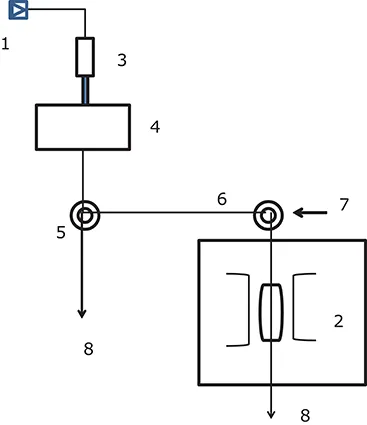
The first direct coupling of HPLC to an NMR spectrometer employed the use of a JEOL FT-NMR FX-60. The NMR probe was modified to be more sensitive than a standard probe because of the requirement of its exclusive use for observing proton (1H) signals. The flow cell consisted of a thin-wall Teflon tube of 1.4-mm inner diameter (ID) that penetrated the NMR probe and provided a flow-through structure. The effective length and volume of the LC-NMR probe were about 1 cm and 15 µL, respectively. The flow cell was connected to the detector of HPLC with thick-wall Teflon tubing of 0.5-mm ID and 165 cm total length. Because this connecting tubing contributed to most of the broadening after the HPLC detector, it was made as short as possible. A schematic drawing of the LC-NMR system is shown in Figure 1.1. A series of valves was used to control the sample flow and resolution to the probe. Valve 1 was turned at a certain delay after the maximum of the chromatographic peak monitored by the HPLC detector and the eluent was held in the LC-NMR probe during measurement of NMR spectrum. The spectral resolution was achieved by introducing acetone-d6 into the probe through valve 2, to allow the signal to remain as durable as possible. This was because the HPLC solvent did not contain a deuterium signal; hence, it was necessary to introduce deuterated acetone through valve 2 to serve as the magnetic field lock. The investigators observed that when multiple transient acquisitions were required, the use of an external lock method resulted in compromised resolution.
FIGURE 1.1 Schematic diagram of LC-NMR direct coupling. (1) HPLC column inlet, (2) FT-NMR, (3) column, (4) dielectric constant detector, (5) three-way valve 1, (6) three-way valve 2, (7) injection port for resolution, and (8) drain.
The HPLC system used in this first reported LC-NMR study was composed of Milton Roy pump and Rheodyne universal injector with a loop of 20 µL. A silica column (30-cm × 4-mm ID) was used along with carbon tetrachloride or tetrachloroethylene as the mobile phase. Effluents were monitored by the dielectric constant detector that was built in the investigators’ laboratory.
To determine how much delay should be applied before turning valve 1 after the maximum detector peak appeared, the response of NMR versus the elapsed time was measured. The profile of the detector peaks was used to estimate the volume of the connecting tube and the flow rate of mobile phase.
To test the LC-NMR system, 20 µL of sample solution containing three isomers of dimethylphenol were injected into an ETH-silica column (ETH-silica gel supplied by Toyo Soda Co. Inc.) using tetrachloroethylene as mobile phase. Stopping the eluents i...
Table of contents
Cover
Half Title
Series Page
Title Page
Copyright Page
Dedication
Table of Contents
Foreword
Preface
Author
Chapter 1. Introduction to LC-NMR
Chapter 2. NMR Theory
Chapter 3. Separation Methods
Chapter 4. NMR Instrumentation and Probe Technologies
Chapter 5. NMR-Associated Isolation Technologies
Chapter 6. NMR Experiments
Chapter 7. Applications
Chapter 8. Other Specialized Flow NMR
Chapter 9. Quantitation of Isolated Compounds
Chapter 10. QM/DFT Chemical Shift Prediction
Glossary
Index
Trusted by 375,005 students
Access to over 1.5 million titles for a fair monthly price.
Study more efficiently using our study tools.
Frequently asked questions
Yes, you can cancel anytime from the Subscription tab in your account settings on the Perlego website. Your subscription will stay active until the end of your current billing period. Learn how to cancel your subscription
No, books cannot be downloaded as external files, such as PDFs, for use outside of Perlego. However, you can download books within the Perlego app for offline reading on mobile or tablet. Learn how to download books offline
Perlego offers two plans: Essential and Complete
Essential is ideal for learners and professionals who enjoy exploring a wide range of subjects. Access the Essential Library with 800,000+ trusted titles and best-sellers across business, personal growth, and the humanities. Includes unlimited reading time and Standard Read Aloud voice.
Complete: Perfect for advanced learners and researchers needing full, unrestricted access. Unlock 1.5M+ books across hundreds of subjects, including academic and specialized titles. The Complete Plan also includes advanced features like Premium Read Aloud and Research Assistant.
Both plans are available with monthly, semester, or annual billing cycles.
We are an online textbook subscription service, where you can get access to an entire online library for less than the price of a single book per month. With over 1.5 million books across 990+ topics, we’ve got you covered! Learn about our mission
Look out for the read-aloud symbol on your next book to see if you can listen to it. The read-aloud tool reads text aloud for you, highlighting the text as it is being read. You can pause it, speed it up and slow it down. Learn more about Read Aloud
Yes! You can use the Perlego app on both iOS and Android devices to read anytime, anywhere — even offline. Perfect for commutes or when you’re on the go. Please note we cannot support devices running on iOS 13 and Android 7 or earlier. Learn more about using the app
Yes, you can access LC-NMR by Nina C. Gonnella in PDF and/or ePUB format, as well as other popular books in Physical Sciences & Pharmacology. We have over 1.5 million books available in our catalogue for you to explore.