- 552 pages
- English
- ePUB (mobile friendly)
- Available on iOS & Android
eBook - ePub
About this book
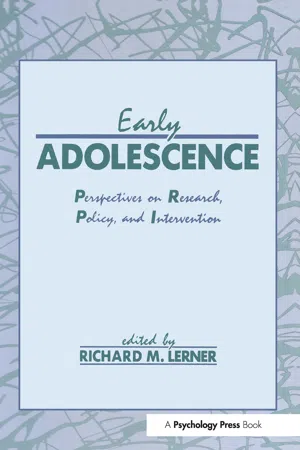
This volume brings together a broad group of scholars from a diverse array of disciplines to write integratively about cutting-edge research issues pertinent to various facets of the study of early adolescence. All contributors speak to the idea of interdisciplinary integration as a means of advancing knowledge in particular focus areas of early adolescence; all approach their topic with an orientation to integrating levels of organization. In so doing, they testify to the importance of two interrelated integrations -- multidisciplinary and multiprofessional -- for furthering understanding of young adolescents.
Information
1 Early Adolescence: Toward an Agenda for the Integration of Research, Policy, and Intervention
Richard M. Lerner
Michigan State University
From conception through the adult and aged years human development involves a dynamic synthesis—or fusion—of biological, psychological, and sociocultural factors (Baltes, 1987; Lerner, 1986; Lerner & Spanier, 1978; Tobach, 1981; Tobach & Greenberg, 1984). The processes of behavior and development are ones linking variables across these levels. Unidisciplinary models and reductionistic methodological strategies do not suffice in the analysis of these interlevel relations (Baltes, Reese, & Nesselroade, 1977; Lerner, 1991; Nesselroade & Baltes, 1979; Nesselroade & Cattell, 1988). As a consequence, many scholars have suggested that the character of human development requires a model that promotes both multidisciplinary theoretical analysis and an integrated empirical examination of the dynamic relations comprising human life (e.g., Baltes, 1987; Featherman, 1983; Lerner, 1984; Petersen, 1988). In other words, interdisciplinary conceptual integration and methodological pluralism have been forwarded as optimal avenues for the analysis of the multiple, fused bases of human behavior and development. For many contemporary scholars, the favored theoretical model framing this approach to human development is termed developmental contextualism (Lerner, 1986, 1991).
This orientation is the conceptual basis of this book. A key theme is that multidisciplinary theoretical and methodological integration in the study of human development enhances understanding and provides effective and innovative means for the design, delivery, and evaluation of policies and interventions. Moreover, it is the belief of the authors of this volume that the basic and applied usefulness of an integration of “levels of organization” ranging from the biological through the socio-cultural can be well documented in the study of adolescence, particularly in the appraisal of the early portion of this period of life. Accordingly, the goal of this book is to demonstrate the current and potential usefulness of integrated multidisciplinary conceptual and methodological approaches for the understanding of development in early adolescence, and for the design, delivery, and evaluation of policies and programs aimed at enhancing the lives of youth during this period.
The integration of multiple levels of organization involves processes both within the young adolescent (e.g., involving genetic and neurohormonal levels with cognitive and affective ones) and between the adolescent and his or her context (e.g., involving the adolescent and peer group, family, school, and community relations). Understanding this integration allows the identification of both normative developmental patterns and the individual differences in change that are emblematic of life during adolescence (Lerner, 1987; Petersen, 1988; Schneirla, 1957; Tobach & Greenberg, 1984). Through attention to interlevel integration of processes during early adolescence, knowledge of both general and specific characteristics of this period can be used to design and deliver more appropriately focused policies and programs for youth.
Global models of development and research that ignore the diversity of youth and of their contexts cannot be adequate bases for policies and programs. Thus, only through scholarship and application that are sensitive to diversity and context can the richness and complexity of the adolescent period be best appreciated and best used to enhance development during this period.
The Importance of an Integrated Multidisciplinary Approach to Diversity and Context for Research, Policy, and Intervention
Adolescence has been described as a phase of life beginning in biology and ending in society (Petersen, 1988). Indeed, adolescence may be defined as the period within the life span when most of a person’s biological, psychological, and social characteristics are changing from what is typically considered childlike to what is considered adultlike (Lerner & Spanier, 1980). Early adolescence (typically the years between 10 and 15) is the period in which most of these transitions begin. For the young adolescent experiencing these transitions it is a time of dramatic challenge requiring adjustment to changes in self, family, and peer group. In contemporary American society, young adolescents experience institutional changes as well: There is a transition from elementary school to either junior high school or middle school.
Understandably, then, for both adolescents and their parents, early adolescence is a time of excitement and of anxiety, of happiness and of troubles, of discoveries and of bewilderment, and of breaks with the past but also of continuations of childhood behavior. It is a period about which much has been written but, until relatively recently, little has been known. In short, early adolescence can be a challenging time for the adolescent experiencing this phase of life, for the parents who are nurturing the adolescent during progression through this period, and for the adults charged with enhancing the development of youth during this period of life.
The feelings and events pertinent to parents’ reactions to their adolescent children are well known to parents, to teachers, and to many writers who have romanticized or dramatized the adolescent experience in novels, short stories, or news articles. Indeed, it is commonplace to survey a newsstand and find magazine articles describing the “stormy years” of adolescence, the new crazes or fads of youth, or the “explosion” of problems with teenagers (e.g., crime or sexuality).
Until the last 20 years, when medical, biological, and social scientists began to study the adolescent period intensively, there was relatively little sound scientific information available to verify or refute the romantic, literary characterizations of adolescence. Today, however, such information does exist, and it is not consistent with the idea that early adolescence is a necessarily stormy and stressful period (Feldman & Elliott, 1990; Lerner, 1988; Lerner, Petersen, & Brooks-Gunn, 1991; Petersen, 1988).
Indeed, today, the more voluminous and sophisticated scientific literature about adolescence indicates that many of the generalizations made about this period are not accurate (e.g., see Lerner, 1988; Petersen, 1985, 1988). Current information indicates, for instance, that:
1. There are multiple pathways through adolescence (e.g., Block, 1971; Offer, 1969). Individual differences in development are the “rule” in this period of life;
2. Most developmental trajectories across this period involve good adjustment on the part of the adolescent, and the continuation of positive parent-child relationships (e.g., Douvan & Adelson, 1966; Offer, 1969);
3. The individual differences in adolescent development and the problems that do occur for many youths involve connections among biological, psychological, and social factors—and not one of these influences (e.g., biology) acting either alone or as the “prime mover” of change (Magnusson, 1988; Petersen, 1987; Petersen & Taylor, 1980; Stattin & Magnusson, 1990); and
4. The period of early adolescence is one of continual change and transition; however, when these multiple changes occur simultaneously (e.g., when menarche occurs at the same time as a school transition), there is a greater risk of problems occurring in the youth’s development (e.g., Simmons & Blyth, 1987).
Thus, the breadth and depth of high quality scientific information that is currently and increasingly available about development in early adolescence underscores the diversity and dynamics of this period of life (e.g., see Lerner et al., 1991). Theoretically interesting and socially important changes of this period constitute reasons that the field of adolescence has garnered increasing scientific attention and has engaged the activities of growing numbers of high quality scholars and students (Petersen, 1988). This academic prominence has been reflected, in part, by the growth in the number of articles about adolescence; by the number of journals devoted specifically to this period of life; by the publication of a handbook (Adelson, 1980) and an encyclopedia (Lerner et al., 1991) focused on this developmental period; and by the establishment and rapid growth of a scholarly society concerned specifically with advancing quality scientific study of this period, the Society for Research on Adolescence.
Burgeoning scientific activity devoted to adolescence has occurred synergistically with the recognition by society of the special developmental challenges of this period (e.g., pubertal changes and the emergence of reproductive capacity; the development of self-definition and of roles that will allow youth to become productive and healthy adult members of society). In addition, there has been a recognition by society emerging in concert with the growing scientific database, that the individual differences that occur in adolescent development and the problems youth encounter in meeting the stressors of this period represent a special intellectual and professional challenge. For those who wish not only to understand the nature of adolescence but who also desire to employ this knowledge for enhancing the lives of adolescents, a synthesis of research, policy, and intervention must exist to secure an optimal future for the invaluable human capital represented by a nation’s youth.
Research must be conducted with an appreciation of the individual differences in adolescent development, differences that arise as a consequence of diverse people’s development in distinct families, communities, and sociocultural settings. In turn, policies and programs must be similarly attuned to the diversity of people and context in order to maximize the chances of meeting the specific needs of particular groups of youth. Such programs and policies must be derived appropriately from research predicated on multidisciplinary integrative models of human development such as developmental contextualism. The evaluation of such applications should provide both societally important information about the success of endeavors aimed at youth enhancement, and theoretically invaluable data about the validity of the synthetic, multilevel processes presumed to characterize human life.
Meeting the challenge represented by the need to merge research with policy and intervention design, delivery, and evaluation will bring the study of early adolescence to the threshold of a new intellectual era. The linkage between research, policy, and intervention I have envisioned will demonstrate to scientists that the basic processes of human behavior are ones involving the development of relations between individually distinct youth and the specific social institutions they encounter in their particular ecological setting (Lerner, 1991). This demonstration will be a matter of bringing data to bear on the validity of a new conception of what constitutes basic process and basic research. Studying changing relations between diverse peoples and contexts becomes the basic analytic frame in investigations of human development. In turn, the evaluation of the programs and policies aimed at changing developmental patterns of youth becomes a theoretically vital activity, providing critical empirical feedback about the conceptual usefulness of the ideas of multilevel integration from which the policies and programs should have been derived.
In other words, policy and program design, delivery, and evaluation are not “second-class citizens” to basic research. Within the frame of the fused levels of organization that comprise human behavior and development when seen from a developmental contextual perspective, policies and programs constitute necessary and basic empirical tests of the core, relational process of life. Accordingly, if we wish to meet the challenge of youth development, the activities of colleagues w...
Table of contents
- Cover
- Half Title
- Series
- Title Page
- Copyright Page
- Table of Contents
- Foreword
- Preface
- 1 Early Adolescence: Toward an Agenda for the Integration of Research, Policy, and Intervention
- I Adolescents and the Family
- II Early Adolescent Education
- III Health Promotion in Early Adolescence
- IV Preventive Interventions in Early Adolescence
- V Adolescents and the Media
- VI Research, Policy, and Programs: Toward an Integrated Approach
- Author Index
- Subject Index
Trusted by 375,005 students
Access to over 1.5 million titles for a fair monthly price.
Study more efficiently using our study tools.
Frequently asked questions
Yes, you can cancel anytime from the Subscription tab in your account settings on the Perlego website. Your subscription will stay active until the end of your current billing period. Learn how to cancel your subscription
No, books cannot be downloaded as external files, such as PDFs, for use outside of Perlego. However, you can download books within the Perlego app for offline reading on mobile or tablet. Learn how to download books offline
Perlego offers two plans: Essential and Complete
- Essential is ideal for learners and professionals who enjoy exploring a wide range of subjects. Access the Essential Library with 800,000+ trusted titles and best-sellers across business, personal growth, and the humanities. Includes unlimited reading time and Standard Read Aloud voice.
- Complete: Perfect for advanced learners and researchers needing full, unrestricted access. Unlock 1.5M+ books across hundreds of subjects, including academic and specialized titles. The Complete Plan also includes advanced features like Premium Read Aloud and Research Assistant.
We are an online textbook subscription service, where you can get access to an entire online library for less than the price of a single book per month. With over 1.5 million books across 990+ topics, we’ve got you covered! Learn about our mission
Look out for the read-aloud symbol on your next book to see if you can listen to it. The read-aloud tool reads text aloud for you, highlighting the text as it is being read. You can pause it, speed it up and slow it down. Learn more about Read Aloud
Yes! You can use the Perlego app on both iOS and Android devices to read anytime, anywhere — even offline. Perfect for commutes or when you’re on the go.
Please note we cannot support devices running on iOS 13 and Android 7 or earlier. Learn more about using the app
Please note we cannot support devices running on iOS 13 and Android 7 or earlier. Learn more about using the app
Yes, you can access Early Adolescence by Richard M. Lerner in PDF and/or ePUB format, as well as other popular books in Psychology & Developmental Psychology. We have over 1.5 million books available in our catalogue for you to explore.