eBook - ePub
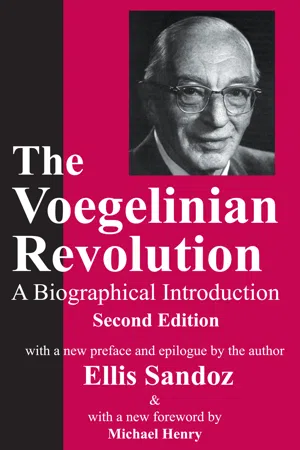
The Voegelinian Revolution
A Biographical Introduction
- 299 pages
- English
- ePUB (mobile friendly)
- Available on iOS & Android
eBook - ePub
About this book
Over the past half-century, Eric Voegelin has produced a demanding body of writing on the philosophy of history and the history of political theory since antiquity. This is the first full-scale treatment of his inquiry into the reality of man's political existence. It includes close readings of the texts, with Voegelin's own comments on them interspersed, offering a thorough explication of the philosopher's quest.Incorporating an "Autobiographical Memoir" prepared in collaboration with Voegelin especially for the volume, Ellis Sandoz interweaves the events of this great thinker's life with the philosophical inquiry to which that life has been devoted. Among the uniquely engaging biographical subjects covered are Voegelin's reminiscences of his involvement with such seminal minds as Max Weber, and with Karl Kraus, Hans Kelsen, and other lights of Vienna's intellectual community of the 1920s and 1930s; a full discussion of his early responses to national socialism and his escape from the Anschluss in 1938; and a summary of his early years in America, with particular attention to the years at Louisiana State University with Cleanth Brooks, Robert Penn Warren, and Robert Heilman.Carefully analyzing Voegelin's contribution to our understanding of ourselves, Sandoz convincingly argues that Voegelin's achievement is revolutionary. He emphasizes the common sense running through Voegelin's thought, and reveals how Voegelin reached a new analysis of reality and provides us with a new science of human affairs. Sandoz does not reveal the "truth to end the quest for truth," but shows how such "stop history" answers are defective. Exploring the meaning of that "first truth" as it has been intellectually and spiritually unraveled by one of our century's leading thinkers, Voegelinian Revolution shows anyone interested in politics and human affairs how to follow Voegelin's path. This book will be of interest to historians, political theorists, students of philosophy and religion, and educated readers concerned about the plight of American/Western civilization and looking for a new view on our current "crisis."
Information
CHAPTER I A Starting Point: Common Sense and the New Science
To convince oneself of Jascha Heifetz’ greatness as a violinist one has only to hear him play; a similar test of the profundity of Eric Voegelin as a philosopher is most convincing. Accordingly, a bibliography of Voegelin’s writings is provided at the end of this volume as an index of a scholar’s production which is in every way the equivalent of the artist’s achievement, if range and virtuosity be accepted as common criteria. Of course, if one dislikes violin-playing on principle—or if one is exclusively a fan of Emerson, Lake, and Palmer and responds with “Jascha Who?”—then hearing Heifetz play will offer less-than-cogent proof of his brilliance. Still: the proof of the pudding is in the eating (to change metaphors), and a perusal of Voegelin’s own work is the best demonstration of its significance.
I
Another way of documenting the unique significance of Voegelin is by consulting experts, the jury technique widely used in academe whenever a qualitative judgment is wanted. A sampler of such expert opinions might begin with the statement of a distinguished Old Testament scholar, Princeton’s Bernhard W. Anderson:
The great merit of Voegelin’s work is that he seeks to recover “the whole” by penetrating to the dynamic of human existence.. . . The field of Old Testament studies, like other scholarly disciplines, is currently the victim of specialization. Hence, it is refreshing to read the work of a philosophical “layman” in the field who has taken it upon himself to master the original sources and the secondary literature up to the time of his writing. . . . This [Israel and Revelation] is one of the few books on the Old Testament which has so engrossed my interest that I have eagerly wondered what would be on the next page.1
James L. Wiser has commented: “Voegelin has attempted much more than simply rigorous intellectual history. Important as the understanding of the Greek science of order is in itself, the greater achievement of this study becomes clear only within the larger horizon constituted by Voegelin’s own theoretical intentions. . . . Voegelin’s attempt to understand philosophy as a form of existence-in-truth is simultaneously a presentation of those historical events in which the opening of existence towards transcendence was seen as disclosing the very nature of humanity itself.”2
John H. Hallowell has written: “This analysis of Plato and Aristotle reflects a brilliant, subtle mind and displays an erudition that few scholars can match. It is a remarkable intellectual achievement but more importantly it is, along with his other writing, an adventure in philosophy not unlike the one undertaken by Plato himself.”3 Dante Germino has written:
With the publication of the long-awaited fourth volume to his magnum opus, Order and History, Eric Voegelin has established himself as the leading political philosopher of our time. The virtues apparent in previous volumes—enormous erudition, openness to the evidence wherever it leads, masterful use of sources, exceptional interpretive gifts, penetration to the key philosophical issues—abound in the present one also, but another dimension of the argument is more powerfully present: Voegelin no longer stands forth principally as the interpreter of the thought of past philosophers but presents his own original and profound philosophy of history. What we have before us, then, is not another book but a masterpiece.4
Theologian Thomas J. J. Altizer, has called Voegelin “one of the major thinkers of our time, and major religious thinkers,” going on to say, “Eric Voegelin may well be historically unique in having mastered the worlds of both Athens and Jerusalem: Order and History is surely unique in its project of unveiling the coinherence [sic] of noetic [rational] understanding and biblical faith as the primary and indispensable ground of Western civilization.”5 Political scientist R. Bruce Douglass has commented: “Order and History . . . elaborate[s] a history of the symbolization of order, out of which a philosophy of history begins to emerge. This development of a philosophy of history rooted in detailed, catholic study of the history of symbolisms of order is Eric Voegelin’s distinctive contribution to political theory. . . . The logic of his work would seem to be that the only way to challenge effectively a defective view of history is to provide an alternative that is philosophically sound.”6
In 1956, when Order and History first began to appear, Crane Brinton of Harvard said, “This whole work seems to me clearly to take rank with the works of Toynbee, Spengler, Sorokin, and Collingwood.” And Roger Shinn called Israel and Revelation “one of the great intellectual works of our generation. ... A masterful combination of scientific scholarship with theological and poetic insight.” As Shinn later wrote: “It is evident that the lavish praise Voegelin has won from many critics is not extravagant. His is one of the monuments of scholarship of our time.”7 Distinguished historian C. A. Robinson of Brown University said of Voegelin’s analysis of Hellenic antiquity: “The true strength of these volumes, and it is a very great and remarkable strength, lies in the penetrating and significant analysis of the ancient Greek writers.”8 James B. Pritchard and W. F. Albright were two among many others who lauded Voegelin’s achievements. Albright went so far as to say that Voegelin’s “use of Hebrew is almost impeccable.”9 And Notre Dame’s Gerhart Niemeyer found the initial three volumes of Order and History “a great deed of the spirit, one which will stand as a monument of this mid-century.”10
Voegelin’s The New Science of Politics excited such interest that Time magazine seized upon it for the feature article of its thirtieth anniversary issue, entitled “Journalism and Joachim’s Children.”11 Michael Oakeshott’s anonymous review for the London Times Literary Supplement included the statement that “this book must be considered one of the most enlightening essays on the character of European politics that has appeared for half a century.”12 Arnold Brecht wrote elsewhere that the “mid-century revolt against positivism, scientific method, and relativism in political science is making headway. It has now found what may easily come to be considered its leading expression in a small and difficult, but rich and important book by Professor Eric Voegelin.”13 And a Yale political scientist, Robert A. Dahl, while expressing nearly total disagreement with Voegelin, grudgingly conceded the author to be “a writer of such massive erudition [that he] uses a third-century document with more skill than most of us use the New York Times.”14
II
In response to such a series of comments from authority—and those observations represent only a fraction of the published commentary—one might reasonably argue that Voegelin is not obscure at all. It was, after all, to Voegelin that Newsweek turned for a comment when Toynbee died in 1975. And he has lectured and served as visiting professor throughout this country and abroad at such leading universities as Oxford, London, Chicago, Harvard, Johns Hopkins, Yale. He maintains a staggering correspondence with scholars in dozens of disciplines in all corners of the world. He has been the subject of two panels of the American Political Science Association, and his work has been honored by the Association with the Benjamin E. Lippincott Award. He was appointed in 1958 to fill the chair in political science at the University of Munich left vacant since the death of Max Weber in 1930. And he served as Salvatori Distinguished Scholar in the Hoover Institution on War, Revolution, and Peace at Stanford University after retirement from Munich in 1969.
This is not exactly obscurity. Still, Voegelin is not nearly so famous as, say, Herbert Marcuse or Angela Davis, nor even so well known as those with whom he is most frequently compared: Spengler, Toynbee, Sorokin, or perhaps Collingwood. Why this absence of popular appreciation despite the aforementioned praises? The answer is not simple; it goes to the heart of the body of thought before us. Parts of the answer are implied by the commentators I have quoted. To begin with, much of Voegelin’s work has focused on antiquity, a far remove from the workaday concerns of the general public and even of social scientists. Moreover, Voegelin steadily moves at the frontier of knowledge. Hence, full appreciation of his work requires the attentive response of an accomplished scholar. As a reviewer of The Ecumenic Age expressed it: “Voegelin’s brilliant work rests on a mastery of considerable ancient history, philosophy, and religion. . . . This author attempts to create a universally significant philosophy of history on a scale superseding Spengler, Toynbee, Hegel, and Marx. . . . Only advanced scholars in the realms of philosophy of history, intellectual history, and religion will exert the effort required to understand this book,”15 No D. C. Somervell has appeared to edit and popularize Order and History as occurred with Toynbee’s A Study of History16—nor would Voegelin permit such a thing to be done.
Addressing the man’s evident obscurity even within the restricted horizon of professional political scientists, William C. Havard, Jr., and Gregor Sebba pondered the question of what has “prevented the appropriate recognition of the emergence of a new theory of politics” as that is provided in Voegelin’s thought and writings. They concluded that two things were decisive. “The first is that the advancement of that theory’. . .is largely the work of one independent thinker . . . who published his first book four decades ago and is still forging ahead at a pace which leaves his best readers behind.’ The second is the enormous demand which the [Voegelinian] achievement makes on the ‘newcomer to such studies.’ Not only must the reader be able to follow abstract reasoning at its highest level, but he must know the history of ideas, philosophy (in all its dimensions), theology, the full sweep of history from prehistory to modernity, and the present development of scholarship in fields as widely separated as anthropology, biblical criticism, comparative literature, psychology, and others. . . . ‘All this is very far from the concerns of the practicing political scientist today.’”17
These explanations for Voegelin’s relative obscurity are surely valid. But there is another, perhaps more fundamental explanation. As a philosopher and scientist devoted to the exploration of the human condition in all its dimensions, Voegelin’s work is revolutionary. Thus, he must be approached on his own terms; he cannot be “explained” in terms either of the variegated subject matter he deals with or the source materials he utilizes. The decisive dimension of his achievement lies in the sphere of imaginative insight. New insights are always difficult to appreciate, doubly so when they necessitate a major shift in the structure of scientific thinking itself. Yet just this kind of Copernican revolution is present in Voegelin’s work.
A lesser, but more obvious, effect of Voegelin’s revolutionary originality is that he is (in varying degrees) at odds with all schools of thought. He does not fit any of the convenient intellectual pigeonholes. Hence, he has no applauding claque, no automatic clientele, either academic or political. He is a genuinely independent thinker. His work is strikingly free of polemics, yet it clearly entails a rejection of all of the dearest Idols of the Cave of modern intellectuals here and abroad, most especially of positivism, Marxism, and Freudianism. And these are not merely the idols of the intellectuals, but of a substantial segment of the educated public which has itself been educated at the hands of such intellectuals, not a few of whom are university professors and publicists, shapers of the climate of opinion more generally. In stressing that he was partisan of no cause, Voegelin once made the point this way :
I have in my files the documents according to which I am a Communist, a Fascist, a National Socialist, an old Liberal, a new Liberal, a Catholic, a Protestant, a Platonist, a neo-Augustinian, a Thomist, and of course an Hegelian. Not to forget that I was strongly influenced by Huey Long. This list I consider of some importance, because the various characterizations of course always name the pet bête noire of the respective critic and give therefore a very good picture of the intellectual corruption and destruction which characterizes the contemporary academic world. Understandably I have never answered criticisms of this kind; critics of this type can become objects of inquiry but they cannot be partners in a discussion.18
“To be great is to be misunderstood,” Emerson once said,19 and misunderstood Voegelin has assuredly been. For it is evident that he could not belong to all of the persuasions with which he has been identified, but it is scarcely comprehensible even to persons of considerable sophistication that he belongs to none of them.
This is so much a source for the misunderstanding of Voegelin’s work, as well as for the muting of its resonance among the educated public, that another illustrative example may not be amiss. Thus the following humorous detail in Voegelin’s recounting of the grim life-and-death drama of his escape from Austria into Switzerland after the Nazi Anschluss and his immediate firing from the law faculty of the University of Vienna in 1938. Having narrowly eluded the Gestapo and fleeing by train with two bags, leaving his wife at her parents’ home to follow a week later, he crossed the Austrian border and presented himself at an American consulate in Switzerland.
In Zurich I had to wait for a nonquota immigration visa extended to scholars who had been offered jobs in the United States. My friends at Harvard— [Gottfried von] Haberler, [Joseph A.] Schumpeter, and in a very decisive function as head of the Department of Government, Arthur Holcombe— had provided a part-time instructorship. But I had not yet received an official letter, and I had to wait for that in Zurich in order to get the American visa. In waiting for the visa I had dealings with the American vice-consul in Zurich, a very nice Harvard boy, who had grave suspicions about me. He explained that I was neither a Communist, nor a Catholic, nor a Jew and therefore had no reason whatsoever not to be in favor of National Socialism and be a National Socialist myself. Hence, if I was obviously in flight the only reason must be some criminal record; and he did not want to give me the visa before the matter of my criminality was cleared up. Fortunately, in due course the letter of Holcombe arrived, advising me of my appointment as a part-time instructor, and with the signature of Holcombe on the letter the Harvard boy in the consulate was convinced that I was in the fold, and I got my visa.
I am telling this incident not in order to, be critical of this particular vice-consul, who was as innocent of political problems, and especially human problems, as such people happen to be. . . ....
Table of contents
- Cover Page
- Halftitle Page
- Title Page
- Copyright Page
- Library of Conservative Thought
- Content Page
- Dedication
- Abbreviations Used in Text
- Preface to the Transaction Edition
- Foreword to the Transaction Edition
- Addenda and Corrigenda
- Acknowledgments
- Introduction
- Chapter 1 A Starting Point: Common Sense and the New Science
- Chapter 2 Biography and the Course of Thought to 1938
- Chapter 3 Americanization: A Scholar’s Pilgrimage to 1981
- Chapter 4 The Science of History and Politics: 1952
- Chapter 5 History and Its Order: 1957
- Chapter 6 Myth, Philosophy, and Consciousness: 1966
- Chapter 7 Principia Noetica: The Voegelinian Revolution—1981 and Beyond
- Chapter 8 The Vision of the Whole
- Epilogue
- Bibiliographic Note
- Works by Eric Voegelin, 1922-1981
- Index
Trusted by 375,005 students
Access to over 1.5 million titles for a fair monthly price.
Study more efficiently using our study tools.
Frequently asked questions
Yes, you can cancel anytime from the Subscription tab in your account settings on the Perlego website. Your subscription will stay active until the end of your current billing period. Learn how to cancel your subscription
No, books cannot be downloaded as external files, such as PDFs, for use outside of Perlego. However, you can download books within the Perlego app for offline reading on mobile or tablet. Learn how to download books offline
Perlego offers two plans: Essential and Complete
- Essential is ideal for learners and professionals who enjoy exploring a wide range of subjects. Access the Essential Library with 800,000+ trusted titles and best-sellers across business, personal growth, and the humanities. Includes unlimited reading time and Standard Read Aloud voice.
- Complete: Perfect for advanced learners and researchers needing full, unrestricted access. Unlock 1.5M+ books across hundreds of subjects, including academic and specialized titles. The Complete Plan also includes advanced features like Premium Read Aloud and Research Assistant.
We are an online textbook subscription service, where you can get access to an entire online library for less than the price of a single book per month. With over 1.5 million books across 990+ topics, we’ve got you covered! Learn about our mission
Look out for the read-aloud symbol on your next book to see if you can listen to it. The read-aloud tool reads text aloud for you, highlighting the text as it is being read. You can pause it, speed it up and slow it down. Learn more about Read Aloud
Yes! You can use the Perlego app on both iOS and Android devices to read anytime, anywhere — even offline. Perfect for commutes or when you’re on the go.
Please note we cannot support devices running on iOS 13 and Android 7 or earlier. Learn more about using the app
Please note we cannot support devices running on iOS 13 and Android 7 or earlier. Learn more about using the app
Yes, you can access The Voegelinian Revolution by Lynda Lytle Holmstrom,Ellis Sandoz in PDF and/or ePUB format, as well as other popular books in Philosophy & Philosopher Biographies. We have over 1.5 million books available in our catalogue for you to explore.