Poetic Inquiry
eBook - ePub

Poetic Inquiry

Craft, Method and Practice

  1. 204 pages
  2. English
  3. ePUB (mobile friendly)
  4. Available on iOS & Android
eBook - ePub

Poetic Inquiry

Craft, Method and Practice

About this book

Poetic Inquiry: Craft, Method and Practice examines the use of poetry as a form of qualitative research, representation, and method used by researchers, practitioners, and students from across the social sciences and humanities. It serves as a practical manual for using poetry in qualitative research through the presentation of varied examples of Poetic Inquiry. It provides how-to exercises for developing and using poetry as a qualitative research method.

The book begins by mapping out what doing and critiquing Poetic Inquiry entails via a discussion of the power of poetry, poets', and researchers' goals for the use of poetry, and the kinds of projects that are best suited for Poetic Inquiry. It also provides descriptions of the process and craft of creating Poetic Inquiry, and suggestions for how to evaluate and engage with Poetic Inquiry. The book further contends with questions of method, process, and craft from poets' and researchers' perspectives. It shows the implications for the aesthetic and epistemic concerns in poetry, and furthers transdisciplinary dialogues between the humanities and social sciences.

Faulkner shows the importance of considering the form and function of Poetic Inquiry in qualitative research through discussions of poetry as research method, poetry as qualitative analysis and representation, and Poetic Inquiry as a powerful research tool.

Frequently asked questions

Yes, you can cancel anytime from the Subscription tab in your account settings on the Perlego website. Your subscription will stay active until the end of your current billing period. Learn how to cancel your subscription.
No, books cannot be downloaded as external files, such as PDFs, for use outside of Perlego. However, you can download books within the Perlego app for offline reading on mobile or tablet. Learn more here.
Perlego offers two plans: Essential and Complete
  • Essential is ideal for learners and professionals who enjoy exploring a wide range of subjects. Access the Essential Library with 800,000+ trusted titles and best-sellers across business, personal growth, and the humanities. Includes unlimited reading time and Standard Read Aloud voice.
  • Complete: Perfect for advanced learners and researchers needing full, unrestricted access. Unlock 1.4M+ books across hundreds of subjects, including academic and specialized titles. The Complete Plan also includes advanced features like Premium Read Aloud and Research Assistant.
Both plans are available with monthly, semester, or annual billing cycles.
We are an online textbook subscription service, where you can get access to an entire online library for less than the price of a single book per month. With over 1 million books across 1000+ topics, we’ve got you covered! Learn more here.
Look out for the read-aloud symbol on your next book to see if you can listen to it. The read-aloud tool reads text aloud for you, highlighting the text as it is being read. You can pause it, speed it up and slow it down. Learn more here.
Yes! You can use the Perlego app on both iOS or Android devices to read anytime, anywhere — even offline. Perfect for commutes or when you’re on the go.
Please note we cannot support devices running on iOS 13 and Android 7 or earlier. Learn more about using the app.
Yes, you can access Poetic Inquiry by Sandra L. Faulkner in PDF and/or ePUB format, as well as other popular books in Social Sciences & Social Science Research & Methodology. We have over one million books available in our catalogue for you to explore.

1

The Power of Poetry

Poetry allows us to hear the tread of another through their experiences and it compels us to explore a different way of capturing social science research.
Gradle, 2017, p. 234
Poetry is another way of singing. Language is wearing its other story.
Rita Dove, 2018

Poetic Inquiry Is …

At its best, Poetic Inquiry bootstraps comprehension of a research topic, energizes inquiry, and challenges how we come to knowledge and what we think we know, undercutting disciplinary, discursive norms.
James, 2017, p. 23
Welcome to the revised edition of Poetry as Method wherein I examine the use of poetry as a form of research, representation, and method used by researchers, practitioners, and students from across the social sciences and humanities. Through discussions of poetry as research method, poetry as qualitative analysis and representation, and Poetic Inquiry as a powerful research tool, I make an argument for the importance of considering the form and function of Poetic Inquiry in qualitative research. This project extends my own and others’ work on issues of poetic and arts-based research methodology through an examination of explicit, and often implicit, writing and beliefs about what constitutes effective poetry and arts-based research. This project contends with questions of method, process, and craft from poets’ and researchers’ perspectives to show the implications for the aesthetic and epistemic concerns in poetry and to further transdisciplinary dialogues between the humanities and social sciences. I argue for Poetic Inquiry as a feminist, liberatory methodology that will enhance our teaching, research, and practice. This revision also serves as a practical manual for using poetry in qualitative research through the use of varied examples of Poetic Inquiry and providing how-to exercises for developing and using poetry as qualitative research method. I map out what doing and critiquing Poetic Inquiry entails by beginning with a discussion of the power of poetry, moving to poets’ and researchers’ goals for the use of poetry in their work and the kinds of projects that are best suited for Poetic Inquiry, then describing the process and craft of that writing, and suggesting ways that we may evaluate and engage with Poetic Inquiry.
This chapter introduces the idea of poetry as research, method, and methodology by defining poetry and Poetic Inquiry and making the argument for the power of poetry by addressing the following questions:
  • What is poetry as research?
  • What does it mean to say that poetic practice is a research method?
  • What do we label poetry used in and as research?
  • What is poetry as research methodology?
  • How is poetry praxis and response?
I begin with an autoethnographic account of my move to Poetic Inquiry in my research as a social scientist to position myself in the conversation and demonstrate reflexivity. Next, I define poetry and Poetic Inquiry, synthesize and discuss the scope of Poetic Inquiry, before moving to the goals and kinds of projects that are best suited for Poetic Inquiry. This includes framing Poetic Inquiry within feminist, queer, narrative, and identity theories to show how we can use poetry as research method, to represent research and the research process, and as praxis. I show that poetry as/in/for research offers scholars, teachers, and practitioners a means of doing, showing, and teaching embodiment and reflexivity, a way to refuse the mind-body dialectic, a form of ethnography and qualitative research, and a catalyst for social agitation and change.

Moving to Poetic Inquiry

Crank Up the Feminism
We declare feminist law
like shrews in heat
dial up the belligerent bass
from the front seat.
We do our hair in rosy rage
smear righteous red on our cheeks
as we pull on our combat best dress
the anti-patriarchy patrol in suffragette white.
The usual boys have no idea
what to do as we shank
the good girl in the mirror:
You’re all lesbians now, America!
Our art bleeds down our legs
pools like rubies on piles of rubble
that can’t be swept under rugs:
our rage refuses to ride shotgun.
We skip the protest and go
right for the throat, steal bologna
sandwiches from the Boy Scout’s
tent yawping, You want to see rogue?
We snap the elastic in your pants,
show up five minutes late
with wet hair and chipped nails,
hit send without proofreading:
you can type your own template
as we crush the control panel
throttle up the appropriate volume
smashing the baby over your knees.
Faulkner, 2018a
I begin with a poem I wrote in response to Alex Ruth Bertulis-Fernandes’ art piece called Dial Down the Feminism, which consists of a photo of a control panel with a dial and two volume settings—complicit in my own dehumanization and raging feminist—with the dial turned to raging feminist (Grasso, 2018). Alex’s art professor told her to dial down the feminism in her work, and Alex responded with feminist art. As I wrote my ekphrastic poetic response to Bertulis-Fernandes’ work, I thought of all of the ways I’ve been told in my life and career that “my feminism has ruined me,” that my work is too critical, that I should be the “Good White Girl,” that I have destroyed others’ altruistic visions of motherhood, and that I shouldn’t put that “poetry stuff” on my vitae (Faulkner, 2016a). I am a poet, a feminist ethnographer, partner, and teacher who studies close relationships and uses Poetic Inquiry as a way to show the messy work of living a feminist life (Ahmed, 2017), being a feminist scholar and teacher, being a feminist partner and mother, and doing feminist relationship research. You can use poetry in your research, teaching, and praxis as a (YOU FILL IN THE BLANK) scholar. I show you my evolution from a traditional qualitative researcher to an Arts-Based Research Practitioner who uses poetry in teaching and as a feminist research method.
“Poetic Inquiry is the use of poetry crafted from research endeavors, either before a project analysis, as a project analysis, and/or poetry that is part of or that constitutes an entire research project” (Faulkner, 2017a, p. 210). I argue that Poetic Inquiry can be a qualitative and feminist research methodology because of what poetry can do and be.
I write poetry because I am a bad (BAD!) social scientist. I study personal relationships; I am most interested in what relationships feel like and sound like and smell like more than how they function as some kind of analytic variable to be deconstructed. I believe in poetic truth(s) more than social science Truth punctuated with a capital T … What I understand is that one can write poetry as social science. What I believe in is the value of poetry as relationship research.
Faulkner, 2017b, p. 148
I began using poetry in my work as a scholar who studies close relationships when I needed to talk about identity and communication in a more nuanced fashion and wanted to describe the physicality and emotionality of doing research (Faulkner, 2005). I have written poetry since childhood and often write poems when I am trying to make sense of difficult life experiences such as cancer and motherhood (e.g., Faulkner, 2014a, 2017c). Shortly after finishing my PhD when I was engaged in a project on LGBTQ Jewish identity (Faulkner and Hecht, 2011), I merged my poetry practice with my social science training by presenting the narrative research as poetry (Faulkner, 2006). “Writing poetry helped me recover from my training in graduate school and the numbing realities of academic writing. It helped me reclaim creativity and its rhythms” (Faulkner, 2014a, p. xiii). I felt that the twists and turns in the research study, showing my reflexivity as a feminist scholar, and the bodily experience of doing and being a feminist ethnographer were best presented as poetry. I wrote the method’s section of the work (Faulkner, 2005) as a series of six poems to show the research story (L. Richardson, 1997a), my subjective emotional processes, difficulties of identities in fieldwork, and the challenges of conducting interviews while being reflexive and conscientious. In the poems, I was able to highlight how identities as researcher and participant were negotiated in situ. For example, the following poem about a participant’s reaction to me as a researcher is a story a traditional method section couldn’t tell:
I’m Not What Lisa Expected
no blonde bunned hair
like the researcher in her mind,
like my second grade teacher, glasses,
but blue and stylish and young.
I’m 31 and old enough to teach,
ask others about their identities,
though I have scant lines on face and vita,
wear shirts without collars.
I talk as a friend—except those questions
about being gay and Jewish—
as I shift, catch words with my recorder,
camo cargo pants belie my worry with uniform.
Another participant claims I walk lesbian-
like, confident stride and spiky cut hair,
into her usual diner on 7th Avenue where
we eat rice pudding like family. She knew
who I was without my description—
5 feet 5 inches, red hair, short and sapphire spectacles—
How do I tell them that I live and flirt
and fight with a man now, that my
ex-girlfriend calls me semi-straight
and semi-gay and too interested in labels?
Fau...
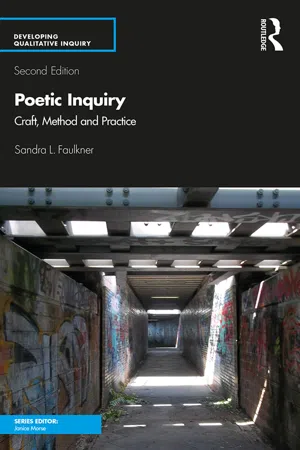
Table of contents

  1. Cover
  2. Endorsements
  3. Half Title
  4. Series Information
  5. Title Page
  6. Copyright Page
  7. Contents
  8. Illustrations
  9. Preface
  10. Acknowledgments
  11. The Book
  12. 1 The Power of Poetry
  13. 2 Poetry as Method
  14. 3 Concern with Craft: The Question of Poetic Criteria
  15. 4 Exercising the Poetry Muscle
  16. References
  17. Index