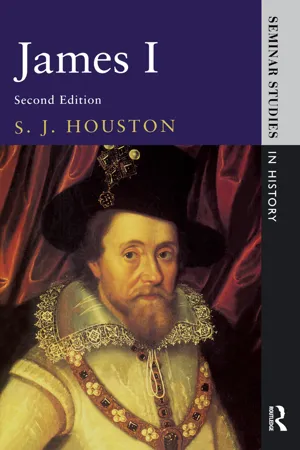
Since publication in 1973 James I has established itself as one of the most popular short accounts of James I's reign. The First Edition was described by John Morrill as `a far better, shrewder, more incisive account of the reign' than the available competition Seventeenth-Century Britain, 1980. The text has now been entirely rewritten to take account of the latest historiography and students will continue to welcome this accessible analysis of the problems, weaknesses and achievements of James I as it enables them to participate in the revisionist arguments that make the study of this period so stimulating.
eBook - ePub
James I
PART ONE: THE BACKGROUND
1 JAMES VI OF SCOTLAND
Perhaps the most significant fact about James I is not that he was learned, or extravagant, or homosexual, but that he was a Scot who, for forty of his fifty-nine years, was an active and successful ruler of his native Scotland. As the only child of Mary, Queen of Scots and Henry Stuart, Lord Darnley, his character was formed by the bleak circumstances of his northern upbringing. His parents’ marriage had ended in disaster. Beguiled by Darnley’s good looks, Mary did not discover, until after they were married and she was pregnant, that he was vicious, stupid and degenerate. The Queen found consolation in the lively company of her secretary, the Italian David Riccio. Three months before James’s birth on 19 June 1566, Riccio was dragged by Darnley from the room at Holyroodhouse where he and Mary were at supper, and stabbed 56 times within ear-shot of the Queen. This brutal murder began a cycle of violence that was to have a profound effect on James’s emotional development. When Darnley refused to attend his son’s baptism, he undermined the credibility of an earlier admission of paternity extracted from him by his wife. Mary and Riccio were not lovers; but the slander that Seigneur Davie was his father would haunt James throughout his life. When, years later, he called himself ‘the English Solomon’, Henry IV would chuckle: ‘Solomon the son of David who played upon the harp’. Shortly after James’s christening, Darnley went to Glasgow to recover from an attack of the pox. In February 1567, he was persuaded by Mary to leave the safety of his father’s house and return to Edinburgh, where he was lodged in Kirk O’Field, a small four-bedroomed residence in a squalid neighbourhood on the outskirts of the city. Soon afterwards, while the Queen was attending a wedding party at Holyrood, an immense explosion reduced the house to rubble. Darnley was found strangled and naked in the garden. Neither Mary’s complicity in the murder, nor the identity of the assassin, has ever been properly established. At the time, everyone assumed that the culprit was James Hepburn, Earl of Bothwell, with whom Mary had fallen in love. When, two and a half months later, the lovers married, an outraged faction of protestant lords forced Bothwell into exile and put Mary in prison where, before escaping and fleeing to England, she was forced to sign deeds of abdication, granting the regency to her half-brother, the Earl of Moray. On 19 July, 1567, her son, aged thirteen months, was carried from Stirling Castle to the nearby parish church of the Holy Rood where, in a brief, bleak ceremony attended by only one-tenth of the nobility, he was crowned in her place.
The political instability of James’s minority had its roots in Mary’s enforced abdication. A significant body of opinion questioned its legality, resenting and exploiting the new government’s dependence on Queen Elizabeth. Only after 1571, when Mary’s assumed complicity in catholic plots to assassinate Elizabeth destroyed all hope of her return to Scotland, did a majority of magnates accept the legitimacy of James’s rule. The boy’s experience, during his minority, of the murderous factiousness of the Scots nobility, did much to form his personality and kingship. Only one of four successive regents died a natural death. James was sometimes the object of these bloody affrays, to be passed around like a trophy by magnates who hoped to control the state through possession of the King. The most telling image of this period is of James, aged five, cowering in terror at the sight of his grandfather, the Earl of Lennox, being carried into Stirling Castle mortally wounded by enemies who had tried to kidnap the young King. There was no affectionate family to cushion the psychological shock of these events. Mary had placed her baby in the care of John Erskine, Earl of Mar, whose predecessors had often been entrusted with the guardianship of royal infants. In 1567 Erskine’s great responsibility was confirmed by the Confederate Lords and provision made at Stirling for a small royal household. However, while proper care was taken of the boy’s physical needs, his emotional development was neglected. The formidable Countess of Mar, who cared for him, was not unkind; but she made no attempt to mother the abandoned child, so that James grew up, in his own phrase, ‘alane, without fader or moder, brither or sister, King of this realm and heir apperand of England’, and with a better understanding of how to be a ruler of men than to be a husband or father.
The King’s rigorous education began almost before he had ceased to be a baby. They made me speak Latin ere I could speak Scots’, he later recalled. Two tutors were appointed shortly after his third birthday. George Buchanan, an elderly humanist scholar of international repute, was ill-tempered and severe; while Peter Young, almost as learned though only twenty-seven, was kinder and more sensitive. It would have been difficult anywhere to equal the pedagogical skills of this team. Buchanan, who did not spare the rod, insisted with ferocious intensity that ‘a king ought to be the most learned clerk in his dominions’. From Young, James imbibed that deep aversion to Catholicism which was thought proper for a Calvinist in the sixteenth century. He also received an excellent grounding in theology, and was throughout his life a committed and knowledgeable protestant – the godly prince his guardians had hoped he would become. James’s education turned him into one of the most learned men in Europe, a man who, in the words of Bishop Goodman, ‘did love solitariness, and was given to study’. He adored controversy and had the wit and flexibility of mind to excel in the most testing of intellectual pursuits. James grew up to be the sort of person for whom conversation marks the difference between eating and dining, so that ‘the Learned stood about him at his Board’, enjoying the King’s learning and bawdy jests [Doc. 3]. His knowledge of history, theology, political theory and the classics provided the foundation for reflections on the relationship between the nature of kingship and the practical difficulties of governing Scotland. These he published in a series of books and pamphlets written in vigorous and salty prose [17]. In The Trew Law of Free Monarchies (1598) and Basilikon Doron (1599), the King reacted sharply against the political theory of Buchanan who, anxious to justify the deposition of Mary, taught his pupil that kings had been chosen originally by ‘the people’ (meaning the aristocracy), to whom they were accountable. Furthermore, a king’s authority had no divine sanction: if he ruled badly he could be deposed, even killed. Buchanan’s thesis of a monarch answerable to a sovereign people, which he documented in an eccentric interpretation of Scottish history entitled De Juri Regni apud Scotus, was echoed by John Knox, another implacable enemy of Mary Stuart and the great leader of the Reformation in Scotland. Knox insisted that the godly people were duty-bound to remove an ungodly prince whose behaviour was unacceptable to God. The practical problem of defining exactly what was unacceptable would be tackled by the ministers of the Kirk. Force-fed a diet of such theories, James found them indigestible. The published works of Knox and Buchanan, he wrote in Basilikon Doron, were ‘infamous invectives’ and he had them collected up and burnt. ‘If any of these infamous libels remain until your days’, he advised his son Henry, ‘use the law against the keepers thereof because ‘the very spirits of these archibellouses of rebellion’ will inhabit anyone who ‘hoards their books and maintains their opinions’.
Buchanan’s teaching affected his pupil in another, more personal way. The old man had once been charmed by Mary. They had read Livy together and he had sent her his poems. But Buchanan was bound to the Lennox clan whose chief was Darnley’s father. Mary, he decided, was responsible for her husband’s death. Consequently, in both the schoolroom and in print she became a ‘bloody woman and poisoning witch’, whose ‘immeasurable but mad’ love for Bothwell justified her deposition. Filthy stories about the Queen, scraped from the tap-rooms of Edinburgh taverns, became the stock-in-trade of Buchanan’s teaching method. The boy’s reaction to this sour and relentless onslaught against his mother was ambivalent and must have caused him pain. He fiercely rejected tales of Mary’s immorality and eventually turned on her traducers. But he could not easily deny Buchanan’s version of the events that led to her abdication: both his office and title of King were dependent on it. And so he kept a politic silence. The ambivalence of James’s feelings for his mother was dramatically exposed in 1586–87 when Mary was found guilty by an English court of conspiring with Anthony Babington to murder Elizabeth. When news of his mother’s alleged part in the conspiracy reached him, James coldly informed Elizabeth that Mary ‘must be content to drink of all she has brewed’. But he could hardly stand silently by when it became clear that his mother faced the axe. To Elizabeth he wrote protesting that ‘the nobility and counsellors of England should take upon them to sentence a Queen of Scotland’. At the same time he tried, by hinting at retaliatory action, to ride the crest of a great wave of nationalist anger that surged through Scotland. But this was the time in James’s life when he ached with longing for a confirmation from Elizabeth of his right of succession to her throne. So there was no ultimatum. To the Earl of Leicester he wrote: ‘How fond [foolish] and inconstant I were if I should prefer my mother to the title’. When news of Mary’s execution reached Scotland, James was rumoured to have whispered: ‘Now I am sole King’. There were ritual protests. But because both his present security and future prosperity were at stake, James took no action. After a decent interlude of recrimination, Anglo-Scottish relations were restored to their previous condition of guarded friendliness. One of the more plausible accounts of the tragedy states that ‘the King moved never his countenance at the rehearsal of his mother’s execution, nor leaves his pastime and hunting more than before’. This absence of filial feeling is not surprising. James had been abandoned by his mother, and those about him had never let him forget it. There was just enough truth in Buchanan’s vindictive stories about her to rankle: small wonder that James felt better off when she was dead.
Lonely and loveless, King James’s life was transformed in September, 1579 by the arrival in Scotland of his French kinsman, Esmé Stuart, a handsome and amusing man some twenty-four years older than himself. James’s vulnerability made him enormously susceptible to the warmth and affection offered by his elegant and charming cousin. For the first time in his life he was treated like an adult and made to feel that he really was a King. Captivated, he showered his kinsman with honours and rewards, a habit of generosity that would be triggered by each succeeding favourite for the remainder of his life. Esmé was created Earl, then Duke of Lennox, the only Duke in Scotland. During the brief period of this favourite’s ascendancy over the Scottish Court, James was happier, probably, than at any other time in his life. Stimulated by the favourite’s patronage of a group of Court poets led by Alexander Montgomerie, he began to write poetry. He learned to enjoy himself riding and hunting, and was treated with deference and respect. Listening attentively to what Lennox could teach him about the management of men and affairs, the King rapidly developed a confidence in his own judgement that he never lost. The favourite reorganised the royal household, combining in his own person the offices of Lord Great Chamberlain and First Gentleman of the Chamber, thereby reinforcing the characteristically French ambience of the Scottish Court that goes back to the reign of James V in the early sixteenth century. Twenty-four gentlemen were appointed to attend upon the King, eight at a time, in quarterly shifts. As First Gentleman, Lennox supervised the staff of the bedchamber and had first option on sleeping there. He helped to dress and undress the King. As Lord Chamberlain he was responsible for the safety of the King’s person, providing a guard of sixty men-at-arms.
Lennox’s influence over the household, his easy access to the sovereign at any time of the day or night, and the King’s obvious dependence upon him, fuelled rumours about the nature of their special friendship. A relationship which, to the unbiased observer, seems like an adolescent crush on an attractive man who offered James the close family relationship he had hitherto lacked, was transformed by prurient speculation into something sinister. David Moysie, a clerk of the Privy Council, noted that ‘his majesty having conceived an inward affection to the Lord d’Aubigny [Lennox], entered in great familiarity and quiet purposes with him’. The clergy were more specific. Lennox, they said, had ‘fouly misused his tender age’ and ‘provoked’ the boy to the pleasures of the flesh, infecting ‘the King’s tender heart with delights and disordinate desires’. In 1581 the relationship came to an abrupt end. Favourites make enemies in court. The ministers of the Kirk, roused to fury by the arrival in Scotland of a Jesuit mission, united with a faction of discontented nobles to drive Lennox from the realm. He died in France the following year. James never forgot his first favourite. Esmé’s son, Ludovic, eight years James’s junior, became a lifelong friend. When he died in 1624, by now Duke of Richmond, he was buried in Westminster Abbey in the chapel reserved for royalty, close to the spot where the King himself would lie, some twelve months later. James’s emotional dependence on attractive male courtiers, prepared to receive and return his affection, remained a feature of his personality for the remainder of his life. Only Buckingham, the last favourite, aroused the intensity of feeling occasioned by the first. Whereas the Scots favourites were often wild and unpredictable, those favoured at the English Court were properly trained. and managed. Observers seem always to have over-estimated their political influence. ‘It is thought’, wrote the Englishman Thomas Fowler in 1581, ‘that this King is too much carried by young men that lie in his chamber and are his minions’. The Earl of Kellie, however, who knew James better than most, insisted that although the King ‘will in any indifferent matter yield to his affections, yet … in matters of … weight he trusts himself and to nobody else’.
Within a year of Lennox’s enforced exile, the King was free of his oppressors and, at the age of seventeen, assumed formal control of the government of Scotland. He continued policies designed to strengthen the monarchy which the Regents had consistently pursued since the 1570s. In the 1584 parliament, statutes were passed subjecting all estates of the realm to the authority of the crown. James’s target was the clergy, but the imposition of law and order on the magnates also received priority. Repeated attempts to extend effective royal control over the far north and west were a failure, the difficulties too great, the clan chiefs too strong and independent. In the troubled border lands the King was more successful. He compelled the inhabitants to respect the law and to abandon, though not completely, the throat-slitting and cattle-rustling which had for so long infuriated their English neighbours. The success of James’s campaign to make certain that his orders were obeyed was partly due to his Chancellor, Sir John Maitland, who staffed the administration with men drawn from gentry stock similar to his own, whose prosperity and advancement depended upon loyal service to the state. To discourage aristocratic violence, the government tried to persuade magnates to settle disputes by using the law courts rather than the sword, and to impose order on their followers in the localities. In the absence of those systems of control available to the modern state, the King worked with, rather than against, his nobility, winning their respect and friendship, and cementing loyalty with patronage. Spectacular conflict with individual noblemen has often obscured the help and cooperation James received from the others. A mixture of favouritism and political expediency inhibited the King’s handling of one of the most persistently wilful and troublesome of the nobility, the Earl of Huntly, who was leader of the catholic landowners of northern Scotland. Together with the Earls of Errol and Angus, Huntly defied royal authority and waged war on the protestant Earl of Moray, who had challenged his supremacy. Even when Moray was brutally murdered, the King refused to intervene, recognising that this was a crisis of local, not national, politics and refusing to take on the role, sketched out for him by the Kirk, of champion of protestantism against the northern catholics. When eventually the earls submitted, they were pardoned. More dangerous was the King’s psychotic cousin, the Earl of Bothwell, who made common cause with the Kirk to avenge Moray’s murder, turning for a short time what had been a local feud into a national crisis lasting from 1590–94. Bothwell terrified the King by conspiring with witches, escaping from captivity, and raiding Holyrood palace where he trapped the King in the privy of his own bedchamber. The crisis ended when Bothwell stupidly agreed to join Huntly’s party in return for money. This turned a blood-feud into a straightforward rebellion, against which James easily rallied the other magnates. Huntly, whom the King loved, was pardoned. Bothwell was banished, his estates divided among the King’s supporters. By 1603 James’s passion for law and order had brought to Scotland an unaccustomed peace which, by encouraging trade, began to promote a small measure of prosperity. His achievement ‘in solving problems which had been oustanding for generations can fairly be described as spectacular’ [188 p. 234].
A principal preoccupation of government throughout James’s life was money, a shortage of which lay at the root of many of his difficulties. Perhaps the most effective way of taming the magnates was to make them pensioners of the crown. The cost of using patronage in this way was high: in cash terms, it depleted the treasury, while politically it placed the King under increasing pressure from people jockeying for positions of power and profit. Inevitably, as the government struggled to raise revenue, central authority pressed more heavily on the localities, enhancing, in the process, the powers of the crown. During James’s personal rule, substantial sums were raised on the occasion of his marriage to Anne of Denmark (£100,000†) and when his son Henry was baptised in 1594 (£100,000† compared to £12,000† levied for James’s christening in 1566). However, as fiscal demands increased, the deficit continued to grow, giving James a foretaste of what would happen when he became King of England. A pension of £4,000 from Elizabeth, paid annually from 1586, did little to lighten the burden. Between 1583 and 1596, in an attempt to make ends meet, the silver content of the coinage was adulterated, producing a ‘profit’ of about £100,000†, while at the same time contributing to inflation. An increase in Customs revenue from flourishing exports of coal and salmon, together with the exaction of heavy fines from lawbreakers, also benefited the Treasury. Yet income failed to meet the rapidly rising cost of government, so that in 1596 the prospect of bankruptcy led James to appoint an eight-man committee – the Octavians – to make economies and increase revenue. The seriousness of the crisis is set out in the preamble of their commission: ‘… all things are come to such confusion … that there is not wheat nor barley, silver nor other rent, to serve his Highness sufficiently in bread and drink’. The Octavians were given draconian powers, and James agreed not to spend without the consent of at least five of the eight commissioners. Their objective was to reduce expenditure and to augment the King’s income by £100,000† a year. Their retrenchment was so successful that courtiers and aristocracy, and eventually the King himself, conspired to stop them. Within weeks of their appointment, 70 members of the King’s Household were made redundant and the pension list vigorously pruned. The Octavians went on to scrutinise revenues from crown lands and feudal dues, making certain that the King received everything to which he was entitled. Parliament was persuaded to authorise an increase of customs dues and to introduce duties on imports, hitherto exempt. These measures to increase revenue became permanent, but the programme of retrenchment did not last much beyond 1597. The King’s evident boredom with the austerities of the Octavians was exploited by courtiers whose incomes had suffered, and so the work of the commission ground to a halt. Thus, long before he became King of England, James had learned that he could not live of his own, a state of affairs that left his government with little choice but to run on credit [193].
Nothing better illustrates the King’s political sagacity than his handling of the long battle with the Kirk. The Reformation Parliament of 1560, after breaking decisively with Rome, had left the details of worship and organisation of the protestant church to be settled by a General Assembly of the Kirk, comprising representatives of the nobility, the burghs and the clergy. On a foundation of Calvinist doctrine, a simple service consisting of a sermon, a bible reading and the singing of metrical psalms was introduced, following the example of ‘the best reformed churches’ overseas. Each congregation was encouraged to ...
Table of contents
- Cover Page
- Half Title page
- Title Page
- Copyright Page
- Contents
- Editorial Foreword
- Note on Referencing System
- Part One: The Background
- Part Two: Analysis — James I
- Part Three: Assessment
- Part Four: Documents
- Glossary
- Bibliography
- Index
- Related Titles
Trusted by 375,005 students
Access to over 1.5 million titles for a fair monthly price.
Study more efficiently using our study tools.
Frequently asked questions
Yes, you can cancel anytime from the Subscription tab in your account settings on the Perlego website. Your subscription will stay active until the end of your current billing period. Learn how to cancel your subscription
No, books cannot be downloaded as external files, such as PDFs, for use outside of Perlego. However, you can download books within the Perlego app for offline reading on mobile or tablet. Learn how to download books offline
Perlego offers two plans: Essential and Complete
- Essential is ideal for learners and professionals who enjoy exploring a wide range of subjects. Access the Essential Library with 800,000+ trusted titles and best-sellers across business, personal growth, and the humanities. Includes unlimited reading time and Standard Read Aloud voice.
- Complete: Perfect for advanced learners and researchers needing full, unrestricted access. Unlock 1.5M+ books across hundreds of subjects, including academic and specialized titles. The Complete Plan also includes advanced features like Premium Read Aloud and Research Assistant.
We are an online textbook subscription service, where you can get access to an entire online library for less than the price of a single book per month. With over 1.5 million books across 990+ topics, we’ve got you covered! Learn about our mission
Look out for the read-aloud symbol on your next book to see if you can listen to it. The read-aloud tool reads text aloud for you, highlighting the text as it is being read. You can pause it, speed it up and slow it down. Learn more about Read Aloud
Yes! You can use the Perlego app on both iOS and Android devices to read anytime, anywhere — even offline. Perfect for commutes or when you’re on the go.
Please note we cannot support devices running on iOS 13 and Android 7 or earlier. Learn more about using the app
Please note we cannot support devices running on iOS 13 and Android 7 or earlier. Learn more about using the app
Yes, you can access James I by S.J. Houston in PDF and/or ePUB format, as well as other popular books in History & British History. We have over 1.5 million books available in our catalogue for you to explore.