The rise of global mobility has had a deep impact on the study of urban multilingualism. Once associated with research on minority speech communities and inner-city ethnolinguistic enclaves (Chinatowns, Little Italies, etc), it is now concerned much more with the use of multiple languages in diverse neighbourhoods across the city. In this book the authors take an innovative approach that builds on previously published work in two ways. First, it focuses on a single city and, second, it adopts a multidisciplinary approach to multilingualism. By examining the phenomenon of multilingualism in a single city from a range of perspectives this book paints a more comprehensive picture of the current dimensions of urban multilingualism. A unique feature of this book is the inclusion of contributions from scholars with expertise in education, geography, media, health communication and international studies, in addition to community practitioners. Sydney is the largest city in Australia and, on most counts, it is also among the most linguistically diverse cities in the world. As such it is an ideal site for a multidisciplinary study of urban multilingualism. The selection of 18 multidisciplinary case studies on multilingualism in Sydney, Australia represents some of the strongest and most innovative research on urban multilingualism in the world today. This book examines how multilingualism permeates institutional and everyday practice in the city, raising important questions about what a 'multilingual city' can and should be.
eBook - ePub
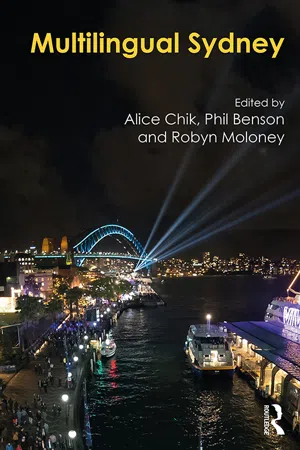
Multilingual Sydney
- 240 pages
- English
- ePUB (mobile friendly)
- Available on iOS & Android
eBook - ePub
Multilingual Sydney
About this book
Information
Part I
A multilingual city in a multilingual world
1
Sydney
A multilingual city in a multilingual world
According to the 2016 census, a language other than English is spoken in at least 38.2 per cent of households in Greater Sydney. This figure places Sydney as the most multilingual Australian city, outranking Melbourne at 34.9 per cent (Australian Bureau of Statistics 2017). Surprisingly, the Sydney figure is considerably higher than the reported figure of 22.1 per cent in London from the most recent census survey in 2011 (Office for National Statistics 2013). Considering that there is no official language policy in Australia and English is only a de facto national language, language diversity is frequently framed in the media as the indicator of migration trends. This edited volume started from conversations with various people on multilingualism and new urban diversities at a one-day symposium held at Macquarie University, Sydney, in November 2016. While the conversations continued and expanded with additional researchers and community leaders joining in, this volume gave us the perfect opportunity to examine the different facets of multilingualism in Sydney. However, we would like to first anchor Sydney among other multilingual cities around the world and argue that language diversity is one inevitable facet of new urban realities. To do this, we will take a short detour to visit a European project, Languages in Urban Communities: Integration and Diversity for Europe (LUCIDE) coordinated by and documented in The Multilingual City (King and Carson 2016).
Urbanism and a research deficit – a LUCIDE response
The LUCIDE project began from a premise that multilingual cities are significant indicators of future possibilities – ‘a microcosm of what is to be, and … a powerful generator of ideas, both for understanding what is, and for driving what is possible in the future’ (King and Carson 2016: 179). It was our belief that cities are a working model of the future, places where new policy discourse can be created and where the constraints of national policies and the limitations of national discourse can be modified or overcome. Not only is multilingualism a vital element in the modern urban space, multilingual cities also provide the arena where new realities can be created, not least through the links that exist between cities.
LUCIDE brought together 14 partners from 13 cities in Europe and two from Canada and Australia1 to set out to answer a number of key questions about the realities of the multilingual city. We wanted to understand more about the ways in which languages are encountered, used and learned in city life, and to this end we decided to investigate five (inevitably overlapping) spheres in which multilingualism plays an important role: education, the public sphere, economic life, the private lives of citizens, and urban spaces or the ‘cityscape’ (King and Carson 2016).
The city has long been a topic of academic, policy and development discourse and in recent years there has also been significant interest in the potential of the city to resolve social and economic problems – the city as a model of the future (see, for example, Barber 2013; Glaeser 2011). We also found that there had been a persistent underestimation of the importance of linguistic diversity as a catalyst for such creativity and change (Duarte and Gogolin 2013; Piller 2016). What research there has been has tended to be in the domain of the sociolinguist, investigating ‘the multiple, everyday social practices that are necessary to the mundane negotiation of being in the city’ (Mac-Giolla Chriost 2007: 202–203) or the observation and description of urban linguistic landscapes (Blommaert 2013; Shohamy, Ben-Rafael and Barni 2010; Smakman and Heinrich 2018).
Research on urbanism, urban politics and urban planning by sociologists, geographers and political scientists has tended, however, to overlook multilingualism, which is considered under the headings of migration and cultural or ethnic diversity, usually rather cursorily and often as a problem to be addressed (Cochrane 2006; Gottdiener and Budd 2005; Piller 2016). While state and institutional responses to the ethnic and cultural mix of cities are discussed extensively, the linguistic mix of cities is rarely mentioned. The Encyclopedia of Urban Studies (Hutchinson 2010), for example, has no entries for ‘multilingualism’ or ‘language’, and its article on ‘ethnic enclaves’ discusses the formation of transnational and diasporic neighbourhoods in global cities without referring to the crucial role that language plays in their development.
The LUCIDE network sought to rectify this lack of attention in a modest way by examining the realities of multilingualism in 18 cities. The research activities occurred in two stages: a phase of secondary data review, followed by primary data collection. The first phase involved meta-surveys of recent secondary data on multilingualism in the network’s cities: as well as academic or policy documents on multilingualism, research teams collected practical examples of multilingual practices. These varied in each sphere, but included artefacts (printed/visual/digital) which illustrated the multilingual reality of the city, such as websites, advertising campaigns, public or private documents (biographies, diaries, official correspondence). The secondary research phase yielded a considerable quantity of data which allowed the consortium to generate hypotheses regarding language visibility (which also includes audibility), affordances and challenges. In the second phase of data collection, LUCIDE’s research teams identified a sample of stakeholders from the five key spheres of city life, and interviewed them about the reality of multi/plurilingualism in their city. A series of semi-structured interviews was conducted on the visibility of different languages, about the challenges involved in creating and managing multilingualism in an urban context and about some of the difficulties posed for individual city-dwellers (King et al. 2010; LUCIDE 2015).
What are the common threads?
One central question to be answered was whether there were any general themes which might indicate the future for multilingual cities. Or does every city tell a different tale? Despite the homogenisation of globalisation, it would appear that diversity is indeed one striking characteristic of our urban world. The idea of ‘unity in diversity’ has been a central theme of European Union policy, certainly until very recent times. The Maalouf Report (2008) suggested that
a common sense of belonging based on linguistic and cultural diversity is a powerful antidote against the various types of fanaticism towards which all too often the assertion of identity has slipped in Europe and elsewhere, in previous years as today.(p. 5)
This may provide the most helpful framework for understanding our common binding threads, and for suggesting some overall conclusions, even if they often lead to further questions. Six broad conclusions were drawn from The LUCIDE project (King 2016), and they could serve as a basis for a new discussion for multilingualism of Sydney:
1. Urban diversity is itself diverse. The model is not one of ‘the multilingual city’, but of a more complex typology of cities. There are some shared characteristics, but essentially these cities are distinctive and rooted in particular landscapes. Our multilingual cities ranged from ‘hyper diverse’ cities built on immigration to cities seeking a place in the global sun, and those which had traditionally been places of emigration now confronted by the mass mobility of the 21st century. Inevitably their political and social priorities varied significantly, as too did the impact on language policy and planning in the provision of public services or priorities in languages education, and on issues of national and local identity.
2. Multilingualism has different meanings. The multilingual city (or town or institution) may simply be taken to mean a place where many languages are spoken. This can, however, be misleading. Even in the major hyper diverse cities this celebrated ‘multilingualism’ often means multiple separate bilingual (or even monolingual) communities. ‘Multilingual vitality’ of a city thus would be indicated rather by the extent to which linguistic communities interact, the degree of public acceptance of linguistic diversity and, more importantly, the ways in which ‘multilingual capital’ is part of the political, economic and educational infrastructure.
3. Some kinds of multilingualism are more visible than others. The LUCIDE research revealed a clear distinction in many people’s perceptions between ‘valued’ and ‘non-valued’ languages. The relatively invisible – non-valued – languages tend to be the languages of relatively recent migrants, which are seen as ‘different’ from the super central languages of communication, such as English, French, German or Chinese. In some of our cities, ‘multilingualism’ tends to be interpreted as knowledge of the national language plus English.
4. People interpret multilingual realities in different ways. Just as the realities of multilingual cities are diverse, so too are the multilingual images of the cities varied. For many city authorities, an image as ‘multilingual’ is seen as highly desirable. They market themselves as ‘multilingual hotspots’, ‘open cities’, or ‘places that can do business with the world’. If this is the kind of positive image that the city authorities wish to promote, it also seems that individual inhabitants have a less settled view. For some, these are indeed the vibrant, cosmopolitan, creative places where they want to live. For others, it is a more uncomfortable environment where the very speed of change has also been unsettling rather than inspirational.
5. The ideals and practices of multilingualism are under threat. The economic crisis is encouraging more extreme forms of nationalism and insularity and attacks on the very idea of positive multilingualism, or, in broader terms, multiculturalism (Maalouf 2008). Such attacks are no longer confined to overtly xenophobic parties and groups. In recent years politicians of all colours have joined a chorus of concern about the consequences of globalisation and a reaffirmation of the need to strengthen national identities. Such statements, along with the more strident comments of nationalist politicians, constitute the dog whistles which encourage intolerance, focused in particular on ever more explicit opposition to immigrants, asylum seekers and minorities more generally. Many of the accepted liberal consensual views about the value of diversity and the role of the state, particularly in promoting inclusive education, are being called into question. The emphasis at a political level now is on assimilation rather than on unity in diversity.
6. Policy and politics can be changed from below. Despite the negative political discourse there is an inescapable logic to reality from the city level. National policy may exclude (by means of quotas, restrictions, walls, for example), or may favour assimilation over community cohesion (for instance, through language priorities in education, or through restricting public access to non-majority languages). However, local authorities and local and community institutions are more concerned that their communities are functioning. This means that they are less concerned with ideological positioning than with solving actual everyday problems for real people. One consequence of this is that local authorities are more orientated towards inclusion and integration than the dominant political rhetoric would suggest. Cities are also places where community action and interventions by voluntary groups can have a major impact; for example, in the provision of bilingual education. Generally, we have seen that although there can be city-wide coordination or at least endorsement of such endeavours, more often there is no such explicit policy but a more pragmatic ‘getting by’ in response to local needs and aspirations, which has a sometimes imperceptible but permanent effect on political discourse and on the attitudes and expectations of the inhabitants of the city.
Some reflections on the future of our cities
A great deal has happened since 2014 that has underlined the relevance of the LUCIDE project – the migration crisis in the Middle East and Africa and its impact on Europe; the growth of anti-globalization, anti-immigrant and nationalist movements in many countries, not least in Europe and the USA; and the continuation of the economic crisis and its effects. This has cast what was a modest piece of research and political analysis into even sharper relief. The challenge for the future is not whether globalization will continue to affect our city dwellers, but how. Will we and they move in the direction of assimilation or of cooperation and mutual learning? Of conformity to an imagined past ideal or of embracing the more demanding delights of diversity? A cosmopolis is multicultural and multilingual, and the diversity drives progress: a city of solutions and invention, of cultural richness, economic growth and communication with the world. It looks outwards to oth...
Table of contents
- Cover
- Half Title
- Title Page
- Copyright Page
- Table of Contents
- List of figures
- List of tables
- List of contributors
- Part I: A multilingual city in a multilingual world
- Part II: Policy, ideologies and practice
- Part III: Learning languages
- Part IV: Languages and communities
- Index
Trusted by 375,005 students
Access to over 1.5 million titles for a fair monthly price.
Study more efficiently using our study tools.
Frequently asked questions
Yes, you can cancel anytime from the Subscription tab in your account settings on the Perlego website. Your subscription will stay active until the end of your current billing period. Learn how to cancel your subscription
No, books cannot be downloaded as external files, such as PDFs, for use outside of Perlego. However, you can download books within the Perlego app for offline reading on mobile or tablet. Learn how to download books offline
Perlego offers two plans: Essential and Complete
- Essential is ideal for learners and professionals who enjoy exploring a wide range of subjects. Access the Essential Library with 800,000+ trusted titles and best-sellers across business, personal growth, and the humanities. Includes unlimited reading time and Standard Read Aloud voice.
- Complete: Perfect for advanced learners and researchers needing full, unrestricted access. Unlock 1.5M+ books across hundreds of subjects, including academic and specialized titles. The Complete Plan also includes advanced features like Premium Read Aloud and Research Assistant.
We are an online textbook subscription service, where you can get access to an entire online library for less than the price of a single book per month. With over 1.5 million books across 990+ topics, we’ve got you covered! Learn about our mission
Look out for the read-aloud symbol on your next book to see if you can listen to it. The read-aloud tool reads text aloud for you, highlighting the text as it is being read. You can pause it, speed it up and slow it down. Learn more about Read Aloud
Yes! You can use the Perlego app on both iOS and Android devices to read anytime, anywhere — even offline. Perfect for commutes or when you’re on the go.
Please note we cannot support devices running on iOS 13 and Android 7 or earlier. Learn more about using the app
Please note we cannot support devices running on iOS 13 and Android 7 or earlier. Learn more about using the app
Yes, you can access Multilingual Sydney by Alice Chik, Phil Benson, Robyn Moloney, Alice Chik,Phil Benson,Robyn Moloney in PDF and/or ePUB format, as well as other popular books in Languages & Linguistics & Linguistics. We have over 1.5 million books available in our catalogue for you to explore.