- 272 pages
- English
- ePUB (mobile friendly)
- Available on iOS & Android
eBook - ePub
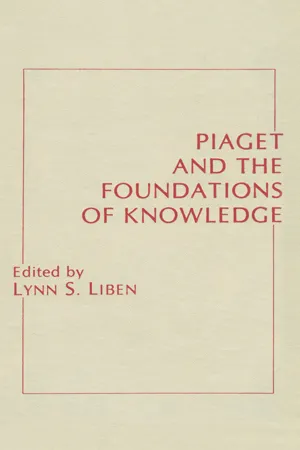
Piaget and the Foundations of Knowledge
About this book
First published in 1983. This volume is drawn from the Tenth Annual Symposium of the Jean Piaget Society. The theme of that Symposium, selected by the Board of Directors of the Society, was Piaget and the Foundations of Knowledge. The goal of the Symposium was to provide a critical discussion of Piaget's views on the origins of knowledge, and to identify alternatives to those views.
Information
1 | From Genetic Epistemology to Historical Epistemology: Kant, Marx, and Piaget |
Boston University
Piaget’s genetic epistemology is a radical reformation, in dynamic, evolutionary terms, of Kant’s transcendental epistemology. Piaget goes beyond the fixed, essentialist notions of Kant’s a priori forms of perception and of the understanding and proposes instead a notion of the development of cognitive structures. Similarly, Piaget goes beyond a biologized Kantianism, which takes the necessary and universal a priori forms of human cognition to be fixed in the genetic structures of the organism. Instead, the emphasis in Piaget’s account is on the genesis of structures that emerge out of the interaction of the human cognitive organism with its environment. In this interaction, he takes the activity of the organism to be central, so that cognitive development is seen as the product of an active encounter in which the objects of cognition are not passively received or imprinted but are literally constructed. Thus, genetic epistemology is neither transcendental, nor biological in the innatist sense, nor evolutionary in the sense of species evolution, though it is conformable with such an evolutionary epistemology. Rather, Piaget wants to begin where the genetically fixed forms of perception and cognition end, where instinct is replaced by intelligence, and where phenotypic modes of adaptation and maturation develop beyond the genotype.
Yet, Piaget’s approach falls short of being a fundamentally sociohistorical one in its account of child development. That is to say, Piaget seeks to discover the universal and historically and culturally invariant laws of cognitive development, and in this sense he seeks a biological explanation of human cognition as a characteristic of the species. My argument in this paper is that Piaget fails to take fully enough into account the sociohistorical dimension of the development of child-thought and of human cognitive growth in general. I take this failure to be based on an inadequate view of the historicity of that very praxis, those very modes of action that genetic epistemology takes to be the source of cognitive development. I argue that what is needed is yet an additional reformation, which takes the theory of cognitive growth beyond both the transcendental structuralism of Kant and the genetic structuralism of Piaget to a historical epistemology, in which changes in modes of perception and cognition are related to changes in the modes of historical praxis and to changes in the history of science. This alternative emphasis, as a framework for developmental psychology and for epistemology, is suggested by Marx’s theory of social development, namely, historical materialism. Thus, I take a historical epistemology to be the epistemological correlate of such a historical materialism; in this sense, I take it to go beyond the biologically oriented species essentialism that remains at the basis of Piaget’s program.
In this paper, I begin with a brief sketch of how Piaget’s genetic epistemology reconstructs and reforms Kant’s transcendental epistemology. Then I review some of the historical and philosophical precedents of Piaget’s developmental view. The analytical argument begins with a consideration of the question of norms, specifically, with the notion of orthogenesis, which underlies Piaget’s developmental theory. Here, I argue that the sociohistorical construction of norms and the changes in norms provide a somewhat different framework of cognitive development and of maturation than Piaget proposes. In this argument, it can be seen that what is crucial is the making and use of artifacts and the activity of representation on which the capacity for internal representation, or interiorization, depends. Finally, I suggest what such a historical epistemology means as a framework for studying the growth of knowledge in the child.
FROM KANT TO PIAGET
Piaget’s relation to Kant and to Kantianism is instructive, for it gives us a precise understanding of what Piaget thinks about the genesis and nature of cognitive structures (by which I mean both perception and thought). Though Piaget holds, with Kant, that we do not come into the world as tabulae rasae upon which sensations impress ideas but rather that we bring structures to bear upon our experience, he differs from Kant in holding that such structures are not innate or preformed. Yet, at the same time, he agrees with Kant that some of these structures are necessary, that is, they have a necessity that goes beyond the simple contingencies of inductive generalization or adaptation. Thus, there are a priori structures, some of which are necessary, but these are a priori in a special way: They come into being and change and therefore are only relatively a priori. In short, they develop and are neither fixed, once and for all, nor innate. On the other hand, the development of such structures, according to Piaget, is not a matter of genetic selection in the mode of evolutionary adaptation; they are not biologically a priori as aspects of heredity, for example, as instincts are. If they were—and here Piaget develops his argument against Lorenz—they would not have the plasticity that the acquisition of structure in development shows as a result of learning, nor would they have the necessity required for the proper characterization of logico-mathematical structures and the deductive necessity that marks logico-mathematical operations (Piaget, 1971a, pp. 313–317). Piaget argues, instead, that for logico-mathematical structures of cognition such necessity is achieved. He (1971a) writes:
Their necessity is brought about by a gradual construction. In fact a study of the development of logico-mathematical structures in a child reveals that the necessity for them is imposed on the subject, not from the beginning, but … very gradually, often until such a time as it crystallizes very suddenly. … The necessary character of logico-mathematical structures, then, does not in the least prove them to be hereditary but emerges from their progressive equilibration by dint of autoregulation [pp. 316–317].
Now this is a very interesting and revealing argument. Piaget wants to retain, with Kant, two crucial notions: (1) the role of a priori structures in the shaping or construction of experience and in the acquisition of knowledge—indeed, as preconditions for such knowledge; (2) the character of necessity which such structures have, at least in the case of logico-mathematical structures. And because, for Piaget, it is such logico-mathematical structures that characterize mature knowledge, approximating to the adult scientific world view, this necessity becomes a hallmark, for Piaget as for Kant, of scientific knowledge. As is shown later, because science is the norm of mature knowledge for Piaget, this characteristic of necessity and the achievement of this schema in thought provide a norm of cognitive development. But Piaget argues against the Kantian form of a priorism both in its transcendental mode in Kant, where it is used to assure the normative validity of scientific truth against the mere accidentality or contingency of experience as such and also in its biologized modes (e.g., in Lorenz 1943, 1957, and in a different way, e.g., in Rensch 1959, 1967), where this a priorism is seen as the selective adaptation by biological means of hereditary and therefore species-fixed modes of cognition. Piaget therefore wants to have his a priorism and eat it too. And he can, because he proposes a theory of the acquisition and change of such structures and also the complex mechanisms by means of which such construction and development take place. In short, Piaget replaces the nondevelopmental, essentialist theory of Kant with a developmental theory while retaining the very ground that for Kant required a transcendental deduction of the categories of perception and thought. The importance of this latter point bears on Piaget’s antiempiricism, his rejection of inductivist, sensationist, or associationist theories of learning. But for our purposes, it bears even more importantly on the normative basis of Piaget’s whole program and on the role of norms in defining knowledge. Indeed, this is what makes Piaget’s program a genetic epistemology rather than a descriptive genetic psychology, for what is at issue in cognitive growth is neither simply the pragmatic norm of successful action or adaptive success nor the mere sequence of cognitive stages, but rather truth.
If Kant took truth to be the regulative norm satisfied by the deductive necessity of conclusions derived from necessary a priori statements, whether analytic or synthetic, then truth is grounded in the very necessity, universality, and unity of Reason itself. But Reason, with a capital R here, is taken to be transcendental and not the result or product of any development, nor the terminus of any inductive procedure. Reason yields truth, for Kant, precisely because the very possibility of knowledge—that is, of the sort of scientific knowledge yielded by Newtonian science, which is Kant’s paradigm of scientific knowledge—depends on the accessibility of the object of knowledge to reason. To put it very briefly indeed, reality has to be rationable, open to rational representation, if it is to be known at all. Because for Kant, “reality” in itself, the “ding-an-sich,” is a limit notion, beyond the possibility of being known, then natural knowledge must consist of knowledge of phenomena, that is, those things-for-us whose coming to be known is conditioned by the very forms under which rational knowledge is itself possible. Necessity, for Kant as for Piaget, lies not in the nature of things or of nature, but in the structures of reason itself as the conditions of the possibility of any scientific knowledge whatever. Therefore, for Kant, pure mathematics as well as mathematically rational physics (i.e., the only physics that is physics proper and not merely empirical) carry with them the necessity of synthetic a priori judgments (i.e., those that are necessarily true of all possible experience, though they are not derived from experience.) For Piaget, such a transcendental rationality as Kant posited, and which he rationally reconstructed by transcendental deduction, has to be rather the product of a cognitive development that arrives at this necessity itself by a process. Thus, though the terminus ad quem is one that Piaget shares with Kant, the terminus a quo is different and, more significantly, so is the road by which the end is achieved.
The historical precedents of Piaget’s view lie both in philosophy and in biology. In philosophy, they may be generally identified with the dialectical tradition of evolutionism and developmentalism in post-Kantian thought, especially as it is elaborated in Schelling and Hegel, as well as with the tradition of Romanticist nature philosophy, in Goethe, and in a different sense, in Schopenhauer. The French roots of this tradition lie most clearly in the renaissance of Lucretian evolutionism in 18th century France, especially in the pre-Lamarckian transformism of Diderot, as well as in the preformationist views of Robinet and Maupertuis. Of course, the whole development of evolutionary biology in the late 18th and in the 19th century are the most obvious sources of Piaget’s evolutionism, but with respect to theories of cognitive evolution or the evolution of thought and particularly with respect to the notion of stages of this development, the most important figure is Auguste Comte.
Now this sort of name-dropping is barely informative. What may be useful is to trace certain themes that are picked up and developed in a distinctive way by Piaget. I focus on three such themes, all of which radically revise the Kantian perspective. First, there is the notion of dialectic as the development or unfolding of the subject—in this case, consciousness itself—in the course of its activity, where this activity is seen as an interaction with another, taken as its object. This dialectic of subject and object goes beyond the Kantian synthetic activity of the understanding in that it unfolds in time and passes from “lower” to “higher” stages, in which each so-called lower stage forms the basis for the dialectical elaboration of the higher stage and in which each lower stage is incorporated and transcended or annulled (or becomes aufgehoben) in the higher stage. This dialectic is perhaps best known in the version that Hegel developed, particularly in his Phenomenology of Mind, (1807) where the active subject is consciousness itself as it attains to full self-consciousness in the course of its recognizing, and being recognized by, another self-consciousness. There is a deep affinity of Piagetan schemes of development with this Hegelian model, but Piaget makes only the briefest mention of it in his work.1 For Hegel, as for Piaget, there are no preformed or fixed a priori structures of the mind; rather, these emerge in the course of the interactive relations between subject and object. But they emerge with a dialectical necessity determined by the end point of the development that for Hegel is the fully self-conscious self-consciousness, which incorporates all knowledge in itself and which is the identical subject-object or the totality which is identified with truth. Now the heady idealism, which is the Hegelian philosophy, is far removed from the biological emergentism of Piaget. But there is much to be studied in the formal relations between the two systems, to which I can only point here.
A second theme is that of evolutionary adaptation and transformation. In Goethe, and again in Schopenhauer, there is developed the notion that biological form is an internalization or a transformation into structure of modes of life activity. Diderot had anticipated such a view of morphological change in several of his works, but especially vividly in Le Rêve de D’Alembert (1875–77). Lamarck, (1809) not long afterwards, developed this as his distinctive theory of the inheritance of acquired characteristics in which forms of life activity influence heredity. In Schopenhauer (1818), this Lamarckism takes on a distinctive form (e.g., as when Schopenhauer says that teeth, throat, and bowels are objectified hunger). The emphasis here is on action and on modes of action that give rise to structures and, indeed, interiorize such structures in the changing adaptive biological forms of organisms themselves. The peculiar German-romantic form of this model is picked up and developed by the organicist schools of German biology and, specifically in embryology, by Driesch (1909) and von Uexküll (1909). I do not need to point to the direct connections with Piaget’s thought here. Piaget’s specific adoption of Waddington’s (1962, 1975) model of biological adaptation and his full discussion of all these matters in Biology and Knowledge and elsewhere fill out the picture in detail.
The third theme, clearly related to the previous two, is the notion of stages. The historical background of this view is ancient, and it is tied in with the idea of progress, whether in theology (where the drama of salvation is marked by stages), in history, in natural history, or in the stages of consciousness. In modern thought, Buffon’s Époques de la Nature or Robinet’s Gradation Naturelle des formes de l’Être mark the pre-Lamarckian and pre-Darwinian notions of stages of natural history. Hegel develops perhaps the most elaborated theory of stages in all domains, whether in his philosophy of history, his philosophy of art (where Symbolic, Classical, and Romantic mark off the necessary developmental epochs of art history), his philosophy of nature, his phenomenology, or his science of logic. One may say that Hegel is stage-happy, for there is a profusion and proliferation of stages everywhere! But of particular moment is the so-called law of three stages that Comte (1830) introduces as the systematic sequence of modes of thought, namely, the theological, the metaphysical, and the positive or scientific. For Comte, these are not stages of ontogenesis, nor even of phylogenesis, but simply lower and higher stages of thought with the progress of intellectual enlightenment. The sequence is of course normative, and thus “positivism” or “positive science” is the highest stage in that it is by science alone that truth finally comes to be revealed. At almost the same time, and independently, Feuerbach (1957) proposes an entirely similar law of three stages in his philosophical critique of religion and philosophy and thus opens the way for an ideology of scientific enlightenment that has profound effects both in German science on the school of so-called “scientific materialists” in German biology and chemistry (Moleschott, Büchner, Vogt, Czolbe) and for the “scientific socialism” and “historical materialism” of Marx and Engels. Toward the latter part of the 19th century, Spencer develops his enormous synthesis of evolution and interprets it also for education and for psychology; and James outrages the Harvard establishment by introducing Spencer’s text in psychology into the classroom.
Piaget’s theory of stages is, of course, far removed from these earlier ideas. And his own emphasis is on the critique of philosophical theories of knowledge and of development as essentially speculative and unscientific because they are not grounded in experimental practice. But here again, the ideational structures of these historical precedents serve to sharpen our understanding of Piaget’s own model both in terms of similarities and differences between them. The more immediate influences on Piaget among the historicist school of French philosophers of science (Brunschvicq, Lalande, Meyerson) lie closer to the surface, in relation to Piaget, for their emphasis is on the development of thought and upon the norms of this development, particularly in the history of science.
What emerges from this brief sketch of antecedents in philosophical and biological thought is the replacement of the ahistorical, nondevelopmental, and fixed categories of Kantian epistemology by the historicized, temporalized, developmental categories of post-Kantian philosophy, and by the organicist and evolutionary models of biological thought. Piaget is heir to both these reformations. But these models of change and development do not capture the essential feature of Piaget’s program, or they do so only incidentally. Piaget’s fundamental category is action or praxis. It is the features of this action that provide the motor of cognitive development and the genesis of structures. It is in the forms, the coordinations, and the schematizations of these actions that the progress of cognitive development has its grounds and the notion of stages receives its concrete interpretation. But it is also in his concept of action that I think Piaget falls short of an adequate account. The three themes of dialectic, adaptation, and stages provide at most a formal framework of the Piagetian program. Its concretization as an experimental study of the growth of child-thought depends on Piaget’s characterization of the very object of experimental observation and inquiry, namely, the actions and judgments of the child. If, as Piaget claims, genetic epistemology is an attempt at a scientific theory of cognitive growth, then the fundamental entities of this science have to be specified clearly, and the fundamental criteria for making scientific judgments about these entities and their relations likewise have to be made clear. Less abstractly, we first have to examine what, for Piaget, counts as an action and then what counts as a case of development or...
Table of contents
- Cover
- Half Title
- Title Page
- Copyright Page
- Table of Contents
- Preface
- 1. From Genetic Epistemology To Historical Epistemology: Kant, Marx, and Piaget
- 2. Development Of Knowledge About Intermodal Unity: Two Views
- 3. Constraints On The Development Of Intermodal Perception
- 4. Some Thoughts On Semantic Development
- 5. The Implications Of A Semantic Theory For The Development of Class Logic
- 6. Structural Invariants In Development
- 7. Cognitive Development Is Structural And Transformational—Therefore Variant
- 8. Newton, Einstein, Piaget, And The Concept Of Self: The Role Of The Self In The Process Of Knowing
- 9. Infant Social Cognition: Self, People, And Objects
- 10. The Role Of Knowledge And Ideation In The Development Of Delay Capacity
- 11. Learning And Development Through Social Interaction And Conflict: A Challenge To Social Learning Theory
- Author Index
- Subject Index
Trusted by 375,005 students
Access to over 1.5 million titles for a fair monthly price.
Study more efficiently using our study tools.
Frequently asked questions
Yes, you can cancel anytime from the Subscription tab in your account settings on the Perlego website. Your subscription will stay active until the end of your current billing period. Learn how to cancel your subscription
No, books cannot be downloaded as external files, such as PDFs, for use outside of Perlego. However, you can download books within the Perlego app for offline reading on mobile or tablet. Learn how to download books offline
Perlego offers two plans: Essential and Complete
- Essential is ideal for learners and professionals who enjoy exploring a wide range of subjects. Access the Essential Library with 800,000+ trusted titles and best-sellers across business, personal growth, and the humanities. Includes unlimited reading time and Standard Read Aloud voice.
- Complete: Perfect for advanced learners and researchers needing full, unrestricted access. Unlock 1.5M+ books across hundreds of subjects, including academic and specialized titles. The Complete Plan also includes advanced features like Premium Read Aloud and Research Assistant.
We are an online textbook subscription service, where you can get access to an entire online library for less than the price of a single book per month. With over 1.5 million books across 990+ topics, we’ve got you covered! Learn about our mission
Look out for the read-aloud symbol on your next book to see if you can listen to it. The read-aloud tool reads text aloud for you, highlighting the text as it is being read. You can pause it, speed it up and slow it down. Learn more about Read Aloud
Yes! You can use the Perlego app on both iOS and Android devices to read anytime, anywhere — even offline. Perfect for commutes or when you’re on the go.
Please note we cannot support devices running on iOS 13 and Android 7 or earlier. Learn more about using the app
Please note we cannot support devices running on iOS 13 and Android 7 or earlier. Learn more about using the app
Yes, you can access Piaget and the Foundations of Knowledge by Lynn S. Liben in PDF and/or ePUB format, as well as other popular books in Psychology & Cognitive Psychology & Cognition. We have over 1.5 million books available in our catalogue for you to explore.