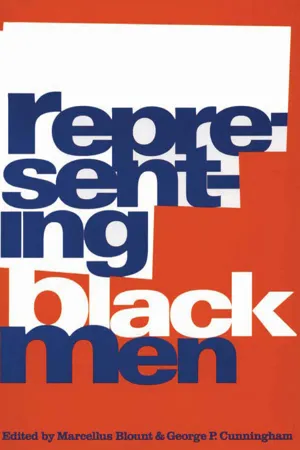
Representing Black Men focuses on gender, race and representation in the literary and cultural work of black men.
- 256 pages
- English
- ePUB (mobile friendly)
- Available on iOS & Android
eBook - ePub
Representing Black Men
About this book
Information
4
VIOLENT AMBIGUITY
Martin Delany, Bourgeois Sadomasochism, and the Production of a Black National Masculinity
In the mythology of the modern world, the quintessential protagonist is the bourgeois, Hero for some, villain for others, the inspiration or lure for most, he has been the shaper of the present, the destroyer of the past.
—Immanuel Wallerstein1
Sadomasochism is fueled and motivated by a restless desire to somehow, in some way, procure recognition from the other.
—Lynn Chancer2
Martin Delany, a man widely thought of as the father of black nationalism, was heralded by contemporary scholars as one of the most articulate and radical black intellectuals of the nineteenth century, and indeed it seems that the facts do support many of their claims. He made speeches on African civilization dressed in “traditional” African clothing, bragged about his pure African ancestry, and reveled in the blackness of his skin. Very little is made of the fact, however, that Delany often derided African Americans for allowing themselves to be exploited by whites. Moreover, no one seems to be able to really explain his obvious gestures toward integration in later life, namely his commission in the Union army and his support for the Democratic Party in Reconstruction South Carolina, a fact for which he was derided by the very freedpeople whom he purported to represent.3 Most importantly, there has been almost no discussion of the fact that Delany, in the face of an economic system in which (black) human life was turned into capital, actively sought to recreate African Americans in the image of the bourgeois subjects who were arguably responsible for the construction and maintenance of the system of slavery he found so onerous.4
The terms of Delany’s political economy are altogether different from what one might expect from a “radical” nationalist. On the one hand, his major treatise, The Condition, Elevation, Emigration, and Destiny of the Colored People of the United States, is an amazingly bold indictment of American slavery and racism, offering a quite compelling argument for black emigration. On the other hand, the “black” people whom Delany exhorts to leave the nation are not the totality of persons of African descent living within the United States, but a discrete minority: free blacks, particularly free blacks of the Northeast. Throughout the text Delany makes a clear distinction between “blacks” and slaves:
the bondman is disfranchised, and for the most part so are we. He is denied all civil, religious, and social privileges … and so are we. They [the bondmen] have no part nor lot in the government of the country, neither have we. They are ruled and governed without representation, existing as mere nonentities among the citizens, and excrescences on the body politic—a mere dreg in community, and so are we. Where then is our political superiority to the enslaved? none, neither are we superior in any other relation to society, except that we are defacto masters of ourselves and joint rulers of our own domestic household, while the bondman’s self is claimed by another, and his relation to his family denied him. (my emphasis)5
Delany’s work here involves the production of a national “we” through comparison with an enslaved other that acts as the mirror of a heretofore invisible community. By focusing on “them,” we (male subjects) are able to see our real relationship to the American body politic, a relationship that is formally not altogether different from that of the slaves themselves. One might argue, in fact, that Delany does such a thorough job of aligning the two communities that the one is collapsed into the other such that the black is always the slave. He introduces a caveat, however, that makes the line of demarcation between the two groups clear. “They” are property and as such are incapable of forming strong or permanent domestic ties, while “we” own ourselves and have at least nominal control over our families.
It does not take too great a conceptual leap to recognize that the condition of “The Black Family” acts in Delany ‘s political economy as a barometer of the condition of “The Black Nation.” One might argue, in fact, that as both a nationalist and a bourgeois, Delany understood the maintenance of autonomous and “respectable” households as absolutely necessary to the production of “New Africa.”6 It is important to remember that Delany wrote his critique of black domesticity, or lack thereof, within the context of an emigrationist polemic, one that dismissed the idea that blacks could ever “stand on level with the most elevated of mankind” in the midst of “white” America.7 Moreover, upon closer examination it becomes apparent how these ideas might have worked upon northern free blacks, Delany’s primary constituency. One should remember that as late as 1790 New York had more slaves than any American city, save Charleston.8 Moreover, the experience of slavery for northern blacks usually involved living apart from one another within white domiciles.9 It is easy to understand then how “freedom” would involve, in the northern free black imagination, the removal of the black domestic from the white home.
If we condense Delany’s position, a position that I am labeling “bourgeois,” to its essentials we find then that he is concerned primarily with both demonstrating and breaking the symbiotic dependence that exists between the (black) slave and the (white) master. Repeatedly Delany argues that blacks will never be fully free, fully human, until they escape white households and learn to fend for themselves. But (slaveholding) whites, as we will see below, could not function in the absence of slaves. As a consequence they were forced to deploy brute force in an effort to maintain the symbiotic process.
This symbiosis, this never-ending cycle of interdependency, of ritualistic acts of dominance and submission, is best described, I believe, as sadomasochistic. The violence inside the master/slave dyad is never completely functional. It is never designed simply to compel the slave to do more work or to produce more goods. Nor is it simply gratuitous. Masters do achieve something more than grotesque pleasure as they apply the whip. The use of violence assures the master that he is in control, that the slave will not leave him and, thereby, force him to confront his dependency; while for slaves, submitting to violence allows them to deny their autonomy, to engage in complex acts of dissimulation by which they can create (marginalized) spaces in which to express their actual independence, creativity, and humanity. As Lynn Chancer has argued in her lively and thoroughly illuminating discussion of sadomasochism,
the sadist’s best-kept secret from self and others is extreme dependency hidden behind a front of apparent independence and strength, the masochist’s analogous secret is far greater relative strength and independence than she or he perceives, hidden behind a front of apparent and extreme dependency.10
The sadomasochistic dynamic that Chancer describes is easy enough to understand in relation to the actual masters and slaves of nineteenth-century America. The master, trapped in the myth of autonomy, had always to deny his dependence on the slave by asserting his complete control over the body and mind of his property. The slave as a matter of survival had, on the other hand, to deny his or her autonomy. He had to construct a self that could survive amid constant rituals of dominance and degradation. And, as I will demonstrate below, Delany gives vivid demonstrations of this phenomenon in his own work.
I would like to add to this the fact that not only the quasi-aristocratic slaver but also the bourgeois was caught up in this sadomasochistic dynamic. Delany was himself never able to escape the process of dissimulation that typifies sadomasochism. In denying the ambiguity of the bourgeois position, a position that is itself dependent upon the subordination of “other” classes, Delany was forced to engage in the very acts of ritual domination that typify the master/slave symbiosis he decries.
I would ask the reader to consider the fact that, as Doris Sommer has pointed out, the development of discourses of nationalism coincided in the West with both the development of probourgeois economic discourses and discourses of sexuality. Following Foucault, Sommer argues that during the early period of bourgeois consolidation, “sex was forced into a productive economy that distinguished a legitimate realm of sexuality inside a clearly demarcated conjugal relationship and ‘banished’ the casual pleasures of polymorphous sexuality.”11 In the work of nationalist ideologues like Delany, this phenomenon would find expression in two ways. First, some sexual and romantic activity would be marked as either nonproductive or counter-productive and, therefore, beyond the realm of the respectable. We have seen exactly this in the constant call by African American intellectuals for blacks to give up their relatively relaxed attitudes toward sexuality and to most especially sever their sexual, romantic, and familial ties to whites.12
Second was the pronounced tendency within African American literature for authors to encourage the practice of “productive” heterosexuality. A proper conjugal union, one that maintained gender, economic, and ideological hierarchies, was imagined as the basis on which Black America would be constructed, while sexuality and romance were imagined as precisely the glue that would bind together the conjugal union.
This is all by way of my attempting to establish sadomasochism as a category through which to read the work of Martin Delany. He regularly points to the sadomasochistic interdependency of slave and master. He alludes through the figure of “the domestic,” and the dual specters of forced intimacy and miscegenation that it conjures, to the sexual underside of this same dependency Moreover, as a bourgeois, it behooves him to delineate what is proper sexual behavior from what is improper. Productive heterosexuality is constantly reinforced in his work, and everything else is confined to the realm of the marginal and the profligate. Even so, it would be wrong to lose sight of the question of bourgeois ambiguity I alluded to in the opening of this essay by quoting Wallerstein, for in the drive to separate the good from the bad, the progressive from the retrograde, one has always to take a bit of the other to replicate at least some of the reprehensible thoughts and behaviors that one has previously condemned. In Delany’s case, this means that he is never able to really explode the slave/master symbiosis but only to repress it, to force it underground, always on the brink of revival.
The conflation of Delany’s gender/sexual economy with his nationalist project is made explicit in his novel, Blake, or The Huts of America. Delany first published twenty-six chapters of Blake in The Anglo-African Magazine from January to July 1859. The novel did not appear in its entirety, however, until its publication—again in weekly installments—in The Weekly Anglo-African from November 26, 1861, until May 24, 1862. It is an exemplar of “the nationalist aesthetic” in that its impetus is to demonstrate the contours, the borders, of the “national landscape.” This is done, moreover, by the spacial and historical movement of what Benedict Anderson describes as a “sociological organism” through the national community.13
The novel’s action centers on the attempt of the male protagonist, Henrico “Henry” Blacus to reunify and avenge his family. Henry, later known as Blake, is described as “a black—pure Negro—handsome, manly and intelligent,” thereby referencing the dark skin and presumably unadulterated Africanity of Delany himself.14 Blake’s wife, Maggie, the “mulatta” daughter of a slave master, is “true to her womanhood.”15 In fact, she has been sold because of her refusal to succumb to the sexual advances of her master and father, Colonel Franks. As a consequence, Blake flees the plantation, taking his infant son and several others with him. The remainder of the novel is taken up with his attempt to find his wife, reunify his family, and avenge their wrongs. In the process, he travels throughout the slave South, then to Cuba and Africa, all along providing sketches of “The New African People.” Throughout, Blake must not only hurdle the incredible obstacles thrown up in the runaway’s path, not only discipline many disparate “African” peoples into a distinct community, but also construct his own masculinity, a masculinity that is constantly threatened, on the one hand, by the profligacy and avarice of white men and, on the other, by the weakness and culpability of blacks, both male and female. Blake’s journey then is not simply a journey to liberate his people but also a journey to liberate his own “manhood” from the taint of effeminacy—and bestiality—engendered by slavery.
As one might imagine, Blake has been fully immersed in the gospel of capital accumulation. Throughout the text he admonishes the slaves with whom he comes into contact to get money at all costs, arguing that it is money that opens the door to freedom. He believes, moreover, that petty moral or philosophical concerns should not deter the nascent bourgeois from his task:
Keep this studiously in mind and impress it as an important part of the scheme of organization, that they must have money, if they want to get free. Money will obtain them everything necessary by which to obtain their liberty. The money is within all of their reach if they only knew it was right to take it. God told the Egyptian slaves to “borrow from their neighbors”—meaning their oppressors—”all their jewels”; meaning to take their money and wealth wherever they could lay hands upon it and depart from Egypt. So you must teach them to take all the money they can get from their masters, to enable them to make the strike without a failure.16
Delany’s emphasis on money might be read as a simple product of his knowledge of bla...
Table of contents
- Cover
- Half Title
- Title Page
- Copyright Page
- Dedication
- Table of Contents
- Introduction: The “Real” Black Man?
- Against Patriarchy
- Negotiating “Masculinity”
- Screening Men
- Selected Bibliography
- List of Contributors
- Index
Trusted by 375,005 students
Access to over 1.5 million titles for a fair monthly price.
Study more efficiently using our study tools.
Frequently asked questions
Yes, you can cancel anytime from the Subscription tab in your account settings on the Perlego website. Your subscription will stay active until the end of your current billing period. Learn how to cancel your subscription
No, books cannot be downloaded as external files, such as PDFs, for use outside of Perlego. However, you can download books within the Perlego app for offline reading on mobile or tablet. Learn how to download books offline
Perlego offers two plans: Essential and Complete
- Essential is ideal for learners and professionals who enjoy exploring a wide range of subjects. Access the Essential Library with 800,000+ trusted titles and best-sellers across business, personal growth, and the humanities. Includes unlimited reading time and Standard Read Aloud voice.
- Complete: Perfect for advanced learners and researchers needing full, unrestricted access. Unlock 1.5M+ books across hundreds of subjects, including academic and specialized titles. The Complete Plan also includes advanced features like Premium Read Aloud and Research Assistant.
We are an online textbook subscription service, where you can get access to an entire online library for less than the price of a single book per month. With over 1.5 million books across 990+ topics, we’ve got you covered! Learn about our mission
Look out for the read-aloud symbol on your next book to see if you can listen to it. The read-aloud tool reads text aloud for you, highlighting the text as it is being read. You can pause it, speed it up and slow it down. Learn more about Read Aloud
Yes! You can use the Perlego app on both iOS and Android devices to read anytime, anywhere — even offline. Perfect for commutes or when you’re on the go.
Please note we cannot support devices running on iOS 13 and Android 7 or earlier. Learn more about using the app
Please note we cannot support devices running on iOS 13 and Android 7 or earlier. Learn more about using the app
Yes, you can access Representing Black Men by Marcellus Blount,George Cunningham in PDF and/or ePUB format, as well as other popular books in Literature & Literary Criticism. We have over 1.5 million books available in our catalogue for you to explore.