This book presents chapters by many eminent researchers and interventionists, all of whom address the development of deaf and hard-of-hearing children in the context of family and school. A variety of disciplines and perspectives are provided in order to capture the complexity of factors affecting development of these children in their diverse environments. Consistent with current theory and educational practice, the book focuses most strongly on the interaction of family and child strengths and needs and the role of educational and other interventionists in supporting family and child growth. This work, and the authors represented in it, have been influenced by the seminal work of Kathryn P. Meadow-Orlans, whose work continues to apply a multidisciplinary, developmental approach to understanding the development of deaf children.
The book differs from other collections in the degree to which the chapters share ecological and developmental theoretical bases. A synthesis of information is provided in section introductions and in an afterword provided by Dr. Meadow-Orlans. The book reflects emerging research practice in the field by representing both qualitative and quantitative approaches. In addition, the book is notable for the contributions of deaf as well as hearing authors and for chapters in which research participants speak for themselves--providing first-person accounts of experiences and feelings of deaf children and their parents. Some chapters in the book may surprise readers in that they present a more positive view of family and child functioning than has historically been the case in this field. This is consistent with emerging data from deaf and hard of hearing children who have benefitted from early identification and intervention. In addition, it represents an emerging recognition of strengths shown by the children and by their deaf and hearing parents.
The book moves from consideration of child and family to a focus on the role and effects of school environments on development. Issues of culture and expectations pervade the chapters in this section of the book, which includes chapters addressing effects of school placement options, positive effects of learning about deaf culture and history, effects of changing educational practice in developing nations, and the need for increased knowledge about ways to meet individual needs of the diverse group of deaf and hard of hearing students.
Thus, the book gives the reader a coherent view of current knowledge and issues in research and intervention for deaf and hard of hearing children and their families. Because the focus is on child and family instead of a specific discipline, the book can serve as a helpful supplemental text for advanced undergraduate and graduate courses in a variety of disciplines, including education, psychology, sociology, and language studies with an emphasis on deaf and hard of hearing children.
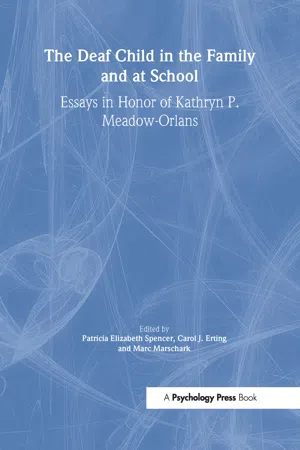
eBook - ePub
The Deaf Child in the Family and at School
Essays in Honor of Kathryn P. Meadow-Orlans
- 344 pages
- English
- ePUB (mobile friendly)
- Available on iOS & Android
eBook - ePub
The Deaf Child in the Family and at School
Essays in Honor of Kathryn P. Meadow-Orlans
About this book
Information
III
The Deaf Child at School
The educational system and the policies and practices of teachers and administrators who represent it impact children’s social development and acculturation as well as their acquisition of traditional academic skills. For most children, school also provides ongoing contact with peers and thus is another important source of socialization, influencing their personal as well as academic images of themselves. In the curricula presented and the kinds of social opportunities they present, schools simultaneously influence and reflect the attitudes and expectations of the culture in general.
For many deaf and hard of hearing children, school can have even more impact than for hearing children. When lack of a shared language system interferes with communication between a child and other family members, interactions with peers and teachers at school provide an especially potent context for social and personal development. Because most deaf children are born into families of hearing persons, school is frequently a primary avenue for acquiring information about being deaf, for making contact with other deaf people, and increasingly for the development of deaf children’s understanding of themselves as a part of a vibrant and identifiable cultural group.
The chapters in this section address three elements of the school environment: placement in separate or mainstreamed schools, the curriculum or the content taught in the schools, and the characteristics of deaf students as learners. The first two chapters in this section discuss effects of various school placements from rather different perspectives. Experiences in special or separate schools are compared with those in local, mainstreamed classrooms where there is much opportunity for interaction between deaf and hearing students. Stinson and Foster provide descriptions of models of educational service delivery predominant in education of deaf children in the United States. They conclude that mainstream placements are associated with higher academic achievement, but special schools better support personal socioemotional development. The authors also note that the two kinds of placements have taken on additional meaning for many students who have accepted the idea that the inclusive placements are for the best students. The inability to be successful in such a placement is seen as a personal failure.
Nash discusses intended and unintended effects of policies in the United States that promote mainstream educational placements for deaf students. These policies and their effects, he argues, can only be fully understood as they relate to basic American attitudes about individualism and individual control over one’s fate. Inability to succeed in the mainstreamed educational environment can lead to increased isolation and may be blamed on a student’s having a negative self-concept or other “character-related” disability. Thus, stigma that might have resulted previously from the presence of a physical disability (such as being deaf or hard of hearing) may be reinterpreted and perceived to be due to personal weakness.
In the third chapter, Stone posits that deaf children’s self-esteem and concepts of self can be enhanced by educational experiences with curricula based on Deaf culture and emphasizing the history, the accomplishments, and the character of the Deaf community. Increased feelings of self-worth can provide deaf and hard of hearing children with personal resources to challenge the barriers they encounter and to promote the development of their inherent strengths and abilities.
Dyssegaard’s chapter provides a view of opportunities and challenges faced by deaf and hard of hearing students in two developing nations: Mongolia and Nepal. Dyssegaard has been an on-site observer of and advisor for changes in educational services in these two countries. Her observations suggest that increased quality of educational practice, wider access to signed communication, higher expectations for students’ achievement, and provision of opportunities to identify with other deaf and hard of hearing children have strongly positive effects on academic and personal outcomes.
The next two chapters focus on the diverse needs and characteristics of deaf and hard of hearing children as learners. Akamatsu and Musselman report analyses from a longitudinal Canadian study of deaf children whose development was assessed from early childhood through adolescence. The children’s cognitive development was analyzed across groups based on etiology of hearing loss (genetic versus non-genetic) and experience with sign language. The authors document complex interactive effects of heredity and language experience, illuminating sources of heterogeneity of learning styles in the population.
Marschark also emphasizes the significant variability within the population of deaf students. Both that variability and the variability between deaf and hearing students, as well as the continuing lack of consistent academic progress observed among deaf students, call for a closer look at the sources and effects of individual differences. The author argues that an educational model appropriate for hearing students often is inappropriately applied to curricula and educational approaches for deaf students. In other cases, theoretical bases for educational approaches developed specifically for deaf students are incomplete, inflexible, and may lack full recognition of the diversity of experiences and characteristics of the population. Marschark challenges researchers, educators, other intervention specialists, and parents to work together to develop a more complete and sensitive model of deaf children as learners so that their optimal development may be more successfully promoted.
In her afterword, Meadow-Orlans applies the wisdom of her years of study of deaf and hard of hearing children and adults to provide an integrated overview of the major ideas presented in the chapters in this book. She reminds us of progress already made but guides us toward contemplation and future study about the many needs to be met before deaf and hard of hearing children have access to social and academic opportunities that maximize the development of their potential.
11
Socialization of Deaf Children and Youths in School
Socialization is concerned with the influences of the diverse social agents, ranging from the family to the culture, on children’s psychological and social development. Socialization is necessary for developing children who are integrated into society as respected participants (Damon, 1984). If the family unit is the first and major vehicle for socialization of children, schools run a close second (Shaffer, 1985). Generally, parents see the beginning of school as an opportunity for their children to meet new peers and adults and to interact in social settings beyond those of home and neighborhood. Getting on the school bus the first day of kindergarten is exciting and stressful precisely because it is recognized as a rite of passage from a closely knit social environment into a larger setting.
Schools affect students’ social and emotional development, as well as their academic development. Schools help students become aware of the rules, norms, and expectations of society and help students move toward eventual economic self-sufficiency. In understanding school socialization processes, it is also important to know the physical, instructional, and social contexts of the educational experience because these contexts affect development (Shaffer, 1985).
The transition from family to school, and the role of schools as a socialization mechanism, is a defining experience for all children. But what about children who are deaf or hard of hearing? What is this experience like for them? How is it the same as or different from the experience of hearing children? What kinds of adaptations must these children, their teachers, and hearing peers make in order to ensure that their developmental experience holds the same opportunities as for hearing children? What kinds of educational conditions enhance socialization of deaf children, and how can these conditions be developed in school settings? These are the central questions that we will attempt to address through this chapter.
The chapter is divided into three sections. In “Elements of Socialization,” we describe those key processes that are essential to the social development of deaf and hard of hearing youths1 in school settings, including access to (a) formal as well as informal communications, (b) peer interactions, and (c) the unwritten curriculum. These processes enhance students’ acquisition of social information and eventual acculturization through incidental learning experiences (unplanned events), social engagement with others, and the development of a positive individual as well as group identity. In “Educational Practice and Socialization,” we describe those educational practices that either promote or inhibit the development of optimal conditions for socialization in schools, including predominant models for education of deaf and hard of hearing students and placement trends since the mid-1970s, the impact of these models on socialization, and new and innovative educational models and practices that may enhance socialization of deaf and hard of hearing students in a variety of educational settings. The chapter concludes with recommendations for future research and innovative practice regarding the personal and social development of deaf and hard of hearing persons in school settings.
PROCESSES OF SOCIALIZATION
Participation in several fundamental kinds of processes is essential for the effective socialization of all students, including those who are deaf or hard of hearing. In this section, we describe each of these processes, as well as their outcomes for personal and social development.
Formal and Informal Communications
Most communication is a form of social engagement. It can be formal or informal, planned or spontaneous, structured or unstructured, or some- thing in between. Communication in school settings can be formal, informal, or a combination. One example of formal, planned, structured communication is when a teacher stands before the class and lectures on a specific topic; another is when the student reads from a textbook and responds to questions listed at the end of the chapter. Examples of informal communications include hallway banter between teachers or students, passing notes in class, or conversations on the bus.
Often the distinction has been made that formal communication is used in schools for academics, whereas informal communications are reserved for social interactions. Although this may be true in a very broad sense, there is also a great deal of overlap between the two. Teachers may assign students to work in groups. In a discussion format, communication may be focused on an academic topic, but it is informal in the sense that it is often unstructured, and the form of engagement may be spontaneous. Similarly, students may find themselves using a more formal communication style at a debate club meeting, during a chess match, or while being briefed by the basketball coach for an upcoming game. All students, including deaf and hard of hearing students, need access to both formal and informal communication in school settings.
Peer Interactions
Communication, especially informal communication, is the foundation for interactions and the development of peer relationships. Peer interaction can range from formal, such as a structured cooperative work group in class, to informal, such as chatter in the lunch room. True friendships and group affiliation may be more likely to occur when there are many opportunities for informal interaction that occur regularly...
Table of contents
- Contents
- Foreword
- Introduction to the Book
- I The Deaf Child in the Family
- II The Deaf Child and Family in Transition
- III The Deaf Child at School
- Afterword Deafness and Social Change: Ruminations of a Retiring Researcher
- Author Index
- Subject Index
Trusted by 375,005 students
Access to over 1.5 million titles for a fair monthly price.
Study more efficiently using our study tools.
Frequently asked questions
Yes, you can cancel anytime from the Subscription tab in your account settings on the Perlego website. Your subscription will stay active until the end of your current billing period. Learn how to cancel your subscription
No, books cannot be downloaded as external files, such as PDFs, for use outside of Perlego. However, you can download books within the Perlego app for offline reading on mobile or tablet. Learn how to download books offline
We are an online textbook subscription service, where you can get access to an entire online library for less than the price of a single book per month. With over 1.5 million books across 990+ topics, we’ve got you covered! Learn about our mission
Look out for the read-aloud symbol on your next book to see if you can listen to it. The read-aloud tool reads text aloud for you, highlighting the text as it is being read. You can pause it, speed it up and slow it down. Learn more about Read Aloud
Yes! You can use the Perlego app on both iOS and Android devices to read anytime, anywhere — even offline. Perfect for commutes or when you’re on the go.
Please note we cannot support devices running on iOS 13 and Android 7 or earlier. Learn more about using the app
Please note we cannot support devices running on iOS 13 and Android 7 or earlier. Learn more about using the app
Yes, you can access The Deaf Child in the Family and at School by Patricia Elizab Spencer,Carol J. Erting,Marc Marschark in PDF and/or ePUB format, as well as other popular books in Psychology & History & Theory in Psychology. We have over 1.5 million books available in our catalogue for you to explore.