This new, practical book provides an explanation of each of the eight mathematical practices and gives elementary school educators specific instructional strategies that align with the Common Core State Standards for Mathematics.
Math teachers, curriculum coordinators, and district math supervisors get practical ideas on how to engage elementary school students in mathematical practices, develop problem-solving skills, and promote higher-order thinking. Learn how to scaffold activities across grades and get strategies you can implement immediately in your classroom. All K-5 mathematics educators should have this book in their professional libraries!
eBook - ePub
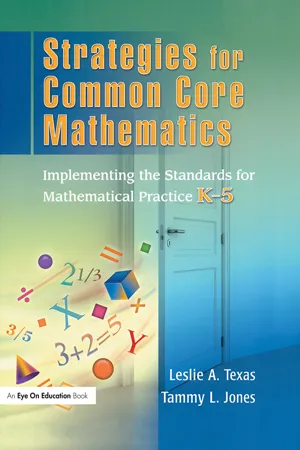
Strategies for Common Core Mathematics
Implementing the Standards for Mathematical Practice, K-5
- 160 pages
- English
- ePUB (mobile friendly)
- Available on iOS & Android
eBook - ePub
Strategies for Common Core Mathematics
Implementing the Standards for Mathematical Practice, K-5
About this book
Trusted by 375,005 students
Access to over 1.5 million titles for a fair monthly price.
Study more efficiently using our study tools.
Information
Topic
EducationSubtopic
Education GeneralSECTION 1

The Doorway to the Common Core
The Common Core State Standards for Mathematics
With the creation of the Common Core State Standards for Mathematics (CCSSM), a new era in mathematics education began for those states that adopted them. States that have adopted the CCSSM now have a common goal in mathematics education.
Building on the excellent foundation of standards states have laid, the Common Core State Standards are the first step in providing our young people with a high-quality education. It should be clear to every student, parent, and teacher what the standards of success are in every school. (Common Core State Standards Initiative, 2012a)
How clear is it “what the standards of success are”? The standards were written “to provide a clear and consistent framework to prepare our children for college and the workforce” (Common Core State Standards Initiative, 2012a).
In its Myths vs Facts section, the CORE Standards website (www.corestandards.org/about-the-standards/myths-vs-facts) states that the standards “are not a curriculum. They are a clear set of shared goals and expectations for what knowledge and skills will help our students succeed.” What are the implications for the classroom teacher, whether teaching kindergarten or high-school algebra? Teachers need to become fluent in the content not only to teach their grade and course, but also to reinforce the prior content knowledge of their students and understand how the current content supports where the students are going. Only through studying these progressions will teachers truly be able to connect the mathematics they are teaching to what their students have previously learned and to what will be expected of them in upcoming grades.
The Standards for Mathematical Practice
According to the Common Core State Standards for Mathematics, “The Standards for Mathematical Practice describe varieties of expertise that mathematics educators at all levels should seek to develop in their students” (2012b). The National Council of Teachers of Mathematics (NCTM), in its Principles and Standards for School Mathematics (PSSM), states that “the five Process Standards highlight ways of acquiring and applying content knowledge” (2005, p. 29).
The Standards for Mathematical Practice (SMP) are based upon the NCTM process standards and the strands of mathematical proficiency in the National Research Council’s report Adding It Up. NCTM chose to present its mathematical processes from the point of view that these are a collection of best practices that teachers can utilize to help their students develop a depth of understanding of key mathematical concepts that also leads to increased retention of those concepts.
Here are the eight Standards for Mathematical Practice (Common Core State Standards Initiative, 2012b):
1. | Make sense of problems and persevere in solving them. |
2. | Reason abstractly and quantitatively. |
3. | Construct viable arguments and critique the reasoning of others. |
4. | Model with mathematics. |
5. | Use appropriate tools strategically. |
6. | Attend to precision. |
7. | Look for and make use of structure. |
8. | Look for and express regularity in repeated reasoning. |
The content standards provide the context, whereas the Standards for Mathematical Practice assist students in developing mathematical proficiency. The eight practices are distinct from one another but interconnected in ways that support students in becoming mathematically proficient. Expertise is generated in practice but implemented through process.
Expertise is generated in practice but implemented through process. |  |
These practices need to be incorporated into daily classroom instruction. The creators of the Common Core State Standards for Mathematics took the perspective that the Standards for Mathematical Practice are observable indicators of student understanding that identify the level of expertise that teachers should foster in their students. The writers for the CCSSM even argue that a lack of understanding in the mathematical content inhibits students from participating in the mathematical practices. But it is the practices themselves that help develop that understanding. So connecting the content to the mathematical practices is critical if teachers want to develop solid mathematical proficiency in their students (Common Core State Standards Initiative, 2012b).
Will these mathematical practices look the same in a kindergarten classroom as in a high-school mathematics classroom? Not necessarily. The students are at a different level in their journey toward attaining expertise in various mathematical topics and skills. Students need procedural fluency in a topic as well as an understanding of the concept. It is for this reason there are three books in this series so these differences can be addressed specifically for each grade band.
The processes are how a student gains proficiencies in the content that allows them to develop the practices that ultimately carry them through their mathematical journey. The CCSSM are a collection of processes, proficiencies, and practices that produces students who are ready for successful transition into the workplace or college.
The Standards for Mathematical Practice versus the Content Standards
The Standards for Mathematical Practice identify the habits that mathematically proficient students have developed. Habits are developed over time. How long it takes to develop a habit is debatable. But clearly, mathematically proficient students, those who have developed these eight habits, have experienced mathematics regularly and consistently over a period of time.
The Standards for Mathematical Practice are how the student engages with the mathematical content to develop both procedural fluency and conceptual understanding. They are separate, yet must be developed together to ensure that students can effectively understand the content and engage in the practices. The processes are how students gain proficiencies in the content that allow them to develop the practices that ultimately become sound habits.
| The processes are how students gain proficiencies in the content that allow them to develop the practices that ultimately become sound habits |
How the Standards for Mathematical Practice Support the Content Standards
For students to connect the practices to the content, teachers need to understand how students learn mathematics and that not all students learn the same way or in the same time frame. Teachers will need to provide opportunities for students to delve deeply into a concept by designing lessons that explicitly embed and utilize the Standards for Mathematical Practice.
The eight Standards for Mathematical Practice are not experienced in isolation. In fact, most of the time, students simultaneously employ several of the practices as they engage in mathematical experiences. If students are to “construct viable arguments and critique the reasoning of others,” they will need to “attend to precision” by using precise vocabulary and symbolism. They will then check the reasonableness of their solutions by gathering supporting evidence. Students who “look for and make use of structure” will also “look for and express regularity in repeated reasoning” while they “make sense of problems and persevere in solving them.” Along the way they also “use appropriate tools strategically.”
The content standards also support the practices. The writers identify “potential ‘points of intersection’” between the content and the SMP as places where the content mastery requires a level of deeper understanding.
The Partnership for Assessment of Readiness for College and Careers (PARCC) Content Framework for Mathematics notes that “opportunities for in-depth work on key concepts and connections to critical practices … intend to support … efforts to deliver instruction that connects content and practices while achieving the standards’ balance of conceptual understanding, procedural skill and fluency, and application” (n.d., para. 3).
Teaching the Standards for Mathematical Practice
Teaching students to become mathematical thinkers does not happen randomly. In order for students to meet the expectations of high-level content knowledge contained in the CCSSM, it is necessary for the students to build a foundation of thinking and communicating mathematically. These practices, outlined in the Standards for Mathematical Practice, must be explicitly and intentionally designed into the curriculum and become a focus of instructional pra...
Table of contents
- Cover
- Title Page
- Copyright Page
- Table of Contents
- Foreword
- Preface: A Note to Our Readers
- Section 1: The Doorway to the Common Core
- Section 2: Framing Strategies for Implementing SMPs #1, #5, and #6
- Section 3: Strategies for Implementing Combinations of SMPs
- Appendix A: Blackline Masters for Strategies and Illustrations
- Appendix B: Common Core State Standards for Mathematics Resources
- References
Frequently asked questions
Yes, you can cancel anytime from the Subscription tab in your account settings on the Perlego website. Your subscription will stay active until the end of your current billing period. Learn how to cancel your subscription
No, books cannot be downloaded as external files, such as PDFs, for use outside of Perlego. However, you can download books within the Perlego app for offline reading on mobile or tablet. Learn how to download books offline
Perlego offers two plans: Essential and Complete
- Essential is ideal for learners and professionals who enjoy exploring a wide range of subjects. Access the Essential Library with 800,000+ trusted titles and best-sellers across business, personal growth, and the humanities. Includes unlimited reading time and Standard Read Aloud voice.
- Complete: Perfect for advanced learners and researchers needing full, unrestricted access. Unlock 1.5M+ books across hundreds of subjects, including academic and specialized titles. The Complete Plan also includes advanced features like Premium Read Aloud and Research Assistant.
We are an online textbook subscription service, where you can get access to an entire online library for less than the price of a single book per month. With over 1.5 million books across 990+ topics, we’ve got you covered! Learn about our mission
Look out for the read-aloud symbol on your next book to see if you can listen to it. The read-aloud tool reads text aloud for you, highlighting the text as it is being read. You can pause it, speed it up and slow it down. Learn more about Read Aloud
Yes! You can use the Perlego app on both iOS and Android devices to read anytime, anywhere — even offline. Perfect for commutes or when you’re on the go.
Please note we cannot support devices running on iOS 13 and Android 7 or earlier. Learn more about using the app
Please note we cannot support devices running on iOS 13 and Android 7 or earlier. Learn more about using the app
Yes, you can access Strategies for Common Core Mathematics by Leslie Texas,Tammy Jones in PDF and/or ePUB format, as well as other popular books in Education & Education General. We have over 1.5 million books available in our catalogue for you to explore.