eBook - ePub
MMPI And MMPI-2
Interpretation Manual For Counselors And Clinicians
- 552 pages
- English
- ePUB (mobile friendly)
- Available on iOS & Android
eBook - ePub
MMPI And MMPI-2
Interpretation Manual For Counselors And Clinicians
About this book
This text is intended to be of use as a reference for practitioners and textbook for graduate level courses. The fourth edition correlates validity, clinical and supplementary scales and summarises interpretations for each.; Experts in the field, the authors interpret MMPI and MMPI-2 profiles, applying them to mental health, private practice and counselling center populations. Their expertise is based on a comprehensive review of both research and major authoritative literature.; Updating content with the latest research findings on all three scales - plus additional supplementary scales and content scale - this edition adds a new chapter on the MMPI and MMPI-2 in medical settings. Most important, it interprets in terms of possible behaviours And Thoughts Rather Than Clinical Labels Or Emotionally Laden Words.
Information
CHAPTER IV
CLINICAL SCALES
A history of the MMPI clinical scales development and construction is available in Greene’s MMPI-2/MMPI: An Interpretive Manual (1991). The clinical scale section of the MMPI profile is composed of ten scales, each with a number, abbreviation, and formal name. These scales are as follows:
1 | Hs | Hypochondriasis |
2 | D | Depression |
3 | Hy | Conversion Hysteria |
4 | Pd | Psychopathic Deviate |
5 | Mf | Masculinity-Femininity |
6 | Pa | Paranoia |
7 | Pt | Psychasthenia |
8 | Sc | Schizophrenia |
9 | Ma | Hypomania |
0 | Si | Social Introversion |
In actual practice, the formal names and abbreviations are not usually used. The names are long and in many instances do not convey a clear picture of what is being measured by the scale. We prefer to use the numbers for the scales because they are neutral and are the way the scales usually are reported in the research literature.
Most practitioners tend to view the clinical scales as giving some indication of problem areas for a client. We feel such a viewpoint is incomplete because these scales also can, in some instances, indicate strengths and/or coping behaviors for the person.
For example, an elevation on scale 5 is fairly typical for college educated males in the arts (music, drama, literature, and art). An elevation on this scale shows aesthetic interests, and as such would be quite advantageous to an arts major. However, engineers with such an elevation on scale 5 may have a problem because their great interest in aesthetics may conflict with the demands from the engineering profession for “scientific rigor.” Therefore, elevations on the clinical scales must be evaluated in terms of the person’s situation.
In all of these clinical scales, the behavior or emotion mentioned as being the meaning of that scale is most clearly seen when that scale is the highest one in the clinical section of the profile; otherwise the behavior or emotion may be partially masked or modified by the higher scale(s).
The term “elevation” as used with the clinical scales usually indicates that a scale score is above 65 T-score points (70, MMPI). We have noted trends in behavior at lower T-score levels. Consequently, we have devised two categories of elevations: Moderate Elevation refers to T-scores of 60–65 (MMPI-2) or 60–70 (MMPI), and Marked Elevation refers to T-scores of 65 and above (MMPI-2) or 70 and above (MMPI). This division of elevations into categories is a convenience and should not be taken as absolute. This is particularly true when a score is on the borderline between the Moderate and Marked Elevations categories, i.e., at 65 T-score points for the MMPI-2 or 70 T-score points for the MMPI. Then the judgment of the tester must be used to determine if the Moderate or Marked Elevation interpretation is most appropriate.
We also have included information on clinical scale low points. The information about the low end of the scales is scanty because little is written or researched about persons receiving such scores. Nevertheless, we do see some trends in these areas that can be useful.
A final section in this chapter deals with the first three clinical scales, 1, 2, and 3, and their various combinations. We have found these combinations to be useful in interpreting profiles for individuals with various physical problems and/or chronic pain and, therefore, have included a section about them in this book.
SCALE 1
(Hs, Hypochondriasis Scale)
This scale has been affected by the redistribution of the clinical scales in their transformation from linear T-scores on the MMPI to uniform T-scores on the MMPI-2. The distribution of the 1 scale for women has not been changed significantly, but the distribution of this scale for men has (Strassberg, 1991). (See Tables 3.1 and 3.2, pp. 42–43.) The scale has been lowered for men, such that in the 60 and 69 range it is 5 T-score points lower on the MMPI-2 than it was on the original MMPI. This lowering effect increases as the T-scores get higher; however, Dahlstrom (1992) has found that this is one of five clinical scales that appeared as first or second high points more frequently when MMPIs were rescored using MMPI-2 norms. This seemed to be due to the fact that some other MMPI-2 clinical scales were lowered even more drastically in the transition from the MMPI to the MMPI-2. He also found that the single largest increase in codetype when these MMPIs were rescored occurred for the 13/31 code, from 28 profiles (2.5%) using the MMPI norms to 61 profiles (5.4%) using the MMPI-2 norms. (See Tables 4.1 and 4.2.)
Given these findings, we suggest that you use caution in interpreting MMPI-2 profiles for which the 1 scale is either the highest or second highest clinical scale elevation. We suggest you score MMPI-2 raw data onto the original MMPI profiles before using the information related to codetypes in this scale section.
Scale 1 is a straightforward scale that measures the number of bodily complaints claimed by a person. This scale does not distinguish actual from imagined physical difficulties.
When this scale is below 45 T-score points (MMPI) or 40 T-score points (MMPI-2), the person generally is seen as an alert, capable who tends to deny bodily complaints. This T-score is the normal level of the scale for persons in the medical profession and related areas (nurses, physical therapists, etc.). Others who also may receive a scale score at this level are the children of those in the medical profession, the children of hypochondriacs, and student nurses. These people have been around illness a lot and have seen others use it as a manipulative device. They do not wish to be classified with these manipulators and, therefore, they deny they have illnesses and tend not to seek medical help in the early stages of real somatic complaints.
TABLE 4.1
Frequencies (and Percentages) of High-Point Pairs for 1,138 Males on K-Corrected Norms for the MMPI (Below the Diagonal) and MMPI-2 (Above the Diagonal)
Frequencies (and Percentages) of High-Point Pairs for 1,138 Males on K-Corrected Norms for the MMPI (Below the Diagonal) and MMPI-2 (Above the Diagonal)
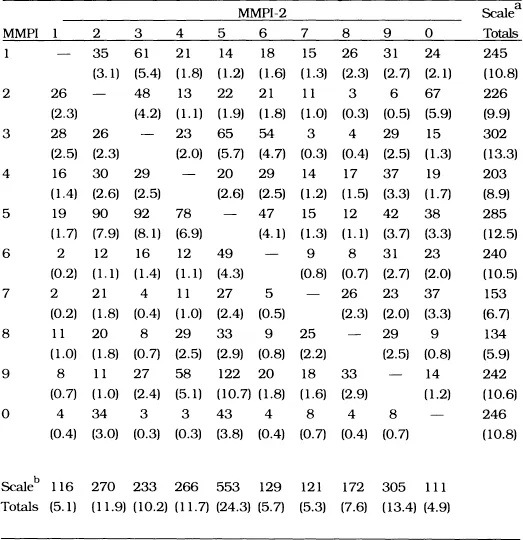
aFrequency with which each scale is highest or second highest in the prgfile for MMPI-2 norms.
bFrequency with which each scale is highest or second highest in the profile for MMPI norms.
Note: From “Comparability of two-point high-point code patterns from original MMPI norms to MMPI-2 norms for the restandardization sample” by W. G. Dahlstrom (1992), Journal of Personality Assessment, 59, pp. 153–164. Reprinted with permission.
TABLE 4.2
Frequencies (and Percentages) of High-Point Pairs for 1.462 Females on K-Corrected Norms for the MMPI (Below the Diagonal) and MM PI-2 (Above the Diagonal)
Frequencies (and Percentages) of High-Point Pairs for 1.462 Females on K-Corrected Norms for the MMPI (Below the Diagonal) and MM PI-2 (Above the Diagonal)
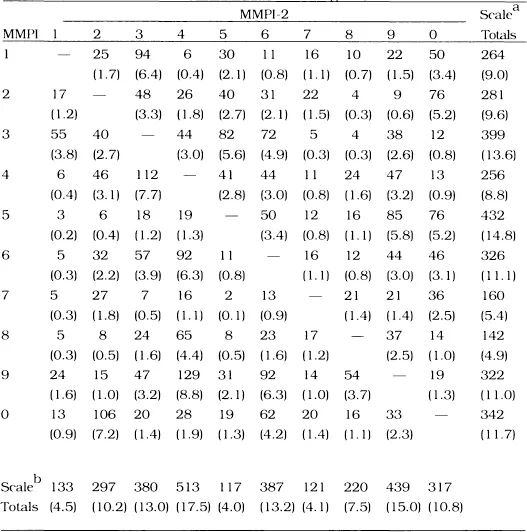
aFrequency with which each scale is highest or second highest in the profile for MMPI-2 norms.
bFrequency with which each scale is highest or second highest in the profile for MMPI norms.
Note: From “Comparability of two-point high-point code patterns from original MMPI norms to MMPI-2 norms for the restandardization sample” by W. G. Dahlstrom (1992). Journal of Personality Assessment, 59, pp. 153–164. Reprinted with permission.
In recent years we have been seeing people with low scale 1 scores who do not fit the above categories. For these people, what seems to be ...
Table of contents
- Cover
- Title Page
- Copyright Page
- PREFACE
- Table of Contents
- LIST OF FIGURES
- LIST OF TABLES
- I INTRODUCTION
- II INTERPRETING THE MMPI
- III VALIDITY SCALES
- IV CLINICAL SCALES
- V SUPPLEMENTARY SCALES
- VI SAMPLE MMPI INTERPRETATIONS
- VII ETHNIC AND CROSS-CULTURAL DIFFERENCES ON THE MMPI-2
- VIII THE MMPI AND MMPI-2 IN MEDICAL SETTINGS
- APPENDIX Validity, Clinical, and Research Scales
- REFERENCES
- SUBJECT INDEX
- NAME INDEX
- CODETYPE INDEX
Trusted by 375,005 students
Access to over 1.5 million titles for a fair monthly price.
Study more efficiently using our study tools.
Frequently asked questions
Yes, you can cancel anytime from the Subscription tab in your account settings on the Perlego website. Your subscription will stay active until the end of your current billing period. Learn how to cancel your subscription
No, books cannot be downloaded as external files, such as PDFs, for use outside of Perlego. However, you can download books within the Perlego app for offline reading on mobile or tablet. Learn how to download books offline
Perlego offers two plans: Essential and Complete
- Essential is ideal for learners and professionals who enjoy exploring a wide range of subjects. Access the Essential Library with 800,000+ trusted titles and best-sellers across business, personal growth, and the humanities. Includes unlimited reading time and Standard Read Aloud voice.
- Complete: Perfect for advanced learners and researchers needing full, unrestricted access. Unlock 1.5M+ books across hundreds of subjects, including academic and specialized titles. The Complete Plan also includes advanced features like Premium Read Aloud and Research Assistant.
We are an online textbook subscription service, where you can get access to an entire online library for less than the price of a single book per month. With over 1.5 million books across 990+ topics, we’ve got you covered! Learn about our mission
Look out for the read-aloud symbol on your next book to see if you can listen to it. The read-aloud tool reads text aloud for you, highlighting the text as it is being read. You can pause it, speed it up and slow it down. Learn more about Read Aloud
Yes! You can use the Perlego app on both iOS and Android devices to read anytime, anywhere — even offline. Perfect for commutes or when you’re on the go.
Please note we cannot support devices running on iOS 13 and Android 7 or earlier. Learn more about using the app
Please note we cannot support devices running on iOS 13 and Android 7 or earlier. Learn more about using the app
Yes, you can access MMPI And MMPI-2 by Jane C. Duckworth,Wayne P. Anderson in PDF and/or ePUB format, as well as other popular books in Psychology & Clinical Psychology. We have over 1.5 million books available in our catalogue for you to explore.