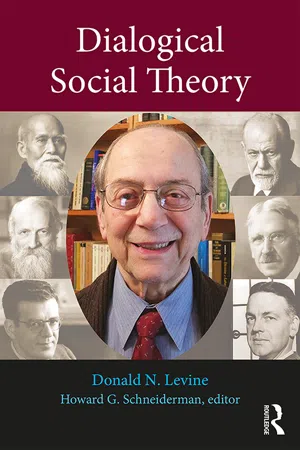
1
Dialogical Social Theory
Prologue. The Idea of Dialogue
The psychological phenomena of intercommunication between two minds have been unfortunately little studied.
– C. S. Peirce
On September 27, 1953—eight years after six million of his fellow Jews had been slaughtered by organized squads of the German government—Martin Buber delivered an address titled “Das echte Gespräch und die Möglichkeiten des Friedens”—“Genuine Dialogue and the Possibilities of Peace” (Buber 1957).1 How he mustered the fortitude, the imagination, and the transcendent compassion to deliver such a talk at that time, in that place, I shall never know. What I have come to believe, however, is that the idea Buber was advocating for, the idea he had planted firmly on the landscape of modern culture in the 1920s—the idea of genuine dialogue—may be the most important idea to have survived the killing fields of the past century.
The classic formulation of this idea, in I and Thou, followed a period in which young Buber, like many of his peers, embraced a Nietzschean ideal of self-transcendence through ecstatic personal experience. Part of the shift in his perspective came from his study under Georg Simmel. Simmel lectured on the significance of the Zwischenmenschliche, the interhuman, and proposed that the forms of social interaction should be examined by contemporary sociology. Buber recalled later that in his youth, he had found this idea broached in the early writings of Ludwig Feuerbach, who saw the human essence contained in the relation between I and Thou; and Buber acknowledged others, from Friedrich Jacobi to Herman Cohen, as contributing to his “History of the Dialogical Principle” (1965). In his own I and Thou (Buber [1923] 2004) and subsequent writings, Buber delved deeply into this theme, which in essence signified treating others not as objects but as subjects and understanding the human self as derived from interacting with others.
Buber’s seminal ideas were developed in various ways by some of the most creative minds in philosophy and theology of the succeeding decades. His colleague Franz Rosenzweig focused on ways in which dialogue helped to fashion the self and how participation in dialogue served to produce redemptive communal consequences. The philosopher Emmanuel Levinas emphasized the potential challenges and benefits of engaging fully with a radically different “other” in communication; the eminent hermeneutic philosopher Hans-Georg Gadamer engaged critically with Buber’s ideas; and the Russian literary theorist Mikhail Bakhtin—who called Buber “the greatest philosopher of the twentieth century”—pushed a notion of “dialogism,” holding that everything anybody says exists in response to things that have been said before and in anticipation of things that will be said in response.
The transformation of Buber’s perspective from being centered on the personal self to being centered on mutually respectful social interaction doubtless drew on other elements besides those previously mentioned. The most profound source of that change arguably was the impact of the so-called Great War. Like most of his intellectual peers, Buber supported the war when it broke out, but at some point, the war’s horrors affected his thinking and turned him into a lifelong promoter of genuine conversation as a means of promoting peace.
Half a century earlier, on another Continent, the horrors of war altered the outlook of some influential American thinkers. Oliver Wendell Holmes, valorous veteran of key battles of the Civil War, came to distrust commitments to absolute principles that motivated so many of the antagonists. For him, the chief lesson of the war was that dogmatic certitude leads to violence. Holmes concluded that the only way to keep certitude from producing violence is through inclusive democratic discourse.
In the 1870s, Holmes took part in a discussion group with friends and colleagues from Harvard, including C. S. Peirce and William James, who shared his distrust in concepts regarded with absolute certainty. From their discussions emerged what became known as the pragmatist movement in philosophy, which was energized by their younger colleague John Dewey when the movement went public in the late 1890s. Dewey, in turn, was influenced in Chicago by Jane Addams, who, following the violence triggered by the Pullman strike of 1893, convinced him that antagonism was unnecessary even when parties thought that they had opposed interests. Dewey devoted much energy to bridging what he considered false dichotomies.
The pragmatist thinkers, including G. H. Mead and Charles Horton Cooley, developed a number of kindred ideas related to their focus on sociality: genesis of the self through intersubjective communication; parallels between scientific and democratic discourse and processes involved in forming a public civil society. As a coda to all that work, John Dewey would sing in 1925: “of all affairs, communication is the most wonderful” (166). Following World War II, Continental philosophers of the dialogical tradition developed theories of communication that resonated with the thoughts of American pragmatist philosophers. Karl-Otto Apel developed his Transcendental-Pragmatic perspective by incorporating ideas about language drawn from Peirce. Jürgen Habermas, after engaging with G. H. Mead, sought to delineate the elements of an “ideal speech situation,” in which distortions could be eliminated and parties to a conversation could thereby arrive at consensus.
Despite the richness of these and other philosophical investigations, the idea of dialogue has not achieved a prominent place in modern culture. Apart from some notable work in the field of communication studies, it has largely failed to enter the discourse of the social sciences. In philosophical treatments, moreover, it remains at a highly abstract level. For all that, I believe, understanding the dimensions and significance of dialogue presents a challenge of exceptional importance for the functioning of contemporary life, not least because of huge obstacles in communication among specialists and among partisans in the global community.
The task of this book, then, is to import the dialogical theme into contemporary sociology. Its underlying assumption is that destructively conflictual modes of discourse among social scientists need to be transformed into discursive modes that embody dialogue. This is so for the sake of the advancement of valid knowledge. It is important no less as an educational vehicle, one that offers concrete models of dialogical conduct for the world. The sociologist, Buber counseled, “must… educate sociologically” (1957, 179); that is, must educate people how to live together, not to be just like one another, and how to express and respect their differences.
To my mind, the beginning of wisdom on the subject of dialogue versus combativeness follows from making two sets of distinctions. For one thing, the process of “intercommunication of two minds,” as Peirce put it, takes many forms. The subject demands that we distinguish different forms of dialogical interaction. For another, some kinds of dialogue can actually involve conflict. Accordingly, we need to distinguish between what sociologists like Louis Kriesberg ([1998] 2014) have described as constructive versus destructive conflicts. These distinctions help analyze a number of discursive forms where proponents of different positions engage in destructive conflict, constructive conflict, and consensual diversity. More concretely, it critically considers styles of dismissiveness, unmasking, caricature, and disavowal in discourse among social scientists.
To accomplish this, I consider historical conditions that promote the evolution of modern nonconfrontational modes of communication (Part I) and then offer a differentiated analysis of forms of dialogicality in social theory (Parts II and III).
Chapter 2 introduces this topic by contrasting dialogue with its opposite: the multitude of phenomena that embody human combativeness. It surveys the dominant theories about the sources of combativeness and attends to the explosions of violence throughout the past century. It then turns to review the many nonviolent breakthroughs of the twentieth century and analyzes a complex of historic developments that lay behind these breakthroughs. Chapter 3 offers two case studies of this secular change. It describes the perceived obsolescence of received combative modes: in American adversarial litigation and in Japanese martial arts. Chapter 4 confronts a well-known claim that the post-Cold War international community would necessarily be marked by a “clash of civilizations” (Huntington 1993) with arguments regarding ways in which all world civilizations contain inclusionary as well as exclusionary assumptions.
The remaining chapters present essays that embody modalities in which contrasting intellectual positions in the social sciences can be related in non-adversarial ways. Part II presents forms of dialogue in which the parties, although holding different positions, nevertheless share common objectives. Chapter 5, a very old paper from 1950, demonstrates how radically different assumptions about human nature and the social world held by the eighteenth-century French philosophes and the nineteenth-century Russian intelligentsia produced similar visions of the global community. Chapter 6 revisits the work of Simmel, Parsons, and Merton—with their markedly varying assumptions and agendas—to find material that can be brought to bear on a single subject, the sociology of morality. Chapter 7, perhaps the most intellectually challenging chapter of the book, compares the complicated conceptual frameworks of Parsons and McKeon with an eye to finding ways in which the strong programs of each can compensate for the weak points of the other. These three chapters all illustrate the theme of dialogue as complementary contributions to a common problem.
The succeeding chapters demonstrate ways in which the ideas of authors who know little or nothing about one another can be brought together to form a novel dialogue. Chapter 8 brings together some key ideas of the Austrian psychoanalyst Sigmund Freud and the Japanese martial artist Morihei Ueshiba. Moving closer to the present, Chapter 9 considers statements about education by John Dewey and Robert Maynard Hutchins. It shows that the much-celebrated differences between them are overshadowed by what can be shown to be shared positions on a common topic.
Part III describes rhetorical forms that transfigure oppositional discourse into productive dialogue. It deals with two major ways in which parties displaying pointed confrontations with one another can contribute to ongoing dialogues that enrich the total discourse about a subject. Chapters 10, 11, and 12 do this for interlocutors from, respectively, the British, French, and German philosophic traditions. Chapter 13 schematizes three mutually exclusive interpretations of the somatic bases of social conflict, then moves toward a fourth interpretation that offers ways to connect them productively. Chapter 14 brings the discussion to a relatively recent political crisis which took place in Ethiopia following the violent reactions to the national election of 2005. My efforts there as a mediator between the government and the imprisoned opposition leaders forced me to find ways to bridge what seemed like implacably opposed positions.
In Chapter 15, finally, I reprint a 1985 essay, “The Forms and Functions of Social Knowledge,” which offers an extensive paradigm of discursive commonplaces used by social scientists.
Note
1 The address was written for the German Book Trade in Frankfurt am Main.
2
Dialogue and Human Combat
Dialogue stands in opposition to human combat, a broad concept that covers everything from organized warfare to interpersonal violence, from jural litigation to antagonistic conversation. Of these, organized physical combat has attracted the most commentary. Even today, our cultural space seems dominated by reports of civil strife, policing actions, and terrorist warfare. Understandably, such phenomena prompt us recurrently to come up with explanations for human bellicosity in general.
Broadly speaking, I see the vast literature of explanations of human aggression framed by three perspectives: Nature; Society and Environment; and Micro-social Situations.
Nature: Aggression Instinctive
Perhaps the most enduring perspective locates a disposition to aggression in some form of natural endowment. The inherent sinfulness of human nature has been proclaimed in the West for millennia. Thomas Hobbes famously depicted the condition of unchecked human assertiveness as a war of all against all. Modern psychologists, however, have reworded the story. William James affirmed that “our ancestors have bred pugnacity into our bone and marrow, and thousands of years of peace won’t breed it out of us” ([1910] 1974, 314). And to answer the stark question posed to him by Albert Einstein, “Why War?” Sigmund Freud replied in terms that have framed much modern thought on the question: “Human instincts are of two kinds: those that conserve and unify… and the instincts to destroy and kill” ([1932] 1939, 90). Musing on the relations between the two instincts, Freud added:
The ideal motive has often served as a camouflage for the dust of destruction; sometimes, as with the cruelties of the Inquisition, it seems that, while the ideal motives occupied the foreground of consciousness, they drew their strength from the destructive instincts submerged in the unconscious.
(Ibid., 92)
Hans Morgenthau, in his landmark formulations of “political realism,” argued that “forces inherent in human nature” lead inexorably to conflict among social groups (1960, 4).
Such assumptions were bolstered by the work of scientific naturalists, like ethologist Konrad Lorenz, whose research concerned “the fighting instinct in beast and man which is directed against members of the same species” (1966, ix). Lorenz demonstrated that aggressive drives form an essential part of the life-preserving organization of instincts. Among humans and many other species, conflict has provided clear adaptive advantages: balancing ecological distributions, selecting fit specimens through fights among rivals, mediating ranking orders for complex organizations, even instigating ceremonies that aid social bonding. Civilized man, he proposed, suffers from the fact that phylogenetically transmitted aggressive instincts that aided survival in prehistoric times now find no adequate discharge. Ethologist Nikolaas Tinbergen likewise posited a universal instinctual proclivity to intraspecific conflict, but remarked: “Among the thousands of species that fight… man is the only species that is a mass murderer” (1968, 180). Primatologists Richard Wrangham and Dale Peterson (1996) developed a point broached by Lorenz: they found the instinct for destructive aggression gender-specific. The proximity of humans to chimpanzees in genetic makeup signifies a chimp-like murderous drive in human “demonic males.”
Society and Environment: Aggression Cultural
Not all evolutionary biologists accept the Wrangham-Peterson argument. In Apes and Human Evolution, Russell H. Tuttle asserted: “There is no paleoanthropological support for the notion that our stem ancestors regularly engaged in intragroup and intergroup killing, infanticide, cannibalism, or female bashing” (2014, 593). Tuttle thereby provides grounds for an opposite perspective, one that appears among social scientists who emphasize the malleability of human dispositions and hold that the scope of human aggression depends on cultural patterns. Anthropologist Ruth Benedict’s Patterns of Culture stands as a classic exemplar of this position. Benedict contrasted the Native American Zuni, whom she described as orderly and peaceable, with the Dobu of New Guinea, among whom “treacherous conflict is the ethical ideal” (1934, 170). In this vein, Erich Fromm (1973) went on to examine anthropological accounts of 30 primitive societies with an eye to determining their levels of aggressiveness or peacefulness. He found several—like the Aztecs, the Dobu, and the Ganda—who evince a great deal of interpersonal aggression and violence both within the tribe and against others. The atmosphere of life within those societies he described as truly Hobbesian, a condition of constant fear and tension. On the other hand, Fromm found a number of primitive societies where precisely the opposite qualities manifest themselves. Among the Zuni Pueblo Indians, the Mountain Arapesh, and the Mbutu, for example, he found little hostility and violence, virtually no warfare, hardly any crime, little envy and exploitation, and a generally cooperative and friendly attitude. Appealing to the environmental factors subsumed under cultural variation, psychoanalytically oriented Fromm pointedly rejects the Freud-Lorenz notion of aggressive instincts as generating an inherent quantum of pent-up energies awaiting discharge.
Other social scientists locate environmental causes of aggressive behavior in various dimensions of social structure. William Graham Sumner, a founding father of sociology, famous for arguing that “the mores can make anything right and prevent condemnation of anything” ([1907] 2002, 521), formulated an enduring generalization: the general rule among social groups is to promote ha...