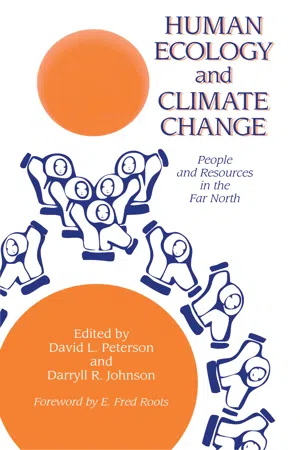
eBook - ePub
Human Ecology And Climatic Change
People And Resources In The Far North
- 362 pages
- English
- ePUB (mobile friendly)
- Available on iOS & Android
eBook - ePub
Human Ecology And Climatic Change
People And Resources In The Far North
About this book
The Far North, a land of extreme weather and intense beauty, is the only region of North America whose ecosystems have remained reasonably intact. Humans are newcomers there and nature predominates. As is widely known, recent changes in the Earth's atmosphere have the potential to create rapid climatic shifts in our life-time and well into the future. These changes, a product of southern industrial society, will have the greatest impact on ecosystems at northern latitudes, which until now have remained largely undisturbed. In this fragile balance, as terrestrial and aquatic habitats change, animal and human populations will be irrevocably altered.
Trusted by 375,005 students
Access to over 1.5 million titles for a fair monthly price.
Study more efficiently using our study tools.
Information
Subtopic
Environment & Energy PolicyIndex
Biological SciencesPART I
Climate and Human Populations—A Dynamic Balance
Human technological development has evolved faster than its ability to deal with its own waste products. Degradation of the atmosphere by modem industrial society has left us with potential problems of global proportions. If we are to address these problems, we need to clearly define them prior to taking any action. We must know where we are—and a little bit about where we have been—before we face an uncertain future.
Describing the climatic systems of northern North America is a daunting task. Offhand critiques of the daily weather forecast tend to ignore the remarkable complexity of the atmosphere. Fortunately, this section sheds some light on exactly how northern climates function and how they might change in the next century. The predictions are ominous. If Earth surface temperatures increase due to an accumulation of greenhouse gases, the greatest increases will occur at northern latitudes. The complexity (and uncertainty) of northern climate is complicated even further by potential feedbacks from hydrologic and biological systems.
It is equally challenging to describe the structure of northern social systems. Demographers and economists have never been very successful at predicting long-term trends despite using the best available information. One thing we know for certain is that populations in northern North America are increasing. We also know that the cultures and lifeways of indigenous people are under considerable stress, and that the path toward acculturation has had tremendous social and economic costs. The social and demographic trends discussed here indicate that some segments of northern society will be quite vulnerable to changes in natural resource availability. Communities where social stress is already high cannot tolerate much more.
This section provides some background for assessing the potential impacts of climate change in the North. Rapid changes in climate and natural resources would have a wide range of impacts on people who depend on those resources. And it is not difficult to imagine that a warmer climate would facilitate the transfer of many economic activities from the South. A wave of immigration to the North would change northern landscapes and cultures forever.
1
Human ecology and climate change at northern latitudes
David L. Peterson and Darryll R. Johnson
Imagine you are a hunter living in Alaska 14,000 years ago. Your world is filled with large and frightening creatures such as the sabertooth (Smilodon fatalis), dire wolf (Canis dims), mastodon (Mammut americanum), and wooly mammoth (Mammuthus primigenius). While you have the tools and knowledge to hunt many of these animals, you are also potential prey for some of the larger carnivores. The paleontological record contains a fascinating account of the number and diversity of large mammals that roamed the landscapes of North America at the end of the last Ice Age.
Then, between 12,000 and 10,000 B.P. (years before present)—a veritable blink of the eye in geological terms—huge numbers of mammals disappeared from the face of the earth. At least 40 large mammal species in North America became extinct (Kurten and Anderson 1980; Pielou 1991). Some 200 mammalian genera became extinct worldwide (Behrensmeyer et al. 1992). This is a remarkable change in biological diversity over a relatively short time period. While there are other examples of massive extinctions (e.g., dinosaurs at the end of the Cretaceous period), the Pleistocene extinctions are particularly intriguing because they were so specific to the so-called mammalian “megafauna.” There is no consensus on the cause of the extinctions.
There are a few things we know for sure about the post-ice Age world. One is that average earth surface temperature increased 5°C as glacial ice sheets and continental glaciers receded (Chapter 2). This resulted in large-scale changes in the distribution of plant species and animal habitat at northern latitudes. Tundra was transformed into forest, and new areas of tundra and wetlands were created along the margins of the retreating ice sheet. Changes in the distribution of habitat during this period may have contributed to the massive extinctions (King and Saunders 1984).
Another thing we know about the post-ice Age world is that human populations were expanding in North America. The ancestors of the Clovis people, who reached North America from Beringia ca. 14,000–12,000 B.P., dispersed rapidly through Alaska, northern Canada, and southerly locations (West 1983; Kunz and Reanier 1994), coincident with the mammal extinctions. These early inhabitants were prolific hunters, and it is possible that many species were vulnerable to this tool-using human predator (Pielou 1991). The notion that humans facilitated the demise of Pleistocene mammalian fauna has been termed the “prehistoric overkill (or blitzkrieg) hypothesis” (Martin 1984; Behrensmeyer et al. 1992).
So what really caused the post-Pleistocene extinctions? We may never know all the details, but the extinctions were no doubt the result of changes in both environmental conditions and human populations (Burney 1993). Regardless of the relative importance of these factors, prehistoric evidence clearly illustrates linkages among climate, natural resources, and humans that have existed for millennia.
Climatic variation and human populations
The paleoecological literature tells a story of dramatic change in the distribution of North American vegetation during the Holocene era (since 12,000 years B.P.). A true long-term equilibrium between climate and ecosystems probably never exists. Even submillennial variations in climate such as during the Medieval Optimum (ca. 1000–1200 A.D.) and the Little Ice Age (ca. 1600–1850 A.D.) can have significant impacts on fire regimes and vegetation distribution (Delcourt and Delcourt 1991). Similarly, true equilibrium between social and ecological systems never exists because the systems and their interactions change continuously.
The impacts of climate on human populations are perhaps better documented for the temperate and arid regions of North America than for the Far North. A prime example of the effects of environmental change on human populations occurred in what is now the southwestern United States. A prolonged drought at the end of the thirteenth century forced the Anasazi people to abandon their extensive cliff dwellings in Canyon de Chelley (Arizona) and Mesa Verde (Colorado), when agriculture was no longer viable (Watson 1953). The archeological record contains many examples in the American Southwest of human communities abandoning areas they had occupied for hundreds of years due to changing climate and environmental conditions. A more recent example of climate-related social impacts occurred in the 1930s, when prolonged droughts caused widespread agricultural failures and soil erosion in the dust bowls of the central United States. As recorded in Woody Guthrie’s songs and John Steinbeck’s novels, thousands of people abandoned their hom...
Table of contents
- Cover
- Half Title
- Frontispiece
- Title Page
- Copyright Page
- Table of Contents
- Preface
- Foreword
- Contributors
- List of Figures and Tables
- Part I Climate and Human Populations—A Dynamic Balance
- Part II Predicting Environmental Change
- Part III Human Populations and Natural Resources: Historical and Contemporary Perspectives
- Part IV Natural Resources and Human Institutions in a Dynamic Environment
- Part V Essays: Conflict in Social Values
- Part VI Searching for Solutions
- Index
Frequently asked questions
Yes, you can cancel anytime from the Subscription tab in your account settings on the Perlego website. Your subscription will stay active until the end of your current billing period. Learn how to cancel your subscription
No, books cannot be downloaded as external files, such as PDFs, for use outside of Perlego. However, you can download books within the Perlego app for offline reading on mobile or tablet. Learn how to download books offline
Perlego offers two plans: Essential and Complete
- Essential is ideal for learners and professionals who enjoy exploring a wide range of subjects. Access the Essential Library with 800,000+ trusted titles and best-sellers across business, personal growth, and the humanities. Includes unlimited reading time and Standard Read Aloud voice.
- Complete: Perfect for advanced learners and researchers needing full, unrestricted access. Unlock 1.5M+ books across hundreds of subjects, including academic and specialized titles. The Complete Plan also includes advanced features like Premium Read Aloud and Research Assistant.
We are an online textbook subscription service, where you can get access to an entire online library for less than the price of a single book per month. With over 1.5 million books across 990+ topics, we’ve got you covered! Learn about our mission
Look out for the read-aloud symbol on your next book to see if you can listen to it. The read-aloud tool reads text aloud for you, highlighting the text as it is being read. You can pause it, speed it up and slow it down. Learn more about Read Aloud
Yes! You can use the Perlego app on both iOS and Android devices to read anytime, anywhere — even offline. Perfect for commutes or when you’re on the go.
Please note we cannot support devices running on iOS 13 and Android 7 or earlier. Learn more about using the app
Please note we cannot support devices running on iOS 13 and Android 7 or earlier. Learn more about using the app
Yes, you can access Human Ecology And Climatic Change by David L. Peterson,Darryll R. Johnson in PDF and/or ePUB format, as well as other popular books in Biological Sciences & Environment & Energy Policy. We have over 1.5 million books available in our catalogue for you to explore.