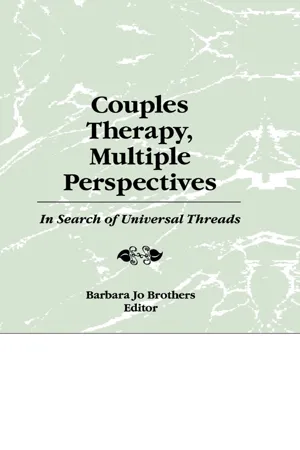
Couples Therapy, Multiple Perspectives is a springboard from which therapists may begin to answer such questions as What are the ingredients essential to good relationships? What are the ingredients essential to activity within the psychotherapeutic relationship? How can what therapists know regarding psychotherapy be combined to create a whole greater than the sum of its parts? Barbara Jo Brothers aids therapists in answering these and other questions about the basic ingredients, the common denominators, and the universal threads of work with couples from exploring the theories and methods of successful therapists.As there are many ways of looking at couples therapy, this volume encourages therapists to work cooperatively, not competitively, in developing clients'possibilities. Couples Therapy, Multiple Perspectives is intended to assist therapists working with couples achieve a broader view of their work and a richer range of choices in helping their clients. Every article, especially the two by master therapists Florence Kaslow and Maurizio Andolfi, moves readers toward a tapestry of therapeutic possibilities.Features of Couples Therapy, Multiple Perspectives include an in-depth look at the ingredients of a successful marriage, or, what makes marriages work for the long-term by Florence Kaslow; an article by Maurizio Andolfi, translated by Vincenzo DiNicola, which brings together an excellent integration of theories, including those of Bowen, Framo, and Whitaker. Andolfi describes a transgenerational approach to work with couples in crisis, with a case example of the value of doing family-of-origin work in the initial phase of therapy. In an interview segment with Virginia Satir (with Sheldon Starr, PhD, in 1985), she explores how all good therapy has essentially the same ingredients. Readers will find Satir's ideas timeless and thought provoking; indeed they may re-evaluate their own position and theories on therapy with couples.
eBook - ePub
Couples Therapy, Multiple Perspectives
In Search of Universal Threads
- 160 pages
- English
- ePUB (mobile friendly)
- Available on iOS & Android
eBook - ePub
About this book
Information
Comprehensive Marital Therapy
Joan D. Atwood, PhD, CSW, is Coordinator of the Graduate Programs in Marriage and Family Therapy at Hofstra University, Hempstead, NY, 11550. She is the author of Treatment Techniques for Common Mental Disorders and Family Therapy: A Cognitive-Behavioral Approach, has done extensive research and writtennumerous j ournal articles in the field of marriage and family therapy.
SUMMARY.This article approaches couple therapy from several theoretical frameworks in that object relations family therapy and cognitive-behavioral marital counseling are integrated into a basic systemic orientation. The paper focuses on the three stages of couple therapy, the early, middle, and later stages, and includes a description of specific therapeutic goals relevant to each stage.
Introduction
Marital Therapy consists of an interface between three individuals, the two partners and the therapist (Kramer, 1985). The therapist has been asked to help the couple to improve some aspect of their relationship. The therapist can view their situation from several possible theoretical frameworks, some of which identify the individual as having the problem, in this case operating within an intrapsychic framework; while others view the problem as a function of a mutual exchange between two persons or as examining the resulting configuration of each member’s contributing makeup, operating from some form of a system framework. The focus of this paper is primarily on a systemic orientation to marital therapy (Hoffman, 1981; Sluzki, 1978; Steinglass, 1978). However, in sodoing, object relations family therapy and cognitive-behavioral marital counseling is integrated into a more systemic orientation. It is the author’s contention that the marital therapies are not and cannot be mutually exclusive. The marital system, comprised of two separate yet interwoven personalities joining together to create the relationship system is much too complicated to be approached by only one theoretical framework. This paper presents a discussion of the three stages of marital therapy: (1) Early Stages, (2) Middle Stages, and (3) Later Stages as approached from a more integrated perspective. Within each section, there is a description of the specific therapeutic goals relevant to that stage.
Assumptions of Marital Therapists
When doing marital therapy, there are certain assumptions held by marital therapists (Napier, 1988). Some of the more major assumptions are:
1. One or both spouses in a chronically disturbed relationship will tend to misperceive the partner’s motivations and personality characteristics (Meissner, 1978; Sonne & Swirsky, 1981).
2. People tend to recreate their interpersonal world by eliciting behavior from others that confirms their inner representational world and by discouraging or selectively ignoring disconfirmatory behavior (Abies & Brandsma, 1977; Willi, 1984).
3. Repetitive observation of spouse behavior that is discrepant with the schema for the perception of the spouse will result in a change in the schema (Willi, 1984).
4. Couples collude, cooperate with each other to maintain the dysfunctional symptom (Blank & Blank, 1968; Dicks, 1963; Willi, 1984).
5. The symptom serves a protective function in that it maintains the homeostasis of the system (Haley, 1965, 1973; 1976; Minuchin, 1974; Stanton, 1981).
6. Every human has a biological drive to unfold and to grow-to be the fullest s/he can be. This drive to grow may be forced underground in a person so that we cannot detect it, but we assume it is still present (Satir, 1967,1972; Whitaker, Greenberg & Greenberg, 1981).
Three Stages of Therapy
As stated above, couple therapy can be discussed in terms of the three phases of the therapeutic process: (A) Early Stages, (B) Middle Stages, and (C) Later Stages. Below is a discussion of each stage.
The Early Stages of Therapy–The Battle for Structure
There are four major therapeutic goals in the beginning stages of couple therapy. They are: (1) Resolving the Battle for Structure, (2) Joining, (3) Creating a Holding Environment, and (4) Systemic Assessment.
Resolving the Battle for Structure
From the onset, there is a Battle for Structure (Napier, 1988). The Battle for Structure determines who is in charge of therapy and under what structure the therapy will be conducted. In order for a therapist to be effective, regardless of theoretical orientation, s/he must adhere to some procedural protocol. With respect to future sessions, it is most important for the therapist to be the one who determines who will attend. If the therapist, for whatever reason, allows the contact spouse to determine which members will be present, then the therapist is allowing that client to control the therapy. In this case, the therapist has become part of the dysfunctional system and in so doing has been manipulated in much the same way as the family members.
Structuring the therapy begins when the therapist receives the inquiring spouse’s phone call. The manner in which the therapist conducts him/herself on the phone, inquiries about the nature of the couple’s problem, determining who will attend the first and possible future therapy sessions, how payment will be made, etc., helps the therapist to establish an appropriate working environment.
Joining
Another task to be accomplished during the first sessions is joining. Joining is the process by which an empathic rapport is developed with the clients (Minuchin, 1974). Effective therapy depends mainly on the ability of the therapist to comprehend how each spouse is experiencing the marital problem and what it is that each desires from the marriage. The therapist’s reflections serve as an empathic connection with the clients, through which each can feel understood, appreciated and safe. It is through this sensitive and delicate thread that therapist earns each spouse’s trust. The deeper the joining, the deeper the trust. This trusting environment creates the ability of the part of the clients to risk changes.
Creating a Holding Environment
Creating an environment conducive to change is the third task to be accomplished in the beginning stages of couple therapy. This is called creating a “holding environment” (Winnicott, 1965) in which both spouses can co-exist, tolerate the others’ presence and involvement, while the therapist acts as both support and defense system. Each spouse is then free to consider his/her position and approach, without fear of intrusion from the other spouse. The holding environment also affords each spouse a safe environment in which to re-explore the other, the relationship, and more importantly, him/herself. This is accomplished through each observing the therapist joining with and “being there” for the other spouse, but not at the expense of the other. Each spouse realizes that they can share each other with the therapist without fearing disloyalty, bias, or threat. In this way, each spouse learns that s/he can once again be open, able to share and express him/herself to the other. Once this facet of therapy has begun, an assessment of the marital difficulties and each spouse’s contribution to the failed solutions, can then be examined.
Systemic Assessment
Systems theory, as presented here, requires the therapist to obtain as complete as possible an understanding of how and why two individuals are interacting as they do. In order to do this, it is useful to obtain information about the present marital situation on two separate levels: the historical and the present. These two levels of analysis are examined within the context of (1) the couple’s family structure, (2) the couple’s relational history, and (3) the couple’s relational process.
The Present Marital Situation. Marital situations can be divided into three experiential levels: the extended family, the spousal relationship, and the personality of each individual. During this phase, the therapist examines the past and present relationships of each spouse in order to better understand how each spouse typically functions within relationships. In general, based on early parent-child interactions and ongoing socialization, individuals develop a preferred way of relating to others. This then becomes the perceptual set as to how they view others and how they expect others to view them. In many ways, perceptual sets determine predictable ways of interacting with others, roles in life, and what individuals expect out of life or from others. In other words, as Watzlawick, Beavin, and Jackson (1967) point out, we create our own reality or more colloquially stated, “We get what we ask for” (Watzlawick, Weakland, & Fisch, 1974). An examination of each spouse’s three experiential levels helps the therapist define these perceptual role sets, as well as when and how they developed.
Gathering information about the couple’s family structure. Beginning with an examination of extended family, each spouse is asked to examine his/her parental relationships, the parent’s marriage, his/her siblings, and any other significant relationships. Specific interactional patterns, roles, structure, boundaries, familial or traditional beliefs/values are identified for the purpose of understanding how these familial attributes are influencing the meaning of a spouse’s behavior or the meaning s/he attaches to the other’s behavior (Aponte & Von Deuser, 1981; Kantor & Lehr, 1975; Kantor & Kuperman, 1985; Minuchin, 1974; Stanton, 1980). This information can be very easily gathered using a genogram (Francis, 1988; Marlin, 1989; McGoldrick & Gerson, 1985). In addition, patterns of relating such as proximity/distance and enmeshment/disengagement are examined (Minuchin, 1974).
If the couple is experiencing more severe marital problems related to unresolved historical issues stemming from the family of origin, more time needs to be spent on these issues. In these cases, it is wise for the therapist to use a more psychodynamic approach (Bowen, 1978; Scharff, 1989; Slipp, 1988).
Next, the marital relationship is explored. In this case, each spouse is asked to identify the couple’s positive and negative qualities, strengths and weaknesses, and division of labor (Jacobson, 1978; Stuart, 1980). In this way, the therapist obtains an understanding of how the couple makes decisions, solves problems, negotiates and resolves conflicts and how each spouse asserts him/herself.
Finally, the intrapersonal level is explored. Here each spouse explores his/her own personal beliefs, values, strengths and weaknesses in order to help the therapist gain a basic understanding of each spouse’s psychological sense of self, emotionality, relational sensitivities, and adaptability.
Gathering information around the couple’s relational history. Within this contextual framework, the therapist examines each spouse’s transcending relational history (Ackerman, 1958; Bowen, 1966,1971,1978; Kerr, 1981; Spark, 1974,1981). Here, there is an examination of each individual’s development, the passage through his/her life cycle events and a review of his/her family of origin patterns and issues. The therapist needs to obtain as comprehensive as possible a picture of each spouse’s physiological, cognitive, emotional, and social development. The therapist is particularly concerned with whether each spouse moved through his/her developmental milestones as expected or if some form of developmental abnormality (speech delayed); deviation (repeating a grade); disruption or an unstable environmental condition (moving around a lot during grade school years); or a trauma (unexpected death of a family member) adversely affected some area of his/her development.
With regard to life cycle events passage (McGoldrick & Carter, 1982), the therapist is concerned with whether or not each spouse successfully achieved certain developmental tasks. For example, most young adults are expected to have matured to the point of wanting to leave home, becoming self sufficient through work, and developing social relationships. If they did successfully pass through a transitional stage, the therapist wants to know: How did they achieve it? If they did not, was it due to premature or delayed arrival of this stage? What family factors were operating at the time? The basic question here is that if there was a problem, why was this phase of interpersonal development a problem? From this information, the therapist can then better understand how developmentally mature and ready each spouse is, and to what extent each spouse is able to effectively manage and cope with interpersonal issues (Haley, 1973; Stanton, 1978; Weakland, Fisch, Watzlawick & Bodin, 1974).
With regard to transgenerational patterns, the therapist is interested in having each spouse become more knowledgeable about his/her own family history as well as that of the other spouse (Feldman, 1976). Transgenerational patterns are identifiable through the study of family traditions and rituals and the symbolic preferred ways of relating. These transgenerational patterns are conveyed and maintained through the ascription of certain meaning to particular types of behavior, interactions, or events. These transgenerational patterns provide each family member with some sense of rootedness, family and personal identity. The therapist is particularly interested in learning how each spouse upholds his/her familial beliefs and practices (regarding gender roles; division of labor; use of violence, illness or money; the meaning given to certain behaviors or events and the customary ways of coping with them) within the present marriage (Spark, 1981). In this manner, the therapist is better able to understand why each spouse chooses to interact with the other in a particular manner, over particular items, at particular times, etc. This information also enables the therapist to understand why one spouse’s response is not always appreciated by the other; or, why one may not be able to respond as the other would like. In this way, the therapist is better able to understand the type of “dance” that the spouses are involved in, whether they are dancing the same or different steps, and whether those steps are appropriate or inappropriate to the music.
Gathering information about the couple’s relational process. As stated above, the therapist acquires the above contextual framework in order to formulate a hypothesis, determine t...
Table of contents
- Cover
- Title
- Copyright
- Dedication
- CONTENTS
- In Memoriam: Robert L. Goulding 1917-1992: Pioneer in the Search for Universal Threads
- Introduction
- “All Good Therapy Has the Same Ingredients”: An Interview with Virginia Satir
- Long Term “Good” Marriages: The Seemingly Essential Ingredients
- A Poem
- Comprehensive Marital Therapy
- The Role of Structure in Couples Therapy: A Search for Universal Threads
- Couple Crises and the Trigenerational Family
- Life Cycle Crises: Sources of Strain and Strength in Relationships
- Suitable for Reframing: The Myers-Briggs Type Indicator in Couples Therapy
- Differentiation of Self and Marital Adjustment of Clinical and Nonclinical Spouses
- Hope for Healing in Russia: Reflections and Epilogue
Trusted by 375,005 students
Access to over 1.5 million titles for a fair monthly price.
Study more efficiently using our study tools.
Frequently asked questions
Yes, you can cancel anytime from the Subscription tab in your account settings on the Perlego website. Your subscription will stay active until the end of your current billing period. Learn how to cancel your subscription
No, books cannot be downloaded as external files, such as PDFs, for use outside of Perlego. However, you can download books within the Perlego app for offline reading on mobile or tablet. Learn how to download books offline
Perlego offers two plans: Essential and Complete
- Essential is ideal for learners and professionals who enjoy exploring a wide range of subjects. Access the Essential Library with 800,000+ trusted titles and best-sellers across business, personal growth, and the humanities. Includes unlimited reading time and Standard Read Aloud voice.
- Complete: Perfect for advanced learners and researchers needing full, unrestricted access. Unlock 1.5M+ books across hundreds of subjects, including academic and specialized titles. The Complete Plan also includes advanced features like Premium Read Aloud and Research Assistant.
We are an online textbook subscription service, where you can get access to an entire online library for less than the price of a single book per month. With over 1.5 million books across 990+ topics, we’ve got you covered! Learn about our mission
Look out for the read-aloud symbol on your next book to see if you can listen to it. The read-aloud tool reads text aloud for you, highlighting the text as it is being read. You can pause it, speed it up and slow it down. Learn more about Read Aloud
Yes! You can use the Perlego app on both iOS and Android devices to read anytime, anywhere — even offline. Perfect for commutes or when you’re on the go.
Please note we cannot support devices running on iOS 13 and Android 7 or earlier. Learn more about using the app
Please note we cannot support devices running on iOS 13 and Android 7 or earlier. Learn more about using the app
Yes, you can access Couples Therapy, Multiple Perspectives by Barbara Jo Brothers in PDF and/or ePUB format, as well as other popular books in Psychology & History & Theory in Psychology. We have over 1.5 million books available in our catalogue for you to explore.