- 408 pages
- English
- ePUB (mobile friendly)
- Available on iOS & Android
eBook - ePub
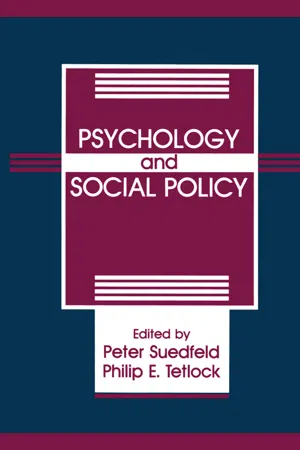
Psychology And Social Policy
About this book
This work explores the application of psychological data and theories to controversial policy issues such as racial and gender inequality, violence and criminal justice. The book also asks whether psychology really has relevant expertise to contribute. First published in 1992. Routledge is an imprint of Taylor & Francis, an informa company.
Information
Publisher
Taylor & FrancisYear
2019Print ISBN
9781138984073
9781560320630
Edition
1eBook ISBN
9781317740292
1
Psychologists as Policy Advocates: The Roots of Controversy
At first glance, the chapters in this book appear to have very little to do with one another. The authors cover an enormous range of intellectual and policy areas: from nuclear deterrence to pornography, from affirmative action to the accuracy of eyewitness testimony. On closer inspection, however, the common theme becomes obvious. In each policy domain, the authors are grappling with the same fundamental question, but often they reach radically different answers. The question is whether behavioral and social scientists, either as individuals or through their professional organizations, have enough evidence to justify their taking sides on controversial political issues, and if so, under what conditions, on what grounds, and in what way.
Looking at the scholarly community at large, it is clear that this question has already been answered, usually in the affirmative. Advocacy positions taken by psychologists, both as individuals and as groups, share the same problems and characteristics, although those taken by groups involve additional issues of consensus, delegation, and legitimacy. But notwithstanding these difficulties, psychologists have expressed themselves freely on a wide range of policy issues.
Many policy-related statements and recommendations have been made by psychologists and by psychology organizations. Among the shared characteristics are a clear stand on one side of a controversial, or at least debatable, issue and the implication that this stand is based on a foundation of knowledge to which psychologists have special access by virtue of their professional training and experience. Consider the following selection of proclamations issued during the past 50 years:
• We, as psychologists, protest most emphatically against the common belief that wars are necessary results of human nature. This opinion is without scientific foundation.—Society for the Psychological Study of Social Issues Council, 1937, quoted in Kimmel (1986).
• [The American Psychological Association (APA) Council of Representatives] urges all members of the APA … to work toward the readmission of Israel to full participation in UNESCO [United Nations Educational, Scientific, and Cultural Organization]….—APA Council, 1976.
• [The Council] recognizes officially and makes suitable promulgation of the fact that it is scientifically and psychologically baseless, as well as in violation of human rights, to discriminate against men because of their sex [in child custody, adoption, child-care occupations, and parental leave].—APA Council, 1977.
• … we call upon [the U.S. and the U.S.S.R.] to adopt an immediate mutual freeze on all further testing, production, and deployment of all nuclear warheads, missiles and delivery systems; and … upon the Administration and the Congress to transfer the funds saved to civilian use.—APA Council, 1983.
• The American Psychological Association is opposed to any attempts to require by statute or other means the inclusion of “creationism” within the science curriculum of the public schools.—APA Council, 1983.
• The American Psychological Association (1) encourages parents to monitor and to control television viewing by children; (2) requests industry representatives to take a responsible attitude in reducing direct imitable violence … and in providing more programming for children designed to mitigate possible effects of television violence, consistent with the guarantees of the First Amendment….—APA Council, 1985.
• Be it resolved that the American Psychological Association: encourage the elimination of both amateur and professional boxing … communicate its opposition to boxing to appropriate regulating bodies; assist state psychological societies to work with their state legislatures to enact laws to eliminate boxing….—APA Council, 1986.
ADVOCACY: A CONTROVERSIAL ROLE
Statements of this sort can be viewed in at least two alternate ways. One is that the people making them are exercising their rights as citizens in a democracy in trying to influence public policies; the other is that they are speaking on the basis of knowledge that they have because of their special training and expertise in behavioral science, which is unavailable to the average citizen. In the former case, positions can be based on political ideology, moral codes, or self-interest (see Rudmin, 1986). But the latter viewpoint gives these comments an ex cathedra quality. To use a social psychological label, the implication is that the source has “expert knowledge” (French & Raven, 1959) that calls for more than just routine attention to what is said.
Our purpose is to consider this claim. First, we should dispose of the possibility that the claim is not being made. If it were not (that is, if these colleagues were speaking merely in their role as citizens), we would expect such arguments to appear in general-circulation magazines and newspapers, rather than in professional and scientific books and journals (and most prominently in American Psychologist, surely the most widely read psychology journal in the world). The authors’ professional qualifications and affiliations would be irrelevant and therefore omitted (cf. Rapoport, 1984). At most, the affiliations might be appended (perhaps disingenuously) “for identification only.” References in the text to psychological data or theories would be muted or absent. And, of course, we would not have such statements issued as the official positions of the committees and governing councils of professional organizations or of those organizations themselves.
If we accept that involvement in advocacy is based on at least self-perceived special knowledge, what are the main points of the debate? One set of arguments revolves around pragmatic consequences for psychology; another, about the appropriate role of organized psychology in advocacy; and a third, the extent to which the self-perception of relevant expertise is correct. To what extent are the psychological and cognate databases adequate for the justification of advocacy positions? Related to this issue, and to the value of psychological advice on policy, is a concern about the extent to which facts discovered through scientific research can and should be separated from value judgments based on the ideology of the organization or individual.
THE PRAGMATIC ASPECTS OF ADVOCACY
Policy involvement by psychologists has had a long history. In the past century, psychologists in their role as citizens have taken stands on a wide range of controversial issues; and in their role as scientists they have enjoyed a string of successes in developing a knowledge base for improvements in applied practices and principles. In the early part of this century, several leaders of the profession were confident enough about these contributions to believe that large-scale social planning and design should be based on behavioral science research. Skinner’s Walden Two (1948) is the best-known, but by no means the first, example of this genre (see Morawski, 1982).
Psychologists as citizens have been politically active for as long as psychology has been an identifiable discipline. Our colleagues and our profession have a record of taking positions on controversial issues. We can look back to Hugo Münsterberg’s vociferous and generally anathemized opposition to United States’ participation in World War I; John Dewey’s part in the examination of Stalinist oppression in the 1930s; Wolfgang Köhler’s emigration from Germany at least in part because of the Nazi persecution of Jews; the wide-ranging involvement of social psychologists and several of their organizations in criticizing various sociopolitical trends in the United States in the 1940s and 1950s (Harris, Unger, & Stagner, 1986). Also there has been E. C. Tolman’s resignation from the University of California over the loyalty oath issue and the more recent support of Soviet dissidents and oppressed Chileans by APA Council resolutions.
It should be emphasized in the context of this book that the cases mentioned above did not directly cite the imprimatur of psychological knowledge. While the participants were clearly identified as psychologists, they generally acted from explicitly moral or political positions rather than from any claimed scientific expertise. One may argue that this is one place where science is not value-free, that an open society is a crucial prerequisite for the self-correcting process of generating knowledge, and that this rule applies to knowledge about human behavior (i.e., about the professional field of the scientific psychologist).
In Support of Advocacy
Psychologists devote their professional lives to the study of circumstances, many of which are directly or indirectly related to the state of society and the health and well-being of individuals. One of the officially stated purposes of the American Psychological Association is “to advance psychology … as a means of promoting human welfare” (American Psychological Association, 1984). Thus, both our area of concentration and the goal of our profession are consistent with the idea that we have an ethical basis for speaking out on policy issues. It would, in fact, be a violation of APA’s purpose and of our ethical obligations as both citizens and professionals not to speak out.
It follows from this position that if psychologists hold themselves aloof from policy debates, there may be serious costs. Not only could they be perceived as uncaring or as self-admittedly irrelevant (Task Force on Psychology and Public Policy, 1986), but useful psychological data and theories could be prevented from reaching a wide public audience. Politics abhors a vacuum; if the research community refrains from involvement in public controversies, someone else—perhaps much less principled and informed—simply will fill the void.
Proponents of advocacy have argued that psychologists are indeed uniquely qualified to investigate the causes of and potential solutions to many social problems. Among these are the concomitants of poverty and discrimination, criminal justice, issues of war and peace, child-rearing, facilities for physically and mentally handicapped people, and so on. Scientific studies in child development, social psychology, cognition, perception, learning, motivation, and physiological psychology can and have shed light on the implications of past and current policies related to these social issues. Perhaps more important, psychological research may help us to anticipate the effects of future policies or, conversely, to design future policies to reach desired effects (see, e.g., Kimmel, 1985). The latter role, that of conducting studies related to possible alternate policies (as opposed to merely evaluating current ones), has been supported even by colleagues generally cautious about psychology’s advocacy role (Cook, 1985). The question of legitimate expertise, which is at the heart of the debate, will be considered at length later in this chapter.
Prominent psychologists have strongly supported involvement in policy issues, not only on the substantive grounds of being able to make useful contributions (e.g., Cook, 1984; Deutsch, 1969), but also because such action would increase public support for the profession (DeLeon, 1986; Pallak & Kilburg, 1986; Task Force on Psychology and Public Policy, 1986). In the case of the APA, the degree of support for specific positions is difficult to ascertain, although in at least some instances a majority of members has been shown to favor Council resolutions. Even there, a warning is clear: As survey researchers are well aware, the result will depend on how the question is worded (see Schumann & Presser, 1981, on the sometimes dramatic differences resulting from different ways of putting the same substantive question on surveys). For example, two surveys concerning the nuclear freeze resolution cited in this chapter showed that support for the APA Council’s action ranged from under 60% to 76% of the respondents (McConnell et al., 1986; Polyson, Stein, & Sholley, 1986; see also Schumann & Presser, 1981).
Arguments Against Advocacy
Pragmatic arguments opposing advocacy have highlighted a number of hazards. These include the danger of degrading the level of psychological discourse, the infringement of the ethics of scientific/professional roles, and possible negative repercussions for psychology itself if its practitioners get too embroiled in policy debates.
Modes of Discourse
Ethical and moral constraints differ greatly when one speaks as a politically involved partisan as opposed to a presumably disinterested scientist. Types and levels of deception, omission or distortion of opposing points of view, and ad hominem attacks are routine in political argument. They are expected and probably discounted by audiences, at least to some degree.
Scientists, on the other hand, are bound by both codified and implicit rules to present and evaluate information and arguments fully and dispassionately. The point is not whether this ideal is achievable in reality; it is that the scientist is supposed to strive toward it and that audiences imbued with respect for this goal may respond with less skepticism than they would in the more usual arenas of policy discourse. Scientists themselves, caught up in the debate, may come to shed more heat than light. Judge David L. Bazelon, in our opinion one of the most sophisticated and open-minded of American jurists in regard to the social sciences, has criticized psychologists’ failure to disclose all the facts underlying their conclusions both in the courtroom and in the public arena (Bazelon, 1982). Psychologists who have served as expert witnesses can testify to the temptation to exaggerate one’s database in the heat of cross-examination.
The dangers of blurring the line have another unintended effect: the growing suspicion by scientists themselves that their colleagues may not be fully honest and disinterested when they get involved in advocacy issues (Hammond & Adelman, 1976). The proposed science court, with an explicitly adversarial relationship between scientific proponents and opponents of alternative policies, would have institutionalized this suspicion. The image of scientists hunting for the advantage of whichever side hired them (or engaged their emotions) was chilling to many people, and the idea of the science court seems to have been abandoned. A better piece of advice may be derived from Harold T. Shapiro’s (1984) editorial in Science on the appropriateness for universities of taking general policy positions, a closely analogous matter. Shapiro reminds academicians of the traditional ideal that their institutions are neutral sources of knowledge and points out the dangers—both pragmatic and ethical—of abandoning this stance.
Exploiting Irrelevant Status
Another problem is whether it is ethically appropriate to use professional status in political argument. As we have seen all too frequently in the case of popular entertainers, sports figures, and celebrities of many sorts, media prominence in one role appears to increase the individual’s credibility (or at least attention-getting ability) in many other roles, even those that are completely unrelated to one’s original basis of eminence (cf. McGuire’s 1985 discussion of the persuasion-facilitating effects of irrelevant source characteristics).
In professional matters, psychology’s code of ethics explicitly prohibits ...
Table of contents
- Cover
- Half Title
- Title Page
- Copyright Page
- Dedication
- Table of Contents
- Contributors
- Preface
- 1 Psychologists as Policy Advocates: The Roots of Controversy
- I International Relations and Foreign Policy
- II Domestic Policy
- III The Criminal Justice System
- Name Index
- Subject Index
Trusted by 375,005 students
Access to over 1.5 million titles for a fair monthly price.
Study more efficiently using our study tools.
Frequently asked questions
Yes, you can cancel anytime from the Subscription tab in your account settings on the Perlego website. Your subscription will stay active until the end of your current billing period. Learn how to cancel your subscription
No, books cannot be downloaded as external files, such as PDFs, for use outside of Perlego. However, you can download books within the Perlego app for offline reading on mobile or tablet. Learn how to download books offline
Perlego offers two plans: Essential and Complete
- Essential is ideal for learners and professionals who enjoy exploring a wide range of subjects. Access the Essential Library with 800,000+ trusted titles and best-sellers across business, personal growth, and the humanities. Includes unlimited reading time and Standard Read Aloud voice.
- Complete: Perfect for advanced learners and researchers needing full, unrestricted access. Unlock 1.5M+ books across hundreds of subjects, including academic and specialized titles. The Complete Plan also includes advanced features like Premium Read Aloud and Research Assistant.
We are an online textbook subscription service, where you can get access to an entire online library for less than the price of a single book per month. With over 1.5 million books across 990+ topics, we’ve got you covered! Learn about our mission
Look out for the read-aloud symbol on your next book to see if you can listen to it. The read-aloud tool reads text aloud for you, highlighting the text as it is being read. You can pause it, speed it up and slow it down. Learn more about Read Aloud
Yes! You can use the Perlego app on both iOS and Android devices to read anytime, anywhere — even offline. Perfect for commutes or when you’re on the go.
Please note we cannot support devices running on iOS 13 and Android 7 or earlier. Learn more about using the app
Please note we cannot support devices running on iOS 13 and Android 7 or earlier. Learn more about using the app
Yes, you can access Psychology And Social Policy by Peter Suedfeld, Peter Tetlock, Peter Suedfeld,Peter Tetlock in PDF and/or ePUB format, as well as other popular books in Psychology & Social Policy. We have over 1.5 million books available in our catalogue for you to explore.