- 176 pages
- English
- ePUB (mobile friendly)
- Available on iOS & Android
eBook - ePub
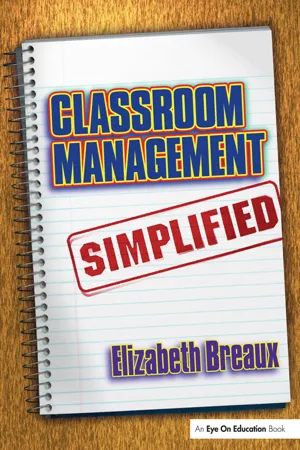
Classroom Management Simplified
About this book
The tips in this book are accompanied by typical classroom scenarios and step-by-step instructions on how to implement them. Also included are actual dialogues to use with your students.
Information
Part I
Procedures for Teachers
In Part I we discuss important procedures for teachers. In addition to an explanation of each procedure there is a section titled “Tips” that explains how to implement that procedure. Also included with each procedure is a typical classroom scenario followed by examples of effective implementation and ineffective implementation.
Read each scenario carefully and remember to laugh as you recognize yourself and some of your peers in these hypothetical cases. Remember that it is only when we can laugh at our own mistakes that we truly grow as professionals. If you are a veteran teacher, you’ve accrued years of laughable (and in some cases embarrassing) memories, some of which you wish you could erase. But don’t forget that they were all valuable tools in the learning process. If you are a new teacher, be aware that you will be creating some laughable moments that will be remembered for years to come! Don’t be so hard on yourself, however. We veterans only pretend that we have never made mistakes.
Procedure 1 for Teachers:
Organize Any Disorganization
If I Survive
I’m certain that I placed it there
I’m looking for it everywhere
Behind the doors and under chairs
Beneath the floor and in the air.
One day I will get organized
Next year sounds good (if I survive)
A better plan I must contrive
I’ll do it tomorrow, if I’m alive!
Elizabeth Breaux
“A place for everything, and everything in its place.” Who said that? Was it my mother, my grandmother, Galileo, Copernicus? Does it really matter? It’s so ingenious yet so basic. Live by it in the classroom, and life will be much less stressful.
An organized environment is a breeding ground for learning. We teachers therefore must become masters of organization if we are to become the masters of our classrooms. Learning cannot take place in a chaotic atmosphere. The bottom line is that if we are disorganized, we cannot command organization from our students. If the teacher is disorganized, the students will follow suit. Ultimately, learning will suffer dramatically. The good news is that the reverse is also true. Students really do love an organized learning environment, but it’s up to the teacher to get the organizational ball rolling.
Organization begins long before the students arrive and continues long after they have “left the building.” Don’t leave the building until you organize your classroom!
Tips for Becoming Organized

Classroom Scenario
At this middle school the school day consists of six one-hour class periods. Students switch classes each hour. Teachers are given one planning period, but the remaining five class periods can be quite hectic, with one class rushing out as another rushes in.
Teacher A
Teacher A signals to her class at 8:58 that the bell will ring in two minutes. She instructs the students to place all materials in the supply boxes. She motions to the materials supervisors to collect the materials and put them in their proper places. She reminds all the students to clear and collect all trash from their spaces. The teacher walks to the door and opens it. The bell rings, and the teacher quickly dismisses each row, beginning with the ones in which all the students have reorganized their spaces and returned all materials to their proper places. The students exit in an orderly fashion. An onlooker would notice that the room is impeccably neat, organized, and ready for the next class to enter (because rows are not dismissed until everything is in place). Miraculously, the teacher had nothing to do with returning the room to its original order (other than training the students to do it for her).
Teacher B
The bells rings, and Teacher B is caught “off guard.” Students are still in groups, and materials are scattered about. There is no obvious procedure for returning materials. Students begin frantically gathering their personal belongings and rushing out of the room. The teacher orders the students not to leave until all the materials have been returned, but few obey the teacher’s “command.” Desks are out of order, and supplies are everywhere. The students are racing to their next classes, and the teacher is frazzled. Unfortunately, another class is arriving, only to be greeted by this mass display of chaos.
The fact is that an organized classroom is free of chaos, and the teacher is basically stress-free. Which classroom would you choose?
Procedure 2 for Teachers:
Plan Well
What Do They Do?
Good teachers love to teach us
There is no doubt about it
They know just how to make a point
And never do they shout it.
They count the minutes till we come
And hate it when we leave
Teaching is their life, we’re sure
From it there’s no reprieve.
We wonder what they really do
When all of us go home
They must just wait around at school
Feeling so alone.
We’re sure that they don’t eat or sleep
Or shop or cook or sew
What do they do while we’re at home?
We’d really like to know!
Elizabeth Breaux
We plan for tomorrow! That’s what we do. There truly is no reprieve. If we’re not te...
Table of contents
- Cover
- Title Page
- Copyright Page
- Dedication
- About the Author
- Foreword
- Table of Contents
- Introduction
- Part I Procedures for Teachers
- Part II Procedures for Teachers and Their Students
- Conclusion
Trusted by 375,005 students
Access to over 1.5 million titles for a fair monthly price.
Study more efficiently using our study tools.
Frequently asked questions
Yes, you can cancel anytime from the Subscription tab in your account settings on the Perlego website. Your subscription will stay active until the end of your current billing period. Learn how to cancel your subscription
No, books cannot be downloaded as external files, such as PDFs, for use outside of Perlego. However, you can download books within the Perlego app for offline reading on mobile or tablet. Learn how to download books offline
Perlego offers two plans: Essential and Complete
- Essential is ideal for learners and professionals who enjoy exploring a wide range of subjects. Access the Essential Library with 800,000+ trusted titles and best-sellers across business, personal growth, and the humanities. Includes unlimited reading time and Standard Read Aloud voice.
- Complete: Perfect for advanced learners and researchers needing full, unrestricted access. Unlock 1.5M+ books across hundreds of subjects, including academic and specialized titles. The Complete Plan also includes advanced features like Premium Read Aloud and Research Assistant.
We are an online textbook subscription service, where you can get access to an entire online library for less than the price of a single book per month. With over 1.5 million books across 990+ topics, we’ve got you covered! Learn about our mission
Look out for the read-aloud symbol on your next book to see if you can listen to it. The read-aloud tool reads text aloud for you, highlighting the text as it is being read. You can pause it, speed it up and slow it down. Learn more about Read Aloud
Yes! You can use the Perlego app on both iOS and Android devices to read anytime, anywhere — even offline. Perfect for commutes or when you’re on the go.
Please note we cannot support devices running on iOS 13 and Android 7 or earlier. Learn more about using the app
Please note we cannot support devices running on iOS 13 and Android 7 or earlier. Learn more about using the app
Yes, you can access Classroom Management Simplified by Elizabeth Breaux,Elizabeth Breaux in PDF and/or ePUB format, as well as other popular books in Education & Classroom Management. We have over 1.5 million books available in our catalogue for you to explore.