This collection pays tribute to Professor Wallace E. Lambert and his contributions to the fields of language and linguistics. Each chapter, written by an internationally renowned theorist or researcher, traces the currents of theory and research within the topic area to the present day, provides a state-of-the-art review of the topic, and offers an outline for future research directions. The book concludes with an overview from Professor Lambert that critically examines the impact of the ideas in each individual chapter.
This volume is organized around the three areas where Professor Lambert's unique contributions are most substantial and most evident: bilingualism, multiculturalism, and second language learning. Specifically, the papers presented discuss the topics of social, psychological, cognitive, and neuropsychological aspects of bilingualism and second language learning, the psychology of inter-group relations and multiculturalism, bilingual/immersion education, and language planning.
Note: Royalties earned from sales of this book will go to the Wallace E. Lambert Student Research Fund at McGill University for use by students interested in second language acquisition, bilingualism, and/or multiculturalism.
eBook - ePub
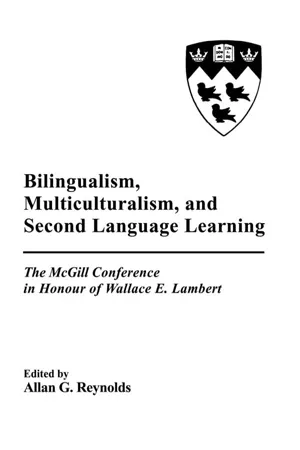
Bilingualism, Multiculturalism, and Second Language Learning
The Mcgill Conference in Honour of Wallace E. Lambert
- 282 pages
- English
- ePUB (mobile friendly)
- Available on iOS & Android
eBook - ePub
Bilingualism, Multiculturalism, and Second Language Learning
The Mcgill Conference in Honour of Wallace E. Lambert
About this book
Information
1 | The Social Psychology of Racial and Cultural Diversity: Issues of Assimilation and Multiculturalism |
McGill University
How newcomers, established ethnic groups, and native peoples accommodate to, and are accommodated by, the dominant group in society is an enduring question that lies at the heart of national unity. Until the early 1960s, in the United States and, to some extent, Canada, politicians and the public alike, supported by theory in the social sciences, envisaged a single inevitable outcome to the integration process—assimilation. But in the middle 1960s (1965 in the USA and 1967 in Canada), dramatic changes in immigration policy placed the integration question at the core of national identity. The policy changes involved removing race and nationality as criteria for qualifying as an acceptable immigrant. The result was a dramatic increase in the number of newcomers from Third World nations, thereby multiplying the mix of colours and very different cultures. The impact was, and is, to test the very limits of human tolerance in terms of dealing with cultural and racial diversity. As we approach the year 2000, politicians, everyday citizens, and social scientists must confront the challenge of understanding the integration process, and of forging a social climate where human diversity and harmony can coexist.
The focus of theory and research on the integration process has revolved around two contrasting ideological positions. At one extreme is assimilation, the belief that cultural groups should give up their “heritage” cultures and take on the host society’s way of life. At the opposite pole is multiculturalism, the view that these groups should maintain their heritage cultures as much as possible.
In this chapter the history of theory and research into racial and cultural diversity will be reviewed in the context of this debate over assimilation and multiculturalism. The debate is truly a multidisciplinary one; to date, sociologists, economists, and political scientists have made the major contributions to the field. Psychology, as a discipline, has only begun to focus on the issues that are central to the debate. The present chapter affords a rare opportunity to review the perspectives of different disciplines in order to place, in a broader context, the direction that psychological theory and research might take.
In the first part of the chapter the preoccupation with an assimilation perspective will be explored. The focus of the next section is on the dramatic shift to a multiculturalism orientation in the form of an almost universal revival of ethnic nationalism. Finally, the current status of these contrasting perspectives is examined, with a view to specifying two key areas that might serve as a focus for social psychological theory and research.
THE PREOCCUPATION WITH ASSIMILATION
The classic assimilationist perspective is presented here not merely for its historical interest but because assimilationist theory in one form or another “continues to be the primary theoretical framework for sociological research” (Hirschman, 1983, p. 401). Assimilationist thinking is captured in the idealized image of the “melting pot,” the title of an influential 1914 Broadway play by Zangwill. The theme was that America is becoming a superior society because of the new product that arises from numbers of cultures and races being stirred and melted in the societal pot.
But the melting pot image points to an important confusion in the definition of assimilation. The implication of the image is that every cultural group contributes to the final product: “American.” Thus every cultural group, old or new, large or small, melts together and the final product is unique, unlike any of the cultural ingredients that went into the pot initially. To quote Zangwill’s play: “Into the crucible with you all! God is making the American.”
This view of assimilation allows for every cultural group to make its unique contribution to the final product. Unfortunately, this egalitarian view is not the meaning usually associated with the assimilationist perspective. The definition, when actually put into theoretical practice, is much more unidirectional, such that cultural groups are expected to give up their heritage culture and adopt the “way of life” of the host culture. In this sense cultural groups do not contribute to the definition of national character. Instead, they are “swallowed up by” or “conform to” the dominant host group. It is this implicitly unidirectional conception of assimilation that guided much of the early theory and research in the field of racial and cultural diversity.
The assimilationist perspective as we have defined it here dominated theory and research until the 1960s. Indeed, this view was so predominant that the focus was not so much on validating assimilation as the end product as it was on theorizing about its course.
For example, Park and Burgess, pioneers in the field who dominated thinking in the early decades of the twentieth century, introduced the “contact hypothesis,” which held that “as social contact initiates interaction, assimilation is its final perfect product” (Park & Burgess, 1969, p. 361). But Park (1950) was much more concerned with the process of assimilation and so hypothesized the race relations cycle that involved four key stages: contact, competition, accommodation, and, finally, assimilation.
Another driving force behind the assimilationist perspective was the fundamental meritocracy ideology that lay at the heart of modernization and industrialization. An economy based on efficiency and productivity with an emphasis on individual effort and ability was incompatible with a society organized in terms of racial and cultural groups (Kerr, Dunlop, Harbison, & Myers, 1964; Myrdal, 1944). That is, the meritocracy ideology emphasizes individual performance as a basis for advancement, and thus racial or cultural affiliation are explicitly discounted as either an advantage or disadvantage for getting ahead in society.
A conceptually more sophisticated view of assimilation was provided by Gordon (1964) who distinguished among seven types of assimilation: cultural, structural, marital, identificational, attitude receptional (prejudice), behavioural receptional (discrimination), and civic. These distinctions allowed for a better understanding of the assimilation process in that not all dimensions of assimilation need, nor indeed would, be expected to proceed at the same pace. Thus, for example, Gordon felt that cultural assimilation proceeds relatively rapidly, but structural assimilation, in terms of the primacy of interactions with one’s own cultural group, evolves at a much slower pace.
Hirschman (1983), in his thoughtful analysis, argued that it is extremely difficult to assess the empirical evidence offered as support for the assimilation perspective. As he noted, given the multidimensional nature of assimilation, trends in the direction of assimilation may vary widely from dimension to dimension. Beyond this, for any given dimension the evidence is likely to be equivocal because the theory is meant to apply to every conceivable group, from the Western European immigrant to visible minorities to native peoples. To highlight the equivocal support for assimilation, Hirschman focussed his review of empirical evidence on four aspects of assimilation: socioeconomic, residential segregation, intermarriage, and attitudes.
The review of the evidence in the economic domain led Hirschman to conclude that “this reading of the evidence on trends in socioeconomic inequality provides general support for the melting pot thesis for European ethnics, but not for black Americans” (p. 406). In terms of residential segregation, he noted that black-white segregation is pervasive, but levels of Hispanic-Anglo segregation are lower and seem to be moderating over time.
Intermarriage is an especially important barometer of assimilation because of the personal and intimate nature of the relationship itself. Unfortunately, the evidence is equivocal. Intermarriage across religious barriers appears to be quite prevalent (see, for example, Alba, 1981); however, mixed racial marriages remain infrequent.
Finally, focussing on intergroup attitudes as an index of assimilation is problematic. There seems to be consistent evidence for a steady decline in racial intolerance over the past few decades. However, there is controversy over the measures used in surveys of racial attitudes (see Taylor, Wright, Moghaddam, & Lalonde, 1990) and there are those who argue that “symbolic racism” has replaced more blatant forms but that in reality little has changed in terms of racism itself (Sears, 1988).
In summary, Hirschman’s (1983) review of the evidence indicates a general pattern that, over time, newcomers do assimilate to the dominant, host culture. The evidence, however, is always equivocal and of such a nature that assimilation theory is never put to the critical test. Where the evidence is contrary to assimilation, theorists in this tradition can claim that the assimilation process is ongoing but as yet incomplete. With more time, they argue, the assimilation process will be completed. Anti-assimilationists argue, of course, that all it requires is one exception to the inevitable drift toward assimilation for the entire theory to be invalidated. Thus, any indication that even one group does not assimilate, or that assimilation does not proceed swiftly on all dimensions, is enough for them to discount assimilation theory.
Psychology and assimilation. The issue of assimilation has never been a major focus for theory and research in the field of psychology and so has not been directly addressed. The two mainstream areas of social psychology that until the mid-1960s most closely related to the present concerns were the areas of interpersonal attraction and ethnic stereotypes. Interestingly, the principles underlying each are entirely consistent with the assimilation perspective. In the field of interpersonal relations the dominant theme was that of a strong relationship between similarity and attraction (e.g., Byrne, 1971; Newcomb, 1961). This relationship holds true across a wide variety of dimensions, including similarity of attitudes, physical attraction, and, of significance for the present context, ethnic group (Kandel, 1978; Simard, 1981). The implication is clear: The type of culturally homogeneous society that arises in the case of pure assimilation is conducive to interpersonal harmony.
In terms of ethnic and racial stereotypes the theme is similar. Stereotypes that reflect cultural differences have been viewed as inferior cognitive processes that are usually wrong (Taylor, 1981; Taylor & Moghaddam, 1987). For this reason psychologists have felt they should be eradicated. Wiping out stereotypes, of course, is consistent with the assimilationist perspective because discounting stereotypes involves denying the cultural differences upon which stereotypes might be built.
THE ETHNIC REVOLUTION
Beginning in the middle 1960s, theory took a dramatic turn. Key social scientists such as Glazer and Moynihan (1970), Greely (1974), and Novak (1972), to name but a few, challenged the assumptions of assimilation, and the “revival of ethnicity” school was born (Hirschman, 1983). Labels such as ethnic diversity, pluralism, and multiculturalism surfaced, and romantic images such as mosaic, tossed salad, and patchwork quilt replaced the melting pot image.
But this revival was not one spearheaded by social scientists. Rather, it was everyday people struggling with the concrete realities of “getting ahead” in society who made phrases such as Black power, Red power, Hispanic, Latino, Québecois, anglophone, allophone, and every conceivable ethnic label a part of North American vocabulary. What really confronted the political and academic establishment was the reality that ethnicity would not go away. The ethnic revolution was especially surprising in North America because all of the conditions that should favour assimilation were present. North America offered newcomers a chance to escape political and economic oppression, the potential for equality of opportunity, and above all, freedom. The only requirement seemed to be that the individual give up the “old” ways and make a commitment to the new national identity. Despite all these forces favouring assimilation, cultural identity persisted, and indeed was becoming more prevalent. Heritage culture, it seems, would not or could not be assimilated.
The ethnic revolution was reflected at both the political and academic levels. Politically in Canada, for example, it gave rise to an official policy of multiculturalism in 1971 whereby ethnic groups would be encouraged to retain their heritage culture and language. Evidence in both the United States (e.g., Glazer & Moynihan, 1970; Greely, 1974) and Canada (Berry, Kalin, & Taylor, 1977; O’Bryan, Reitz, & Kuplowska, 1976) supported the view that ethnic groups were motivated to retain their heritage culture, and indeed that majority groups were mildly receptive to heritage culture maintenance.
This new multiculturalism perspective that had been dominated by sociologists and political scientists began to intrigue psychologists like Lambert who had been working extensively in the field of bilingualism. Lambert (1981, 1984; Lambert & Tucker, 1972) was aware early in his research on second language learning that language and culture were intimately connected. His theory was that bilingualism could be an additive process, one that afforded the individual a dual perspective rather than a confined or incomplete intellectual and social development. And he believed bilingualism was achievable by all.
For Lambert, what was true for language should be equally applicable to culture. Hence he argued that multiculturalism could be a reality that allowed the person to retain his or her heritage culture while at the same time being culturally sophisticated in terms of the host society. Lambert believed that, as with bilingualism, the acquisition of a new culture would breed respect for that culture, and vice versa.
As a psychologist, naturally Lambert’s focus was on the implications of multiculturalism from the individual’s perspective. The multiculturalism theme also influenced two other social psychologists at about the same time. Berry (1987) conceptualized the integration process as one that resulted from two separate attitudes, the individual’s attitude toward the heritage culture and his or her attitude toward the host culture. Assimilation, according to Berry’s scheme, arises when the individual has a positive attitude toward the host culture and a negative attitude toward the heritage culture. Multiculturalism, or what Berry labelled as integration, is characterized by a positive attitude toward both the host and heritage culture.
In the same vein, Taylor and his colleagues (Taylor, 1981; Taylor & Lalonde, 1987; Taylor & Simard, 1979) were redefining the traditional social psychological concept of the ethnic stereotype. Consistent with an assimilation ideology, racial and ethnic stereotypes had traditionally been defined as undesirable, oversimplified images of a group; in other words, they are the prototype of prejudice. Taylor argued that stereotypes are a normal cognitive process that need not be socially undesirable. Specifically, where there are two groups, each having an auto-stereotype and a stereotype of the other group, two conditions are required for a pattern of stereotypes to be socially desirable. First, each group must positively value the attributes they associate with their own group, and second, each group must respect the attributes that are stereotypic of the other group. Taylor (1981) desc...
Table of contents
- Cover
- Title Page
- Copyright Page
- Dedication
- Table of Contents
- Preface
- Biographical Sketches of Contributors
- A Few Words about Wallace E. Lambert
- 1. The Social Psychology of Racial and Cultural Diversity: Issues of Assimilation and Multiculturalism
- 2. Language Attitudes: Discursive, Contextual, and Gerontological Considerations
- 3. Attitudes and Motivation in Second Language Learning
- 4. Developing a Language-Competent American Society: The Role of Language Planning
- 5. Neuropsychological Perspectives on Bilingualism: Right, Left, and Center
- 6. Mental Representation in Bilinguals
- 7. L’ontogénèse de la bilingualité: Dimensions sociales et trans-culturelles
- 8. The Cognitive Consequences of Bilingualism
- 9. Second Language Learning in School Settings: Lessons from Immersion
- 10. Additive Bilingualism and French Immersion Education: The Roles of Language Proficiency and Literacy
- 11. “And Then Add Your Two Cents’ Worth”
- Author Index
- Subject Index
Trusted by 375,005 students
Access to over 1.5 million titles for a fair monthly price.
Study more efficiently using our study tools.
Frequently asked questions
Yes, you can cancel anytime from the Subscription tab in your account settings on the Perlego website. Your subscription will stay active until the end of your current billing period. Learn how to cancel your subscription
No, books cannot be downloaded as external files, such as PDFs, for use outside of Perlego. However, you can download books within the Perlego app for offline reading on mobile or tablet. Learn how to download books offline
Perlego offers two plans: Essential and Complete
- Essential is ideal for learners and professionals who enjoy exploring a wide range of subjects. Access the Essential Library with 800,000+ trusted titles and best-sellers across business, personal growth, and the humanities. Includes unlimited reading time and Standard Read Aloud voice.
- Complete: Perfect for advanced learners and researchers needing full, unrestricted access. Unlock 1.5M+ books across hundreds of subjects, including academic and specialized titles. The Complete Plan also includes advanced features like Premium Read Aloud and Research Assistant.
We are an online textbook subscription service, where you can get access to an entire online library for less than the price of a single book per month. With over 1.5 million books across 990+ topics, we’ve got you covered! Learn about our mission
Look out for the read-aloud symbol on your next book to see if you can listen to it. The read-aloud tool reads text aloud for you, highlighting the text as it is being read. You can pause it, speed it up and slow it down. Learn more about Read Aloud
Yes! You can use the Perlego app on both iOS and Android devices to read anytime, anywhere — even offline. Perfect for commutes or when you’re on the go.
Please note we cannot support devices running on iOS 13 and Android 7 or earlier. Learn more about using the app
Please note we cannot support devices running on iOS 13 and Android 7 or earlier. Learn more about using the app
Yes, you can access Bilingualism, Multiculturalism, and Second Language Learning by Allan G. Reynolds in PDF and/or ePUB format, as well as other popular books in Personal Development & History & Theory in Psychology. We have over 1.5 million books available in our catalogue for you to explore.