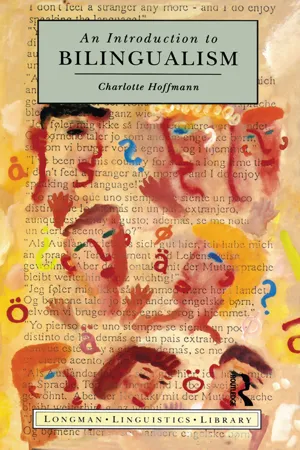
An Introduction to Bilingualism provides a comprehensive review of the most important aspects of individual and societal bilingualism, examining both theoretcial and practical issues.
At the level of the individual, it addresses such questios as: What is involved in the study of bilingual children? What are the patterns of bilingual language acquisition? In which ways do the language competence and the speech of bilinguals differ from those of monolinguals? Topics that sometimes arouse controversy are explored - such as the question of whether there is a relationship between bilingualsim and a child's cognitive, psychological and social development.
The book is also concerned with multilingualism, that is, bilingualsim as a societal phenomenon. It focuses on such issues as language choice in bilingual and multilingual communities, national identity and the education of bilinguals. The inclusion of several case studies of European linguistic minorities serves to exemplify the topics dealt with at the theoretical level and to illustrate the linguistic complexities found in contemporary Europe.
- 368 pages
- English
- ePUB (mobile friendly)
- Available on iOS & Android
eBook - ePub
Introduction to Bilingualism
About this book
Information
PART I
PSYCHOLINGUISTIC ASPECTS OF BILINGUALISM
Chapter 1
Individual bilingualism
1.1 Societal and individual bilingualism
When looking through introductions to the study of bilingualism one sees that it is often mentioned that over half the population of the world is bilingual. Such general statements are open to different interpretations, in view of the fact that patterns of language use found in bilingual communities can be quite varied and that many are changing even as we observe them.
Statistics can mislead, particularly when they do not distinguish between societies and individuals, as there is a fundamental difference between societal and individual bilingualism. We may say that India, Switzerland and Belgium are multilingual countries, that Canada is officially bilingual, as is Finland, or that Paraguay is an example of bilingualism and diglossia, and Luxembourg one of triglossia. In such contexts the labels ‘bilingual’ and ‘multilingual’ reflect official policies towards some, or all, of the countries’ minorities. On the whole, however, they say nothing about the degree or the extent of bilingualism among the inhabitants of these areas. It is only when language planning policies find their way into a nation’s education system with the explicit aim of fostering bilingualism (rather than promoting the majority or the minority language) that bilingualism may be the norm in such parts of the world. Of the countries mentioned above, individual bilingualism may be widespread only in Luxembourg and Paraguay. Mackey (1970) claims that there are actually fewer bilingual people in bilingual countries than there are in so-called unilingual ones, and he points out that the main concern of multilingual states has often been the guaranteed maintenance and use of two or more languages in the same nation, rather than the promotion of bilingualism among its citizens. This observation is particularly relevant in the non-European context, since in western Europe we find only three states which are officially multilingual, Belgium, Switzerland and Finland, and the first two pursue policies of territorial monolingualism (see Chapter 8).
In this part of the book attention focuses on the bilingual speaker as the ‘locus of language contact’ (Weinreich 1968: 1). Naturally, language interaction involves communication in a wider sociocultural setting. We therefore need to bear in mind certain aspects of the context in which the bilingual finds herself or himself, as this provides us with information about the ways in which the two or more languages form part of the person’s everyday life. Equally, it may be relevant to take note of psychological factors that may influence, or affect in some way, the linguistic behaviour of the bilingual, just as one must also be aware that neurological, pathological and general cognitive factors can come into play.
1.2 Describing bilingualism
The most salient feature of bilingualism is that it is a multi-faceted phenomenon. Whether one is considering it at a societal or an individual level, one has to accept that there can be no clear cut-off points. As bilingualism defies delimitation, it is open to a variety of descriptions, interpretations and definitions. We can consider some examples. In Britain people do not usually think of Wales as a bilingual part of the state, yet one does happily use the label ‘bilingual’ when referring to certain types of schools found in the principality. Many people would readily call ‘bilingual’ the two-year-old child of a French-English couple, and the fact that the toddler’s vocabulary may consist of some 200 French and English items in all does not seem to be of importance. Similarly, size of vocabulary may not carry much weight in the case of a graduate in French, who may have spent a considerable amount of time in France and studying the language, and whose total lexicon will be several hundred times larger than the child’s. This person is not, however, often thought of as a ‘bilingual’, and would not normally claim the label for himself or herself. ‘Multi-cultural’ and ‘multi-ethnic’ are adjectives freely used by many people in the English-speaking world, and the children who start school in the UK with little knowledge of English may be referred to as ‘minority children’ or ‘ESL (English as a second language) pupils’, but not as ‘bilinguals’. Why should all this be so?
1.2.1 Some definitions of bilingualism
The notion of bilingualism is firmly established in the mind of the lay person. It may be tinged with bias, and it frequently carries either positive or negative connotations. In the specialist’s mind the concept is also well established. However, the latter is expected to apply objective criteria and to aim for precise delineations. Yet some of the definitions of bilingualism that have been put forward are surprisingly vague, and even contradictory.
Uriel Weinreich, one of the founding fathers of bilingual studies and a bilingual himself, offers one of the shortest definitions in his well-known book Languages in Contact: ‘The practice of alternately using two languages will be called bilingualism, and the person involved, bilingual.’ (Weinreich 1968: 1).
An oft-quoted definition is found in one of the early books on modern linguistics, Leonard Bloomfield’s Language, first published in the USA in 1933. When mentioning that foreign language learning among immigrants may result in language shift, Bloomfield pays special attention to users who become so proficient in the new language that they are indistinguishable from the native speakers around them. He says:
In the cases where this perfect foreign-language learning is not accompanied by loss of the native language, it results in ‘bilingualism’, native-like control of two languages. After early childhood few people have enough muscular and nervous freedom or enough opportunity and leisure to reach perfection in a foreign language; yet bilingualism of this kind is commoner than one might suppose, both in cases like those of our immigrants and as a result of travel, foreign study, or similar association. Of course, one cannot define a degree of perfection at which a good foreign speaker becomes a bilingual: the distinction is relative.(Bloomfield 1933: 55–6)
No doubt Bloomfield had a clear notion of bilingualism, but his definition and subsequent qualifying remarks are not without some degree of contradiction: if one cannot define ‘a degree of perfection’ in bilingualism, how can we talk of ‘perfect foreign-language learning’?
In his article The description of bilingualism’, William Mackey offers a definition that incorporates Weinreich’s alternate use of two languages and is preceded by Bloomfield’s reservation with respect to the degree of proficiency:
It seems obvious that if we are to study the phenomenon of bilingualism we are forced to consider it as something entirely relative. We must moreover include the use not only of two languages, but of any number of languages. We shall therefore consider bilingualism as the alternate use of two or more languages by the same individual.(Mackey 1970: 555)
1.2.2 Some types of bilinguals
The three definitions mentioned so far say nothing about how well the languages need to be known, whether both have to be mastered in all sorts of skills, whether they must be used in similar or different situations, or about any particular requirements regarding the uses to which the languages are put. Yet such considerations would probably be relevant in deciding whether any, or all, of the following should be considered as bilinguals:
(1) the two-year-old who is beginning to talk, speaking English to one parent and Welsh to the other;
(2) the four-year-old whose home language is Bengali and who has been attending an English playgroup for some time;
(3) the schoolchild from an Italian immigrant family living in the United States who increasingly uses English both at home and outside but whose older relatives address him in Italian only;
(4) the Canadian child from Montréal who comes from an English-speaking background and attends an immersion programme which consists of virtually all school subjects being taught through the medium of French;
(5) the young graduate who has studied French for eleven years;
(6) the sixty-year-old scholar who has spent a considerable part of her life working with manuscripts and documents written in Latin;
(7) the technical translator;
(8) the personal interpreter of an important public figure;
(9) the Portuguese chemist who can read specialist literature in his subject written in English;
(10) the Japanese airline pilot who uses English for most of his professional communication;
(11) the Turkish immigrant worker in the Federal Republic of Germany who speaks Turkish at home and with his friends and work colleagues, but who can communicate in German, in both the written and the oral forms, with his superiors and the authorities;
(12) the wife of the latter, who is able to get by in spoken German but cannot read or write it;
(13) the Danish immigrant in New Zealand who has had no contact with Danish for the last forty years;
(14) the Belgian government employee who lives in bilingual Brussels, whose friends and relatives are mainly Flemish speakers but who works in an entirely French-speaking environment and whose colleagues in the office (whether they are Flemish or not) use French as well;
(15) the fervent Catalanist who at home and at work uses Catalan only, but who is exposed to Castilian Spanish from the media and in the street and has no linguistic difficulty in the latter language.
So what is bilingualism? Many specialists would say that all the above individuals could be classed as bilinguals; but public opinion, and at least some of these people themselves, would probably disagree. It is possible to think of a number of explanations for the difficulties involved in arriving at a precise definition. The elusiveness of the phenomenon has already been referred to. Another factor is the nature of the subject itself. Language use is part of human behaviour, and as such not readily accessible to scientific investigation and experimental research. The study of bilingualism is hampered by a host of methodological problems and theoretical shortcomings. These difficulties stem from the complex interplay and variability of social, psychological and chance factors which determine individual conduct – and therefore often render generalizations invalid. Research into bilingualism is, consequently, interdisciplinary in character, as scholars from different academic fields, such as sociology, psychology, linguistics, anthropology and education (and others) bring different methods, criteria and assumptions to bear upon studies of bilingual situations.
‘Bilingualism as a concept has open-ended semantics’, Hugo Baetens Beardsmore (1982: 1) points out at the beginning of his comprehensive discussion of a number of different definitions of bilingualism. Ultimately, all definitions are arbitrary to a greater or lesser extent. It is not necessarily a problem, therefore, that there are so many of them, since in this way the researcher is able to choose the one that best suits her or his purpose.
1.2.3 Factors taken into account when describing bilingualism
One of Baetens Beardsmore’s contributions to the subject under discussion is his exposition of a series of descriptive labels, which have been chosen by various specialists so as to provide a frame of reference. There are many and different areas around which the study of bilingualism can be centred; some of them are fairly clear-cut, whereas others are not. The following list contains some selected examples (a fuller discussion of the issues involved can be found, for instance, in Baetens Beardsmore 1982 or in Skutnabb-Kangas 1984a).
(1) The age of the bilingual at the time of the acquisition may result in considerable differences, as suggested by the terms ‘early bilingualism’ and ‘late bilingualism’. An early bilingual may be a case of ‘infant bilingualism’ (Haugen 1956: 72) or of ‘child bilingualism’. The cut-off point is not firmly established, but it can be set arbitrarily (see, for example, McLaughlin 1984: 73) at the age of three – and between the child bilingual and the case of ‘adult bilingualism’ at the age of puberty. Tove Skutnabb-Kangas’s (1984a: 80 ff.) analysis of definitions of bilingualism recognizes four main types. Her first type comes under the heading of ‘origin’, which at this stage can be taken to correspond with ‘age’. This factor, however, is...
Table of contents
- Cover Page
- Half Title page
- Longman Linguistics Library: Series List
- Title Page
- Copyright Page
- Contents
- List of maps
- Preface
- Dedication
- Introduction
- Part I Psycholinguistic Aspects of Bilingualism
- Part II Sociolinguistic Aspects of Bilingualism
- Appendix
- References
- Subject Index
- Index of Places, Languages and Peoples (including linguistic minorities and minority areas)
- Author Index
Trusted by 375,005 students
Access to over 1.5 million titles for a fair monthly price.
Study more efficiently using our study tools.
Frequently asked questions
Yes, you can cancel anytime from the Subscription tab in your account settings on the Perlego website. Your subscription will stay active until the end of your current billing period. Learn how to cancel your subscription
No, books cannot be downloaded as external files, such as PDFs, for use outside of Perlego. However, you can download books within the Perlego app for offline reading on mobile or tablet. Learn how to download books offline
Perlego offers two plans: Essential and Complete
- Essential is ideal for learners and professionals who enjoy exploring a wide range of subjects. Access the Essential Library with 800,000+ trusted titles and best-sellers across business, personal growth, and the humanities. Includes unlimited reading time and Standard Read Aloud voice.
- Complete: Perfect for advanced learners and researchers needing full, unrestricted access. Unlock 1.5M+ books across hundreds of subjects, including academic and specialized titles. The Complete Plan also includes advanced features like Premium Read Aloud and Research Assistant.
We are an online textbook subscription service, where you can get access to an entire online library for less than the price of a single book per month. With over 1.5 million books across 990+ topics, we’ve got you covered! Learn about our mission
Look out for the read-aloud symbol on your next book to see if you can listen to it. The read-aloud tool reads text aloud for you, highlighting the text as it is being read. You can pause it, speed it up and slow it down. Learn more about Read Aloud
Yes! You can use the Perlego app on both iOS and Android devices to read anytime, anywhere — even offline. Perfect for commutes or when you’re on the go.
Please note we cannot support devices running on iOS 13 and Android 7 or earlier. Learn more about using the app
Please note we cannot support devices running on iOS 13 and Android 7 or earlier. Learn more about using the app
Yes, you can access Introduction to Bilingualism by Charlotte Hoffmann in PDF and/or ePUB format, as well as other popular books in Languages & Linguistics & Linguistics. We have over 1.5 million books available in our catalogue for you to explore.