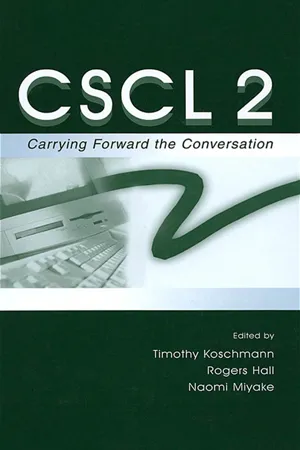
CSCL 2: Carrying Forward the Conversation is a thorough and up-to-date survey of recent developments in Computer Supported Collaborative Learning, one of the fastest growing areas of research in the learning sciences. A follow-up to CSCL: Theory and Practice of an Emerging Paradigm (1996), this volume both documents how the field has grown and fosters a meaningful discussion of how the research program might be advanced in substantive ways.
Recognizing the long-standing traditions of CSCL work in Europe and Japan, the editors sought to broaden and expand the conversation both geographically and topically. The 45 participating authors represent a range of disciplinary backgrounds, including anthropology, communication studies, computer science, education, psychology, and philosophy, and offer international perspectives on the field. For each chapter, the goal was not only to show how it connects to past and future work in CSCL, but also how it contributes to the interests of other research communities. Toward this end, the volume features a "conversational structure" consisting of target chapters, invited commentaries, and author responses. The commentaries on each chapter were solicited from a diverse collection of writers, including prominent scholars in anthropology of education, social studies of science, CSCW, argumentation, activity theory, language and social interaction, ecological psychology, and other areas.
The volume is divided into three sections:
*Part I explores four case studies of technology transfer involving CSILE, one of the most prominent CSCL projects.
*Part II focuses on empirical studies of learning in collaborative settings.
*Part III describes novel CSCL technologies and the theories underlying their design.
Historically, there has been a certain amount of controversy as to what the second "C" in CSCL should represent. The conventional meaning is "collaborative" but there are many C-words that can be seen as relevant. With the publication of this volume, "conversational" might be added to the list and, in this spirit, the book might be viewed as an invitation to join a conversation in progress and to carry it forward.
- 592 pages
- English
- ePUB (mobile friendly)
- Available on iOS & Android
eBook - ePub
About this book
Trusted by 375,005 students
Access to over 1 million titles for a fair monthly price.
Study more efficiently using our study tools.
Information
Topic
EducationSubtopic
Education TechnologyTECHNOLOGIES FOR COLLABORATION AND LEARNING
Becoming More Articulate about the Theories that Motivate our Work
Southern Illinois University
In the closing panel at CSCL ‘97 Roy Pea (2000) called upon us to make explicit in our work “the relation between theory, research, methodology, conclusions, [and] implications.” This is good advice, if not always put into practice, for all researchers. It is of special importance, however, for those of us who work in the still developing field of CSCL. It is critical that we strive to be more articulate about the theories that underlie and motivate the designs of our technological artifacts, pedagogical activities, and assessment methods. For this reason, we examine four projects in this section, focusing on the theories underlying the design and evaluation work described. In keeping with the conversational theme of the book, commentaries were solicited for each chapter from a range of researchers with different areas of specialization. Though each of these chapters raises multiple issues for consideration, I focus only on a single issue for each.
Continuity and Interaction in Participatory Simulations
Vanessa Colella begins her chapter by posing the question, “What should count as a worthwhile educational experience?” To begin to formulate an answer, she turns to the American pragmatist philosopher John Dewey. Dewey (1939/1991) wrote, “Continuity and interaction in their active union with each other provide the measure of the description of the educative significance and value of an experience” (p. 26). To understand Dewey’s approach to evaluating an educational experience, therefore, we need to appreciate his paired principles of continuity and interaction.
Describing the principle of continuity, Dewey (1939/1991) observed “every experience both takes up something from those that have gone before and modifies in some way the quality of those which come after” (p. 19). Garrison and Scheckler in their commentary on Colella’s chapter point out that continuity arises from habits. They write, “Beliefs, for Dewey, are habits and habits are embodied dispositions to act evincing emotions.” Colella proposes that consideration be given to two aspects of continuity when evaluating educational experiences, namely “appropriateness, based upon an understanding of the person entering the experience, and educative value, based upon the directions that it propels that person.” Educative value, in turn, must be judged on the basis of the potential for growth on the part of the learner. Garrison and Scheckler write, “Growth means living a life of expanding capacity, meaning, and value.”
As described by Dewey (1939/1991), the principle of interaction “assigns equal rights to both factors in experience—objective and internal conditions. Any normal experience is an interplay of these two sets of conditions. Taken together, or in their interaction, they form what we call a situation” (p. 24). The term situation is used in a special sense here. For Dewey, situations “are instances or episodes (or ‘fields’) or disequilibrium, instability, imbalance, disintegration, disturbance, dysfunction, breakdown, etc. “that occur” in the ongoing activities of some given organisim/environment system” (Burke, 1994, p. 22). The notion of inquiry, so central to Dewey’s later writing, is closely bound to situations defined in this way. In fact, Dewey (1941/1991) defined inquiry as “the set of operations by which the situation is resolved (settled, or rendered determinate)” (p. 181). Colella writes, “In order for an experience to have educative value, it must be initially problematic in some way, spurring learners on to disambiguate their situation through inquiry.” As discussed by Hall (1996), the principles of continuity and interaction are not independent but rather should be viewed metaphorically as paired coordinates of an experience.
Colella’s chapter presents a particular form of educational experience to be evaluated using these Deweyan criteria. Colella, once a high school science teacher herself, designed an instructional activity she terms “Participatory Simulations” to engage students in a form of scientific inquiry. A crucial part of the simulation is a bit of technology known as “Thinking Tags”; these are programmable badges used to simulate the spread of disease within a population. Each participant is issued one such badge. One or more badges contain a “virus” at the beginning of the simulation that is communicable from badge to badge when participants “meet.” The object for participants is to collaboratively develop a method for analytically determining the origins of the disease and how it was spread.
The task that Colella set for herself, that of applying Dewey’s criteria to this particular educational activity, is a daunting one. What would count as compelling evidence that the badge simulation (or any other educational intervention) was appropriately matched to the participants’ prior beliefs and habits? How could we judge whether the experience was growth producing in the sense described earlier? And most critically, how do we determine whether or not the participants authentically experience the situation as problematic? Clearly no simple pre-test/post-test evaluation will provide the answers. Garrison, whose work is primarily in educational philosophy (e.g., Garrison, 1995), and Scheckler raise an important issue with respect to design: Can true Deweyan inquiry be produced through “rule-constrained role-playing activities”? David Hammer, an educational psychologist with interests in classroom discourse (e.g., Hammer, 1995), raises a different issue pertaining to method: How do we begin to describe the discursive practices of teachers that lead to the social construction that Dewey labeled as inquiry? While no definitive answers are provided here, this chapter and its associated commentaries provide us with a lovely set of questions to ponder and pursue.
Reflexive Awareness in Video-Mediated Collaboration
The second chapter in this section, by Hiroshi Kato and coauthors, describes an experiment using the AlgoBlock system. AlgoBlocks (Suzuki & Kato, 1995) are a set of manipulatives that enable groups of programmers to collaboratively construct computer code. Each block corresponds to an instruction in the Algol programming language. In the experiment described here, a remotely located instructor guides a group of university students through a programming task. The authors trained two cameras on the instructor, one on his face, the other capturing the movement of his hands. The study involved placing monitors displaying the instructor’s face and hands in different locations in the room and analyzing how these arrangements were used differentially by the students while performing their task. Our reflexive awareness of others’ gaze and bodily orientations is the fundamental focus of study here, but one that raises critical questions of a methodological sort. Specifically, how do we go about conducting rigorous analyses of participants’ awareness in observed situations? As noted by the authors, awareness is closely related to notions of intersubjectivity as discussed by ethnomethodologists (e.g., Heritage, 1984) and mutual orientation as studied by conversation analysts (Goodwin, 1986). The authors of the chapter, therefore, turn to these fields for methodological guidance.
Randy Smith, in the first commentary on this chapter, notes that “an assessment of another’s visual field happens with such speed and ease that it has the invisibility of the taken for granted.” Smith has done considerable research of his own with regard to mutual awareness among interactants (e.g., Smith, O’Shea, O’Malley, Scanlon, & Taylor, 1991) and he reminds us here of some of the complexities involved in studying such matters. The second commentary was provided by Curt LeBaron, whose expertise is in research on language and social interaction, specializing in gesture and how people employ their bodies in communication (cf., LeBaron & Streek, 2000). He calls here for a general reassessment of the underlying models of communication employed by CSCL researchers. The third and final commentary was written by Charles Crook, author of what is considered by many to be a classic treatise on CSCL (Crook, 1994). He cautions us that in studying mutual understanding we not rely too heavily on what can be observed in the moment (i.e., talk, gesture, gaze). Crook writes, “If it is hard for us to take account of the reflexive nature of communication as manifested in the visual detection of gesture and posture…then it is surely hard for us to take account of the more subtle reflexive forms that arise from shared histories.” All would agree, therefore, with his closing observation that the authors of this chapter have provided us with a “generous arena” for further exploration.
Procedural Facilitation of Scientific Argumentation
Procedural facilitation has been a central topic of research and theorizing in CSCL since the early days. Scardamalia, Bereiter, McLean, Swallow, and Woodruff (1989) described it in these terms:
[Procedural facilitation] is a theory based approach to providing learners with temporary supports while they are trying to adopt more complex strategies. These supports include turning normally covert processes into overt procedures; reducing potentially infinite sets of choices to limited, developmentally appropriate sets; providing aids to memory; and structuring procedures so as to make it easier to escape from habitual patterns. A cardinal principle is that these supports should be designed so that when they are withdrawn the learner is carrying out the mature process independently. Thus it is essential that design of procedural facilitations be based on adequate models of the mature process, and that it also be informed by models of the immature process,
(p. 54)
Philip Bell’s chapter applies this notion to the development of skills for scientific argumentation.
He describes the rationale behind the development of a particular piece of software, the SenseMaker argumentation tool. Unlike what Bell describes as “discussion-based tools,” such as CSILE, that impose a structure on group exchanges, SenseMaker is designed to “support a more rhetorical construction of arguments by individuals.” The SenseMaker interface uses evidence dots and claim frames as the primitives from which students are expected to construct personalized perspectives on science-related issues. Evidence dots can be dragged into claim frames and can be color coded to reflect students’ assessments of the contributions of particular pieces of evidence to particular claims. Claim frames can be hierarchically nested to construct larger arguments. An external software component enables learners to elaborate on their arguments and provide explanations.
Bell’s work rests on a theory of scientific inquiry attributed to Koslowski (1996) whereby scientific inquiry is viewed as a process of coordinating emerging evidence with an existing set of theories. Past research (Kuhn, 1991) has shown that children and even many adults find this difficult to do. The purpose of SenseMaker, in Bell’s terms, is to make “thinking visible,” that is, to make the normally covert process of argument construction into an overt procedure. This raises a host of questions, however. Are these the right sort of developmentally appropriate supports for the desired forms of argumentation? Do students actually employ them as useful tools in constructing their arguments? And finally, but perhaps most importantly, do students develop new habits for thinking as a result of their experiences using the SenseMaker tool; that is, are they more likely to be skillful at coordinating evidence and theory in the future? Settings in which learners are called upon to collaboratively produce arguments are valuable sites for exploring these basic and applied questions. Bell seeks evidence of procedural facilitation, for example, in the transcripts of the presentations made by students at the conclusion of their unit of study.
Richard Duschl, a researcher in science education (cf., Duschl & Hamilton, 1998; Gitomer & Duschl, 1998), takes issue with two aspects of the design of the SenseMaker tool. He argues, first, that the program depends too heavily on web-based resources for student argument construction and, in so doing, neglects other possible resources such as the past understandings the students bring to the situation. Second, scientific reasoning seems to entail more than simply coordinating theory and evidence. According to Duschl, it involves prediction of new findings from theory, constructing connections among theories, and the development of new ways of representing and communicating scientific models. Though he applauds the contributions made by Bell and colleagues, he sees need for additional work in this area.
A second commentary was provided by Mark Felton and Deanna Kuhn, who do research on the development of argumentation skills (cf. Kuhn, 1991). They acknowledge the value of tools such as SenseMaker in facilitating comparison of student-generated arguments and speculate that such forms of facilitation may contribute to the development of skills for “alternatives-based” argumentation (Kuhn, Shaw, & Felton, 1997). They warn, however, that participation in a single experience, such as the project described by Bell, may not be adequate for developing those skills. Bell provides a response to both commentaries.
Establishing a Frame of Analysis for Studying Mobile Computing
The final chapter by Geraldine Gay, Robert Rieger, an...
Table of contents
- Cover
- Halftitle
- Title
- Copyright
- Contents
- Contributors
- Series Editors’ Comments
- Preface
- I Case Studies of Technology Transfer: Realizations of CSCL Conversations: Technology Transfer and the CSILE Project
- II Empirical Studies of Learning in Collaborative Settings: Collaboration and Learning as Contingent Responses to Designed Environments
- III Technologies for Collaboration and Learning: Becoming More Articulate about the Theories that Motivate our Work
- Author Index
- Subject Index
Frequently asked questions
Yes, you can cancel anytime from the Subscription tab in your account settings on the Perlego website. Your subscription will stay active until the end of your current billing period. Learn how to cancel your subscription
No, books cannot be downloaded as external files, such as PDFs, for use outside of Perlego. However, you can download books within the Perlego app for offline reading on mobile or tablet. Learn how to download books offline
Perlego offers two plans: Essential and Complete
- Essential is ideal for learners and professionals who enjoy exploring a wide range of subjects. Access the Essential Library with 800,000+ trusted titles and best-sellers across business, personal growth, and the humanities. Includes unlimited reading time and Standard Read Aloud voice.
- Complete: Perfect for advanced learners and researchers needing full, unrestricted access. Unlock 1.4M+ books across hundreds of subjects, including academic and specialized titles. The Complete Plan also includes advanced features like Premium Read Aloud and Research Assistant.
We are an online textbook subscription service, where you can get access to an entire online library for less than the price of a single book per month. With over 1 million books across 990+ topics, we’ve got you covered! Learn about our mission
Look out for the read-aloud symbol on your next book to see if you can listen to it. The read-aloud tool reads text aloud for you, highlighting the text as it is being read. You can pause it, speed it up and slow it down. Learn more about Read Aloud
Yes! You can use the Perlego app on both iOS and Android devices to read anytime, anywhere — even offline. Perfect for commutes or when you’re on the go.
Please note we cannot support devices running on iOS 13 and Android 7 or earlier. Learn more about using the app
Please note we cannot support devices running on iOS 13 and Android 7 or earlier. Learn more about using the app
Yes, you can access Cscl 2 by Timothy Koschmann,Rogers P. Hall,Naomi Miyake in PDF and/or ePUB format, as well as other popular books in Education & Education Technology. We have over one million books available in our catalogue for you to explore.