This book stimulates thinking on the topic of detrimental environmental change and how research psychologists can help to address the problem. In addition to reporting environmentally relevant psychological research, the author identifies the most pressing questions from an environmental point of view. Psychology and Environmental Change:
*focuses on ways in which human behavior contributes to the problem;
*deals with the assessment and change of attitudes and with studies of change of behavior;
*proposes ways in which psychological research can contribute to making technology and its products more environmentally benign; and
*introduces topics such as consumption, risk assessment, cost-benefit and tradeoff analyses, competition, negotiation, and policymaking, and how they relate to the objective of protecting the environment.
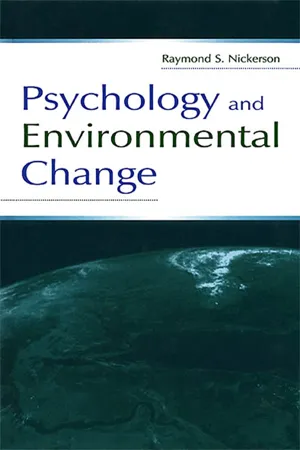
- 336 pages
- English
- ePUB (mobile friendly)
- Available on iOS & Android
eBook - ePub
Psychology and Environmental Change
About this book
Information
Publisher
Psychology PressYear
2002Print ISBN
9780805840971
9780805840964
Edition
1eBook ISBN
9781135638900
CHAPTER 1
Introduction
The problem of environmental change—especially environmental change that results directly from human behavior—is among the more serious problems we face as individuals, as a nation, and as a species. At least I believe that to be the case, which is my reason for writing this book. I believe further that there are many significant opportunities and challenges for work by applied psychologists in this problem area. What I hope to do here is stimulate thinking on the topic of detrimental environmental change and especially on the question of how research psychologists could help address the problem—to add my voice to those of others (e.g., Gardner & Stern, 1996; Geller, Winett, & Everett, 1982; Howard, 2000; R.Olson, 1995; Oskamp, 2000; Stern, 2000) who have expressed their belief that psychology has something to contribute to the cause of environmental protection. Because environmental psychology is an established field of psychological research, it seems appropriate to begin by saying how the focus of this book relates to that field.
ENVIRONMENTAL PSYCHOLOGY
Environmental psychology has been recognized as a field of psychological research since the late 1960s (Altman, 1975; Craik, 1970, 1973; Heimstra & McFarling, 1974; Proshansky, Ittelson, & Rivlin, 1976; Stokols, 1977, 1978). Environmental ergonomics is also becoming recognized as a subfield within ergonomics or human-factors research (Mekjavik, Banister, & Morrison, 1988). Russell and Ward (1982) defined environmental psychology as “that branch of psychology concerned with providing a systematic account of the relationship between person and environment” (p. 652). As Stokols (1978) pointed out, the boundaries of the area are not easily delimited because “the study of human behavior in relation to the environment, broadly speaking, would seem to encompass all areas of psychology” (p. 254).
For the most part, the focus of work has been on the question of how people perceive and react to their immediate surroundings; this is seen in the subtitle of Proshansky, Ittelson, and Rivlin’s (1976) edited volume; Environmental Psychology: People and Their Physical Settings. It is also seen too in a comment in the first Annual Review of Psychology chapter on Environmental Psychology:
The novel value of man-environment studies for such professionals as architects, environmental planners, and natural resources managers lies in its systematic analysis of the human behavior that occurs in and responds to the environmental settings they plan, design, and manage. For psychologists, its distinctive attraction is just the opposite, namely, its serious attention to the environmental contexts of human behavior. (Craik, 1973, p. 404)
Environment is broadly defined to include not only physical spaces of all sorts, but sociocultural contexts, neighborhoods, institutions, and organizations—essentially any context in which people can find themselves. Sometimes the term proxemics is used to connote the relationship between behavior and the physical space in which it occurs (Hall, 1966; Watson, 1972). Stokols (1978) identified the central concern of proxemics as “the manner in which people use space as a means of regulating social interaction” (p. 270), and suggested that it subsumes work on privacy, personal space, territoriality, and crowding. Russel and Ward (1982) argued that interest in these topics has been heightened by concern about the ever-increasing world population, which threatens to make space an increasingly limited resource.
Much attention has been given to the built environment—homes, offices, hospitals, schools—and to the effects of environmental stressors—extreme temperatures, humidity, oxygen deprivation, crowding, noise, air pollution, industrial mishaps—on human performance and well-being (Baum, Fleming, & Davidson, 1983; Baum & Singer, 1982; Baum, Singer, & Baum, 1982; Cox, Paulus, McCain, & Karlovac, 1982; Craik, 1973; Evans & Cohen, 1987; Kasl, White, Will, & Marcuse, 1982; Monat & Lazarus, 1977; Poulton, 1970; Saegert, Mackintosh, & West, 1975; Welford, 1974; Wohwill, 1970). In comparison, relatively little attention has been given by psychologists to the question of how human behavior affects the natural environment and what can be done to protect the environment against behavioral causes of detrimental change. Only 4 of the 43 chapters in the Proshansky, Ittelson, and Rivlin (1976) volume are focused explicitly on the natural environment. The lengthy index contains the entries air pollution, water quality, and pollution, but does not mention global warming, acid rain, ozone, waste, biodiversity, or habitat.
The emphasis of environmental psychology on the built environment is pointed out in the opening statements of Holahan’s (1986) review of the field:
Environmental psychology studies the interrelationship between the physical environment and human behavior and experience. It emerged in the later half of the 1960s as a problem-focused discipline, responding to practical questions posed by architects and planners about real-world design decisions. (p. 381)
This emphasis is borne out by the remainder of the review, which contains no mention of the problem of the deterioration of the natural environment.
As of this writing, environmental psychology has been covered explicitly six times in the Annual Review of Psychology. The first review was published in 1973 by Craik. Subsequent reviews were done by Stokols (1978), Russell and Ward (1982), Holahan (1986), Saegert and Winkel (1990), and Sundstrom, Bell, Busby, and Asmus (1996). In all of these reviews, environmental psychology has the broad connotation indicated by the prior quote from Holahan and the emphasis throughout is on the built environment. Some attention is given, especially in the later chapters to the natural environment, but the emphasis remains on the environment’s effect on human behavior and experience as opposed to human behavior’s effect on the environment and the question of what might be done to mitigate or reverse its negative impact.
Topics prominent in the environmental psychology literature include spatial perception, orientation, and representation (Holding, 1992,1994; O’Keefe & Nagel, 1978); way-finding (navigation through built or natural environments, development of environmental negotiation skills; Canter, 1983b; Gopal, Klatzky, & Smith, 1989; Heft & Wohlwill, 1987; Hirtle & Hudson, 1991; O’Neill, 1991); cognitive maps (Downs & Stea, 1977; Gärling, 1989; Gärling, Book, & Lindberg, 1984; Kitchin, 1994; Kuipers, 1982); personal space, privacy, and territoriality (Altman, 1970, 1977, 1979; Edney, 1974; Evans & Howard, 1973; Hayduk, 1978; Sommer, 1969; Taylor, Gottfredson, & Brower, 1980); accident prevention and child safety (Gärling & Gärling, 1990); environmental assessment (Canter, 1983a); affective effects of environment (Russell & Pratt, 1980; Russell & Snodgrass, 1987), effects of environmental stressors such as noise (Cohen & Spacapan, 1984), heat (Anderson, 1989; Anderson & DeNeve, 1992), and residential or household crowding (Baum & Gatchel, 1981; Evans, Palsane, Lepore, & Martin, 1989; Heft, 1985; Rohe, 1982; Saegert, 1981) on behavior, mood, and cognition (Aldwin & Stokols, 1988; Evans & Cohen, 1987); the design of offices, classrooms, and other interior spaces (Marans & Spreckelmeyer, 1982; Sundstrom, Herbert, & Brown, 1982); environmental effects on health and well-being (Evans, Kliewer, & Martin, 1991; Hedge, 1989; Winkel & Holahan, 1985); environmental affordances or deterrents of antisocial and criminal behavior (Perkins, Wandersman, Rich, & Taylor, 1993; Sampson & Groves, 1989; Shaw & Gifford, 1994; Taylor, 1987); and changes in environmental needs with age (Carp, 1987; Lawton, 1985a, 1985b). The list could easily be extended.
The study of geographically or architecturally delimited places—shopping malls, school rooms, subway stations, kitchens, hospitals, sports arenas, nature parks, beaches, prisons—as physical settings of human behavior has been a focus of many investigators (Ajdukovic, 1990; Barker & Associates, 1978; Bronfenbrenner, 1979; Craik, 1970; Stokols & Shumaker, 1981; Wicker, 1979; Wong, Sommer, & Cook, 1992). What characteristics of places or settings should be used to categorize them and distinguish one from another is one question of interest. How the characteristics of places influence human behavior and how behavior helps shape, change, and impose functional and symbolic meaning on the places in which it occurs are others (Moore, 1979; Rapoport, 1982).
Russell and Ward (1982), who considered the place-specificity of behavior to be the “fundamental fact of environmental psychology” (p. 652), pointed out that one is in many places at any given time, all of which can have implications for behavior.
The environment is seen to be more than a single stimulus; it is a complex of immediate and distant places, psychologically arranged into a hierarchy such that each place is part of a larger place and can be subdivided into smaller places…. One hierarchy, for example, would be nation, region, town, neighborhood, home, dining room, and each person’s place at the dining room table…various relationships may exist between person and environment, and the type of relationship may vary with the level in the hierarchy being studied. The relationship between a person and the room he or she is in probably cannot be described in the same terms as the relationship between a person and the community he or she lives in. (p. 654)
Underlying much of the work in this general area is the assumption that an understanding of behavior is impossible apart from an understanding of the environmental context in which that behavior occurs. This assumption is reflected in the use by some investigators of the term ecological psychology to represent their interests (Barker, 1960, 1968; Bronfenbrenner, 1977, 1979; Catalano, 1979; Rogers-Warren & Warren, 1977). In ecological psychology, the basic unit of analysis sis is the behavior setting, and the focus is on how behavior is influenced by the specific context (sporting event, classroom, restaurant) in which it takes place (Stokols, 1978). Stokols and Shumaker (1981) attributed the emergence of this interest during the late 1960s to doubts among psychologists about the adequacy of stimulus-response models to account for the complexity of behavior as it occurs in nonlaboratory settings. “In light of these concerns, many psychologists shifted their theoretical focus from the micro to the molar environment in the hope of identifying the contextual moderators of environment-behavior relationships” (p. 444). Environment is taken to include sociocultural as well as physical contexts. Ecopsychology has been coined to denote a related emerging interest in the implications for mental health of the way human beings connect with their surroundings (Roszak, 1993; Roszak, Gomes, & Kanner, 1995).
Stokols (1990) distinguished three views of people-environment relations that can be seen in the history of environmental psychology. Initially, there was the minimalist view, according to which one’s environment was assumed not to exert much influence on one’s behavior, health, or well-being. As long as this view prevailed, little attention was given to the environment by psychologists. As a consequence, in part, of the writings of such environmentalists as Carson (1962), Ehrlich (1968), and Hardin (1968), Stokols suggested, psychologists became aware of the possible importance of the environment to human health and behavior, and the minimalist view began to give way to instrumental and spiritual views.
The instrumental view sees the environment as a tool—“a means for achieving behavioral and economic goals.” The emphasis is on material features of the environment and environmental quality—seen primarily in such objective indicators as behavior, comfort, and health. The spiritual view sees the environment as “a context in which human values can be cultivated.” The emphasis is on symbolic and affective features of the environment and environmental quality—seen not only in terms of comfort, health, and behavioral effects, but also in the richness of its psychological and sociocultural meaning. Central also to much of the work in this field is the idea of people in transactional relationships with their environments (Altman, 1975; Baum, Singer, & Baum, 1982; Evans & Cohen, 1987; Ittelson, 1989; Reser & Scherl, 1988; Stokols, 1978; Stokols & Shumaker, 1981).
Although replacement of the minimalist view by instrumental and spiritual views stimulated research aimed at providing a better understanding of people-environment relations, most of this work has focused on the question of how people—their health, productivity, mood—are affected by the environments, especially the built environments, in which they live, work, and play. Much attention has been given to the question of how to design environments that are more congruent with—better able to meet the needs and objectives of—their occupants (Michelson, 1976; Stokols, 1979). The idea that the establishment and maintenance of healthful environments should be a societal objective is a prevalent one (Cohen, Evans, Stokols, & Krantz, 1986; Stokols, 1992). More has been learned about the environment’s effects on behavior and health than about the relationship between environmental design and spiritual enrichment, but the symbolic and affective aspects of people’s surroundings are receiving increasing attention (Csikszentmihalyi & Rochberg-Halton, 1981; Franck, 1987).
In short, environmental psychology has evolved as a highly applied field, concerned with understanding how people relate to their environments and with improving various environments from the point of view of the people who live and work in them or who use them for recreational purposes. A good representation of the field’s major interests may be found in the two-volume Handbook of Environmental Psychology, the two-volume Advances in Environment, Behavior and Design, the six-volume Advances in Environmental Psychology, the six Annual Review articles on the subject, textbooks (Bell, Fisher, Baum, & Greene, 1990; Heimstra & McFarling, 1974), and several edited collections of papers (Harvey, 1981; Kaplan & Kaplan, 1978; Proshansky, Ittelson, & Rivlin, 1976; Stokols, 1977; Stokols & Altman, 1987; Stokols & Shumaker, 1981; Zube & Moore, 1987, 1989).
The primary focus of the field, to date, ...
Table of contents
- Contents
- Preface
- CHAPTER 1 Introduction
- CHAPTER 2 The Problem
- CHAPTER 3 Behavior as a Cause of Environmental Change
- CHAPTER 4 Attitude Assessment and Change
- CHAPTER 5 Changing Behavior
- CHAPTER 6 Technology Enhancement
- CHAPTER 7 Substituting Resource-Light for Resource-Heavy Technologies
- CHAPTER 8 Artifact Design and Evaluation
- CHAPTER 9 Consumption, Consumerism, and Environmental Economics
- CHAPTER 10 Risk and the Psycnology of Prevention
- CHAPTER 11 Cost—Benefit and Trade-Off Analyses
- CHAPTER 12 Competition, Cooperation, Negotiation and Policymaking
- CHAPTER 13 Concluding Comments
- References
- Author Index
- Subject Index
Trusted by 375,005 students
Access to over 1.5 million titles for a fair monthly price.
Study more efficiently using our study tools.
Frequently asked questions
Yes, you can cancel anytime from the Subscription tab in your account settings on the Perlego website. Your subscription will stay active until the end of your current billing period. Learn how to cancel your subscription
No, books cannot be downloaded as external files, such as PDFs, for use outside of Perlego. However, you can download books within the Perlego app for offline reading on mobile or tablet. Learn how to download books offline
Perlego offers two plans: Essential and Complete
- Essential is ideal for learners and professionals who enjoy exploring a wide range of subjects. Access the Essential Library with 800,000+ trusted titles and best-sellers across business, personal growth, and the humanities. Includes unlimited reading time and Standard Read Aloud voice.
- Complete: Perfect for advanced learners and researchers needing full, unrestricted access. Unlock 1.5M+ books across hundreds of subjects, including academic and specialized titles. The Complete Plan also includes advanced features like Premium Read Aloud and Research Assistant.
We are an online textbook subscription service, where you can get access to an entire online library for less than the price of a single book per month. With over 1.5 million books across 990+ topics, we’ve got you covered! Learn about our mission
Look out for the read-aloud symbol on your next book to see if you can listen to it. The read-aloud tool reads text aloud for you, highlighting the text as it is being read. You can pause it, speed it up and slow it down. Learn more about Read Aloud
Yes! You can use the Perlego app on both iOS and Android devices to read anytime, anywhere — even offline. Perfect for commutes or when you’re on the go.
Please note we cannot support devices running on iOS 13 and Android 7 or earlier. Learn more about using the app
Please note we cannot support devices running on iOS 13 and Android 7 or earlier. Learn more about using the app
Yes, you can access Psychology and Environmental Change by Raymond S. Nickerson in PDF and/or ePUB format, as well as other popular books in Psychology & Applied Psychology. We have over 1.5 million books available in our catalogue for you to explore.