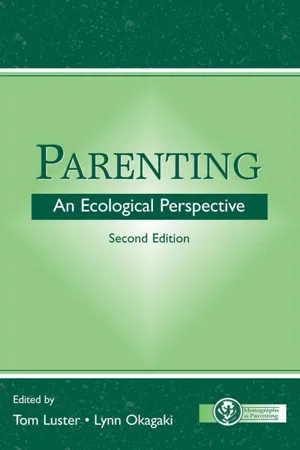
Parenting: An Ecological Perspective was originally created in 1993 to answer questions such as: Why do parents differ markedly in the ways in which they care for their children? What factors contribute to individual differences in parenting behavior? The framework used for addressing these questions is the ecological perspective developed by Urie Bronfenbrenner, who recognized that children's development is influenced by the interactions that they have over time with the people, objects, and symbols in their immediate environment.
Luster and Okagaki have updated the original text focusing on parental behavior and also included 6 new chapters covering topics such as:
*fathers/gender of parent;
*children with special needs;
*ethnicity and socioeconomic status; and
*parent education.
The text summarizes the latest research on factors that influence parenting, with each chapter providing a look at one important influence and the linkages among these various factors. An ecological perspective draws attention to the fact that the lives of parents and children are intertwined, and that understanding factors that influence parents is important for understanding the experiences of children.
- 464 pages
- English
- ePUB (mobile friendly)
- Available on iOS & Android
eBook - ePub
About this book
Information
Subtopic
Developmental PsychologyIndex
PsychologyIII
CONTEXTUAL INFLUENCES
ON PARENTING
7
Parenting and the
Marital Relationship
Frank D. Fincham
Florida State University
Julie H. Hall
University at Buffalo, The State University of New York
INTRODUCTION
Parent and spouse roles are characterized by numerous expectations and responsibilities that tend to be fulfilled simultaneously as partners in a marriage are often partners in parenting as well. Thus, it can be quite difficult to disentangle marital and parenting processes, and to determine how one relationship impacts the other. Considerable attention has been devoted to exploring how becoming a parent affects the marital relationship; the birth of a child is associated with an increase in marital conflict and a decrease in marital satisfaction, but an increased sense of partnership (Belsky, Lang, Rovine, 1985; Cowan, Cowan, Heming, Garrett, Coysh, Curtis-Boles, & Boles, 1985). Yet at the same time, marital relationships also exert a considerable influence on parenting processes and behaviors. Given the nature of this book, we focus on this aspect of the association between marriage and parenting.
In Bronfenbrenner’s (1979, 1992) ecological model, the marital relationship constitutes part of a child’s microsystem, and thus directly influences the child. Behavioral exchanges between spouses are one of the major vehicles through which the immediate environment directly affects a child’s psychological growth (Bronfenbrenner, 1979, 1992). Beyond the direct effects of the marital relationship on child development, Bronfenbrenner also highlighted how marriage impacts children indirectly, through the parenting relationship. Such indirect influence, defined as second-order effects, points out how the marital relationship can affect interactions between parent and child (Bronfenbrenner, 1979). The ecological model also emphasizes the importance of the marital relationship as a support system for parenting; Bronfenbrenner (1986) reviewed evidence that mothers who felt supported by their husbands tended to have higher marital satisfaction and more positive attitudes toward parenting. This research helped lay the foundation for much current work on marital and parenting processes, and illustrated the importance of the environment in such processes.
In keeping with Bronfenbrenner’s ecological model, this chapter explores the direct effects of the marital relationship on child development, as well as the indirect effects that occur through parenting. We review briefly direct effects, before turning to the primary focus of the chapter, how marital and parenting processes interact to influence child development. Following consideration of the major research in this area, the next section identifies promising avenues for future research. The chapter concludes with a summary of the main arguments.
DIRECT EFFECTS OF THE MARITAL RELATIONSHIP
ON CHILD DEVELOPMENT
There is a robust association between marital conflict and child behavior problems. For example, the meta-analysis by Buehler, Anthony, Krishnakumar, and Stone (1997) of 68 studies testing the association between marital conflict and child adjustment showed that the average effect size for this association was .32, midway between a small (.20) and medium (.50) effect as described by Cohen (1977). According to social learning theory, negative marital interactions lead children to adopt similar maladaptive behaviors through the processes of modeling. Children who are repeatedly exposed to marital conflict may acquire negative strategies of conflict resolution and affective expression through observing their parents’ behavior (Easterbrooks & Emde, 1988), and they are at greater risk for externalizing disorders (Cummings & Davies, 1994). Children also tend to be more aggressive towards peers after observing an angry argument between adults (Cummings, Iannotti, & Zahn-Walker, 1985), and are more likely to have social problems with siblings and peers (Stocker & Youngblade, 1999).
There is also a direct relation between marital conflict and disorganized-disoriented infant attachment behavior (Owen & Cox, 1997). It has been suggested that exposure to negative marital interactions adversely affects the organization of children’s emotional response to stressful situations (Davies & Cummings, 1994). Owen and Cox (1997) argued that exposure to chronic marital conflict leads infants to experience their parents as frightening, and to have limited options for alleviating accompanying distress. In contrast, marital satisfaction is associated with secure attachment in toddlers (Goldberg & Easterbrooks, 1984).
Specific aspects of marital conflict appear to have differential effects on child adjustment; Buehler and colleagues (1997) showed that effect sizes differed depending on how conflict was expressed. Studies assessing overt conflict, defined as direct expressions of hostile behavior and affect, produced a larger effect size (.35) than studies examining covert conflict (.28), in which hostility is expressed indirectly, withdrawal from conflict (.27), or studies simply measuring conflict frequency (.19). These differences suggest that the way parents manage conflict, rather than its occurrence per se, determines its impact on children.
The direct relation between marital conflict and child adjustment can also be understood by conceptualizing conflict as a stressor on children (Fincham, Grych, & Osborne, 1994; Wilson & Gottman, 1995). Children report that observing interparental conflict is a significant stressor (Lewis, Siegal, & Lewis, 1984), and observational studies show that children typically exhibit distress when exposed to angry or aggressive interactions involving their parents (see Cummings, Davies & Campbell, 2000). Even at a young age, children become distressed when observing family conflict (Cummings, Zahn-Walker, Radke-Yarrow, 1981), and that distress increases with more frequent exposure to anger and aggression (Cummings et al., 1985). Exposure to conflict has also been found to threaten children’s sense of safety and emotional security (Davies & Cummings, 1994).
However, as noted, interparental conflict may not be intrinsically damaging to children; rather, how conflict is handled may determine whether the interaction will serve as a stressor for the child. Frequent conflicts that are intense, unresolved, and child-related tend to be more distressing to children than non-child related conflicts that are resolved constructively and nonaggressively (Grych & Fincham, 1992). It has also been suggested that children are more affected by marital conflict when parent-to-child hostility is expressed during the course of the conflict (Gordis, Margolin, & John, 2001).
Although some scholars have argued that the relation between conflict and child adjustment is due to the effects of marital conflict on parenting (e.g., Fauber & Long, 1991), others have argued that this relation cannot be reduced to variations in parenting. In support of this position it is noted that overt marital conflict has a greater impact on children than covert conflict (Emery, Fincham, & Cummings, 1992) and that children’s perceptions of marital conflict tend to be related to their adjustment (Cummings, Davies, & Simpson, 1994; Harold, Fincham, Osborne, & Conger, 1997). Such findings would be unlikely if parenting processes accounted for all of the variance in child adjustment.
INDIRECT EFFECTS OF THE MARITAL RELATIONSHIP
ON CHILD DEVELOPMENT
Parenting has consistently been shown to play a mediating role in the relation between marital quality and child functioning. High marital quality is associated with sensitive parenting and optimal toddler functioning (e.g., Goldberg & Easterbrooks, 1984), whereas marital discord undermines and disrupts effective parenting practices and is associated with poor child adjustment (Belsky, 1984; Fauber & Long, 1991; Reid & Crisafulli, 1990). However, before one can fully explore such associations, it is critical to examine central constructs. For example, Erel and Burman (1995) were not able to test adequately whether relevant variables moderated the association between the marital and parent–child relationships owing to the heterogeneity of effect sizes within categories of the moderator variables that they examined (e.g., different operationalizations of marital quality).
Marital Quality Is Not Marital Quality Is Not Marital Quality
Much of the literature regarding the marriage–parenting association has focused on the general concept of marital quality, and how it relates to parenting practices. As noted by Erel and Burman (1995) and Goldberg and Easterbrooks (1984), however, studies have varied widely in the conceptualization and measurement of marital quality. The emergence of a replicable association between marital quality and the quality of parenting is noteworthy. But both of these constructs are multidimensional. Thus, it is important to distinguish among their dimensions and to consider how specific aspects of the marital relationship are associated with specific aspects of parenting. The importance of such conceptual development is emphasized by the fact that even the most sophisticated statistical analyses cannot clarify ambiguous constructs.
Erel and Burman (1995) identified three conceptualizations of marital quality used by researchers: general marital satisfaction, overt marital conflict, and marital coalition. Before we consider the first two of these in greater detail, it is important to note that parenting can be conceptualized along numerous dimensions, including global quality, satisfaction, covert control, discipline, or within/between parent consistency. However, the majority of the studies in Erel and Burman’s (1995) meta-analysis measured marital quality in terms of marital satisfaction and the parent–child relationship in terms of global quality. Nevertheless, it is important to consider these distinctions when reviewing the literature, as a general association between marital quality and parenting could reflect several different relationships.
What is Marital Satisfaction? This is not the context in which to offer a definitive answer to this question, and we therefore limit ourselves to two observations. First, two of the most commonly used measures of marital satisfaction, the Marital Adjustment Test (MAT; Locke & Wallace, 1959) and Dyadic Adjustment Scale (DAS; Spanier, 1976), combine heterogeneous question types, including general evaluative questions and specific descriptive questions about behavior (e.g., communication, affection). As a result, these scales may overestimate associations between marital quality and self-reported interpersonal processes within marriage because of item overlap (Bradbury, Fincham, & Beach, 2000; Feeney, Noller, & Ward, 1997). This has led some researchers to suggest that global, evaluative measures of marital satisfaction (e.g., Quality Marriage Index, QMI; Norton, 1983; Kansas Marital Satisfaction Scale, KMSS; Schumm, Paff-Bergen, Hatch, Obiorah, Copeland, Meens, & Bugaighis, 1986) are more appropriate when seeking to capture an individual’s overall sentiment toward the marriage (Fincham, 1998; Fincham & Bradbury, 1987). However, global measures are only appropriate when the researcher is seeking to measure marital quality as an overall evaluative judgment, and they are less useful when information is sought about specific dimensions of marital quality.
Second, it is important to note that marital satisfaction is not the mere absence of dissatisfaction, and that satisfaction and dissatisfaction are not necessarily inversely related (Bradbury et al., 2000). In actuality, it is possible for an individual to evaluate his or her marriage as both positive and negative (Fincham, Beach, & Kemp-Fincham, 1997; Fincham & Linfield, 1997). Conceptualizating marital quality as bi-dimensional allows researchers to distinguish between people who may score similarly on measures of global marital satisfaction, despite the fact that some are high in positivity and negativity (i.e., ambivalent), whereas others are low on both dimensions (i.e. indifferent; see Fincham & Linfield, 1997). Few researchers have so far adopted this bi-dimensional approach.
In summary, then, marital quality has been operationalized in different ways. The vast majority of studies have used the MAT, DAS or some variant of these measures. Increasingly, however, researchers are limiting marital satisfaction to global judgments of the marriage and using separate measures to assess different aspects of marriage (e.g., communication, consensus) that are also tapped by instruments such as the MAT and DAS.
What Is Marital Conflict? Marital conflict has been conceptualized in several different ways, with most sharing the common themes that conflict can be overt or covert, can arise from the perceived conflict of interests, goals, wishes, expectations, or interference with behavior, and that conflict behaviors vary across time and situation (Fincham & Beach, 1999). Couples can be differentiated based on their marital conflict styles, including physical aggression, verbal aggression, withdrawal, and nondistressed/low levels of conflict (Burman, Margolin, & John, 1993). Marital conflict can also be considered in terms of process, by exploring cycles of escalation and resolution within couples. For example, Burman et al. (1993) found that physically aggressive and nondistressed couples display similar negative conflict behavior patterns, but nondistressed couples are able to exit from negative exchanges more quickly. As with measures of marital satisfaction, measures of marital conflict vary according to the specific dimensions of interest to the researcher.
Overlap Between Satisfaction and Conflict. Although we have discussed marital satisfaction and marital conflict as separate constructs, empirical evidence suggests that conflict directly affects satisfaction in well established relationships (Christensen & Walczynski, 1997). When compared to non-distressed couples, distressed couples experience more frequent conflict (Christensen & Margolin, 1988), engage in more criticism and disagreement, and are more likely to reciprocate negative behaviors. In fact, negative reciprocity is more consistent across different types of situations than is the amount of negative behavior, making it the most reliable overt signature of a dissatisfied marriage. Both frequency and reciprocity of negative behavior are more pronounced in couples where physical aggression is found (Fincham, 2003). Marital conflict also predicts deterioration in relationship satisfaction over time (Karney & Bradbury, 1995). Nevertheless, they are distinct constructs, as it is possible for marriages to be high in conflict and satisfaction or low in both. Furthermore, marital satisfaction and conflict have unique effects on parenting and parent–child behavior. Thus, we continue to consider them separately.
Models of the Association Between Marriage and Parenting
Erel and Burman (1995) found a positive association between marital quality and parenting (the composite mean weighted effect size was .46). Thus, on the whole, harmonious marriages tend to be associated with effective parenting, whereas troubled marriages are linked to maladaptive parenting. This finding supports a spillover model whereby the affective tone of the marriage spills over into the parent–child relationship; it stands in sharp contrast to the alternative compensatory model in which marital quality and parenting quality are posited to be negatively related (Erel & Burman, 1995; Goldberg & Easterbrooks, 1984).
However, there is some empirical support for the compensatory model in which parents are hypothesized to compensate for marital frustration and dissatisfaction by channeling these negat...
Table of contents
- COVER PAGE
- TITLE PAGE
- COPYRIGHT PAGE
- DEDICATION
- SERIES FOREWORD MONOGRAPHS IN PARENTING
- INTRODUCTION
- I. CHARACTERISTICS OF THE PARENTS
- II. CHARACTERISTICS OF THE CHILD
- III. CONTEXTUAL INFLUENCES ON PARENTING
- IV. PARENTAL BEHAVIOR AND CHILDREN’S DEVELOPMENT
- ABOUT THE AUTHORS
Trusted by 375,005 students
Access to over 1.5 million titles for a fair monthly price.
Study more efficiently using our study tools.
Frequently asked questions
Yes, you can cancel anytime from the Subscription tab in your account settings on the Perlego website. Your subscription will stay active until the end of your current billing period. Learn how to cancel your subscription
No, books cannot be downloaded as external files, such as PDFs, for use outside of Perlego. However, you can download books within the Perlego app for offline reading on mobile or tablet. Learn how to download books offline
Perlego offers two plans: Essential and Complete
- Essential is ideal for learners and professionals who enjoy exploring a wide range of subjects. Access the Essential Library with 800,000+ trusted titles and best-sellers across business, personal growth, and the humanities. Includes unlimited reading time and Standard Read Aloud voice.
- Complete: Perfect for advanced learners and researchers needing full, unrestricted access. Unlock 1.5M+ books across hundreds of subjects, including academic and specialized titles. The Complete Plan also includes advanced features like Premium Read Aloud and Research Assistant.
We are an online textbook subscription service, where you can get access to an entire online library for less than the price of a single book per month. With over 1.5 million books across 990+ topics, we’ve got you covered! Learn about our mission
Look out for the read-aloud symbol on your next book to see if you can listen to it. The read-aloud tool reads text aloud for you, highlighting the text as it is being read. You can pause it, speed it up and slow it down. Learn more about Read Aloud
Yes! You can use the Perlego app on both iOS and Android devices to read anytime, anywhere — even offline. Perfect for commutes or when you’re on the go.
Please note we cannot support devices running on iOS 13 and Android 7 or earlier. Learn more about using the app
Please note we cannot support devices running on iOS 13 and Android 7 or earlier. Learn more about using the app
Yes, you can access Parenting by Tom Luster,Lynn Okagaki in PDF and/or ePUB format, as well as other popular books in Psychology & Developmental Psychology. We have over 1.5 million books available in our catalogue for you to explore.