Refugee News, Refugee Politics
eBook - ePub

Refugee News, Refugee Politics

Journalism, Public Opinion and Policymaking in Europe

  1. 228 pages
  2. English
  3. ePUB (mobile friendly)
  4. Available on iOS & Android
eBook - ePub

Refugee News, Refugee Politics

Journalism, Public Opinion and Policymaking in Europe

About this book

The unprecedented arrival of more than a million refugees, asylum seekers, and migrants – plus the political, public, and policy reactions to it – is redefining Europe. The repercussions will last for generations on such central issues as security, national identity, human rights, and the very structure of liberal democracies. What is the role of the news media in telling the story of the 2010s refugee crisis at a time of deepening crisis for journalism, as "fake news" ran rampant amid an increasingly distrustful public?

This volume offers students, scholars, and the general reader original research and candid frontline insights to understand the intersecting influences of journalistic practices, news discourses, public opinion, and policymaking on one of the most polarizing issues of our time. Focusing on current events in Greece, Austria, and Germany – critical entry and destination countries – it introduces a groundbreaking dialogue between elite national and international media, academic institutions, and civil society organizations, revealing the complex impacts of the news media on the thorny sociopolitical dilemmas raised by the integration of hundreds of thousands of asylum seekers in EU countries.

Frequently asked questions

Yes, you can cancel anytime from the Subscription tab in your account settings on the Perlego website. Your subscription will stay active until the end of your current billing period. Learn how to cancel your subscription.
No, books cannot be downloaded as external files, such as PDFs, for use outside of Perlego. However, you can download books within the Perlego app for offline reading on mobile or tablet. Learn more here.
Perlego offers two plans: Essential and Complete
  • Essential is ideal for learners and professionals who enjoy exploring a wide range of subjects. Access the Essential Library with 800,000+ trusted titles and best-sellers across business, personal growth, and the humanities. Includes unlimited reading time and Standard Read Aloud voice.
  • Complete: Perfect for advanced learners and researchers needing full, unrestricted access. Unlock 1.4M+ books across hundreds of subjects, including academic and specialized titles. The Complete Plan also includes advanced features like Premium Read Aloud and Research Assistant.
Both plans are available with monthly, semester, or annual billing cycles.
We are an online textbook subscription service, where you can get access to an entire online library for less than the price of a single book per month. With over 1 million books across 1000+ topics, we’ve got you covered! Learn more here.
Look out for the read-aloud symbol on your next book to see if you can listen to it. The read-aloud tool reads text aloud for you, highlighting the text as it is being read. You can pause it, speed it up and slow it down. Learn more here.
Yes! You can use the Perlego app on both iOS or Android devices to read anytime, anywhere — even offline. Perfect for commutes or when you’re on the go.
Please note we cannot support devices running on iOS 13 and Android 7 or earlier. Learn more about using the app.
Yes, you can access Refugee News, Refugee Politics by Giovanna Dell'Orto, Irmgard Wetzstein, Giovanna Dell'Orto,Irmgard Wetzstein,Giovanna Dell’Orto in PDF and/or ePUB format, as well as other popular books in Politics & International Relations & Civil Rights in Politics. We have over one million books available in our catalogue for you to explore.

PART I

Policy, Politics, and Media Discourses from Fortress Europe to Mutti Merkel and Idomeni

This section of the book contextualizes and explores relationships between journalistic narratives, public opinion, policymaking, and politics in the mid-2010s “refugee crisis” in three countries that played pivotal roles in it: Greece, Austria, and Germany. Through different methodologies, the chapters present new research on crucial facets ranging from party politics to the influence of gender and security in discourses about migration.
Chapter One discusses the evolution of political and public responses to the refugee influx in Germany, which received the brunt of it and became the de facto leader in shaping Europe’s approach. The sidebar following it introduces a German journalist’s questioning of Chancellor Merkel’s defining response to the crisis – “We can do it!” Chapter Two continues the analysis of the public opinion/policymaking nexus, but also gap, by focusing on the European Union, which faced an existential crisis as it struggled to coordinate a response amid rising populism. Chapter Three merges the examination of EU statements about border issues with those present in mediated political discourse in one crucial transit/destination country, Austria. Chapter Four brings the level of analysis squarely to Austrian media discourses, addressing women’s rights in the context of European mores and forced migration. Chapter Five and the brief testimonial that follows it reveal and unpack several illuminating paradoxes concerning public opinion about refugee flows in Greece, the frontline country in the crisis, and Greek attitudes toward, and consumption of, news (real and fake) about it.

1

Welcoming Citizens, Divided Government, Simplifying Media

Germany’s Refugee Crisis, 2015–2017

Dietrich Thränhardt
University of münster
In 2015, most Germans welcomed 890,000 refugees, in reaction to the horrors of the Syrian war. The media covered the plight of the refugees, and Chancellor Angela Merkel accepted the refugees stranded in inhospitable Hungary. An unprecedented wave of volunteers began to assist, and local governments and states provided accommodation. The federal asylum bureaucracy was less effective and could not process applications in due time. First hopes of an easy integration were disappointed, as it takes time to find jobs for refugees in the highly specialized German economy. Terrorist acts created fears, and the discourse became polarized. More than two years after the mass arrivals, the German public was more realistic but still active, engaging, and welcoming. Instead of following the complex bureaucratic processes, the German media personalized and created moral heroes and villains of the main politicians involved – especially Merkel. Based on an analysis of public opinion trends, media coverage, political statements, and implementation statistics, this chapter covers the variance and internal logics of political and administrative processes, citizen engagement, and the media.

Welcome Culture and the Person of the Year 2015

When Merkel said “Wir schaffen das” (“We can do this”) on August 31, 2015, she responded to a wave of goodwill and hospitality in the population and in the media. She herself suddenly became an icon of openness at a time when many other governments closed their borders. It was an ideal moment: A people united with their chancellor in active hospitality. A few weeks earlier, in an emotional meeting with a Palestinian girl at a school, Merkel had cautioned that Germany could not take in all the people in need in the world. She had been criticized as cold-hearted – the “ice queen” (Alexander, 2017: 32).
When Merkel agreed to let in the refugees on September 5, 2015, amidst the agonizing reports about smuggled refugees suffocated in an abandoned lorry in Austria, and the iconic picture of the little boy who drowned in the Aegean Sea and washed up onto the Turkish coast, she won the hearts of a great majority of Germans, and beyond. People were used to politicians warning against immigrants and trying to keep them out in one way or another. This time, however, the discourse turned on the idea that Germany had successfully integrated earlier waves of immigrants and was strong enough to do it again. Support for the refugees came from all walks of life: Church communities, students, schools, elderly people, business and trade unionists. Volunteers organized themselves spontaneously, and fascinatingly effectively, collecting and providing food, blankets, children’s toys – all the things needed – and giving emotional support. Surveys show 46% of the German population doing something for the refugees. Table 1.1 illustrates some of these activities, which continue to this day. Only 18% of the population said that they would not like to contribute anything (Ahrend, 2017). Elderly women remembered the harsh times after expulsion from their homes in the lost German territories in 1945–1946, and wanted to help, out of their own experience. Against the ever-present memory of the Nazi past, this was a kind of positive redemption (“Mama Merkel,” 2015).
However, from the beginning, reactions were polarized: Against strong feelings of solidarity and the wish to help among the majority of the population, there developed deep-seated fear and hatred within a minority, particularly in the eastern parts of the country, the former GDR. The international echo was polarized, too. US President Barack Obama and then-candidate Donald Trump, to mention only the most prominent, praised and condemned Merkel’s hospitality, respectively.
Table 1.1 People who had supported or would support refugees, May 2016, in percent
Activity Already done Could imagine
Donation in kind 40 26
Donated money 21 25
Distributed food or cloth 19 47
Support refugee center nearby 12 44
Helped with language 9 37
Accompanied with administration 6 40
Caring for children 4 34
Have refugees living in their home 1 14
Source: Ahrend, Petra-Angela, Wie blickt Deutschland auf Flüchtlinge? Erwartungen der Bevölkerung zur Aufnahme von Flüchtlingen zwischen November 2015 und April 2017. [How does Germany look at refugees? Expectations of the population on the acceptance of refugees between November 2015 and April 2017], Sozialwissenschaftliches Institut der Evangelischen Kirche in Deutschland, Hannover, 2017, p. 41.
Germans were not alone in their largely positive reaction. In many European countries, activists began working to aid refugees. The Scottish government sent clothes and a symbolic 10,000 pounds to Munich – a protest against the negative stance of the British government (“Warme Kleidung,” 2015). Thousands of well-organized volunteers were active in Vienna as well as in Munich, and in many other places. The tragedy of the Syrian refugees spoke to the hearts. In fact, it was not Merkel but the Austrian Chancellor, Werner Faymann, who first took the initiative to open the borders, and asked Merkel to back him up. However, Faymann was never able to acquire the same aura as his German colleague – even when Austria, like Sweden, took in more refugees per capita. Faymann was soon criticized by the right-wing opposition, and then by his conservative coalition partner. He resigned in May 2016. The Austrian grand coalition made daily headlines with internal quarrels and divisions. Austria’s popular foreign minister, Sebastian Kurz, was instrumental in closing the “Balkan route,” together with southeast European governments, arranging coordinated border controls, and particularly controls at the Greek-Macedonian border. Later he radicalized his position and came out with the idea of deporting all asylum seekers to an island or to Africa, modeled after the Australian policy. Thus he outflanked the traditional xenophobes, and his New People’s Party (whose migration strategies are discussed in Chapter Three) won the October 2017 parliamentary elections.
In Germany, however, the opposition parties as well as the Social Democratic coalition partner supported Merkel’s stance. This was what they had always wanted: A hospitable Germany. Leftists suddenly felt sympathy for Merkel. She became the hero of “welcome culture,” all the other politicians dwarfed besides her, even when Green politicians were even more enthusiastic in welcoming refugees. It did not matter that vice chancellor Sigmar Gabriel had said “Wir schaffen das” some days before Merkel (Heißler, 2016) – she was the chancellor, she had the stature, and she became Time magazine’s “Person of the Year...
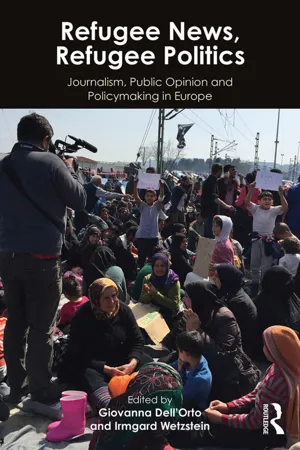
Table of contents

  1. Cover
  2. Half Title
  3. Title Page
  4. Copyright Page
  5. Dedication
  6. Contents
  7. List of Figures
  8. List of Tables
  9. Notes on Contributors
  10. Acknowledgments
  11. Introduction: Situating the “Refugee Crisis” and its sociopolitical effects through 21st-century European journalism
  12. Part I: Policy, politics, and media discourses from Fortress Europe to Mutti Merkel and Idomeni
  13. Part II: Civil society responses as another lens into public opinion in Greece, Austria, and Germany
  14. Part III: Journalism at the border: Reporting on the crisis in Greece
  15. Part IV: Journalism and integration: Reporting on the crisis in Austria and Germany
  16. Conclusion: Interplays of journalistic practices, news, public opinion, and policies in Europe’s refugee crisis
  17. Index