- 244 pages
- English
- ePUB (mobile friendly)
- Available on iOS & Android
eBook - ePub
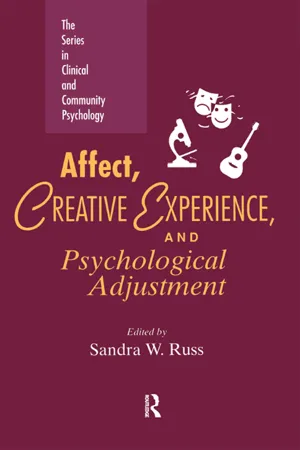
Affect, Creative Experience, And Psychological Adjustment
About this book
Previously neglected, more and more affect and creativity is recognized as an area that is important and exciting area to investigate. This book presents the very latest ideas and research by leaders in the field about the role of affect in the creative process. Affect, Creative Experience and Psychological Adjustment is an arena where new theories and concepts can be presented, research findings compared and discussed, methodological issues debated, and future research outlined. Key questions in affect and creativity focus on identifying specific affective processes that are most important in creativity, discovering the underlying mechanisms that account for the relationships between affect and creativity, exploring differential effects of various types of affect, such as positive and negative affect, on creativity and understanding how these things relate to psychological adjustment. As with any new line of research investigation, there is a fermenting of ideas, speculations, research findings, hunches, methodological issues and tests of theoretical models that evolves into a clear vision of heuristic theoretical models and identification of the most important research questions. This book contributes to that process in the area of affect and creativity.
Information
Part One:
Affect and the Creative Experience
1
On the Relationship Between Affect and Creative Problem Solving
A growing body of research indicates that positive affect is associated with greater cognitive flexibility and improved creative problem solving across a broad range of settings. This relationship has been found with both induced and naturally occurring positive affect (or “positive affectivity”) and not only with college student samples, but also in organizational settings, in consumer contexts, in negotiation, in the literature on coping and stress, in a sample of practicing physicians asked to solve a diagnostic problem, and among children and young adolescents (e.g., Aspinwall & Taylor, 1997; Carnevale & Isen, 1986; Estrada, Isen, & Young, 1997; Estrada, Young, & Isen, 1994; Fiske & Taylor, 1991; George & Brief, 1996; Greene & Noice, 1988; Hirt, Melton, McDonald, & Harackiewicz, 1996; Isen, 1987, 1993; Isen & Baron, 1991; Isen, Daubman, & Nowicki, 1987; Isen, Johnson, Mertz, & Robinson, 1985; Isen & Williams, 1988; Kahn & Isen, 1993; Mano, in press; Showers & Cantor, 1985; Staw & Barsade, 1993; Staw, Sutton, & Pelled, 1994; Taylor & Aspinwall, 1996).
Several studies have indicated that positive affect increases a person’s ability to organize ideas in multiple ways and access alternative cognitive perspectives. This has been proposed as a process by which positive affect facilitates creative problem solving. For example, three studies showed that positive affect, induced in any of a variety of simple ways, such as watching 5 min of a comedy film or receiving a small, unanticipated gift, led people to have a broader range of first associates to neutral words (but not to negative words) compared with controls (Isen et al., 1985). That is, people in the positive-affect condition, as a group, had more unusual and more diverse first associates than did people in a neutral-affect control condition. Another study, involving young adolescents (eighth graders), similarly showed increased verbal fluency in the positive-affect condition (Greene & Noice, 1988). When the children were asked to name as many members of a given category as they could, those in the positive-affect condition gave more category words, and more unusual examples of the category, than did controls.
A compatible result with adult participants was obtained recently by Hirt et al. (1996), who found that the effects of positive affect on persistence and performance depended on whether the processing goals assigned to participants focused on enjoyment or “sufficiency” of performance on the task. When people were told to work on the task as long as they were enjoying it, people in the positive-affect condition persisted longer and did more than controls; when the participants were instructed to stop working on the task when they felt they had “done enough,” people in the positive-affect condition stopped earlier than controls and did less work. These results are compatible with recent findings and formulations that suggest that the impact of positive affect on cognitive processing and task performance depends on processing demands and goals, and in part on the nature of the materials and the importance or interestingness or enjoyability of the task (e.g., Bodenhausen, Kramer, & Susser, 1994; Forgas, 1995; Isen, 1993; Martin, Ward, Achee, & Wyer, 1993). More important for the purposes of this chapter, the results showed that participants in the positive-affect condition gave more creative responses than controls in all conditions, regardless of the processing goal they were using.
Several other studies have shown that people in positive-affect conditions are able to classify material more flexibly, seeing ways in which nontypical members of categories can be viewed as members of the categories (e.g., Isen & Daubman, 1984; Isen, Niedenthal, & Cantor, 1992; Kahn & Isen, 1993). Through the use of a rating task like that employed by Rosch (1975), creative or flexible classification of nontypical category members has been found for items in natural categories (Isen & Daubman, 1984); for products in the class of snack foods (Kahn & Isen, 1993); and for person types in positive, but not negative, person categories (Isen et al., 1992). Flexible classification has even been found for perception and classification of human social groups: Recent work on social-group perception has shown that induced positive affect results in a tendency to integrate and perceive a socially distinct out-group as part of a superordinate group of which the perceiver is also a member (Dovidio, Gaertner, Isen, & Lowrance, 1995). Thus, positive affect has been shown to enable people to classify not only items, but also people more flexibly, and in particular to see potential relatedness and commonalities among them, and classify them as members of the same group.
It has also been found that if experimental participants are specifically asked to focus on differences and to find ways in which items differ from one another, positive affect can result in more perceived difference (Isen, 1987, p. 234; Murray, Sujan, Hirt, & Sujan, 1990). It has been suggested that this is because positive affect gives rise to cognitive elaboration (e.g., Isen et al., 1985). Elaboration, or the presence in mind of more information, has been found to increase either perceived similarity or perceived difference, depending on contextual factors such as the question that participants are asked to address (Tversky & Gati, 1978). Together, these studies also can be interpreted as indicating that positive affect promotes cognitive flexibility: People who are feeling happy, compared with those in a neutral feeling state, become more able to make associations among ideas and see multiple relations among stimuli. The details of the result of this process (e.g., increased perceived similarity or perceived difference) may depend on factors in the task context (e.g., the processing goal or the question posed); the relevant point for the present discussion is that these results show still another way that positive affect enables flexible consideration of different aspects of concepts, or alternative cognitive perspectives.
Several other studies illustrate additional ways in which positive affect facilitates flexible cognitive processing of neutral or positive material. In a study of the impact of positive affect on job perceptions, people in whom positive affect had been induced judged an interesting task that they had been assigned, but not a dull one, as richer and more varied than did control participants (Kraiger, Billings, & Isen, 1989). In the organizational behavior literature, a task is said to be rich if it is relatively complex and interesting and affords a sense of choice or variety. Again, then, the influence of positive affect on perceived task richness can be seen as reflecting an ability on the part of the positive-affect participants to see additional associations and aspects, particularly of interesting things.
At the same time, the interaction between affect and the type of task, like interactions between affect and the nature of the stimulus materials (e.g., the positive or negative valence of the materials) in the aforementioned studies, indicates that a substantive process related to elaboration and thinking is responsible for the observed effects of positive feelings. This is in contrast with alternative hypotheses about how positive affect may exert influence, which sometimes propose an artifact such as nonsystematic processing or a response bias to perceive everything more positively. The reason that the observed statistical interactions between affect and type of task or stimulus material signify a substantive process, rather than just a bias, is that any nonspecific effect, such as bias or tendency to process non-systematically, should affect all stimuli equivalently. However, interactions between affect and the stimulus materials or task requirements, which have been observed repeatedly, indicate specific processes that are fostered by positive affect.
Another study that supports the point that positive affect promotes cognitive flexibility is Carnevale and Isen’s (1986) finding that positive affect, induced by means of receipt of a small gift and by reading funny cartoons, facilitated participants’ taking a problem-solving approach in an integrative bargaining task, which resulted in improved outcomes for both parties in the negotiation. An integrative bargaining task is one in which, in order to reach the optimal agreement, people must make trade-offs on different issues, of differing value to them, about which they are bargaining. Reaching agreement on such a task requires seeing possibilities, thinking innovatively, and reasoning flexibly about possible trade-offs. In such a task, neither obvious compromises nor simply yielding to the other party’s demands results in satisfactory outcomes (for greater detail, see, e.g., Pruitt, 1983).
In this study, people in the positive-effect condition who bargained face-to-face were significantly less likely to break off negotiations, and more likely to reach agreement and to reach the optimal agreement possible in the situation, than were face-to-face bargainers in the control condition, in which positive affect had not been induced (Carnevale & Isen, 1986). They were also less likely to engage in aggressive tactics during the negotiations and reported more enjoyment of the session. Finally, they were better able than control participants to figure out the other person’s payoff matrix (schedule of profit for each component of the agreement) in the negotiation, which differed for the two bargainers. Although the findings include the fact that people in the positive-affect condition enjoyed the session more and were less likely than control participants to behave aggressively, the results of the study suggest that such factors were not responsible for the improved outcome of the negotiation. Rather, the results suggest that positive affect enables flexible thinking and improves people’s ability to see ways of relating aspects of the situation to one another to come up with a good solution to the problem.
Another series of studies reflecting positive affect’s influence on flexibility and cognitive organization indicates that positive affect promotes creative or innovative responding, measured through tasks typically considered indicators of classic creativity or innovative problem solving (Isen et al., 1987). In one of these methods, the “candle problem” (Duncker, 1945), a person is presented with a candle, a box of tacks, and a book of matches and is asked to affix the candle to the wall so that it will burn without dripping wax on the table or floor. To solve the problem, the person has to empty the box of tacks, tack the box to the wall, and place the candle in the box so that the candle can be lit and won’t drip wax onto the table or floor. Thus, the person must “break set” and use one of the items (the box) in a nontypical way. In three studies, from two different labs, using two different age range populations (college students and eighth-grade students), people in whom positive affect had been induced performed significantly better than controls on this task (e.g., Greene & Noice, 1988; Isen et al., 1987). Solving this problem in this way involves cognitive flexibility or the ability to put ideas together in new and useful ways, a classic definition of creativity (e.g., Koestler, 1964). In the early problem-solving literature, it was also referred to as “breaking set” or overcoming “functional fixedness” (Duncker, 1945; Wertheimer, 1945).
A task derived from the Remote Associates Test (M. T. Mednick, Mednick, & Mednick, 1964) has also been used to study the influence of positive affect on cognitive flexibility or creativity. This test, which is based on S. A Mednick’s (1962) theory of creativity, has been validated, in its full form, as a measure of individual differences in creativity. In it, participants are presented with three words and a blank line and are asked to provide a fourth word that relates to each of the three words given in the problem. For example,
MOWER | ATOMIC | FOREIGN | _________ |
In this example, POWER is the correct answer. When the task is used to study the influence of affect on creativity, seven items of moderate difficulty are used. Several studies in which this dependent measure of cognitive flexibility or creativity was used confirm that positive affect increases such ability. These studies employed different populations of participants, including college students and practicing physicians (e.g., Estrada, et al., 1994; Isen et al., 1987).
In another line of investigation, three studies (Kahn and Isen, 1993) indicate that positive affect promotes variety seeking among safe, enjoyable products (though it does not foster risk taking or seeking of danger). These studies reported that when given the opportunity to make several choices in a food category (e.g., soup or snacks), people in whom positive affect had been induced, showed more switching among alternatives than did controls and included a broader range of items in their choice sets, as long as the circumstances did not make unpleasant or negative potential features of the items salient. In contrast, when a negative, but not risky, feature (e.g., the possibility that a low-salt product would be less tasty than the regular) was salient, there was no difference between affect groups in variety seeking, or the tendency to switch around among the items in making choices. Thus, there is evidence that positive affect promotes enjoyment of variety and of a wider range or possibilities but that this occurs only when the situation does not prompt the person to think of unpleasant outcomes.
To summarize the work described so far, more than 25 studies, from several different topic areas, that have examined the effects of different affect inductions and various measures of cognitive flexibility in diverse populations indicate that when positive affect is induced in participants ...
Table of contents
- Cover
- Half Title
- Title Page
- Copyright Page
- Dedication
- Table of Contents
- Contributors
- Foreword
- Introduction
- Acknowledgments
- PART ONE AFFECT AND THE CREATIVE EXPERIENCE
- PART TWO AFFECT AND CREATIVE EXPRESSION
- PART THREE CREATIVITY, PSYCHOPATHOLOGY, AND ADJUSTMENT
- Index
Trusted by 375,005 students
Access to over 1.5 million titles for a fair monthly price.
Study more efficiently using our study tools.
Frequently asked questions
Yes, you can cancel anytime from the Subscription tab in your account settings on the Perlego website. Your subscription will stay active until the end of your current billing period. Learn how to cancel your subscription
No, books cannot be downloaded as external files, such as PDFs, for use outside of Perlego. However, you can download books within the Perlego app for offline reading on mobile or tablet. Learn how to download books offline
Perlego offers two plans: Essential and Complete
- Essential is ideal for learners and professionals who enjoy exploring a wide range of subjects. Access the Essential Library with 800,000+ trusted titles and best-sellers across business, personal growth, and the humanities. Includes unlimited reading time and Standard Read Aloud voice.
- Complete: Perfect for advanced learners and researchers needing full, unrestricted access. Unlock 1.5M+ books across hundreds of subjects, including academic and specialized titles. The Complete Plan also includes advanced features like Premium Read Aloud and Research Assistant.
We are an online textbook subscription service, where you can get access to an entire online library for less than the price of a single book per month. With over 1.5 million books across 990+ topics, we’ve got you covered! Learn about our mission
Look out for the read-aloud symbol on your next book to see if you can listen to it. The read-aloud tool reads text aloud for you, highlighting the text as it is being read. You can pause it, speed it up and slow it down. Learn more about Read Aloud
Yes! You can use the Perlego app on both iOS and Android devices to read anytime, anywhere — even offline. Perfect for commutes or when you’re on the go.
Please note we cannot support devices running on iOS 13 and Android 7 or earlier. Learn more about using the app
Please note we cannot support devices running on iOS 13 and Android 7 or earlier. Learn more about using the app
Yes, you can access Affect, Creative Experience, And Psychological Adjustment by Sandra W. Russ in PDF and/or ePUB format, as well as other popular books in Psychology & Mental Health in Psychology. We have over 1.5 million books available in our catalogue for you to explore.