- 380 pages
- English
- ePUB (mobile friendly)
- Available on iOS & Android
eBook - ePub
About this book
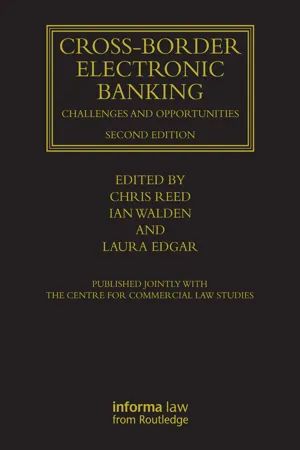
Cross-border Electronic Banking addresses everything from the changes made to payment clearing since the deregulation of cross-border flows of funds, to the development of capital adequacy ratios and the Euro. This insightful and revealing book, backed up by extensive practical experience, will alert you to the ways that electronic banking practices affect even the simplest daily transactions, and will unveil the legal technicalities imposed by these developments.
Information
Chapter 1
International Funds Transfers: Mechanisms and Laws
Introduction
This chapter is an overview of transaction elements, system components, risks, and legal issues pertaining to international funds transfers.1 Part I sets out the elements of the credit transfer, which is the common large value international funds transfer, in the context of the typical transaction. Part II focuses on domestic large value transfer systems (LVTS), which are heavily used in international funds transfers. It presents the essential components of an LVTS, reviews large value payment system risks incurred in transfers over LVTS, as well as risk control measures, and provides a brief outline of LVTS in major currency countries. Part III outlines cardinal aspects of the law of credit transfers in principal major currency jurisdictions.
I. International Large Value Transfers
International large value funds transfers are commonly credit driven payment mechanisms. The ensuing discussion sets out the elements of the credit transfer as one type of giro payment mechanism, outlines the elements of international credit transfers, and presents the inherent risk in concurrent international transfers.
(a) Credit transfers
In its simplest sense, payment requires the physical delivery of money (coins and/or banknotes) from a payor to a payee. Any machinery facilitating the transmission of money which bypasses, in whole or in part, the transportation of money and its physical delivery from the payor to the payee, thereby eliminating or at least reducing costs of storage and transportation as well as the ensuing risk of loss or theft, is a payment mechanism.
Any payment mechanism whereby payment must be received only by the payee, only at a bank,2 and only in a specified manner, as provided in the payment instructions issued by the payor or under the payor’s authority, is a giro system. The term “giro” is taken from the Greek word gigros, meaning ring, revolve, circular or cyclical. In this context, it denotes the movement of funds (namely money deposited in banks) among bank accounts. As a rule, a giro transfer is thus a payment carried out exclusively by the movement of funds from one bank account to another, whether at the same or two different banks.3
A giro transfer operates as a process by which a bank’s obligation to the payee replaces a bank’s obligation, in the same amount, to the payor, possibly (but not necessarily) in discharge of a debt owed by the payor to the payee. It was correctly observed that in this context, “transfer” may be a somewhat misleading word, since the original obligation of the bank to the payor is not assigned. Rather, the obligation in extinguished or reduced pro tanto, and a new obligation, by a bank in the payee’s favour, arises instead.4
A giro transfer is initiated by payment instructions given by the payor or under the payor’s authority ultimately to the payor’s bank. Depending on the manner in which these instructions were communicated to the payor’s bank, which affects the sequence of the banking operations in debiting the payor’s account or crediting the payee’s account, giro transfers are divided into debit and credit transfers. As a rule, the communication flow and the movement of funds are in opposite directions in a debit transfer but in the same direction in a credit transfer.
In a debit transfer, the payor’s instructions are communicated to the payor’s bank by the payee through the payee’s bank. Such instructions may be initiated by the payee pursuant to the payor’s authority, as for example in connection with recurring mortgage or insurance premium payments. When the instructions are first communicated by the payee to the payee’s bank, the payee’s account is credited. When the instructions ultimately reach the payor’s bank, the payor’s account is debited; that is, in a debit transfer, the credit to the payee’s account precedes the debit to the payor’s account. The credit to the payee’s account, however, is initially provisional and is subject to reversal if the payor’s bank dishonours the payor’s instructions, e.g. for lack of funds, and communicates its rejection to the payee’s bank. Credit to the payee’s account is final only as the debit to the payor’s account becomes irreversible. In a debit transfer, funds credited to the payee’s account are collected or “pulled” from the payor’s account. To a large extent, the process replicates that of cheque collection.
In contrast, in a credit transfer, such as a direct deposit of payroll, benefit, interest, pension or dividend, the payor’s instructions are communicated to the payor’s bank directly by him, without the mediation of a credit to the payee’s account at the payee’s bank. When the instructions are communicated, the payor’s account is debited. As such, in a credit transfer, unlike in a debit transfer, the first impact of the payor’s instructions on the banking system is a debit to the payor’s account with the payor’s bank. Having received the payor’s instructions and debited the payor’s account, the payor’s bank forwards the instructions to the payee’s bank which then proceeds to credit the payee’s account. Thus, in a credit transfer, the debit to the payor’s account precedes the credit to the payee’s account, and is not subject to reversal, for example for lack of funds. In a credit transfer, funds debited to the payor’s account are “pushed” to that of the payee.
In both debit and credit transfers, whenever the payor’s and payee’s accounts are at the same bank, no interbank communication is required. Nonetheless, the sequence of banking operations, as set out above, is unaffected.
As a rule, large value international payments are credit transfers. The ensuing discussion will thus deal exclusively with them.
In the credit transfer, the payor is called the originator, and the payee is the beneficiary. Accordingly, the payor’s bank is the originator’s bank and the payee’s bank is the beneficiary’s bank. Any other bank participating in the transaction is an intermediary bank. Payment instructions are the subject matter of a “payment order”. Each payment order is transmitted by a sender to a receiving bank.5
A credit transfer is initiated by the issue of a payment order by the originator to the originator’s bank. The transaction is ultimately carried out by debiting the originator’s account at the originator’s bank and crediting the beneficiary’s account at the beneficiary’s bank. Where these are separate banks, the originators’ bank executes the originator’s payment order by issuing its own payment order, either to the beneficiary’s bank or to an intermediary’s bank. An intermediary bank will issue its own payment order, either to the beneficiary’s bank or to another intermediary bank that will do the same, until a final payment order is issued to the beneficiary’s bank. Each interbank payment order must be paid by the sender to the receiving bank. Interbank communication thus corresponds to the interbank payment or settlement facilities; namely, each bank will issue a payment order only to a receiving bank with which such settlement facilities are available. Typically, such facilities are either bilateral, in the form of a correspondent account, i.e. an account one bank has with the other,6 or multilateral, in the form of accounts several banks hold at a central counterparty, which could be the central bank.
Accordingly, a credit transfer may be in-house, correspondent or complex.7 Where the originator’s and the beneficiary’s accounts are at the same bank the transaction is in-house. No interbank payment order is required to execute the originator’s payment order. Where the originator’s and beneficiary’s accounts are at different banks, which are correspondents, meaning one of them has an account with the other, the transaction is a correspondent transfer and requires an interbank payment order between the two correspondent banks. Payment of the payment order is then carried out at this account.
Otherwise, the transaction requires the participation of intermediary banks and is classified as a complex transfer. In its simplest pattern, a common correspondent, that is, a third bank having bilateral correspondent relationships with both the originator’s beneficiary’s banks, will mediate between them. One or more intermediary banks may be required in the absence of such a common correspondent. In its most sophisticated pattern, a complex transfer will involve a clearing-house facilitating multilateral interbank communication and settlement on the books of a central counterparty, with which they all hold accounts, such as a central bank. For each country or currency, the domestic Large Value Transfer System (“LVTS”) linking all major banks is such a facility.8
(b) International credit transfer
Broadly speaking, an international credit transfer is from an originator’s to a beneficiary’s bank when at least one of these banks is located in a country other than that of the currency.9 Depending on the location of the originator’s and beneficiary’s banks in relation to the country of the currency, an international transfer is either onshore or offshore.10
Whenever one of these two banks is located in the country of the currency, the transfer is onshore; it could be either incoming or outgoing. While an incoming onshore transfer is originated at an overseas/cross-border originator’s bank and its destination is a local beneficiary’s bank (at the country of the currency), an outgoing onshore transfer is originated at a local originator’s bank (in the country of the currency), and its destination is an overseas/cross-border beneficiary’s bank.
Conversely, whenever both the originator’s and the beneficiary’s banks are located outside the country of the currency, the transfer is offshore. It does not matter whether the two banks are situated in one or two countries, as long as neither of them is located in the country of the currency. In any event, it is quite common for an offshore transfer to “pass through” one or more intermediary banks in the country of the currency, so as to become an offshore “passing through” transfer.11
Where the originator’s and beneficiary’s banks are not correspondents, onshore incoming and outgoing transfers, as well as offshore “passing through” transfers, are likely to go in part over the LVTS of the currency of the transfer. Thus, a typical incoming onshore transfer involving non-correspondent originator’s and beneficiary’s banks will be routed by the originator’s bank to its correspondent in the country of the currency which will act as an intermediary bank and transmit its payment order to the beneficiary’s bank over the domestic LVTS. Similarly, a typical outgoing onshore transfer involving non-correspondent originator’s and beneficiary’s banks will be routed by the originator’s bank, over the domestic LVTS, to the local correspondent of the overseas or cross-border beneficiary’s bank, for further transmission to that beneficiary’s bank. On its part, an offshore transfer will usually pass through one or more intermediary banks in the country of the currency. The transfer will thus be routed by the originator’s bank to its correspondent in the country of the currency. Where the latter does not have a correspondent relationship with the beneficiary’s bank, it will transmit its payment order to the correspondent of the beneficiary’s bank in the country of the currency over the LVTS of that currency. Ultimately, the correspondent of the beneficiary’s bank will transmit its payment order to the beneficiary’s bank.
In each of these settings, a small bank without access to the domestic LVTS and/or without an overseas/cross-border correspondent will use a local correspondent having the required facility. This will increase the number of intermediary banks participating in the credit transfer.12
In a credit transfer, each payment order, whether from the originator to the orginator’s bank or from one bank to another, can be given in writing, orally13 or by electronic means. A payment order is given electronically whenever it is embodied in a cable or telex (“wire”), initiated through a magnetic tape or diskette that may physically be delivered, or sent from a terminal over a dedicated communication network. Communication by wire or over a dedicated network is “on-line”; when transmission immediately follows input it is also in “real-time”. An electronic funds transfer (“EFT”) occurs whenever a payment order is given by any electronic means.
Domestic interbank communication for large-value domestic currency payment orders is usually over the local LVTS. In major currency countries local LVTS utilise communication networks for the transmission of interbank payment orders. In the past, overseas/cross-border interbank communication was either by airletter or by means of cable or telex (“wire”); the large value credit transfer has thus been called, in fact to this day, a “wire transfer”. However, in overseas/cross-border interbank communication the wire has increasingly lost ground to the dedicated communication network of SWIFT.
The Society for Worldwide Interbank Financial Telecommunication (“SWIFT”) is a non-profit co-operative society organised under Belgian law, and owned by numerous banks throughout the world. The SWIFT system operated by it is a computerised telecommunications network that operates a global data-processing system for transmitting financial messages over dedicated lines among its members and other connected users.
In its current SWIFT II configuration, SWIFT is a central switch system14 linking numerous and diverse bank terminals all over the world. The central switch currently consists of two slice processors, one situated in the Netherlands and the other in the USA, each functioning as an independent and ad hoc network, linking SWIFT access points. Each country is assigned to a SWIFT access point. Interbank communication is via the SWIFT access points mediated by a slice processor. A system control processor monitors and controls functions of the system but is not involved in routing messages.
More specifically, each SWIFT message travels first on a domestic circuit from the sending bank’s terminal to the SWIFT access point for that country. From there, it continues on an international circuit to the slice processor...
Table of contents
- Cover
- Title
- Copyright
- Foreword
- Introduction
- Contents
- Contributors
- Table of Cases
- Table of Legislation
- CHAPTER 1 INTERNATIONAL FUNDS TRANSFERS: MECHANISMS AND LAWS
- CHAPTER 2 WHOLESALE FUND TRANSFERS-UCC ARTICLE 4A
- CHAPTER 3 DEMATERIALISATION OF SHIPPING DOCUMENTS
- CHAPTER 4 THE BOLERO SYSTEM
- CHAPTER 5 PAYMENT SYSTEMS, DATA PROTECTION AND CROSS-BORDER DATA FLOWS
- CHAPTER 6-CONSUMER ELECTRONIC BANKING
- CHAPTER 7-PAYMENT SYSTEMS FOR E-COMMERCE
- CHAPTER 8-ELECTRONIC MONEY
- CHAPTER 9 THE COMPUTERISATION OF THE SECURITIES MARKETS: FROM SECURITIES TO INTERESTS IN SECURITIES
- Index
Trusted by 375,005 students
Access to over 1.5 million titles for a fair monthly price.
Study more efficiently using our study tools.
Frequently asked questions
Yes, you can cancel anytime from the Subscription tab in your account settings on the Perlego website. Your subscription will stay active until the end of your current billing period. Learn how to cancel your subscription
No, books cannot be downloaded as external files, such as PDFs, for use outside of Perlego. However, you can download books within the Perlego app for offline reading on mobile or tablet. Learn how to download books offline
Perlego offers two plans: Essential and Complete
- Essential is ideal for learners and professionals who enjoy exploring a wide range of subjects. Access the Essential Library with 800,000+ trusted titles and best-sellers across business, personal growth, and the humanities. Includes unlimited reading time and Standard Read Aloud voice.
- Complete: Perfect for advanced learners and researchers needing full, unrestricted access. Unlock 1.5M+ books across hundreds of subjects, including academic and specialized titles. The Complete Plan also includes advanced features like Premium Read Aloud and Research Assistant.
We are an online textbook subscription service, where you can get access to an entire online library for less than the price of a single book per month. With over 1.5 million books across 990+ topics, we’ve got you covered! Learn about our mission
Look out for the read-aloud symbol on your next book to see if you can listen to it. The read-aloud tool reads text aloud for you, highlighting the text as it is being read. You can pause it, speed it up and slow it down. Learn more about Read Aloud
Yes! You can use the Perlego app on both iOS and Android devices to read anytime, anywhere — even offline. Perfect for commutes or when you’re on the go.
Please note we cannot support devices running on iOS 13 and Android 7 or earlier. Learn more about using the app
Please note we cannot support devices running on iOS 13 and Android 7 or earlier. Learn more about using the app
Yes, you can access Cross-border Electronic Banking by Chris Reed,Ian Walden in PDF and/or ePUB format, as well as other popular books in Law & Financial Law. We have over 1.5 million books available in our catalogue for you to explore.